CLINICAL EXAMINATION OF
THE HIP
MAJ VIVEKMA
THEWPHILIP
RESIDENT
ORTHOP
AEDICS
AFMC
CLINICAL EXAMINATION OF
THE HIP
●Anatomy
●History
●Clinical Examination
ANATOMY.
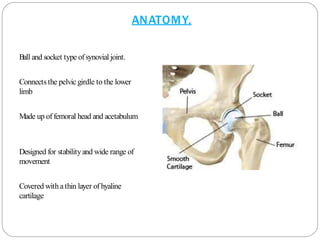
Ball and socket type ofsynovial joint.
Connects the pelvicgirdle to the lower
limb
Made up of femoral head and acetabulum
Designed for stabilityand wide range of
movement
Covered with athin layer of hyaline
cartilage
Anatomy
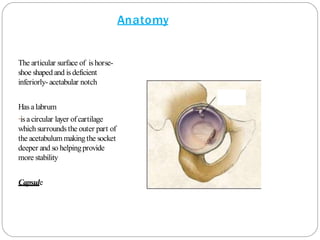
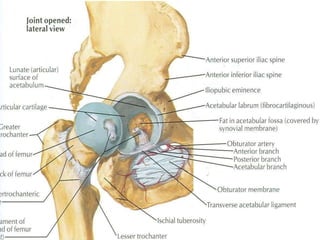
The articular surface of ishorse-
shoe shaped and is deficient
inferiorly- acetabular notch
Has alabrum
-isacircular layer ofcartilage
which surrounds the outer part of
the acetabulum makingthe socket
deeper and so helpingprovide
more stability
Capsule
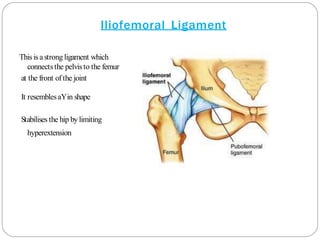
Iliofemoral Ligament
Thisis astrongligament which
connectsthe pelvisto the femur
at the front ofthe joint
It resemblesaYin shape
Stabilises the hip bylimiting
hyperextension
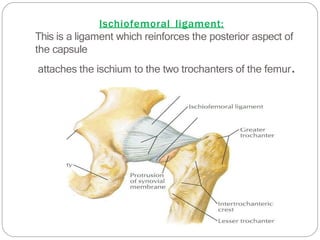
Ischiofemoral ligament:
This is a ligament which reinforces the posterior aspect of
the capsule
attaches the ischium to the two trochanters of the femur.
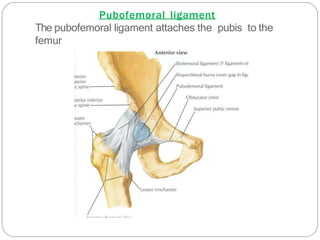
Pubofemoral ligament
The pubofemoral ligament attaches the pubis to the
femur
●Transverse acetabular Ligament:
●Bridges acetabular notch.
●Ligament of head of femur: flat and triangular in shape
●Lies within joint, ensheathed by synovium
Muscles
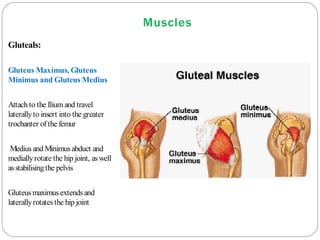
Gluteals:
Gluteus Maximus, Gluteus
Minimus and Gluteus Medius
Attach to the Ilium and travel
laterallyto insert into the greater
trochanter of the femur
Medius and Minimus abduct and
mediallyrotate the hip joint, aswell
asstabilisingthe pelvis
Gluteusmaximusextendsand
laterallyrotatesthe hip joint
More Muscles
s
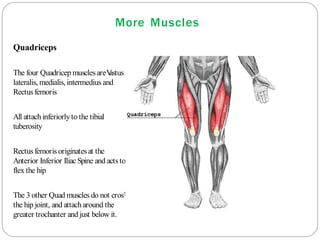
Quadriceps
The four Quadricep musclesareV
astus
lateralis, medialis, intermedius and
Rectusfemoris
All attachinferiorlyto the tibial
tuberosity
Rectusfemoris originates at the
Anterior Inferior Iliac Spine and actsto
flex the hip
The 3 other Quad muscles do not cros
the hip joint, and attacharound the
greater trochanter and just below it.
:
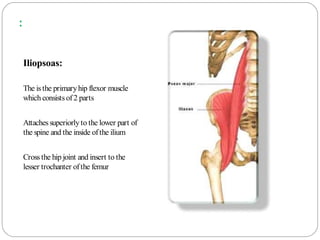
Iliopsoas:
The isthe primaryhip flexor muscle
which consists of2 parts
Attaches superiorlyto the lower part of
the spine and the inside ofthe ilium
Cross the hip joint and insert to the
lesser trochanter ofthe femur
Muscles:
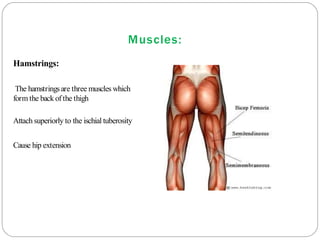
Hamstrings:
The hamstringsare three muscles which
form the back of the thigh
Attach superiorly to the ischial tuberosity
Cause hip extension
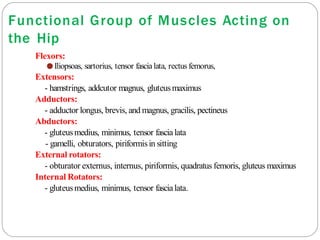
Functional Group of Muscles Acting on
the Hip
Flexors:
●Iliopsoas, sartorius, tensor fascialata, rectus femorus,
Extensors:
- hamstrings, addcutor magnus, gluteusmaximus
Adductors:
- adductor longus, brevis, and magnus, gracilis, pectineus
Abductors:
- gluteusmedius, minimus, tensor fascialata
- gamelli, obturators, piriformisin sitting
External rotators:
- obturator externus, internus, piriformis, quadratus femoris, gluteus maximus
Internal Rotators:
- gluteusmedius, minimus, tensor fascialata.
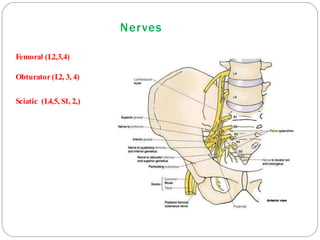
Nerves
Femoral (L2,3,4)
Obturator (L2, 3, 4)
Sciatic (L4,5, S1, 2,)
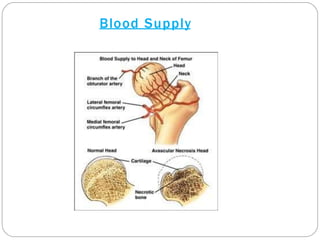
Blood Supply
EXAMINATION OF HIP
●History
● General examination
●Gait
●Inspection
●Palpation
●Movements
●Measurements
●Special tests
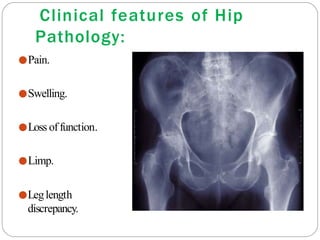
Clinical features of Hip
Pathology:
●Pain.
●Swelling.
●Loss offunction.
●Limp.
●Leglength
discrepancy.
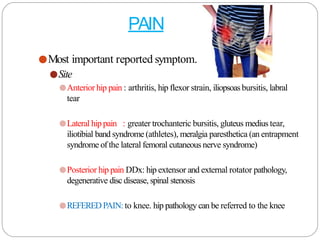
PAIN
●Most important reported symptom.
●Site
●Anterior hip pain : arthritis, hip flexor strain, iliopsoasbursitis, labral
tear
●Lateral hip pain : greater trochanteric bursitis, gluteus medius tear,
iliotibial band syndrome (athletes), meralgia paresthetica (an entrapment
syndrome of the lateral femoral cutaneous nerve syndrome)
●Posterior hip pain DDx: hip extensor and external rotator pathology,
degenerative disc disease, spinal stenosis
●REFEREDPAIN:to knee. hip pathology can be referred to the knee
The Pain Continues...
● Onset: When did it start?
Hours, days, weeks, years
●Character
●Sharp: muscle strain/ tear, fracture
●Dull: OA, RA
●Achy: OA, RA, A
VN
●Radiation
●Sciaticacan run from the hip, down the back of the thigh, into
the foot
●Radiates to the groin can imply inguinal hernia, groin strain,
etc.
Pain:
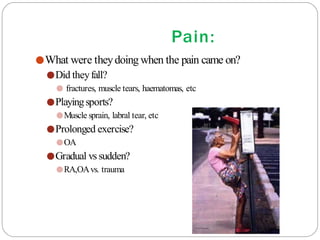
●What were theydoing when the pain came on?
●Did theyfall?
● fractures, muscle tears, haematomas, etc
●Playingsports?
●Muscle sprain, labral tear, etc
●Prolonged exercise?
●OA
●Gradual vs sudden?
●RA,OAvs. trauma
Pain:
●Do theyhave anyaggravatingor relievingfactors?
●OAgets worse asthey daygoes on and is relieved byrest
●Muscle tears/sprains may be exacerbated by movement
●RAis worse after prolonged periods of rest
●If analgesiaworks, find out what they take and how often!
●How does the pain affect their daily life?
●How far can theywalk?
●Difficulty walking up/down stairs?
●Are they still able to do their favourite hobbies?
●Has their partner noticed their pain limiting them?
●Are theytaking regular analgesia?
SWELLING
●Site
●Onset
●Duration
●Association with pain
●Progression over time
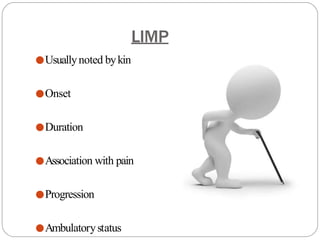
LIMP
●Usuallynoted bykin
●Onset
●Duration
●Association with pain
●Progression
●Ambulatorystatus
PAST HISTORY
●Trauma
●Tuberculosis
●Surgeryaround hip
●Skin
/ hematological
disorders
●Neurological disorders
●Connective tissue disorders
●Steroid intake
●Any other significant
medical / surgical illness
PERSONAL HISTORY
●Occupation and worktolerance
●Diet
●Smoking/alcohol
●Sexual history
●Menopausal history
FAMILY HISTORY
●TBin close relative
●Dysplasia
●Metabolic storage disorders
●Inflammatoryarthritis
GENERAL EXAMINATION
• Ht/wt/BMI
• Fever
• Vital signs
• Pallor
• External iliac/ inguinal
lymph nodes
• Stigmata of rheumatoid
arthritis/TB
• Chest expansion
LOCAL EXAMINATION
●Inspection
●Palpation
●Movements
●Measurements
●Specialtests
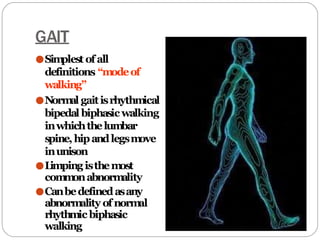
GAIT
●Sim
plest ofall
definitions “modeof
walking”
●Norm
al gaitisrhythm
ical
bipedal biphasicwalking
inwhichthelumbar
spine,hipandlegsm
ove
inunison
●Limping isthem
ost
com
m
onabnorm
ality
●Canbedefinedasany
abnorm
ality of norm
al
rhythmic biphasic
walking
TYPES OF GAIT
●Antalgicgait
in painful hip
conditions
pt walks with
reduced stance
phase on the
affected side
●W
addlinggait
Body sways from side
to side on awide base
seen in b/ l
DDH,pregnancy
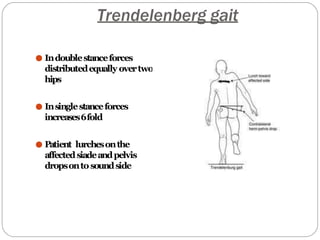
Trendelenberg gait
● Indoublestanceforces
distributedequally overtwo
hips
● Insinglestanceforces
increases6fold
● Patient lurchesonthe
affectedsiadeandpelvis
dropsontosoundside
Trendelenburg gait
Cont’d…
●Short limbgait-
When the affected limb
becomesshort
Up and down movement
of halfof the body
Pt lurches on the affected
side with a pelvis drop on
the same side
●Circumduction gait-
In fixed abduction
deformity or in
hemiparesisthe pt moves
hislimbs while dragginghis
body alongwith limb in a
semi circle
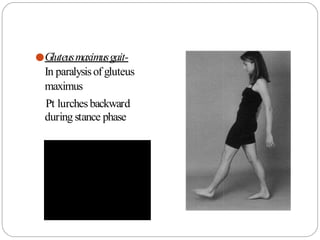
●Gluteusmaximusgait-
In paralysisof gluteus
maximus
Pt lurchesbackward
during stance phase
Quadriceps gait
●Inquadriceps
weaknessbody
collapses-hence the
trunk goesfor
anterior bendingto
shift the vertical
vector anterior to the
knee to balance
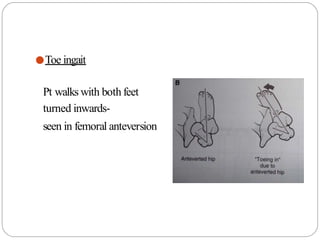
●Toe ingait
Pt walks with both feet
turned inwards-
seen in femoral anteversion
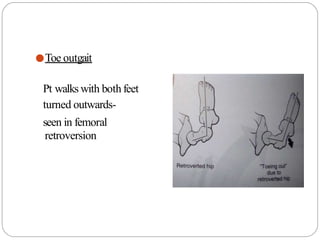
●Toe outgait
Pt walks with both feet
turned outwards-
seen in femoral
retroversion
ATTITUDE OF THE LIMB
●Standing : position of the head
level of scapulae and nipples
curvature ofthe spine
attitude of hip, knee &ankle
position of the ASIS-square or oblique
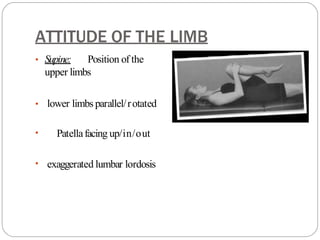
ATTITUDE OF THE LIMB
• Supine: Position of the
upper limbs
• lower limbs parallel/rotated
• Patellafacing up/in/out
• exaggerated lumbar lordosis
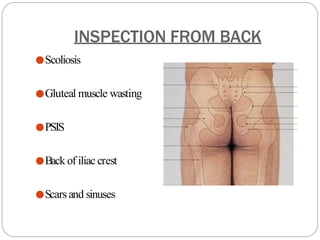
INSPECTION FROM BACK
●Scoliosis
●Gluteal muscle wasting
●PSIS
●Back of iliac crest
●Scarsand sinuses
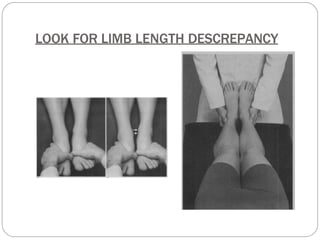
LOOK FOR LIMB LENGTH DESCREPANCY
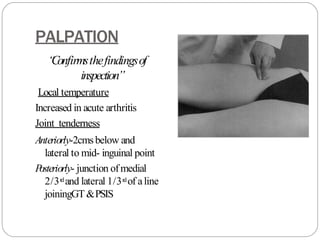
PALPATION
“
Confirmsthefindingsof
inspection”
Local temperature
Increased in acute arthritis
Joint tenderness
Anteriorly-2cmsbelow and
lateral to mid- inguinal point
P
osteriorly- junction ofmedial
2/3rdand lateral 1/3rdof aline
joiningGT&PSIS
●Tenderness
ASI
S
GT
PSIS
pubic symphysis
SIjoint
ischial tuberosity
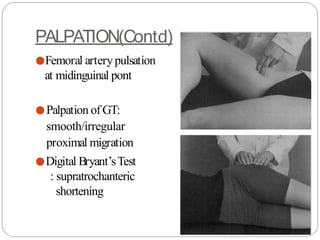
PALPATION(Contd)
●Femoral arterypulsation
at midinguinal pont
●Palpation ofGT:
smooth/irregular
proximal migration
●Digital Bryant’sTest
: supratrochanteric
shortening
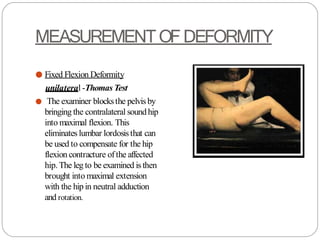
MEASUREMENTOFDEFORMITY
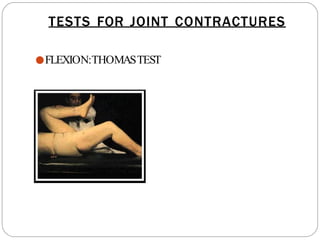
● Fixed Flexion Deformity
unilateral -Thomas Test
● The examiner blocksthe pelvisby
bringing the contralateral soundhip
into maximal flexion. This
eliminates lumbar lordosisthat can
be used to compensate for the hip
flexion contracture ofthe affected
hip. The leg to be examined is then
brought into maximal extension
with the hip in neutral adduction
and rotation.
●Patient inprone
positionwithlower
lim
bshangigngout
fromtheedgeofthe
table
●Patient should be able to
kep both thighs extended
●Measure the angle between
thigh and bed for ffd
BILATERAL FFD
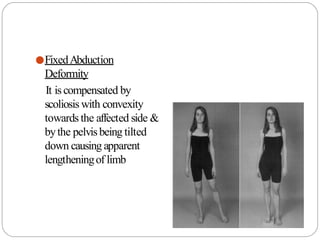
●FixedAbduction
Deformity
It iscompensated by
scoliosis with convexity
towards the affected side &
bythe pelvisbeing tilted
down causing apparent
lengtheningof limb
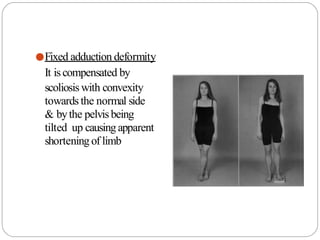
●Fixed adduction deformity
It iscompensated by
scoliosis with convexity
towards the normal side
& bythe pelvisbeing
tilted up causing apparent
shortening of limb
Fixed external & internal rotation deformity
● Alwaysremains revealed
Determined bynoting the direction of anterior surface of
patella or the toes when the foot is held at right angle to the
leg
Movements
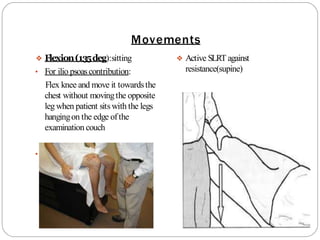
❖ Flexion(135deg):sitting
• For ilio psoascontribution:
Flex knee and move it towardsthe
chest without movingthe opposite
leg when patient sitswith the legs
hangingon the edge ofthe
examination couch
•
❖ Active SLRT against
resistance(supine)
Movements
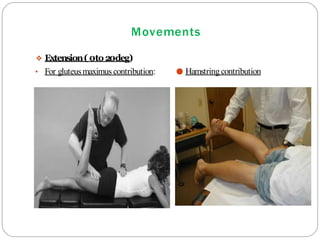
❖ Extension(0to20deg)
• For gluteusmaximus contribution:
•
● Hamstringcontribution
Movements
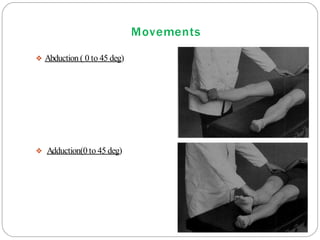
❖ Abduction ( 0 to 45 deg)
❖ Adduction(0 to 45 deg)
Movements
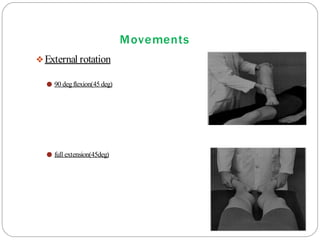
❖External rotation
● 90 degflexion(45 deg)
● full extension(45deg)
Movements
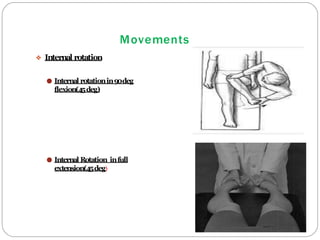
❖ Internal rotation
● Internal rotationin90deg
flexion(45deg)
● Internal Rotation infull
extension(45deg)
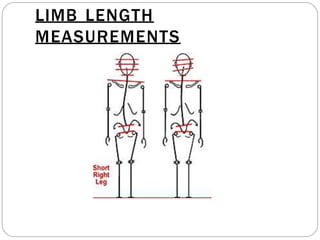
LIMB LENGTH
MEASUREMENTS
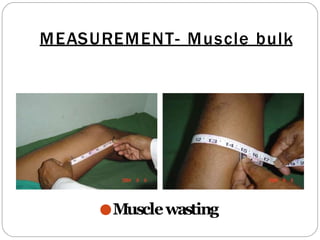
MEASUREMENT- Muscle bulk
●Musclewasting
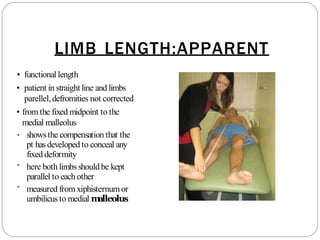
LIMB LENGTH:APPARENT
• functional length
• patient in straight line and limbs
parellel,defromities not corrected
• from the fixed midpoint to the
medial malleolus
•
•
• showsthe compensation that the
pt hasdeveloped to conceal any
fixed deformity
here both limbsshouldbe kept
parallel to each other
measured fromxiphisternum or
umbilicusto medial m
alleolus
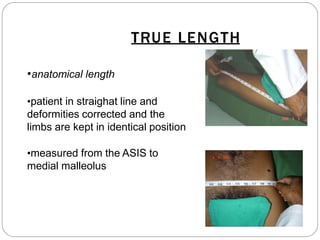
TRUE LENGTH
•anatomical length
•patient in straighat line and
deformities corrected and the
limbs are kept in identical position
•measured from the ASIS to
medial malleolus
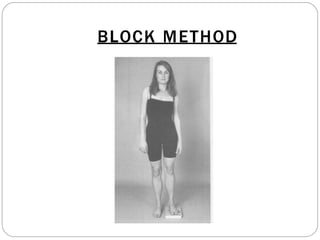
BLOCK METHOD
MEASUREMENTS
●IfTrue Shortening= Apparent Shortening: No
compensation
●True Shortening >apparent shortening: only part of the
deformity is compensated by tilting the pelvis(fixed
abduction deformity)
●True Shortening<apparent Shortening:fixed adduction
deformity with no compensation
●Every10 degree of deformity : 01 cm
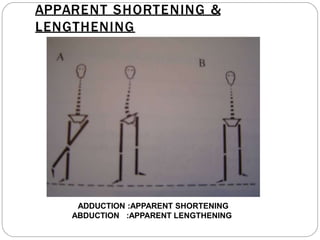
APPARENT SHORTENING &
LENGTHENING
ADDUCTION :APPARENT SHORTENING
ABDUCTION :APPARENT LENGTHENING
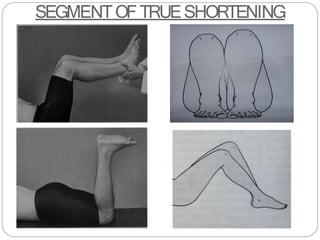
SEGMENTOFTRUESHORTENING
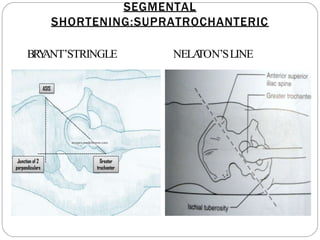
SEGMENTAL
SHORTENING:SUPRATROCHANTERIC
BR
Y
ANT’STRINGLE NELA
TON’SLINE
MEASUREMENTS
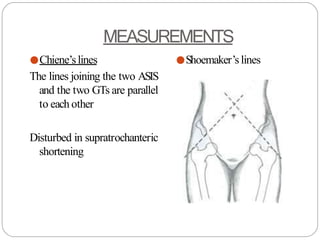
●Chiene’slines
The lines joining the two ASIS
and the two GTs are parallel
to each other
Disturbed in supratrochanteric
shortening
●Shoemaker’s lines
MEASUREMENTS
Morris’Bistrochanteric Test:
• it measues the distance between the GT and pubic
symphysis on bothsides
• Reduced in hip dislocations
Supra trochanteric
●
●
●
●
●
●
●
Coxa V
ara
Perthes
SCFE
Malunited basal # NOF
Congenital Coxa Vara
Arthritis
Dislocation
Infra trochanteric
●Malunion
●Fracture femur & tibia
●Growth arrest from polio
●Trauma and infective
sequale
True shortening
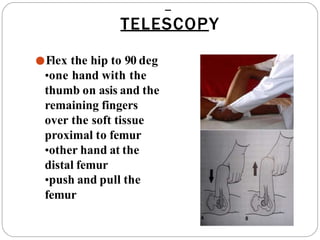
TELESCOPY
●Flex the hip to 90 deg
•one hand with the
thumb on asis and the
remaining fingers
over the soft tissue
proximal to femur
•other hand at the
distal femur
•push and pull the
femur
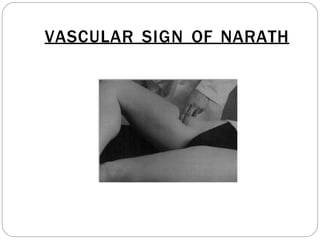
VASCULAR SIGN OF NARATH
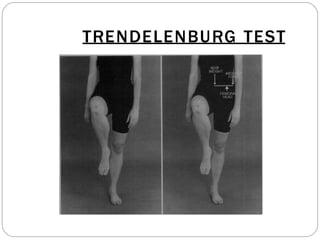
TRENDELENBURG TEST
● This test examine the strength of the abductor mechanism of the hip.
● Fulcrum: head offemur
Loadarm:weight ofthe body
Powerarm: abductors
Lever: neck and trochantersofthe femur
● Normally, in aone legged stance, the pelvis is raised up on the unsupported
side. Ifthe weight bearing hip is unstable, the pelvis drops on the unsupported
side, to avoid fallingthe patient has to throw hisor her body towards the
loaded side.
● •In the classic test, the examiner stands behind the patient. Ifthe patient stands
on ahealthy hip the gluteal fold on this side drops.
● •If the patient stands on adiseased leg the gluteal fold on the opposite side
drops(the sound side sags).
● 1.. Weakness of the hip abductors e.g. poliomyelitis
● 2.. Shorteningoffemoral neck e.g. coxavara.
● 3. Dislocation or subluxation ofthe hip
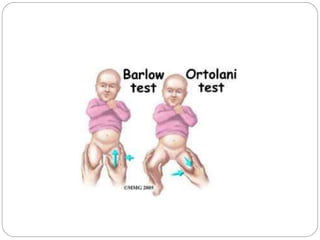
TESTS FOR DDH
● BARLOW’SMANOUVRE
The maneuver iseasily
performed byadducting the
hip while applyinglight
pressure on the knee,
directing the force
posteriorly.[2
] Ifthe hip is
dislocatable - that is, if the
hip can be popped out of
socket with this maneuver -
the test is considered positive
● ORTOLANI TEST
● It isperformed byan examiner first
flexingthe hipsand kneesofa
supine infant to 90 degrees, then
with the examiner's index fingers
placinganterior pressure on the
greater trochanters, gentlyand
smoothly abducting the infant's legs
usingthe examiner's thumbs.
● Apositive sign is adistinctive
'clunk' whichcan be heard and felt
asthe femoral head relocates
anteriorly into the acetabulum:[2]
● hip
TESTS FOR JOINT CONTRACTURES
●FLEXION:THOMASTEST
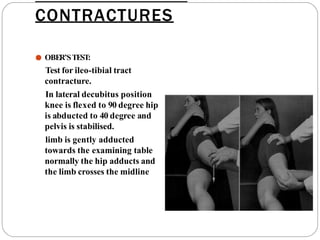
CONTRACTURES
● OBER’STEST:
Test for ileo-tibial tract
contracture.
In lateral decubitus position
knee is flexed to 90 degree hip
is abducted to 40 degree and
pelvis is stabilised.
limb is gently adducted
towards the examining table
normally the hip adducts and
the limb crosses the midline
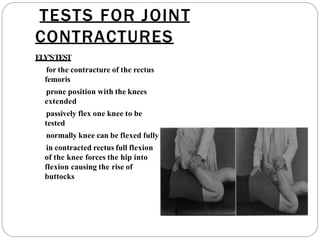
TESTS FOR JOINT
CONTRACTURES
EL
Y’STEST
for the contracture of the rectus
femoris
prone position with the knees
extended
passively flex one knee to be
tested
normally knee can be flexed fully
in contracted rectus full flexion
of the knee forces the hip into
flexion causing the rise of
buttocks
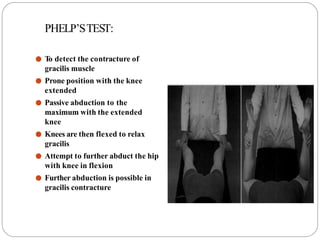
PHELP’STEST:
● T
o detect the contracture of
gracilis muscle
● Prone position with the knee
extended
● Passive abduction to the
maximum with the extended
knee
● Knees are then flexed to relax
gracilis
● Attempt to further abduct the hip
with knee in flexion
● Further abduction is possible in
gracilis contracture
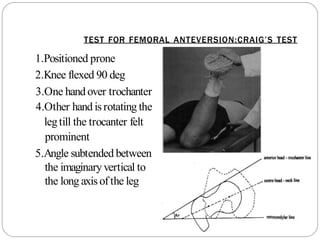
TEST FOR FEMORAL ANTEVERSION:CRAIG’S TEST
1.Positioned prone
2.Knee flexed 90 deg
3.One hand over trochanter
4.Other hand is rotating the
legtill the trocanter felt
prominent
5.Angle subtended between
the imaginaryvertical to
the long axis ofthe leg
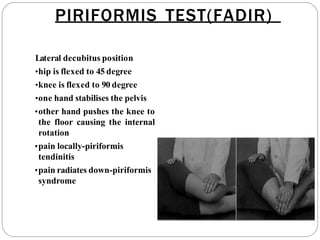
PIRIFORMIS TEST(FADIR)
Lateral decubitus position
•hip is flexed to 45 degree
•knee is flexed to 90 degree
•one hand stabilises the pelvis
•other hand pushes the knee to
the floor causing the internal
rotation
•pain locally-piriformis
tendinitis
•pain radiates down-piriformis
syndrome
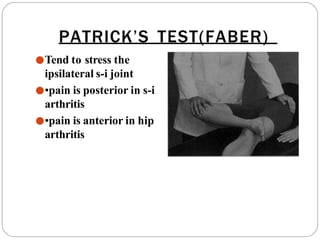
PATRICK’S TEST(FABER)
●Tend to stress the
ipsilateral s-i joint
●•pain is posterior in s-i
arthritis
●•pain is anterior in hip
arthritis
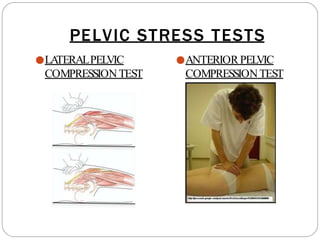
PELVIC STRESS TESTS
●LA
TERALPEL
VIC
COMPRESSIONTEST
●ANTERIORPEL
VIC
COMPRESSIONTEST
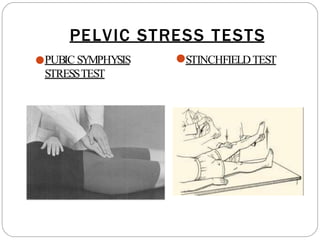
PELVIC STRESS TESTS
●PUBIC SYMPHYSIS ●STINCHFIELDTEST
STRESSTEST
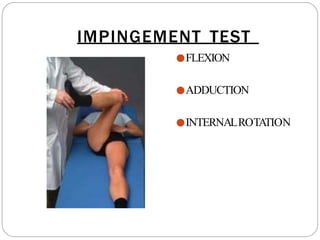
IMPINGEMENT TEST
●FLEXION
●ADDUCTION
●INTERNALROTA
TION
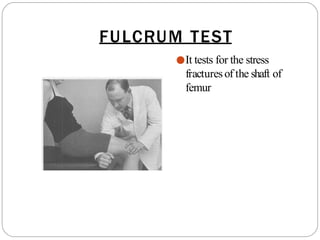
FULCRUM TEST
●It tests for the stress
fracturesof the shaft of
femur
NOT TO FORGET
•OTHERLOWERLIMBJOINTS
•SPINE
•PERRECTALEXAMINA
TION
THANK YOU
Hip examination

Hip examination