Floor Reaction Orthosis
Presented by
INDRA VIJAY SINGH
(Lecturer P&O)
PDUNIPPD,NEW DELHI
9/22/2018 INDRA VIJAY SINGH( LECTURER P&O)
Floor Reaction Orthosis
Objectives
Define floor Reaction Orthosis
Biomechanics /Mechanical Principle
Indications
Advantage /Disadvantage
Discussion
9/22/2018 INDRA VIJAY SINGH( LECTURER P&O)
Floor Reaction Orthosis
Floor Reaction Orthosis is revolutionary
orthosis: Custom fabricated, moulded plastic
device that supports the ankle and foot area of
the body and extends from below the knee
down to and including the foot.
9/22/2018 INDRA VIJAY SINGH( LECTURER P&O)
Floor Reaction Orthosis
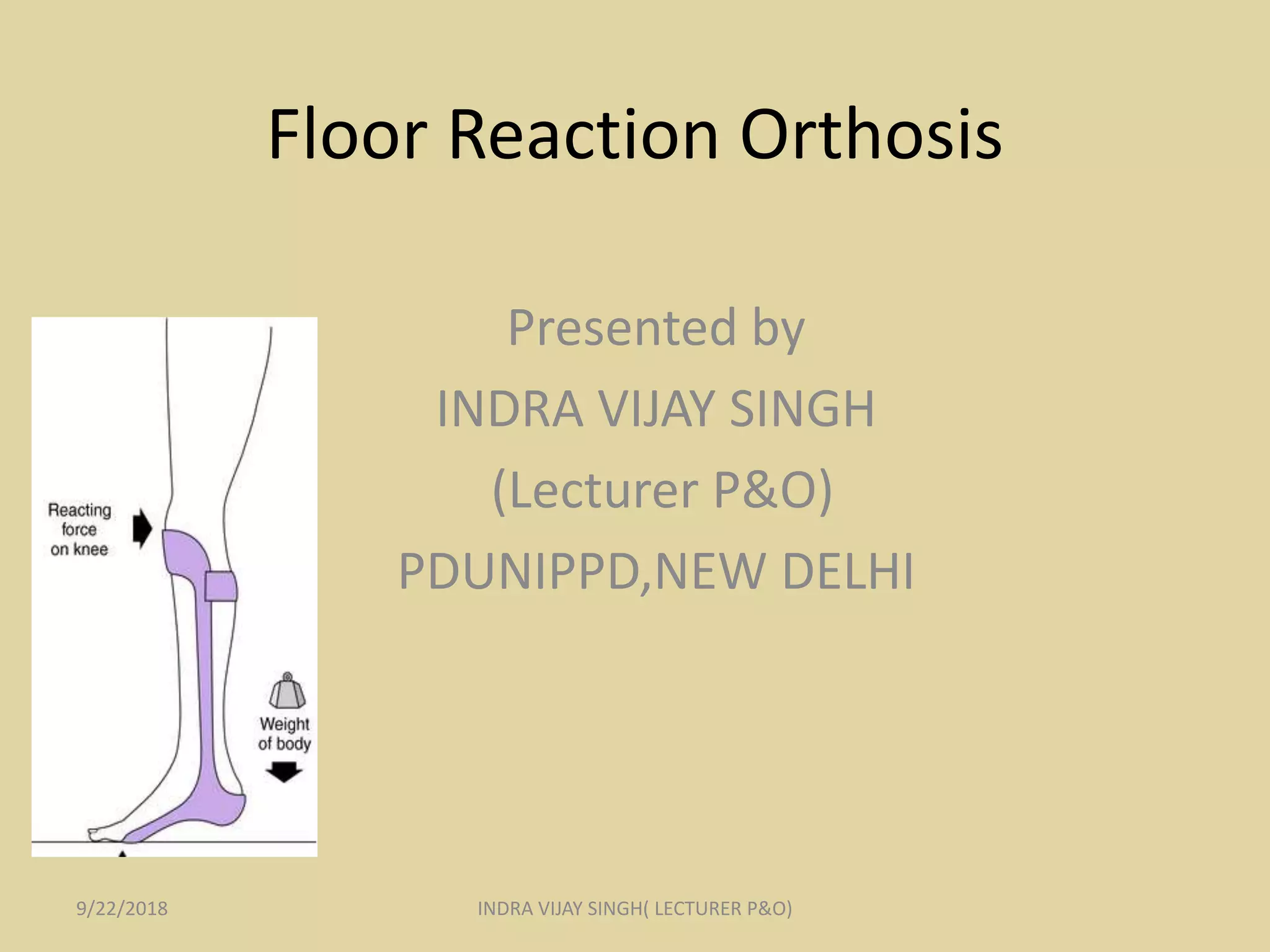
• It was described by Saltiel for the use of weak
quadriceps or plantar flexors in 1969.
• It holds the ankle in equinus to prevent the
heel from touching the ground. As the body
weight brings the heel downwards, the supra
patellar band will press the knee back
preventing knee from buckling during stance
phase. It allows the knee to flex during swing
phase when the foot is off the ground.
9/22/2018 INDRA VIJAY SINGH( LECTURER P&O)
Stage in evaluation of FRO
 Salitial FRO Pressing over the sensitive
patella .
PTB contours Provided by differentiating
between pressure sensitive & pressure
tolerance zone or areas.
 Deep infrapatellar groves and proximally trim
line extending to the mid- patella level gives
no problem.
9/22/2018 INDRA VIJAY SINGH( LECTURER P&O)
Component of FRO
• FRO has a posterior shell like solid ankle foot
orthosis.
• Toe plate is stiff and long with slight plantar
flexion.
• Anterior shell comfortably capture the
resultant extension moment and stabilize the
knee
9/22/2018 INDRA VIJAY SINGH( LECTURER P&O)
Principles of FRO
Mechanical& Biomechanical:
 Newton’s third law: For every action, there is
an equal and opposite reaction.
Body weight over the orthosis and over the
ground .
9/22/2018 INDRA VIJAY SINGH( LECTURER P&O)
GRF
The GRF has a point of application on the sole of the
foot, magnitude, a line of direction, GRF force offered
support surface, equaling and opposing force due to
body mass passing through the foot to the ground
surface; GRF is resolved into vertical (counteraction
body weight) and horizontal ( leading to forward
movement) components.
GRF is provide stability during stance phase.
9/22/2018 INDRA VIJAY SINGH( LECTURER P&O)
GRF
9/22/2018 INDRA VIJAY SINGH( LECTURER P&O)
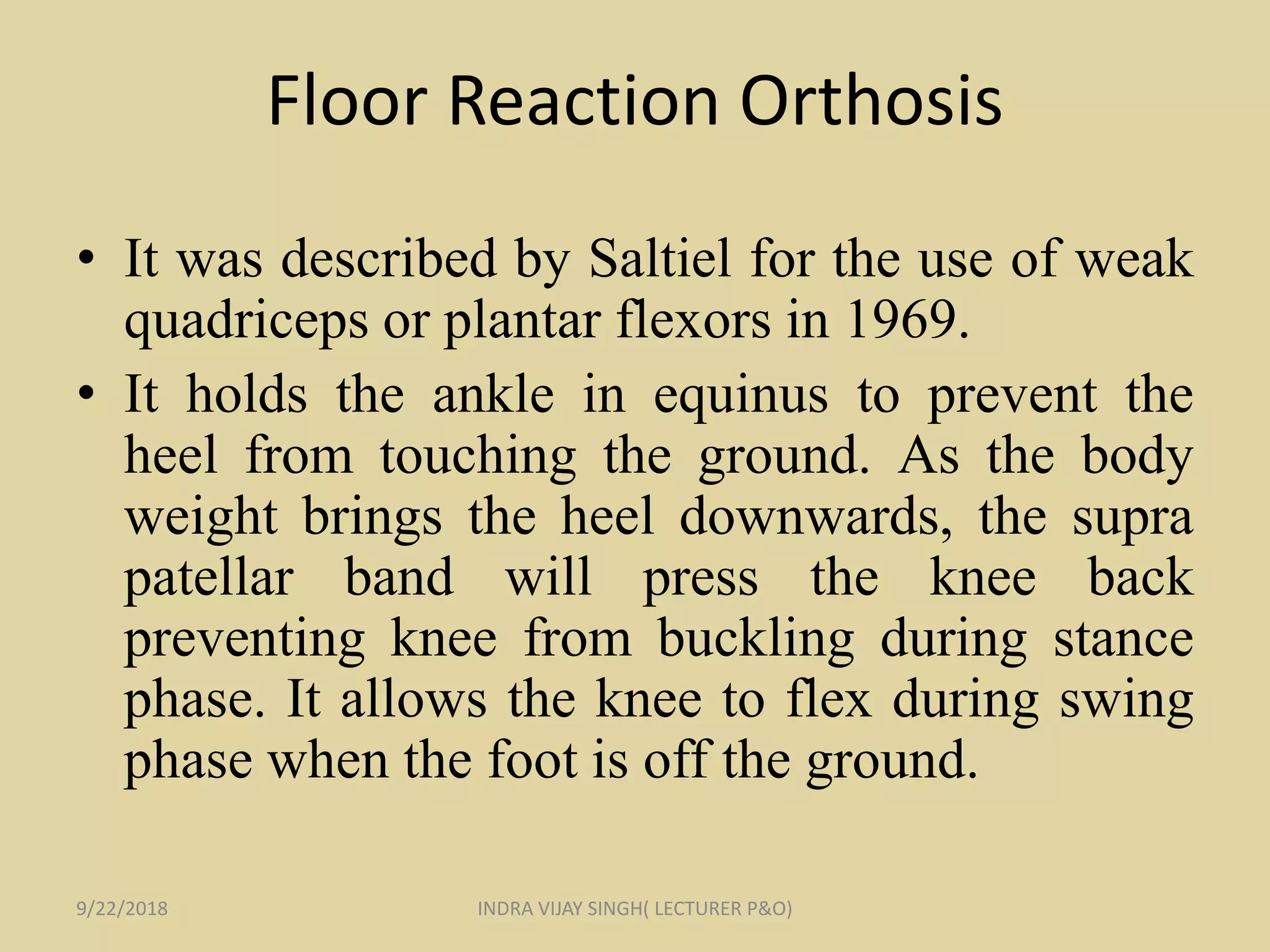
External moment caused by ground reaction force
9/22/2018 INDRA VIJAY SINGH( LECTURER P&O)
Force System
9/22/2018 INDRA VIJAY SINGH( LECTURER P&O)
Force System
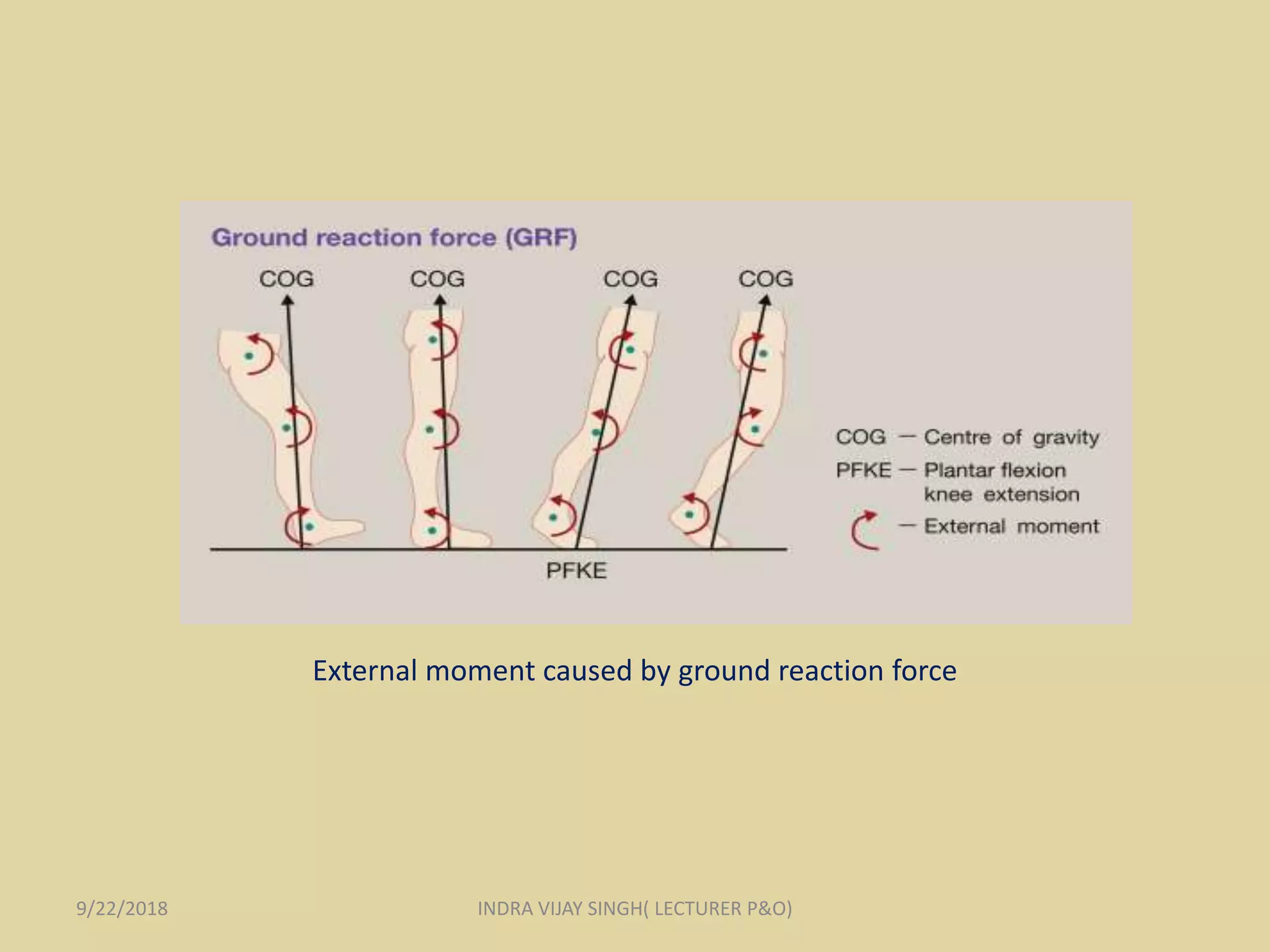
• FRO design 3 point force system. The 3 point
force system permits angular change or
control over a joint.
• The first force system is similar to control
plantar flexion (Leaf Spring AFO).
• Second force system is same as in case of
solid AFO to control inversion and eversion.
• Third force system controls dorsiflexion.
9/22/2018 INDRA VIJAY SINGH( LECTURER P&O)
Force System
Another set of Force system is working in this
FRO:
1. A posteriorly directed force on the upper tibia
or preferably on the patellar tendon.
2. A compression force in the plastic at the ankle
joint form mid stance to toe-off.
3. An upwardly directed force on the sole of the
foot during and after mid stance
9/22/2018 INDRA VIJAY SINGH( LECTURER P&O)
Principles of FRO
 When feet absorb the reaction forces and keep
the knee and ankle straight.
 Here the foot and orthosis absorb the forces and
keep knee straight.
 FRO holds the ankle in slight equinus to
prevent the heel from touching the ground
 when body brings the heel down, there is a
turning point at which orthosis joint press the
proximal leg back, making extension of knee
 prevents knee from buckling during stance
phase allows to flex in swing phase and permits
ground clearance
9/22/2018 INDRA VIJAY SINGH( LECTURER P&O)
Functions of FRO
 This orthosis is used to create an extension moment at
knee, generally in cases where patient is walking with
hand to knee gait.
 This extension moment is generated when ankle is
locked in a position of plantar flexion.
 Prevents knee flexion in weight bearing
 Gives medio lateral support and roatatory stability to
knee
 Helps to maintain the upright position in stance and
stabilized gait
 Other functions are similar to that of a solid ankle
AFO
9/22/2018 INDRA VIJAY SINGH( LECTURER P&O)
Indication of FRO
• Lower limb weakness eg. Post polio paralysis
• Neurological conditions
• For assist knee extension at mid stance and
compensate for weak / absent gastro soleus
(places extension forces close to knee)
• Generally all the previous conditions with
quadriceps having a fair muscle power.
•
–
9/22/2018 INDRA VIJAY SINGH( LECTURER P&O)
Indication of FRO
• Indication- Management of a crouch gait,
which is characterized by excessive ankle
dorsiflexion, increased knee flexion, and
increased hip flexion in mid stance.
9/22/2018 INDRA VIJAY SINGH( LECTURER P&O)
Indication of FRO
– spina bifida
– cerebral palsy
– brain injury
– spinal cord injury
9/22/2018 INDRA VIJAY SINGH( LECTURER P&O)
CONTRA INDICATION
• fixed contracture of knee and ankle
• Can not be prescribed bilaterally
• Contraindications - Hip flexion contracture
>30°,
Knee flexion contracture
>20°
9/22/2018 INDRA VIJAY SINGH( LECTURER P&O)
ADVANTAGES
Lightweight – swing phase not labored – easier
ground clearance
Easily trainable to patients – better patient
compliance – worn inside shoe , cosmetically
better
 Prevents knee from buckling – stabilizes knee
without muscle action
 stabilizes knee , ankle and foot
9/22/2018 INDRA VIJAY SINGH( LECTURER P&O)
DISADVANTAGES
Has to be custom made – do not function if
not correct fit
9/22/2018 INDRA VIJAY SINGH( LECTURER P&O)
Discussion
• The ankle joint is kept in 5 to 7 degrees of plantar
flexion in order to shift the line of floor reaction.
• By keeping ankle in plantar flexion, the resultant of
floor reaction passes posterior to the ankle joint and
anterior to the knee joint generating a posteriorly
directed moment which tends to push the knee in
extension thus controlling knee flexion allowing the
patient to remove his or her hand.
• If used in bilateral cases, tip-toe type of gait will be
achieved which is very uncomfortable for the patients
and hard to maintain the balance, hence
contraindicated in bilateral cases.
9/22/2018 INDRA VIJAY SINGH( LECTURER P&O)

Floor reaction orthosis

  • 1.
    Floor Reaction Orthosis Presentedby INDRA VIJAY SINGH (Lecturer P&O) PDUNIPPD,NEW DELHI 9/22/2018 INDRA VIJAY SINGH( LECTURER P&O)
  • 2.
    Floor Reaction Orthosis Objectives Definefloor Reaction Orthosis Biomechanics /Mechanical Principle Indications Advantage /Disadvantage Discussion 9/22/2018 INDRA VIJAY SINGH( LECTURER P&O)
  • 3.
    Floor Reaction Orthosis FloorReaction Orthosis is revolutionary orthosis: Custom fabricated, moulded plastic device that supports the ankle and foot area of the body and extends from below the knee down to and including the foot. 9/22/2018 INDRA VIJAY SINGH( LECTURER P&O)
  • 4.
    Floor Reaction Orthosis •It was described by Saltiel for the use of weak quadriceps or plantar flexors in 1969. • It holds the ankle in equinus to prevent the heel from touching the ground. As the body weight brings the heel downwards, the supra patellar band will press the knee back preventing knee from buckling during stance phase. It allows the knee to flex during swing phase when the foot is off the ground. 9/22/2018 INDRA VIJAY SINGH( LECTURER P&O)
  • 5.
    Stage in evaluationof FRO  Salitial FRO Pressing over the sensitive patella . PTB contours Provided by differentiating between pressure sensitive & pressure tolerance zone or areas.  Deep infrapatellar groves and proximally trim line extending to the mid- patella level gives no problem. 9/22/2018 INDRA VIJAY SINGH( LECTURER P&O)
  • 6.
    Component of FRO •FRO has a posterior shell like solid ankle foot orthosis. • Toe plate is stiff and long with slight plantar flexion. • Anterior shell comfortably capture the resultant extension moment and stabilize the knee 9/22/2018 INDRA VIJAY SINGH( LECTURER P&O)
  • 7.
    Principles of FRO Mechanical&Biomechanical:  Newton’s third law: For every action, there is an equal and opposite reaction. Body weight over the orthosis and over the ground . 9/22/2018 INDRA VIJAY SINGH( LECTURER P&O)
  • 8.
    GRF The GRF hasa point of application on the sole of the foot, magnitude, a line of direction, GRF force offered support surface, equaling and opposing force due to body mass passing through the foot to the ground surface; GRF is resolved into vertical (counteraction body weight) and horizontal ( leading to forward movement) components. GRF is provide stability during stance phase. 9/22/2018 INDRA VIJAY SINGH( LECTURER P&O)
  • 9.
    GRF 9/22/2018 INDRA VIJAYSINGH( LECTURER P&O)
  • 10.
    External moment causedby ground reaction force 9/22/2018 INDRA VIJAY SINGH( LECTURER P&O)
  • 11.
    Force System 9/22/2018 INDRAVIJAY SINGH( LECTURER P&O)
  • 12.
    Force System • FROdesign 3 point force system. The 3 point force system permits angular change or control over a joint. • The first force system is similar to control plantar flexion (Leaf Spring AFO). • Second force system is same as in case of solid AFO to control inversion and eversion. • Third force system controls dorsiflexion. 9/22/2018 INDRA VIJAY SINGH( LECTURER P&O)
  • 13.
    Force System Another setof Force system is working in this FRO: 1. A posteriorly directed force on the upper tibia or preferably on the patellar tendon. 2. A compression force in the plastic at the ankle joint form mid stance to toe-off. 3. An upwardly directed force on the sole of the foot during and after mid stance 9/22/2018 INDRA VIJAY SINGH( LECTURER P&O)
  • 14.
    Principles of FRO When feet absorb the reaction forces and keep the knee and ankle straight.  Here the foot and orthosis absorb the forces and keep knee straight.  FRO holds the ankle in slight equinus to prevent the heel from touching the ground  when body brings the heel down, there is a turning point at which orthosis joint press the proximal leg back, making extension of knee  prevents knee from buckling during stance phase allows to flex in swing phase and permits ground clearance 9/22/2018 INDRA VIJAY SINGH( LECTURER P&O)
  • 15.
    Functions of FRO This orthosis is used to create an extension moment at knee, generally in cases where patient is walking with hand to knee gait.  This extension moment is generated when ankle is locked in a position of plantar flexion.  Prevents knee flexion in weight bearing  Gives medio lateral support and roatatory stability to knee  Helps to maintain the upright position in stance and stabilized gait  Other functions are similar to that of a solid ankle AFO 9/22/2018 INDRA VIJAY SINGH( LECTURER P&O)
  • 16.
    Indication of FRO •Lower limb weakness eg. Post polio paralysis • Neurological conditions • For assist knee extension at mid stance and compensate for weak / absent gastro soleus (places extension forces close to knee) • Generally all the previous conditions with quadriceps having a fair muscle power. • – 9/22/2018 INDRA VIJAY SINGH( LECTURER P&O)
  • 17.
    Indication of FRO •Indication- Management of a crouch gait, which is characterized by excessive ankle dorsiflexion, increased knee flexion, and increased hip flexion in mid stance. 9/22/2018 INDRA VIJAY SINGH( LECTURER P&O)
  • 18.
    Indication of FRO –spina bifida – cerebral palsy – brain injury – spinal cord injury 9/22/2018 INDRA VIJAY SINGH( LECTURER P&O)
  • 19.
    CONTRA INDICATION • fixedcontracture of knee and ankle • Can not be prescribed bilaterally • Contraindications - Hip flexion contracture >30°, Knee flexion contracture >20° 9/22/2018 INDRA VIJAY SINGH( LECTURER P&O)
  • 20.
    ADVANTAGES Lightweight – swingphase not labored – easier ground clearance Easily trainable to patients – better patient compliance – worn inside shoe , cosmetically better  Prevents knee from buckling – stabilizes knee without muscle action  stabilizes knee , ankle and foot 9/22/2018 INDRA VIJAY SINGH( LECTURER P&O)
  • 21.
    DISADVANTAGES Has to becustom made – do not function if not correct fit 9/22/2018 INDRA VIJAY SINGH( LECTURER P&O)
  • 22.
    Discussion • The anklejoint is kept in 5 to 7 degrees of plantar flexion in order to shift the line of floor reaction. • By keeping ankle in plantar flexion, the resultant of floor reaction passes posterior to the ankle joint and anterior to the knee joint generating a posteriorly directed moment which tends to push the knee in extension thus controlling knee flexion allowing the patient to remove his or her hand. • If used in bilateral cases, tip-toe type of gait will be achieved which is very uncomfortable for the patients and hard to maintain the balance, hence contraindicated in bilateral cases. 9/22/2018 INDRA VIJAY SINGH( LECTURER P&O)
  • 23.
    9/22/2018 INDRA VIJAYSINGH( LECTURER P&O)