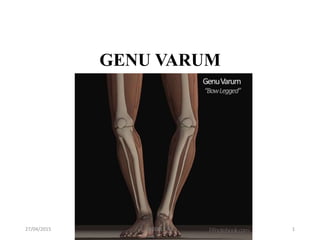
GENU VARUM
27/04/2015 1AYODELE A.E
CONTENTS
• INTRODUCTION
• CAUSES
• CLINICAL FEATURES
• EXAMINATION
• TREATMENT
• REFERENCES
27/04/2015 2AYODELE A.E
INTRODUCTION
• The three common deformities are genu varum
(bow leg) genu valgum (knock knee) and genu
recurvatum (hyperextended knee).
• Genu varum is also called bow leg or tibia vara is a
physical deformity marked by (outward) bowing of
the leg in relative to the thigh, giving the
appearance of an archer’s bow.
27/04/2015 3AYODELE A.E
CAUSES
• Physiological/developmental
• commonly occurs in childhood.
• Bowed legs in a toddler is very common. When a
child with bowed legs stands with his or her feet
together, there is a distinct space between the
lower legs and knees. This may be a result of either
one or both of the legs curving outward. Walking
often exaggerates the bowed appearance.
• gradually corrected spontaneously as the child
grows.
27/04/2015 4AYODELE A.E
Pathological
• Genu varum may also occur in adults.
• In both children and adults it may occur as a
consequence of injury or disease.
• Disorders which cause distorted epiphyseal and/or
physeal growth may give rise to bow leg or knock
knee;
• these include some of the skeletal dysplasias and
the various types of rickets, as well as injuries of
the epiphyseal and physeal growth cartilage.
• A unilateral deformity is likely to be pathological.
27/04/2015 5AYODELE A.E
Blount’s Disease
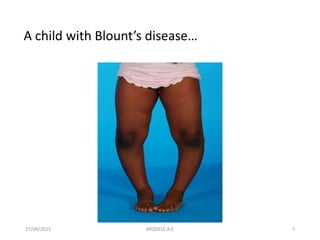
• can occur in toddlers as well as in adolescents.
• results from an abnormality of the growth plate in the upper part
of the tibia.
• Growth plates determine the length and shape of the adult bone.
In a child under the age of 2 years, it may be impossible to
distinguish infantile Blount’s disease from physiologic genu
varum.
• By the age of 3 years, however, the bowing will worsen and an
obvious problem can often be seen in an X-ray.
• Progressive; associated abnormal growth of the posteromedial
part of the proximal tibia.
• The condition is bilateral in 80% of cases and black children are
affected more. The condition is noticeably worse than in
physiological bow legs and may include internal rotation of the
tibia.
• Spontaneous resolution is rare.
27/04/2015 6AYODELE A.E
27/04/2015 7
A child with Blount’s disease…
AYODELE A.E
Rickets
• bone disease in children that causes bowed legs
and other bone deformities.
• Children with rickets do not get enough calcium,
phosphorus or vitamin D.
• Nutritional rickets unusual in developed countries.
• can also be caused by a genetic abnormality that
does not allow vitamin D to be absorbed correctly.
This form of rickets may be inherited.
27/04/2015 8AYODELE A.E
In adults…
• common in adults.
• may be sequel to childhood deformity and if so usually
cause no problems.
• However, if the deformity is associated with joint instability,
this can lead to osteoarthritis of the medial compartment.
• Other causes include:
• Fracture of the lower part of the femur or the upper part of
the tibia with malunion.
• Osteoarthritis
• Rarefying diseases of the bone such as rickets or
osteomalacia.
• Other bone-softening diseases such as Paget’s disease
(osteitis deformans)
27/04/2015 9AYODELE A.E
Clinical features
• deformity is usually gauged from simple observation.
• Bilateral genu varum can be recorded by measuring the
distance between the knees with the patient standing
and heels touching.
• Internal rotation is also common in toddlers and
frequently occurs in combination with bowed legs.
• The deformity typically do not cause pain.
• During adolescence/adulthood however, persistent
bowing can lead to discomfort in the hips, knees,
and/or ankles because of the abnormal stress that the
curved legs have on the joints.
27/04/2015 10AYODELE A.E
27/04/2015 11
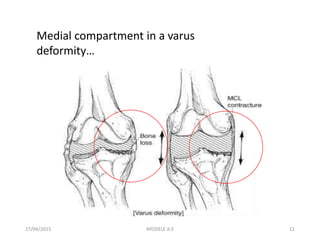
Medial compartment in a varus
deformity…
AYODELE A.E
Examination
• should begin with a thorough history taking.
• followed by a careful physical assessment to exclude
underlying organic disorders; if necessary by radiographs.
• If the patient is under 2 1/2 and has symmetrical bowing, an
X-ray may be required. The likelihood of having Blount’s
disease or rickets is greater at this age.
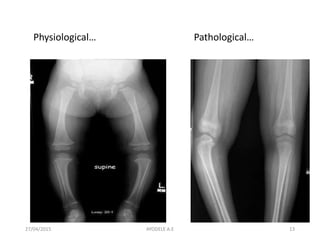
• In Blount’s disease, the proximal tibial epiphysis is flattened
medially and the adjacent metaphysis is beak-shaped. The
medial cortex of the proximal tibia appears thickened. This
is an illusory effect produced by internal rotation of the
tibia.
• In contrast to physiological bowing, abnormal alignment
occurs in the proximal tibia and not in the joint.
27/04/2015 12AYODELE A.E
27/04/2015 13
Physiological… Pathological…
AYODELE A.E
Treatment
• Physiologic genu varum nearly always spontaneously
corrects itself as the child grows.
• This usually occurs by the age of 3 to 4 years.
• Blount’s disease does not require treatment to
improve. If the disease is caught early, treatment with
brace may be all that is needed.
• Bracing is not effective however with adolescents with
Blount’s disease.
• Untreated infantile Blount’s disease or untreated
rickets results in progressive worsening of the bowing
in later childhood and adolescence.
• For children with rickets, the condition can be managed
with medications.
27/04/2015 14AYODELE A.E
Surgical Treatment
• Physiologic genu varum
• In rare instances, physiologic genu varum in the
toddler will not completely resolve and during
adolescence, the bowing may cause the child and
family to have cosmetic concerns.
• If the deformity is severe enough, then surgery to
correct the remaining bowing may be needed.
27/04/2015 15AYODELE A.E
Surgical Treatment Cont’d
• Blount's disease. If bowing continues to progress in a
child with infantile Blount's disease despite the use of a
brace, surgery will be needed by the age of 4 years.
Surgery may stop further worsening and prevent
permanent damage to the growth area of the
shinbone.
• Older children with bowed legs due to adolescent
Blount's disease require surgery to correct the problem.
• Rickets. Surgery may also be needed for children with
rickets whose deformities persist despite proper
management with medications.
27/04/2015 16AYODELE A.E
Surgical Procedures
different procedures; two main types.
• Guided growth. This surgery of the growth plate stops
the growth on the healthy side of the shinbone which
gives the abnormal side a chance to catch up,
straightening the leg with the child’s natural growth.
• Tibial osteotomy. In this procedure, the shinbone is cut
just below the knee and reshaped to correct the
alignment.
• After surgery, a cast may be applied to protect the bone
while it heals.
• Crutches may be necessary for a few weeks, and
exercises to restore strength and range of motion.
27/04/2015 17AYODELE A.E
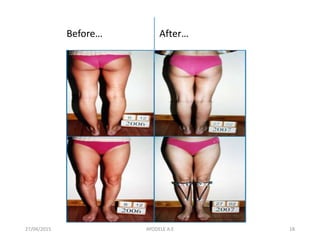
27/04/2015 18
Before… After…
AYODELE A.E
References
• Bowed Legs Reviewed by members of POSNA
(Pediatric Orthopaedic Society of North America) @
http://orthoinfo.aaos.org/topic.cfm?topic=a00230
Accessed on 01/04/2015.
• Hamblen, D. L., & Simpson, H. (2009). Adams's
outline of orthopaedics. Elsevier Health Sciences.
• Solomon L, Warwick D, & Nayagam S. (Eds.). (2010).
Apley's system of orthopaedics and fractures. CRC
Press.
27/04/2015 19AYODELE A.E
THANKS ALL!
27/04/2015 20AYODELE A.E

Genu Varum

  • 1.
  • 2.
    CONTENTS • INTRODUCTION • CAUSES •CLINICAL FEATURES • EXAMINATION • TREATMENT • REFERENCES 27/04/2015 2AYODELE A.E
  • 3.
    INTRODUCTION • The threecommon deformities are genu varum (bow leg) genu valgum (knock knee) and genu recurvatum (hyperextended knee). • Genu varum is also called bow leg or tibia vara is a physical deformity marked by (outward) bowing of the leg in relative to the thigh, giving the appearance of an archer’s bow. 27/04/2015 3AYODELE A.E
  • 4.
    CAUSES • Physiological/developmental • commonlyoccurs in childhood. • Bowed legs in a toddler is very common. When a child with bowed legs stands with his or her feet together, there is a distinct space between the lower legs and knees. This may be a result of either one or both of the legs curving outward. Walking often exaggerates the bowed appearance. • gradually corrected spontaneously as the child grows. 27/04/2015 4AYODELE A.E
  • 5.
    Pathological • Genu varummay also occur in adults. • In both children and adults it may occur as a consequence of injury or disease. • Disorders which cause distorted epiphyseal and/or physeal growth may give rise to bow leg or knock knee; • these include some of the skeletal dysplasias and the various types of rickets, as well as injuries of the epiphyseal and physeal growth cartilage. • A unilateral deformity is likely to be pathological. 27/04/2015 5AYODELE A.E
  • 6.
    Blount’s Disease • canoccur in toddlers as well as in adolescents. • results from an abnormality of the growth plate in the upper part of the tibia. • Growth plates determine the length and shape of the adult bone. In a child under the age of 2 years, it may be impossible to distinguish infantile Blount’s disease from physiologic genu varum. • By the age of 3 years, however, the bowing will worsen and an obvious problem can often be seen in an X-ray. • Progressive; associated abnormal growth of the posteromedial part of the proximal tibia. • The condition is bilateral in 80% of cases and black children are affected more. The condition is noticeably worse than in physiological bow legs and may include internal rotation of the tibia. • Spontaneous resolution is rare. 27/04/2015 6AYODELE A.E
  • 7.
    27/04/2015 7 A childwith Blount’s disease… AYODELE A.E
  • 8.
    Rickets • bone diseasein children that causes bowed legs and other bone deformities. • Children with rickets do not get enough calcium, phosphorus or vitamin D. • Nutritional rickets unusual in developed countries. • can also be caused by a genetic abnormality that does not allow vitamin D to be absorbed correctly. This form of rickets may be inherited. 27/04/2015 8AYODELE A.E
  • 9.
    In adults… • commonin adults. • may be sequel to childhood deformity and if so usually cause no problems. • However, if the deformity is associated with joint instability, this can lead to osteoarthritis of the medial compartment. • Other causes include: • Fracture of the lower part of the femur or the upper part of the tibia with malunion. • Osteoarthritis • Rarefying diseases of the bone such as rickets or osteomalacia. • Other bone-softening diseases such as Paget’s disease (osteitis deformans) 27/04/2015 9AYODELE A.E
  • 10.
    Clinical features • deformityis usually gauged from simple observation. • Bilateral genu varum can be recorded by measuring the distance between the knees with the patient standing and heels touching. • Internal rotation is also common in toddlers and frequently occurs in combination with bowed legs. • The deformity typically do not cause pain. • During adolescence/adulthood however, persistent bowing can lead to discomfort in the hips, knees, and/or ankles because of the abnormal stress that the curved legs have on the joints. 27/04/2015 10AYODELE A.E
  • 11.
    27/04/2015 11 Medial compartmentin a varus deformity… AYODELE A.E
  • 12.
    Examination • should beginwith a thorough history taking. • followed by a careful physical assessment to exclude underlying organic disorders; if necessary by radiographs. • If the patient is under 2 1/2 and has symmetrical bowing, an X-ray may be required. The likelihood of having Blount’s disease or rickets is greater at this age. • In Blount’s disease, the proximal tibial epiphysis is flattened medially and the adjacent metaphysis is beak-shaped. The medial cortex of the proximal tibia appears thickened. This is an illusory effect produced by internal rotation of the tibia. • In contrast to physiological bowing, abnormal alignment occurs in the proximal tibia and not in the joint. 27/04/2015 12AYODELE A.E
  • 13.
  • 14.
    Treatment • Physiologic genuvarum nearly always spontaneously corrects itself as the child grows. • This usually occurs by the age of 3 to 4 years. • Blount’s disease does not require treatment to improve. If the disease is caught early, treatment with brace may be all that is needed. • Bracing is not effective however with adolescents with Blount’s disease. • Untreated infantile Blount’s disease or untreated rickets results in progressive worsening of the bowing in later childhood and adolescence. • For children with rickets, the condition can be managed with medications. 27/04/2015 14AYODELE A.E
  • 15.
    Surgical Treatment • Physiologicgenu varum • In rare instances, physiologic genu varum in the toddler will not completely resolve and during adolescence, the bowing may cause the child and family to have cosmetic concerns. • If the deformity is severe enough, then surgery to correct the remaining bowing may be needed. 27/04/2015 15AYODELE A.E
  • 16.
    Surgical Treatment Cont’d •Blount's disease. If bowing continues to progress in a child with infantile Blount's disease despite the use of a brace, surgery will be needed by the age of 4 years. Surgery may stop further worsening and prevent permanent damage to the growth area of the shinbone. • Older children with bowed legs due to adolescent Blount's disease require surgery to correct the problem. • Rickets. Surgery may also be needed for children with rickets whose deformities persist despite proper management with medications. 27/04/2015 16AYODELE A.E
  • 17.
    Surgical Procedures different procedures;two main types. • Guided growth. This surgery of the growth plate stops the growth on the healthy side of the shinbone which gives the abnormal side a chance to catch up, straightening the leg with the child’s natural growth. • Tibial osteotomy. In this procedure, the shinbone is cut just below the knee and reshaped to correct the alignment. • After surgery, a cast may be applied to protect the bone while it heals. • Crutches may be necessary for a few weeks, and exercises to restore strength and range of motion. 27/04/2015 17AYODELE A.E
  • 18.
  • 19.
    References • Bowed LegsReviewed by members of POSNA (Pediatric Orthopaedic Society of North America) @ http://orthoinfo.aaos.org/topic.cfm?topic=a00230 Accessed on 01/04/2015. • Hamblen, D. L., & Simpson, H. (2009). Adams's outline of orthopaedics. Elsevier Health Sciences. • Solomon L, Warwick D, & Nayagam S. (Eds.). (2010). Apley's system of orthopaedics and fractures. CRC Press. 27/04/2015 19AYODELE A.E
  • 20.