KNEE JOINT
EXAMINATION
DR. UTKARSH SHAHI
ASSISTANT PROFESSOR
DEPARTMENT OF ORTHOPAEDICS
REVIEW OF KNEE ANATOMY
 The knee is called a pivot joint, as along with Flexion and
extension as principle movement around this joint, it also has
some rotary component.
 The knee is one of the most frequently injured joints, because of
 It’s anatomical structure.
 Exposure to external forces.
 Functional demands placed on it.
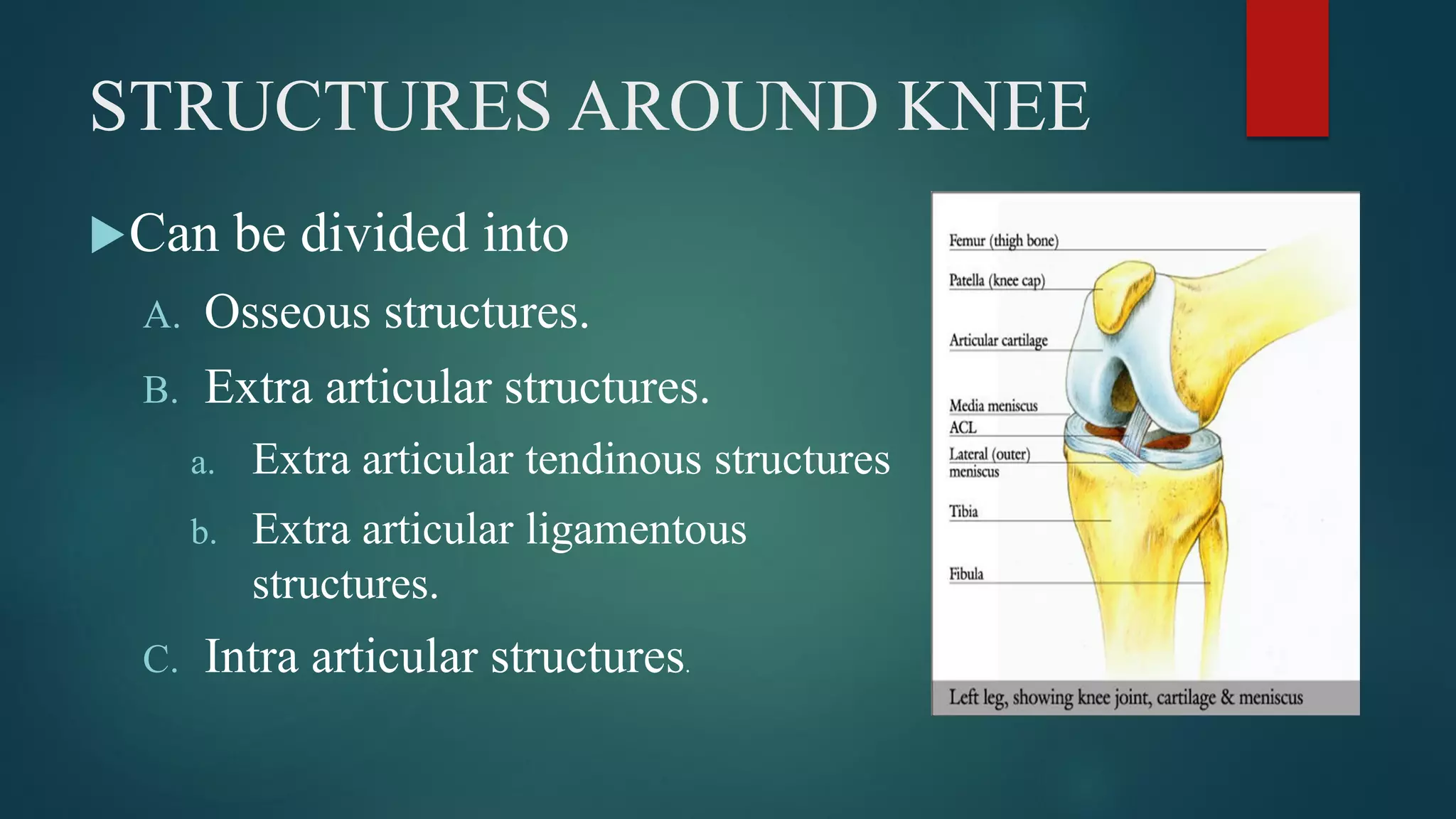
STRUCTURES AROUND KNEE
Can be divided into
A. Osseous structures.
B. Extra articular structures.
a. Extra articular tendinous structures
b. Extra articular ligamentous
structures.
C. Intra articular structures.
OSSEOUS STRUCTURES
Consist of three components
A. Distal Femoral Condyles.
B. Proximal Tibial Plateaus.
C. The Patella.
EXTRAARTICULAR STRUCTURES
 The important extra articular structures supporting and
influencing the function of this joint are
The synovium.
Joint capsule.
Collateral ligaments.
Musculotendinous units that span the joint. ( also known as “extra
articular tendinous structures of knee joint”
EXTRA-ARTICULAR
TENDINOUS STRUCTURES
 Principally these include:
Quadriceps mechanism
Gastrocnemius
Medial Hamstring group
Lateral Hamstring group
Popliteus
Iliotibial Band
EXTRA-ARTICULAR LIGAMENTOUS
STRUCTURES
Primarily these include:
The joint capsule.
Medial collateral ligament.
Lateral collateral ligament.
INTRA ARTICULAR STRUCTURES
Medial meniscus
Lateral meniscus
Anterior cruciate ligament
Posterior cruciate ligament
KNEE CONDITIONS
Injury and mechanical derangement.
Congenital and developmental abnormalities.
Infection and inflammation.
Arthritis and rheumatic disorders.
Metabolic and endocrine disorders.
Tumours and lesions that mimic them.
Neurological disorders and muscle weakness.
HISTORY TAKING
PATIENT DETAILS CHIEF COMPLAINTS
HISTORY OF PRESENT ILLNESS PAST HISTORY
FAMILY HISTORY PERSONAL HISTORY
TREATMENT HISTORY NEGATIVE HISTORY
COMPLAINTS
PAIN LIMP
LOCKING SWELLING
DEFORMITY WEAKNESS
INSTABILITY PARASTHESIA
LOSS OF FUNCTION STIFFNESS
PAIN
Site Time and mode of onset
Severity or Intensity Character or Nature
Progression Referred pain
Aggravating factors Relieving factors
Any diurnal variation Any seasonal variation
PAIN
 The extent of reference is governed by a number of factors.
 The depth of the structure beneath the skin.
 The position of the structure within the dermatome.
 The severity of the lesion
LIMP
Time of Onset
•Congenital
•Developmental
•Acquired
Duration
•Acute
•Chronic
Progression
•Progressive
•Static
•Regressive
Aggravating factors
Associated
symptoms
•Pain
•Disability
•Neurovascular
Associated Illness
SWELLING
Site Shape Size
First notice
Associated Symptoms
•Pain
•Pressure
•Neurological
•Vascular
•Articular
Progression
Any other swelling Reducibility
Any discharge
•If present
•Duration
•Regular or intermittent
•Character of discharge
DEFORMITY
Site
Associated Symptoms
• Neurological
• Vascular
• Articular
Amount of
disability
Time of Onset
• Congenital
• Developmental
• Acquired
Correctability
• Completely correctable
• Partially correctable
• Incorrectable
WEAKNESS
Site
Generalised
Localised
Type
Pure Motor
Sensorimotor
Muscular
Mixed
Duration
Acute
Chronic
Onset
Sudden
Gradual
Progression
Progressive
Static
Regressive
INSTABILITY
Time of Onset
•Congenital
•Developmental
•Acquired
Frequency
•Single episode
•Recurrent Aggravating factors
Associated
symptoms
•Pain
•Disability
•Neurovascular
Reducibility
•Reducible
•Irreducible Associated Illness
PARASTHESIA
Aetiology
Mode of
onset
Duration
Site and
Pattern
Progression
Aggravating
and Relieving
Factors
LOSS OF FUNCTION
Mode of onset
• Sudden
• Gradual
Duration
• Congenital
• Chronic
• Acute
Involved region
and function(s)
Progression
Associated
features
STIFFNESS
Generalised Localised
Locking Ankylosis
DIFFERENTIAL DIAGNOSIS
1. _ _ _ _ _ _ _ _ _ _ _ _ _ _ _ _ _ _ _ _ _ _ _ _
2. _ _ _ _ _ _ _ _ _ _ _ _ _ _ _ _ _ _ _ _ _ _ _ _
3. _ _ _ _ _ _ _ _ _ _ _ _ _ _ _ _ _ _ _ _ _ _ _ _
4. _ _ _ _ _ _ _ _ _ _ _ _ _ _ _ _ _ _ _ _ _ _ _ _
5. _ _ _ _ _ _ _ _ _ _ _ _ _ _ _ _ _ _ _ _ _ _ _ _
DIFFERENTIALS IN KNEE
 Trauma
 Patella Fracture
 Knee Dislocation
 Tibial Plateau Fracture
 Arthritis
 Osteoarthritis
 Rheumatoid Arthritis
 Traumatic arthritis
 Tumour
 Infections
 Knee Lesions
 Articular Cartilage Defects of Knee
 Osteonecrosis of the Knee
 Spontaneous Osteonecrosis of the
Knee (SONK)
 Plicae
 Paediatric Conditions
 Osteochondritis Dissecans
 Osgood Schlatter's Disease
(Tibial Tubercle Apophysitis)
 Sinding-Larson-Johansson Syndrome
DIFFERENTIALS IN KNEE
 Sports Conditions
 Ligament Injury
 ACL Tear
 PCL Injury
 MCL Injuries
 LCL Injuries
 Posterolateral Corner Injury
 Proximal Tibiofibular dislocation
 Meniscal Injuries
 Medial Meniscal Tear
 Lateral Meniscal Tear
 Sports Conditions
 Knee Overuse injuries
 Patellar Tendinitis
 Quadriceps tendonitis
 Semimembranosus Tendinitis
 Pre-patellar Bursitis (Housemaid's knee)
 Iliotibial Band Friction Syndrome
 Knee Extensor Mechanism
 Patellofemoral joint
 Patellar Instability
 Lateral Patellar Compression Syndrome
 Idiopathic Chondromalacia Patellae
 Quadriceps Tendon Rupture
 Patella Tendon Rupture
Physical
Examination
General
Examination
Systemic
Examination
Regional
Examination
GENERAL EXAMINATION
Vitals
•Pulse
•Blood Pressure
•Respiratory Rate
•Temperature
Consciousness Orientation Comfort level Position of Patient
Height and Weight
General
Appearance
Pallor Icterus Clubbing
Cyanosis Pupillary Reaction Lymphadenopathy Dexterity Anything specific
Systemic
Examination
Respiratory
System
Cardiovascular
System
Gastrointestinal
System
Central Nervous
System
REGIONAL EXAMINATION
• InspectionLOOK
• PalpationFEEL
• Strength TestingMOVE
• Shortening or Lengthening
• Range of Motion
• Regional measurements
MEASURE
• Depends upon specific region in considerationSPECIAL TESTS
PHYSICAL EXAM - GENERAL
 Develop a standard routine
 Alleviate the patient's fears
 Adequate exposure - bilateral
 Compare both sides
EXAMINATION OF THE KNEE
Observe the gait and posture.
Observe the patient in standing and lying on couch
Observe the patient from front, side and back.
Look for any evidence of shortening.
INSPECTION
Any obvious deformity
Any compensatory mechanism
Gross shortening
Muscle wasting
Any swelling
Any scar
•Active sinus
•Healed sinus
•Scars of old surgery
Temperature Tenderness Swelling
DeformityPALPATIONAnterior Knee
Palpation
Medial Knee
Palpation
Posterior Knee
Palpation
Lateral Knee
Palpation
PALPATION
ANTERIOR POSTERIOR
PALPATION
LATERAL MEDIAL
RANGE OF MOTION (ROM)
 Evaluate active ROM
 If movement limited by pain, weakness, or tightness, assist
passively
 Evaluate bilaterally for comparison
RANGE OF MOTION (ROM)
RANGE OF MOTION: 0 – 155 DEGREE
KNEE FLEXION
SCIATIC NERVE
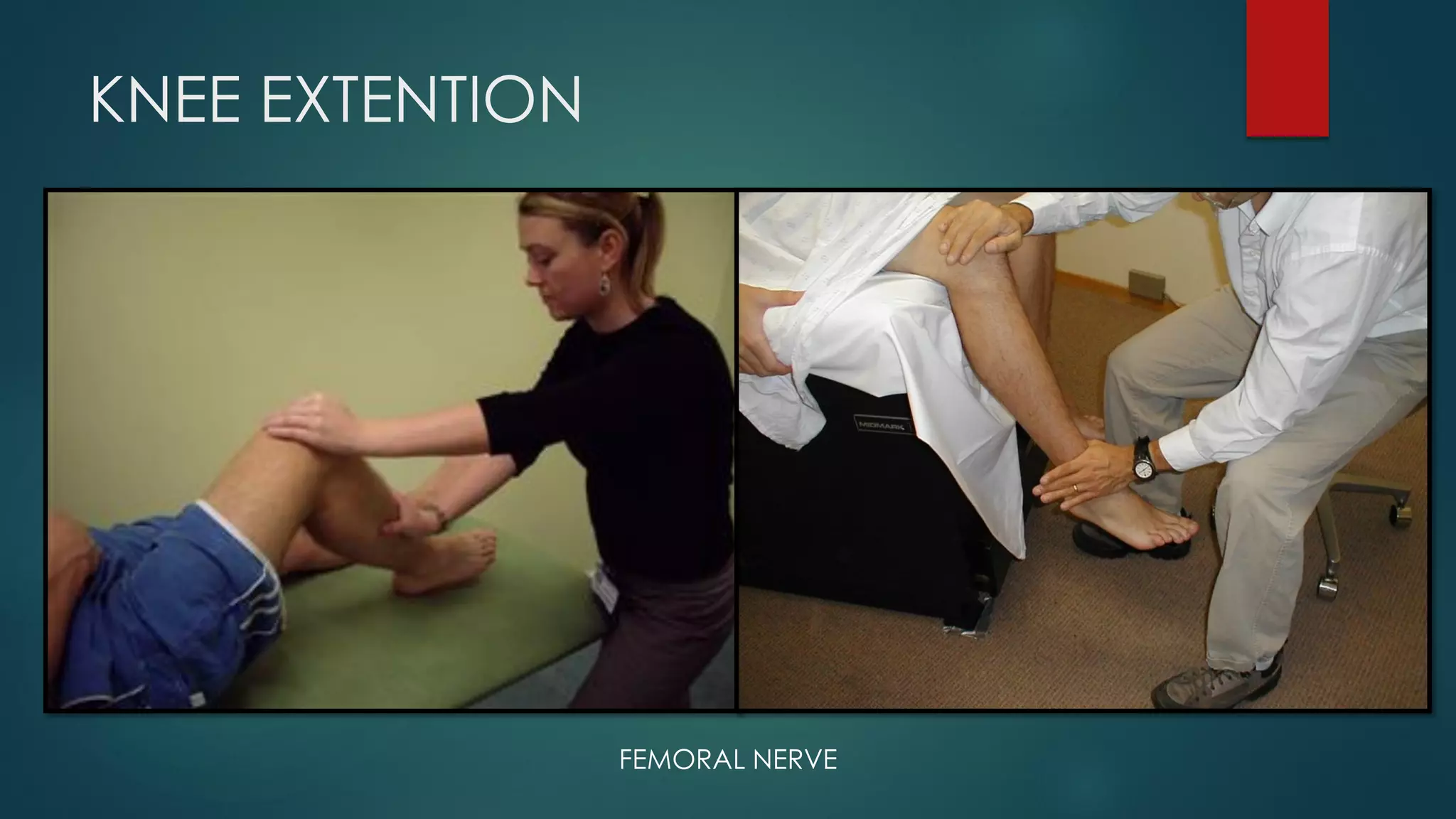
KNEE EXTENTION
FEMORAL NERVE
SPECIAL TESTS
•Patellar grinding
•Patellar TrackingPATELLA
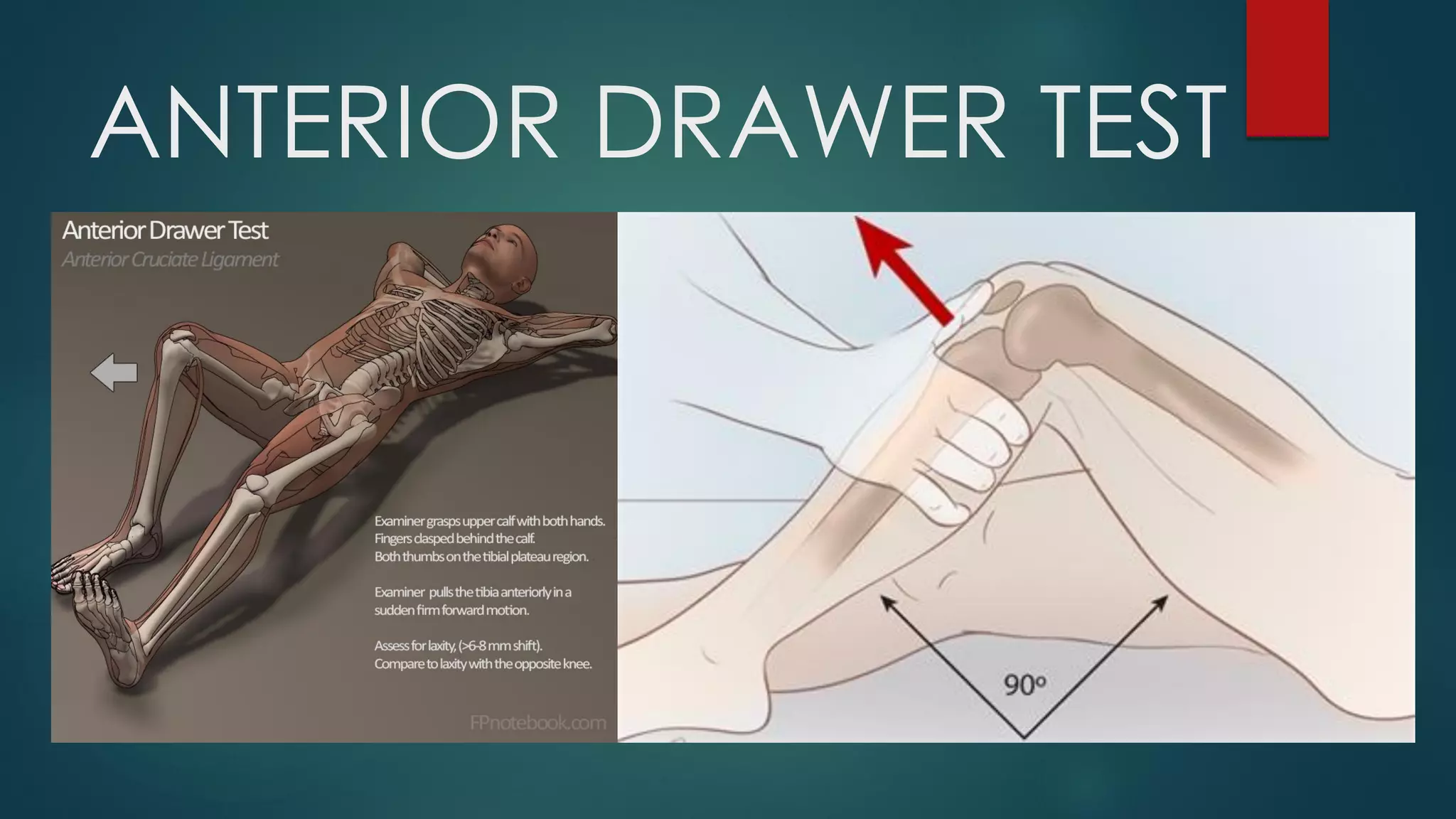
•Anterior drawer test
•Lachman testACL
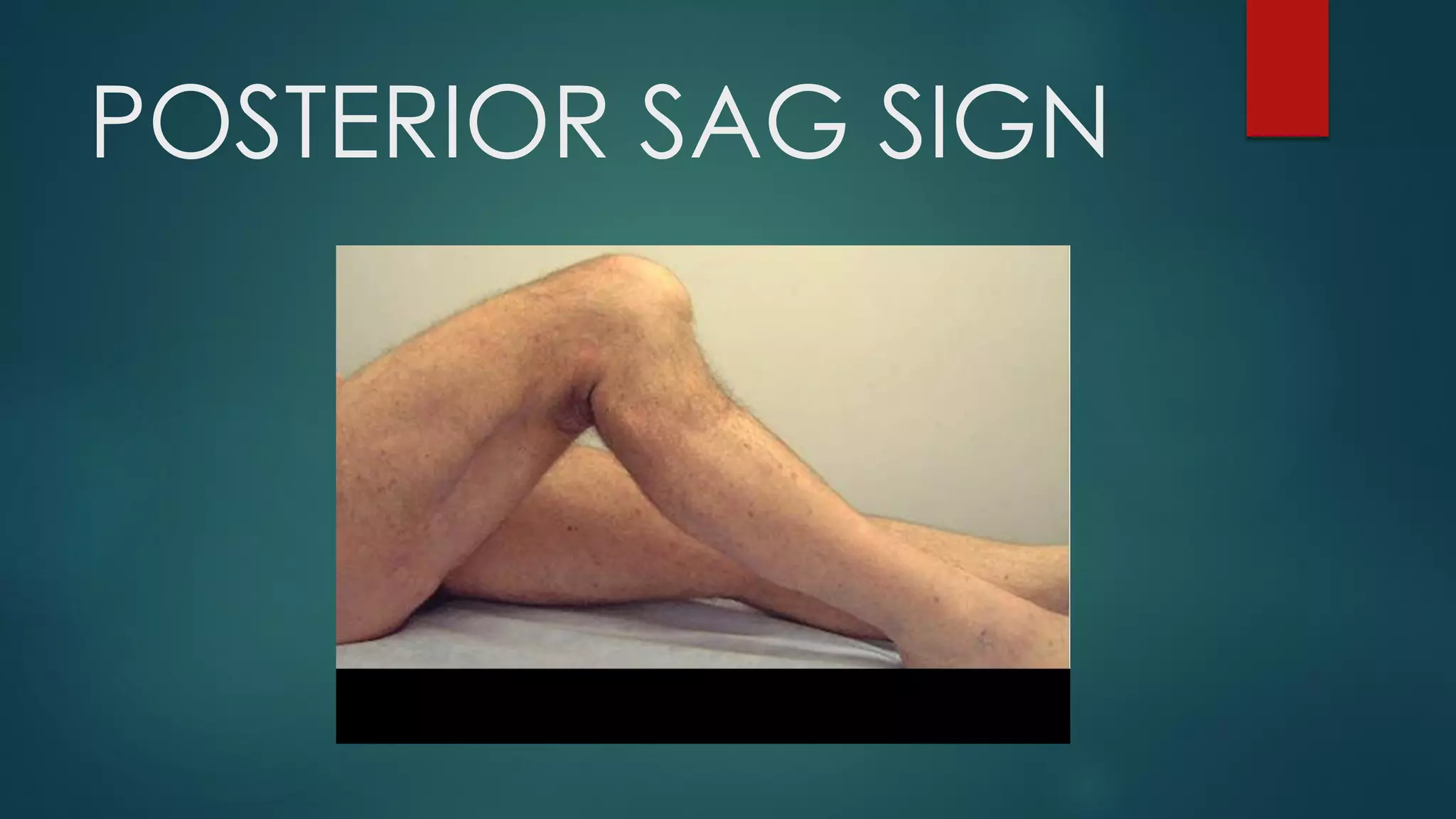
•Posterior Drawer Test
•Posterior Sag SignPCL
•Valgus Stress TestMCL
•Varus Stress TestLCL
•Apley’s Grinding
•McMurray’s TestMeniscus
ANTERIOR DRAWER TEST
LACHMAN TEST
POSTERIOR DRAWER TEST
POSTERIOR SAG SIGN
STRESS TESTS
STRESS TESTS
VALGUS STRESS TEST
VARUS STRESS TEST
McMURRAY TEST
APLEY’S COMPRESSION TEST
PROVISIONAL DIAGNOSIS
1. _ _ _ _ _ _ _ _ _ _ _ _ _ _ _ _ _ _ _ _ _ _ _ _
2. _ _ _ _ _ _ _ _ _ _ _ _ _ _ _ _ _ _ _ _ _ _ _ _
3. _ _ _ _ _ _ _ _ _ _ _ _ _ _ _ _ _ _ _ _ _ _ _ _
4. _ _ _ _ _ _ _ _ _ _ _ _ _ _ _ _ _ _ _ _ _ _ _ _
5. _ _ _ _ _ _ _ _ _ _ _ _ _ _ _ _ _ _ _ _ _ _ _ _
INVESTIGATIONS
DIAGNOSTIC
IMAGING
LABORATORY
TESTS
OTHER
SPECIALIZED
TESTS
DIAGNOSTIC
IMAGING
PLAIN
RADIOGRAPHS
CONTRAST
RADIOGRAPHS
SPECIALIZED
IMAGING
MODALITIES
ULTRASONOGRAPHY
LABORATORY
TESTS
HAEMATOLOGY
SEROLOGY
IMMUNOLOGY
ENZYME
ANALYSIS
SYNOVIAL
FLUID ANALYSIS
OTHER
SPECIALIZED
TESTS
BONE BIPOSY
BONE MINERAL
DENSITOMETRY
DIAGNOSTIC
ARTHROSCOPY
DEFINITIVE DIAGNOSIS
1. _ _ _ _ _ _ _ _ _ _ _ _ _ _ _ _ _ _ _ _ _ _ _ _
2. _ _ _ _ _ _ _ _ _ _ _ _ _ _ _ _ _ _ _ _ _ _ _ _
3. _ _ _ _ _ _ _ _ _ _ _ _ _ _ _ _ _ _ _ _ _ _ _ _
4. _ _ _ _ _ _ _ _ _ _ _ _ _ _ _ _ _ _ _ _ _ _ _ _
5. _ _ _ _ _ _ _ _ _ _ _ _ _ _ _ _ _ _ _ _ _ _ _ _
THE END
THANK YOU

PS SESSION : EXAMINATION OF KNEE JOINT