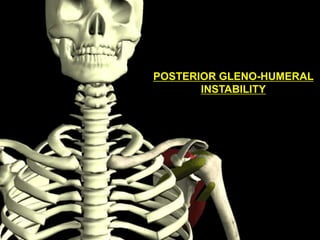
POSTERIOR GLENO-HUMERAL INSTABILITY
INTRODUCTION2-12% of all shoulder instabilityIsolation / MDISymptoms are usually mild and can be overlookedAthletes
ETIOLOGYCongenital	- Ligamentous laxity	- Scapulohumeral anatomyAcquired	-  Athletes	-  Repetitive stress to the posterior capsule resulting in laxity Traumatic	- Fall or blow to arm in “at risk” position 			(forward flexion, abduction and internal rotation) 
ASSOCIATED ATHLETIC ACTIVITIESACTIVITY			MOTIONWeightlifting			Bench press, push-upsPitching			Follow-through phaseSwimming			Butterfly and freestyleRacquet sports		Backhand stokesGolf				Motions of lead armGymnastics			Parallel bars, ringsBoxing			Axial load with punching
CLASSIFICATIONVoluntary /Involuntary   Habitual InstabilityResults from underlying neuromuscular imbalanceUnderlying psychiatric problems commonOften refractory to surgeryPositional DislocatorDemonstrate instability by placing the arm in a position of riskUsually do not have psychiatric illness or secondary gainOrdinary avoid provocative manoeuvresPhysiotherapy still first-line treatment but surgery gives good results
CLINICAL PRESENTATIONPain rather than instabilityUsually mild Occur during or after activityTraumatic event may precede onset of symptomsRarely is there a history of frank posterior dislocationSlip, pop or click out and in
EXAMINATION - 1Posterior joint line tenderness ROM - NormalRotator cuff strength - NormalScapular winging secondary to scapula muscle dysfunctionLigamentous laxity?Examine unaffected shoulder
EXAMINATION - 2Load and Shift Test (posterior drawer)Examiner grasps humeral head and pulls directly backward with the shoulder muscles relaxed.Humeral head subluxates posteriorly (<50% normal)Patients reaction to translation more important than amountPosterior ApprehensionUncommonArm brought into forward flexion and internal rotation with posterior stress appliedSense of instability, pain or painful subluxation is suggestive of the diagnosis
INVESTIGATIONSShoulder XRAP in ER/IRLateralAxillary viewDynamic XR with shoulder subluxedCTArthrogramMRI Labral changesCapsular DamageEUA +/- arthroscopyDoubt regarding direction or extent of instability
MANAGEMENTNON-SURGICAL TREATMENTSURGICAL TREATMENTARTHROSCOPICOPEN
SURGERY - 1INDICATIONSRecurrent, symptomatic, unidirectional subluxation that has failed to respond to a comprehensive non-operative program Posterior instability itself is not an indication for surgery2/3 will respond to a proper exercise programNo patient who has not had 6/12 of an exercise program should have surgery
SURGERY - 2CONTRA-INDICATIONSPsychiatric disorderSignificant degenerative gleno-humeral arthritisFailure to undergo or co-operate in physiotherapy program Ligamentous laxityMultidirectional instability
ARTHROSCOPY Capsular shift25% recurrence at 2 year follow-up in one study on 20 patients Capsulo-labral augmentation41 patients in study – 86% improved stabilityThermal capsulorrhaphyThin posterior capsule which is less responsive to shrinkageComplicated by necrosis
  SURGICAL PROCEDURESOPENSOFT TISSUE				BONE			Posterior capsulorrhaphy			Glenoid osteotomyInferior capsular shift			Posterior bone block(anterior/posterior)			Infraspinatus advancementPosterior Bankart repairStaple capsulorrphaphyBiceps tendon transferSubscapularis transfer ARTHROSCOPICPosterior Capsulolabral AugmentationPosteroinferior Capsular ShiftThermal Capsulorrhaphy
OPEN TECHNIQUES - 1Soft tissueSoft tissue abnormalities are the predominant cause of 	posterior instabilityPosterior capsular shiftAnterior/posterior approachPosterior capsule thin 1.5mmStaples fallen out of favourRecent report 13/14 patients were satisfied at 44/12 follow-upRecurrence rate 30% some studies50% high level athletes return to sports
OPEN TECHNIQUES - 2BoneGlenoplastyGlenoid retroversion/hypoplasia Opening wedge osteotomyCadaveric studies confirm effective change in Glenoid shape and increased stabilityRecent study 17 patients atraumatic posterior instability at 5 year follow-up81% rated good to excellent12.5% had a recurrencePost-op degenerative changes were seen in 25%Recommended glenoplasty if glenoid retroversion 7-10° radiographicallyHumeral OsteotomyExternal rotation osteotomyIndicated if symptoms worsened on internal rotationFew reports in literature
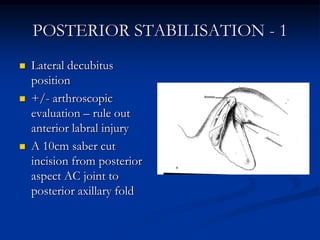
POSTERIOR STABILISATION - 1Lateral decubitus position+/- arthroscopic evaluation – rule out anterior labral injuryA 10cm saber cut incision from posterior aspect AC joint to posterior axillary fold
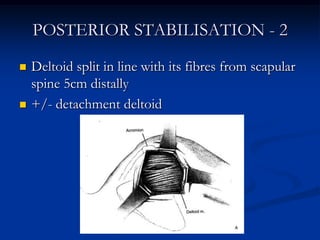
POSTERIOR STABILISATION - 2Deltoid split in line with its fibres from scapular spine 5cm distally+/- detachment deltoid
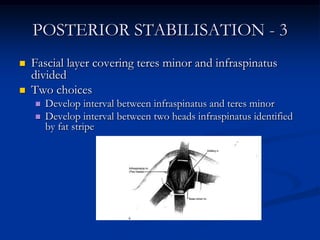
POSTERIOR STABILISATION - 3Fascial layer covering teres minor and infraspinatus dividedTwo choicesDevelop interval between infraspinatus and teres minorDevelop interval between two heads infraspinatus identified by fat stripe
POSTERIOR STABILISATION - 4Divided from tendon insertion to just medial to glenoidbeware branches suprascapular nerve 1.5cm from glenoidInfraspinatus dissected free from capsule
POSTERIOR STABILISATION - 5Capsule divided lateral to medial in mid-portion +/- labral repairT-capsular incision based medially along edge of labrumSuperior and inferior flaps tagged
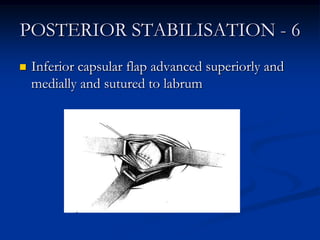
POSTERIOR STABILISATION - 6Inferior capsular flap advanced superiorly and medially and sutured to labrum
POSTERIOR STABILISATION - 7Superior flap brought over inferior flap inferior and mediallySutures tied in neutral rotation
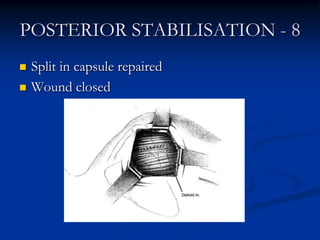
POSTERIOR STABILISATION - 8Split in capsule repairedWound closed
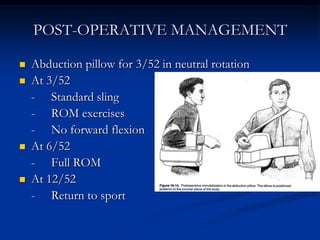
POST-OPERATIVE MANAGEMENTAbduction pillow for 3/52 in neutral rotationAt 3/52	-	Standard sling	-	ROM exercises	-	No forward flexionAt 6/52	-	Full ROMAt 12/52	-	Return to sport
COMPLICATIONSLoss internal rotation secondary to over-tight posterior capsular repairSuprascapular/axillary nerve injuryHardware problemsRecurrence - 30%
Posterior gleno-humeral-instability

Posterior gleno-humeral-instability

  • 1.
  • 2.
    INTRODUCTION2-12% of allshoulder instabilityIsolation / MDISymptoms are usually mild and can be overlookedAthletes
  • 3.
    ETIOLOGYCongenital - Ligamentous laxity -Scapulohumeral anatomyAcquired - Athletes - Repetitive stress to the posterior capsule resulting in laxity Traumatic - Fall or blow to arm in “at risk” position (forward flexion, abduction and internal rotation) 
  • 4.
    ASSOCIATED ATHLETIC ACTIVITIESACTIVITY MOTIONWeightlifting Benchpress, push-upsPitching Follow-through phaseSwimming Butterfly and freestyleRacquet sports Backhand stokesGolf Motions of lead armGymnastics Parallel bars, ringsBoxing Axial load with punching
  • 5.
    CLASSIFICATIONVoluntary /Involuntary Habitual InstabilityResults from underlying neuromuscular imbalanceUnderlying psychiatric problems commonOften refractory to surgeryPositional DislocatorDemonstrate instability by placing the arm in a position of riskUsually do not have psychiatric illness or secondary gainOrdinary avoid provocative manoeuvresPhysiotherapy still first-line treatment but surgery gives good results
  • 6.
    CLINICAL PRESENTATIONPain ratherthan instabilityUsually mild Occur during or after activityTraumatic event may precede onset of symptomsRarely is there a history of frank posterior dislocationSlip, pop or click out and in
  • 7.
    EXAMINATION - 1Posteriorjoint line tenderness ROM - NormalRotator cuff strength - NormalScapular winging secondary to scapula muscle dysfunctionLigamentous laxity?Examine unaffected shoulder
  • 8.
    EXAMINATION - 2Loadand Shift Test (posterior drawer)Examiner grasps humeral head and pulls directly backward with the shoulder muscles relaxed.Humeral head subluxates posteriorly (<50% normal)Patients reaction to translation more important than amountPosterior ApprehensionUncommonArm brought into forward flexion and internal rotation with posterior stress appliedSense of instability, pain or painful subluxation is suggestive of the diagnosis
  • 9.
    INVESTIGATIONSShoulder XRAP inER/IRLateralAxillary viewDynamic XR with shoulder subluxedCTArthrogramMRI Labral changesCapsular DamageEUA +/- arthroscopyDoubt regarding direction or extent of instability
  • 10.
  • 11.
    SURGERY - 1INDICATIONSRecurrent,symptomatic, unidirectional subluxation that has failed to respond to a comprehensive non-operative program Posterior instability itself is not an indication for surgery2/3 will respond to a proper exercise programNo patient who has not had 6/12 of an exercise program should have surgery
  • 12.
    SURGERY - 2CONTRA-INDICATIONSPsychiatricdisorderSignificant degenerative gleno-humeral arthritisFailure to undergo or co-operate in physiotherapy program Ligamentous laxityMultidirectional instability
  • 13.
    ARTHROSCOPY Capsular shift25% recurrenceat 2 year follow-up in one study on 20 patients Capsulo-labral augmentation41 patients in study – 86% improved stabilityThermal capsulorrhaphyThin posterior capsule which is less responsive to shrinkageComplicated by necrosis
  • 14.
    SURGICALPROCEDURESOPENSOFT TISSUE BONE Posterior capsulorrhaphy Glenoid osteotomyInferior capsular shift Posterior bone block(anterior/posterior) Infraspinatus advancementPosterior Bankart repairStaple capsulorrphaphyBiceps tendon transferSubscapularis transfer ARTHROSCOPICPosterior Capsulolabral AugmentationPosteroinferior Capsular ShiftThermal Capsulorrhaphy
  • 15.
    OPEN TECHNIQUES -1Soft tissueSoft tissue abnormalities are the predominant cause of posterior instabilityPosterior capsular shiftAnterior/posterior approachPosterior capsule thin 1.5mmStaples fallen out of favourRecent report 13/14 patients were satisfied at 44/12 follow-upRecurrence rate 30% some studies50% high level athletes return to sports
  • 16.
    OPEN TECHNIQUES -2BoneGlenoplastyGlenoid retroversion/hypoplasia Opening wedge osteotomyCadaveric studies confirm effective change in Glenoid shape and increased stabilityRecent study 17 patients atraumatic posterior instability at 5 year follow-up81% rated good to excellent12.5% had a recurrencePost-op degenerative changes were seen in 25%Recommended glenoplasty if glenoid retroversion 7-10° radiographicallyHumeral OsteotomyExternal rotation osteotomyIndicated if symptoms worsened on internal rotationFew reports in literature
  • 17.
    POSTERIOR STABILISATION -1Lateral decubitus position+/- arthroscopic evaluation – rule out anterior labral injuryA 10cm saber cut incision from posterior aspect AC joint to posterior axillary fold
  • 18.
    POSTERIOR STABILISATION -2Deltoid split in line with its fibres from scapular spine 5cm distally+/- detachment deltoid
  • 19.
    POSTERIOR STABILISATION -3Fascial layer covering teres minor and infraspinatus dividedTwo choicesDevelop interval between infraspinatus and teres minorDevelop interval between two heads infraspinatus identified by fat stripe
  • 20.
    POSTERIOR STABILISATION -4Divided from tendon insertion to just medial to glenoidbeware branches suprascapular nerve 1.5cm from glenoidInfraspinatus dissected free from capsule
  • 21.
    POSTERIOR STABILISATION -5Capsule divided lateral to medial in mid-portion +/- labral repairT-capsular incision based medially along edge of labrumSuperior and inferior flaps tagged
  • 22.
    POSTERIOR STABILISATION -6Inferior capsular flap advanced superiorly and medially and sutured to labrum
  • 23.
    POSTERIOR STABILISATION -7Superior flap brought over inferior flap inferior and mediallySutures tied in neutral rotation
  • 24.
    POSTERIOR STABILISATION -8Split in capsule repairedWound closed
  • 25.
    POST-OPERATIVE MANAGEMENTAbduction pillowfor 3/52 in neutral rotationAt 3/52 - Standard sling - ROM exercises - No forward flexionAt 6/52 - Full ROMAt 12/52 - Return to sport
  • 26.
    COMPLICATIONSLoss internal rotationsecondary to over-tight posterior capsular repairSuprascapular/axillary nerve injuryHardware problemsRecurrence - 30%