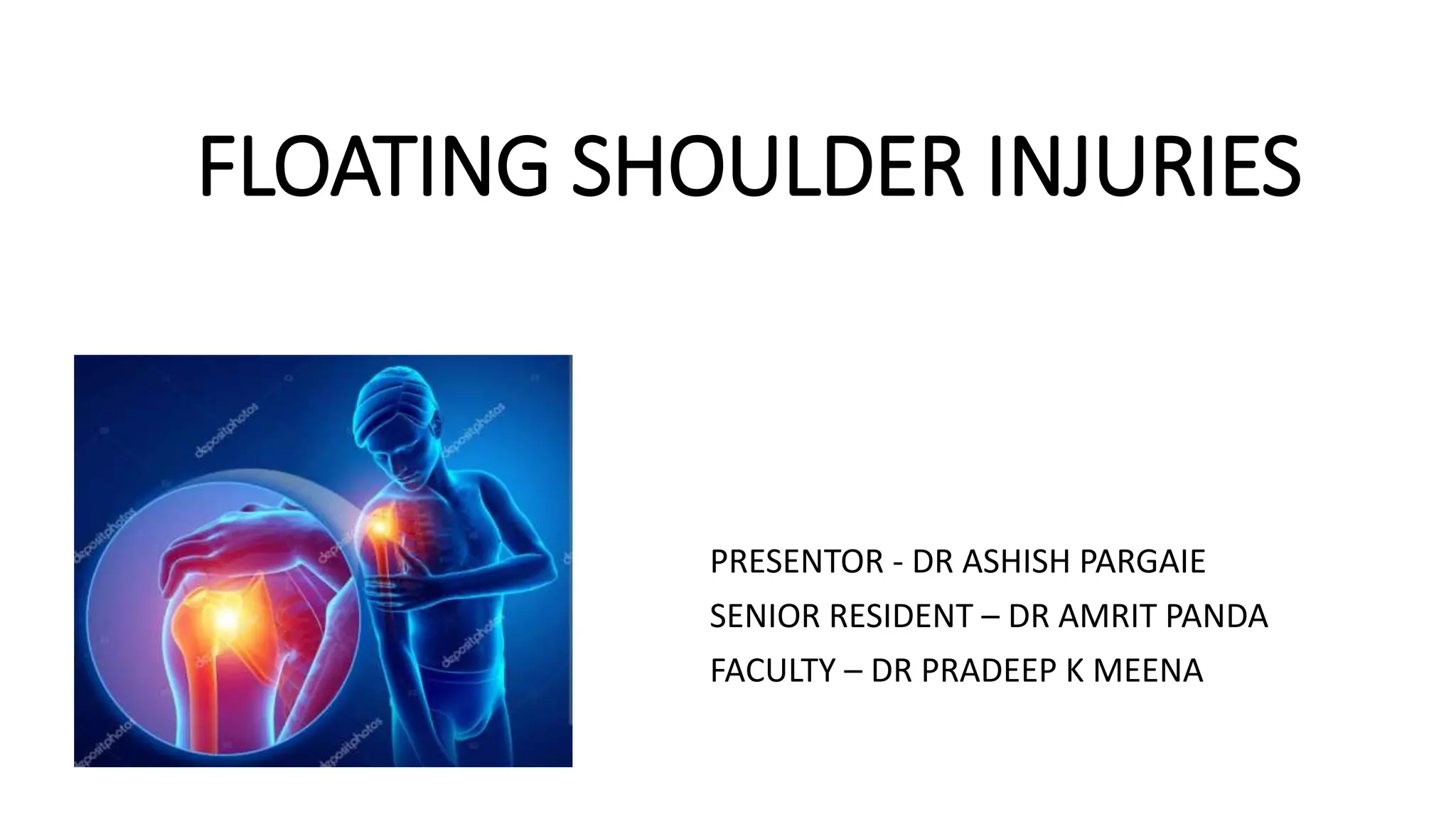
FLOATING SHOULDER INJURIES
PRESENTOR - DR ASHISH PARGAIE
SENIOR RESIDENT – DR AMRIT PANDA
FACULTY – DR PRADEEP K MEENA
• Introduction
• Definition
• Related anatomy
• Pathoanatomy
• classification
• Investigation
• Treatment option
• Conclusion
Introduction :
• Ganz and Noesberger 1975 – floating shoulder – the ipsilateral
glenoid surgical neck and midshaft clavicle fracture
• Goss 1993 introduced the consept of superior shoulder
suspensory complex
Incidence :
• Scapular fracturre < 1 % of all fractures
• 3-5% of shoulder girdle fracture
• Age b/w 25 – 50 yr
• M > F
• it will mainly associated with polytrauma
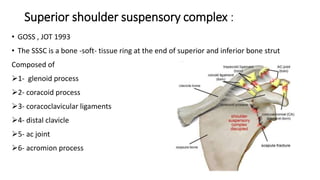
Superior shoulder suspensory complex :
• GOSS , JOT 1993
• The SSSC is a bone -soft- tissue ring at the end of superior and inferior bone strut
Composed of
1- glenoid process
2- coracoid process
3- coracoclavicular ligaments
4- distal clavicle
5- ac joint
6- acromion process
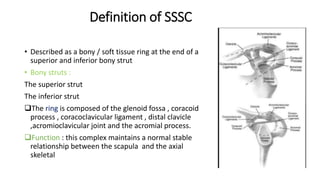
Definition of SSSC
• Described as a bony / soft tissue ring at the end of a
superior and inferior bony strut
• Bony struts :
The superior strut
The inferior strut
The ring is composed of the glenoid fossa , coracoid
process , coracoclavicular ligament , distal clavicle
,acromioclavicular joint and the acromial process.
Function : this complex maintains a normal stable
relationship between the scapula and the axial
skeletal
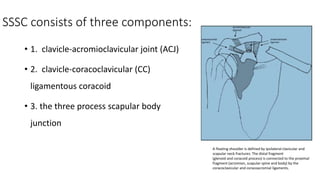
SSSC consists of three components:
• 1. clavicle-acromioclavicular joint (ACJ)
• 2. clavicle-coracoclavicular (CC)
ligamentous coracoid
• 3. the three process scapular body
junction
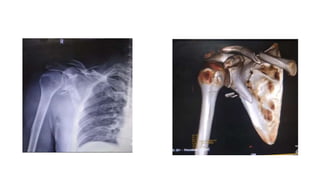
A floating shoulder is defined by ipsilateral clavicular and
scapular neck fractures. The distal fragment
(glenoid and coracoid process) is connected to the proximal
fragment (acromion, scapular spine and body) by the
coracoclavicular and coracoacromial ligaments.
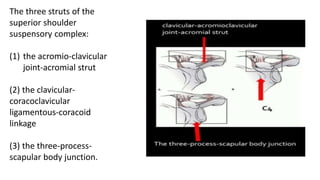
The three struts of the
superior shoulder
suspensory complex:
(1) the acromio-clavicular
joint-acromial strut
(2) the clavicular-
coracoclavicular
ligamentous-coracoid
linkage
(3) the three-process-
scapular body junction.
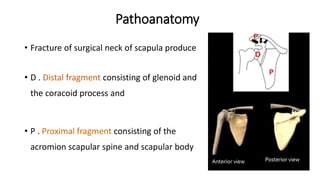
Pathoanatomy
• Fracture of surgical neck of scapula produce
• D . Distal fragment consisting of glenoid and
the coracoid process and
• P . Proximal fragment consisting of the
acromion scapular spine and scapular body
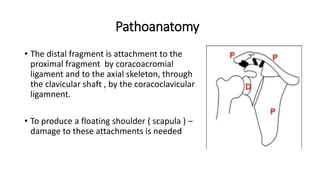
Pathoanatomy
• The distal fragment is attachment to the
proximal fragment by coracoacromial
ligament and to the axial skeleton, through
the clavicular shaft , by the coracoclavicular
ligamnent.
• To produce a floating shoulder ( scapula ) –
damage to these attachments is needed
Mechanism of injury :
• Most are following road traffic injuries
• High energy injuries
• Polytrauma associated with chest injuries – pneumo/ haemo thorax,
rib fracture
Associated injuries :
• SSSC injury a high incidence associated traumatic lesions.
• Local and regional injuries incidences of up to 44 %
• Permanent neurological deficit due to injury of brachial plexus
• High incidence of thoarcic trauma
 Multiple ribs fracture
 Hemothorex
 Hemopneumothorex
 tension pneumothorex
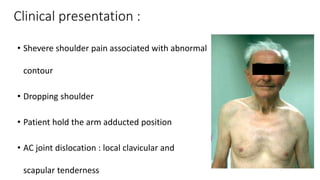
Clinical presentation :
• Shevere shoulder pain associated with abnormal
contour
• Dropping shoulder
• Patient hold the arm adducted position
• AC joint dislocation : local clavicular and
scapular tenderness
• Active and passive movement of the arm are painfull in any direction
• Neurovascular finding sometime difficult to determine on intial
physical examination
• Defenitive diagnosis is finally based on the radiographs
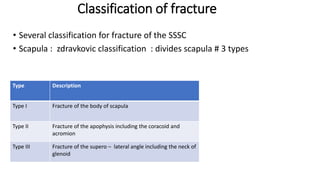
Classification of fracture
• Several classification for fracture of the SSSC
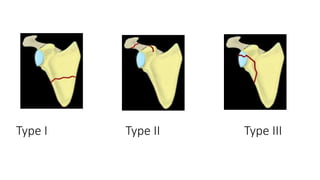
• Scapula : zdravkovic classification : divides scapula # 3 types
Type Description
Type I Fracture of the body of scapula
Type II Fracture of the apophysis including the coracoid and
acromion
Type III Fracture of the supero – lateral angle including the neck of
glenoid
Type I Type II Type III
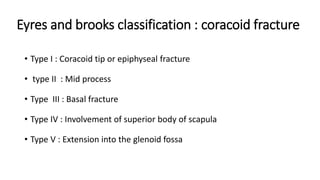
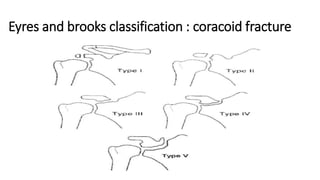
Eyres and brooks classification : coracoid fracture
• Type I : Coracoid tip or epiphyseal fracture
• type II : Mid process
• Type III : Basal fracture
• Type IV : Involvement of superior body of scapula
• Type V : Extension into the glenoid fossa
Eyres and brooks classification : coracoid fracture
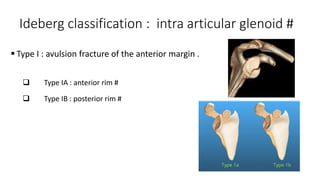
Ideberg classification : intra articular glenoid #
 Type I : avulsion fracture of the anterior margin .
 Type IA : anterior rim #
 Type IB : posterior rim #
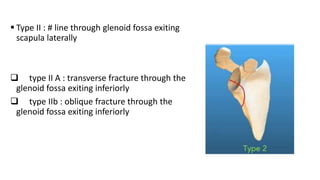
 Type II : # line through glenoid fossa exiting
scapula laterally
 type II A : transverse fracture through the
glenoid fossa exiting inferiorly
 type IIb : oblique fracture through the
glenoid fossa exiting inferiorly
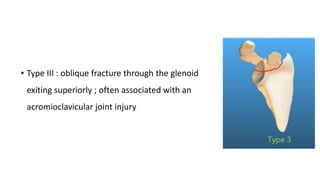
• Type III : oblique fracture through the glenoid
exiting superiorly ; often associated with an
acromioclavicular joint injury
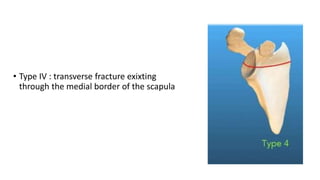
• Type IV : transverse fracture exixting
through the medial border of the scapula
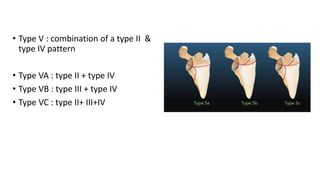
• Type V : combination of a type II &
type IV pattern
• Type VA : type II + type IV
• Type VB : type III + type IV
• Type VC : type II+ III+IV
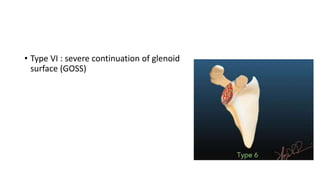
• Type VI : severe continuation of glenoid
surface (GOSS)
Kuhn acromial fracture classification
• Type I : nondisplaced or minimally displaced
• Type II : displaced but does not compromise the
subacromial space
• Type III: displaced & compromise the
subacromial space
CLAVICLE FRACTURE
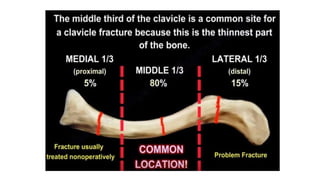
• ALLMAN / CRIAG divided Clavicle fracture into 3 parts
 group I - medial 1/3rd
 group II - middle 1/3rd
 group III - lateral 1/3rd
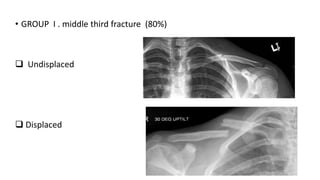
• GROUP I . middle third fracture (80%)
 Undisplaced
 Displaced
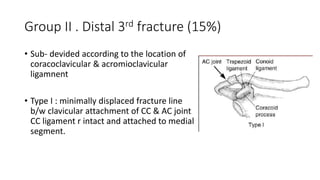
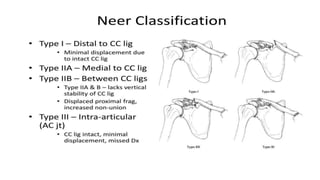
Group II . Distal 3rd fracture (15%)
• Sub- devided according to the location of
coracoclavicular & acromioclavicular
ligamnent
• Type I : minimally displaced fracture line
b/w clavicular attachment of CC & AC joint
CC ligament r intact and attached to medial
segment.
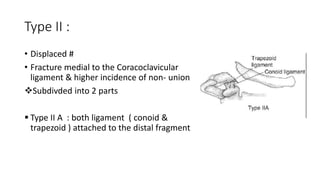
Type II :
• Displaced #
• Fracture medial to the Coracoclavicular
ligament & higher incidence of non- union
Subdivded into 2 parts
 Type II A : both ligament ( conoid &
trapezoid ) attached to the distal fragment
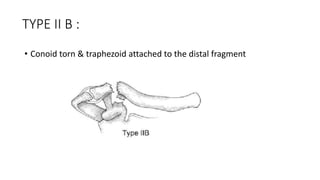
TYPE II B :
• Conoid torn & traphezoid attached to the distal fragment
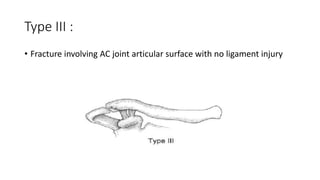
Type III :
• Fracture involving AC joint articular surface with no ligament injury
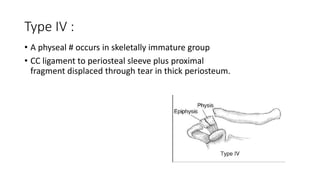
Type IV :
• A physeal # occurs in skeletally immature group
• CC ligament to periosteal sleeve plus proximal
fragment displaced through tear in thick periosteum.
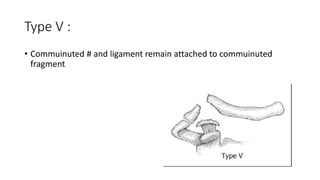
Type V :
• Commuinuted # and ligament remain attached to commuinuted
fragment
Group III – fracture of the 3rd (5%)
Devided into 5 types
• Type I : Minimally displacement
• Typeii : Displaced
• Type III : Intra-articular
• Type IV : Epiphyseal separation
• Type V : Comminuted
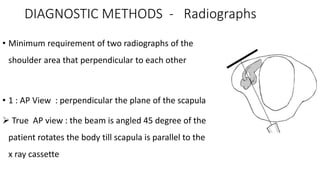
DIAGNOSTIC METHODS - Radiographs
• Minimum requirement of two radiographs of the
shoulder area that perpendicular to each other
• 1 : AP View : perpendicular the plane of the scapula
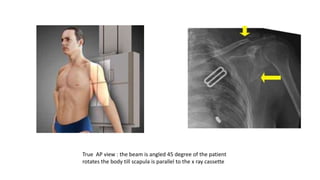
 True AP view : the beam is angled 45 degree of the
patient rotates the body till scapula is parallel to the
x ray cassette
True AP view : the beam is angled 45 degree of the patient
rotates the body till scapula is parallel to the x ray cassette
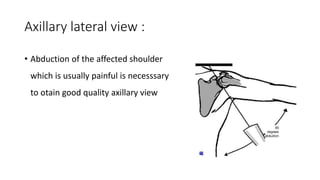
Axillary lateral view :
• Abduction of the affected shoulder
which is usually painful is necesssary
to otain good quality axillary view
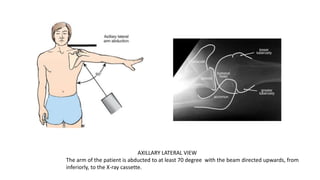
AXILLARY LATERAL VIEW
The arm of the patient is abducted to at least 70 degree with the beam directed upwards, from
inferiorly, to the X-ray cassette.
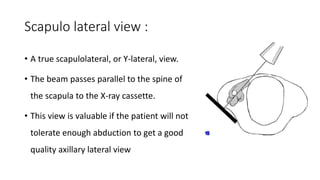
Scapulo lateral view :
• A true scapulolateral, or Y-lateral, view.
• The beam passes parallel to the spine of
the scapula to the X-ray cassette.
• This view is valuable if the patient will not
tolerate enough abduction to get a good
quality axillary lateral view
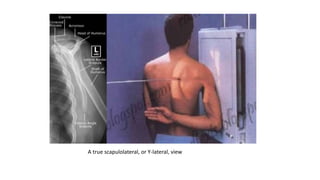
A true scapulolateral, or Y-lateral, view
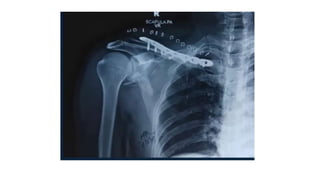
MANAGEMENT : CLAVICLE FARCTURE
• Should be fixed if displaced
• Reduces risk of non union
• Reduces tension on brachial plexus
• Restore anatomical relationship
• Improves function
• ? may reduce & stabilise glenoid fracture
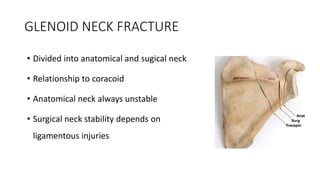
GLENOID NECK FRACTURE
• Divided into anatomical and sugical neck
• Relationship to coracoid
• Anatomical neck always unstable
• Surgical neck stability depends on
ligamentous injuries
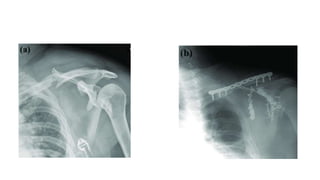
SURGICAL MANAGEMENT
• Fix both (goss)
• Some authors feel if clavicle fixed it may be enough
• However if scapular fracture remain displaced it should be fixed
• Sequence of fixation has to be individualised
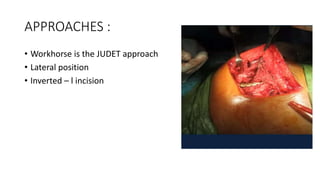
APPROACHES :
• Workhorse is the JUDET approach
• Lateral position
• Inverted – l incision
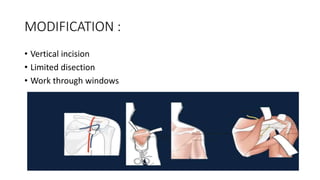
MODIFICATION :
• Vertical incision
• Limited disection
• Work through windows
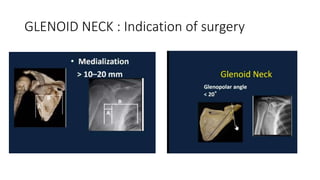
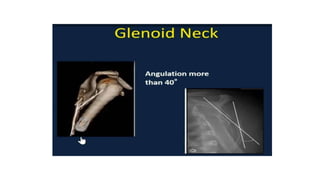
GLENOID NECK : Indication of surgery
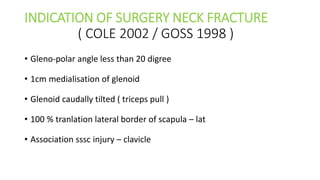
INDICATION OF SURGERY NECK FRACTURE
( COLE 2002 / GOSS 1998 )
• Gleno-polar angle less than 20 digree
• 1cm medialisation of glenoid
• Glenoid caudally tilted ( triceps pull )
• 100 % tranlation lateral border of scapula – lat
• Association sssc injury – clavicle
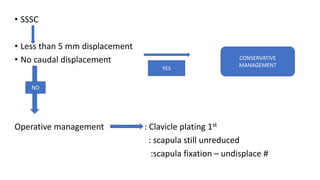
• SSSC
• Less than 5 mm displacement
• No caudal displacement
Operative management : Clavicle plating 1st
: scapula still unreduced
:scapula fixation – undisplace #
YES
CONSERVATIVE
MANAGEMENT
NO
TAKE HOME MESSAGE
• Most scapular fractures can be treated non – operatively
• Indication :
- glenoid articular displacement in young patient
- neck + clavicle fracture
- double sssc disruption
- Neck fracture with significant displacement
REMEMBER ASSOCIATED INJURIES
THANK YOU

floating shoulder ppt-3.pptx Dr Ashish pargaie Orthopaedic resident Aiims rishikesh

  • 1.
    FLOATING SHOULDER INJURIES PRESENTOR- DR ASHISH PARGAIE SENIOR RESIDENT – DR AMRIT PANDA FACULTY – DR PRADEEP K MEENA
  • 2.
    • Introduction • Definition •Related anatomy • Pathoanatomy • classification • Investigation • Treatment option • Conclusion
  • 3.
    Introduction : • Ganzand Noesberger 1975 – floating shoulder – the ipsilateral glenoid surgical neck and midshaft clavicle fracture • Goss 1993 introduced the consept of superior shoulder suspensory complex
  • 4.
    Incidence : • Scapularfracturre < 1 % of all fractures • 3-5% of shoulder girdle fracture • Age b/w 25 – 50 yr • M > F • it will mainly associated with polytrauma
  • 5.
    Superior shoulder suspensorycomplex : • GOSS , JOT 1993 • The SSSC is a bone -soft- tissue ring at the end of superior and inferior bone strut Composed of 1- glenoid process 2- coracoid process 3- coracoclavicular ligaments 4- distal clavicle 5- ac joint 6- acromion process
  • 6.
    Definition of SSSC •Described as a bony / soft tissue ring at the end of a superior and inferior bony strut • Bony struts : The superior strut The inferior strut The ring is composed of the glenoid fossa , coracoid process , coracoclavicular ligament , distal clavicle ,acromioclavicular joint and the acromial process. Function : this complex maintains a normal stable relationship between the scapula and the axial skeletal
  • 7.
    SSSC consists ofthree components: • 1. clavicle-acromioclavicular joint (ACJ) • 2. clavicle-coracoclavicular (CC) ligamentous coracoid • 3. the three process scapular body junction A floating shoulder is defined by ipsilateral clavicular and scapular neck fractures. The distal fragment (glenoid and coracoid process) is connected to the proximal fragment (acromion, scapular spine and body) by the coracoclavicular and coracoacromial ligaments.
  • 8.
    The three strutsof the superior shoulder suspensory complex: (1) the acromio-clavicular joint-acromial strut (2) the clavicular- coracoclavicular ligamentous-coracoid linkage (3) the three-process- scapular body junction.
  • 9.
    Pathoanatomy • Fracture ofsurgical neck of scapula produce • D . Distal fragment consisting of glenoid and the coracoid process and • P . Proximal fragment consisting of the acromion scapular spine and scapular body
  • 10.
    Pathoanatomy • The distalfragment is attachment to the proximal fragment by coracoacromial ligament and to the axial skeleton, through the clavicular shaft , by the coracoclavicular ligamnent. • To produce a floating shoulder ( scapula ) – damage to these attachments is needed
  • 11.
    Mechanism of injury: • Most are following road traffic injuries • High energy injuries • Polytrauma associated with chest injuries – pneumo/ haemo thorax, rib fracture
  • 12.
    Associated injuries : •SSSC injury a high incidence associated traumatic lesions. • Local and regional injuries incidences of up to 44 % • Permanent neurological deficit due to injury of brachial plexus • High incidence of thoarcic trauma  Multiple ribs fracture  Hemothorex  Hemopneumothorex  tension pneumothorex
  • 13.
    Clinical presentation : •Shevere shoulder pain associated with abnormal contour • Dropping shoulder • Patient hold the arm adducted position • AC joint dislocation : local clavicular and scapular tenderness
  • 14.
    • Active andpassive movement of the arm are painfull in any direction • Neurovascular finding sometime difficult to determine on intial physical examination • Defenitive diagnosis is finally based on the radiographs
  • 15.
    Classification of fracture •Several classification for fracture of the SSSC • Scapula : zdravkovic classification : divides scapula # 3 types Type Description Type I Fracture of the body of scapula Type II Fracture of the apophysis including the coracoid and acromion Type III Fracture of the supero – lateral angle including the neck of glenoid
  • 16.
    Type I TypeII Type III
  • 17.
    Eyres and brooksclassification : coracoid fracture • Type I : Coracoid tip or epiphyseal fracture • type II : Mid process • Type III : Basal fracture • Type IV : Involvement of superior body of scapula • Type V : Extension into the glenoid fossa
  • 18.
    Eyres and brooksclassification : coracoid fracture
  • 19.
    Ideberg classification :intra articular glenoid #  Type I : avulsion fracture of the anterior margin .  Type IA : anterior rim #  Type IB : posterior rim #
  • 20.
     Type II: # line through glenoid fossa exiting scapula laterally  type II A : transverse fracture through the glenoid fossa exiting inferiorly  type IIb : oblique fracture through the glenoid fossa exiting inferiorly
  • 21.
    • Type III: oblique fracture through the glenoid exiting superiorly ; often associated with an acromioclavicular joint injury
  • 22.
    • Type IV: transverse fracture exixting through the medial border of the scapula
  • 23.
    • Type V: combination of a type II & type IV pattern • Type VA : type II + type IV • Type VB : type III + type IV • Type VC : type II+ III+IV
  • 24.
    • Type VI: severe continuation of glenoid surface (GOSS)
  • 25.
    Kuhn acromial fractureclassification • Type I : nondisplaced or minimally displaced • Type II : displaced but does not compromise the subacromial space • Type III: displaced & compromise the subacromial space
  • 26.
    CLAVICLE FRACTURE • ALLMAN/ CRIAG divided Clavicle fracture into 3 parts  group I - medial 1/3rd  group II - middle 1/3rd  group III - lateral 1/3rd
  • 28.
    • GROUP I. middle third fracture (80%)  Undisplaced  Displaced
  • 29.
    Group II .Distal 3rd fracture (15%) • Sub- devided according to the location of coracoclavicular & acromioclavicular ligamnent • Type I : minimally displaced fracture line b/w clavicular attachment of CC & AC joint CC ligament r intact and attached to medial segment.
  • 30.
    Type II : •Displaced # • Fracture medial to the Coracoclavicular ligament & higher incidence of non- union Subdivded into 2 parts  Type II A : both ligament ( conoid & trapezoid ) attached to the distal fragment
  • 31.
    TYPE II B: • Conoid torn & traphezoid attached to the distal fragment
  • 32.
    Type III : •Fracture involving AC joint articular surface with no ligament injury
  • 33.
    Type IV : •A physeal # occurs in skeletally immature group • CC ligament to periosteal sleeve plus proximal fragment displaced through tear in thick periosteum.
  • 34.
    Type V : •Commuinuted # and ligament remain attached to commuinuted fragment
  • 35.
    Group III –fracture of the 3rd (5%) Devided into 5 types • Type I : Minimally displacement • Typeii : Displaced • Type III : Intra-articular • Type IV : Epiphyseal separation • Type V : Comminuted
  • 37.
    DIAGNOSTIC METHODS -Radiographs • Minimum requirement of two radiographs of the shoulder area that perpendicular to each other • 1 : AP View : perpendicular the plane of the scapula  True AP view : the beam is angled 45 degree of the patient rotates the body till scapula is parallel to the x ray cassette
  • 38.
    True AP view: the beam is angled 45 degree of the patient rotates the body till scapula is parallel to the x ray cassette
  • 39.
    Axillary lateral view: • Abduction of the affected shoulder which is usually painful is necesssary to otain good quality axillary view
  • 40.
    AXILLARY LATERAL VIEW Thearm of the patient is abducted to at least 70 degree with the beam directed upwards, from inferiorly, to the X-ray cassette.
  • 41.
    Scapulo lateral view: • A true scapulolateral, or Y-lateral, view. • The beam passes parallel to the spine of the scapula to the X-ray cassette. • This view is valuable if the patient will not tolerate enough abduction to get a good quality axillary lateral view
  • 42.
    A true scapulolateral,or Y-lateral, view
  • 43.
    MANAGEMENT : CLAVICLEFARCTURE • Should be fixed if displaced • Reduces risk of non union • Reduces tension on brachial plexus • Restore anatomical relationship • Improves function • ? may reduce & stabilise glenoid fracture
  • 44.
    GLENOID NECK FRACTURE •Divided into anatomical and sugical neck • Relationship to coracoid • Anatomical neck always unstable • Surgical neck stability depends on ligamentous injuries
  • 45.
    SURGICAL MANAGEMENT • Fixboth (goss) • Some authors feel if clavicle fixed it may be enough • However if scapular fracture remain displaced it should be fixed • Sequence of fixation has to be individualised
  • 49.
    APPROACHES : • Workhorseis the JUDET approach • Lateral position • Inverted – l incision
  • 50.
    MODIFICATION : • Verticalincision • Limited disection • Work through windows
  • 51.
    GLENOID NECK :Indication of surgery
  • 53.
    INDICATION OF SURGERYNECK FRACTURE ( COLE 2002 / GOSS 1998 ) • Gleno-polar angle less than 20 digree • 1cm medialisation of glenoid • Glenoid caudally tilted ( triceps pull ) • 100 % tranlation lateral border of scapula – lat • Association sssc injury – clavicle
  • 54.
    • SSSC • Lessthan 5 mm displacement • No caudal displacement Operative management : Clavicle plating 1st : scapula still unreduced :scapula fixation – undisplace # YES CONSERVATIVE MANAGEMENT NO
  • 55.
    TAKE HOME MESSAGE •Most scapular fractures can be treated non – operatively • Indication : - glenoid articular displacement in young patient - neck + clavicle fracture - double sssc disruption - Neck fracture with significant displacement REMEMBER ASSOCIATED INJURIES
  • 56.