 Early days – congenital deformity.
 Smillie [1768] – Obstetric origin
 Danyau [1851] – Autopsy – lesion
 Duchenne [1861]- traction injury, OBPI
 ERB [1875]- pointed lesion at upper trunk
 Kennedy [1903]- early surgical repair
 Narakas [1981]- microsurgical results.
 Incidence: 4/1000 in poor OBG care, 0.1-0.3
% in good centers.
 1% of OBPP, injury is bilateral
 More on one side. [exclusive in breach]
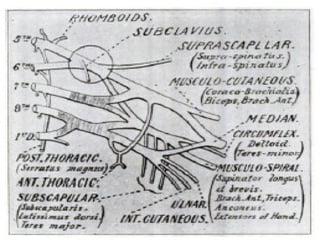
 Formed by anterior primary rami of C5-T1.
 Roots – between scalene muscles
 Trunks – posterior triangle
 Divisions- behind clavicle.
 Cords in axilla.
 Roots & trunk- supraclavicular part [OBPP]
 Cords & branches – infraclavicular part
 Stretching
 Overweight babies with cephalic
presentations
 Underweight babies with breech
 Forceful widening of angle between the neck
& shoulder.
 Force is more at C5 root
 Always supraclavicular
 Not associated with vascular damage.
 Large birth weight
 Breech presentation
 Maternal diabetes
 Multiparity
 II stage of labour - > 60 min
 Assisted delivery [forceps, vacuum ext]
 previous child with OBPP
 Intrauterine torticollis
 Shoulder dystocia
 Lesions range from degree I[neuropraxia] – V
[neurotmesis or root avulsions].
 Upper trunk –1st
affected, most vulnerable
part.
 Upper trunk – mostly stretched
 Lower trunks – mostly ruptured
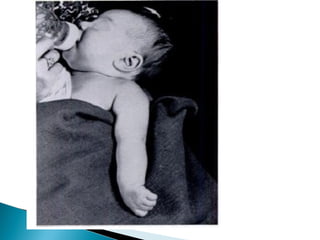
 U.E is flail & dangling
 Look for other extremities
 U.R: arm held in IR,add, active abd not
possible, elbow extended forearm pronated,
thumb flexed.
 Complete paralysis- vasomotor impairment,
pale & marble like color
 Horner’s sign
 Associated # [clavicle,humerus,]
 Complete Recovery
 Extent of paralysis regress, total paralysis limited
to U.R
 No improvement.
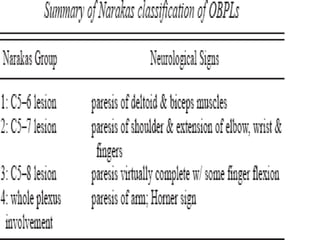
 C5-6: the arm is adducted and internally
rotated at the shoulder, elbow extended,
forearm pronated, wrist and (sometimes)
fingers flexed. (Classic waiter tip/Erb’s
palsy/upper roots).
 C5-7 : as above, although the elbow may be
slightly flexed.
 Intermediate root palsy C7.
 C5-T1 : the arm is totally flail with a claw
hand. marbled appearance, Horner’s
syndrome.
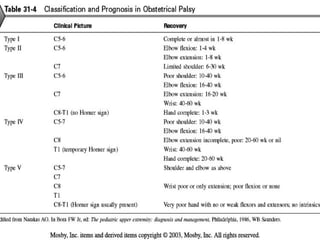
 Done at 2 months of age
 Not anatomic,
 Grading overall severity of lesion based on
clinical course.
 Prognosis.
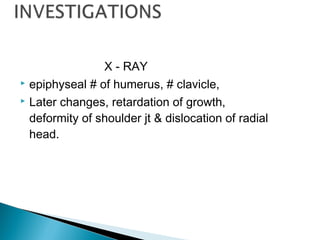
X - RAY
 epiphyseal # of humerus, # clavicle,
 Later changes, retardation of growth,
deformity of shoulder jt & dislocation of radial
head.
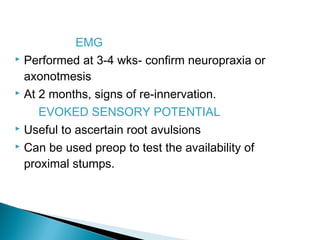
EMG
 Performed at 3-4 wks- confirm neuropraxia or
axonotmesis
 At 2 months, signs of re-innervation.
EVOKED SENSORY POTENTIAL
 Useful to ascertain root avulsions
 Can be used preop to test the availability of
proximal stumps.
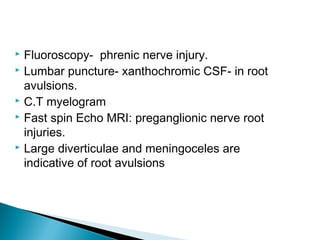
 Fluoroscopy- phrenic nerve injury.
 Lumbar puncture- xanthochromic CSF- in root
avulsions.
 C.T myelogram
 Fast spin Echo MRI: preganglionic nerve root
injuries.
 Large diverticulae and meningoceles are
indicative of root avulsions
 Nature of injury [rupture better]
 Lower plexus paralysis,
 global involvement,
 persistence of pupillary signs of phrenic nerve
palsy
 Ass. #.
 Physiotheraphy- cornerstone
 Rest for first 2 wks,
 Arm fixed across the chest by pinning
 ROM ex, facilitation of active movt, promotion
of sensory awareness.
 Avoid abduction & posterior projection of
shoulder. Limb to be supported when holding
baby
 Goals: minimizing bony deformities, Jt
contractues.
 Weight bearing activity-skeletal growth
Early nerve repair
 Indications:
1. Failure of recovery of biceps or deltoid at 3
months
2. Group III& IV lesions
3. Presence of Horners sign.
 Diminishing potential for axon regeneration with
age
 Cross innervation & muscle imbalance aborted
 Provide better condition for tendon transfer
 Nerve repair is superior to spontaneous recovery.
 Total palsy: 3 months
 Upper trunk palsy: 5 months
TYPE OF SURGERY
1. neurolysis,
2. resection and anastomosis in ruptures
3. nerve grafting using sural nerves as
interposition grafts.
 Repair using the proximal roots of the plexus itself
if the injury is post ganglionic as in a rupture
 Extra plexal neurotisation using other donor
motor nerves to selectively aim at reinnervating
the important muscle groups.
 Spinal accessory (XIth) nerve.
 Intercostal nerves (commonly 3rd to 6th)
 C4 motor root
 Ansa hypoglossi
 Opposite C7.
 Suprascapular
 Musculocutaneous,
 Axillary
 Median.
Order of priority of restoration of function
 Elbow flexion
 Shoulder stability (rotator cuff via
suprascapular nerve)
 Shoulder abduction
 Hand prehension
 To predict poor outcomes if microsurgical
repair or grafting is not done.
 scale consists of grading elbow flexion,
elbow extension, wrist extension, finger
extension, and thumb extension. [max -12]
 score of < 3.5 predicted a poor long-term
outcome without microsurgery.
 Fracture of clavicle or humerus shaft or physeal
separation
 septic arthritis / osteomyelitis
 Congenital malformation of plexus
 Postinfectious [varicella] plexopathy of muscles
 Nerve regeneration: some muscles recover
earlier, others paretic  muscle imbalance
 Recovery results from misdirection of regenerated
axons  cross innervation
 Co-contraction of synergestic & antagonistic
muscles
 Diminishing functional recovery
 Muscle contracture  deformity
 Sequelae depends on three factors which
are additive
1. Paralysis of muscle groups [ext.rot, elbow
flexors]
2. Contracture of healthy antagonist muscles
3. Impaired growth  osseous deformities
 Sequale – seen in spontaneous recovery in
gr III & IV lesion.
 Between shoulder abductors [S.S, I.S ,del] &
adductors [pect maj, ter.m]  limitation of
shoulder elevation
 Elbow flexors [biceps & brachialis] & elbow
extensors [triceps]
 Elbow flexors & shoulder abductors  trumpet
sign
 Shou abd, elb flex,forearm flex
 Putti sign; with shoulder abduction, medial
edge of scapula, often seen protruding above
shoulder jt line
 Reduction of shou abd – deltoid weakness or
lack of ER.
 Trumpet sign
 Mild shortening & atrophy of limb
 Posterior sublux of shoulder – IR overpower
ER.
 Bitting of nail & hand (47%) –total obp.
 UPPER ARM: mainly in shoulder & occ elbow &
forearm
 LOWER ARM: hand more affected
 WHOLE ARM; flaccid paralysis
 Group I: joint contracture due to nerve lesions
& simultaneous trauma to shoulder Jt
 Group II Flaccid; flaccid paralysis- upper trunk
injury.
 Group I: subdivided in to 4 groups
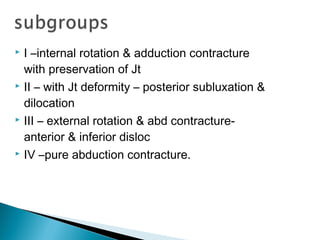
 I –internal rotation & adduction contracture
with preservation of Jt
 II – with Jt deformity – posterior subluxation &
dilocation
 III – external rotation & abd contracture-
anterior & inferior disloc
 IV –pure abduction contracture.
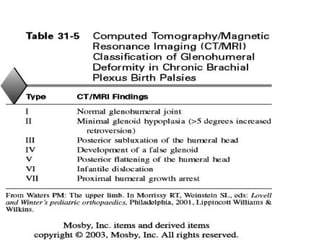
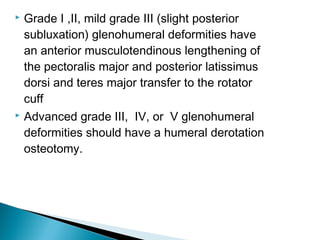
 Grade I ,II, mild grade III (slight posterior
subluxation) glenohumeral deformities have
an anterior musculotendinous lengthening of
the pectoralis major and posterior latissimus
dorsi and teres major transfer to the rotator
cuff
 Advanced grade III, IV, or V glenohumeral
deformities should have a humeral derotation
osteotomy.
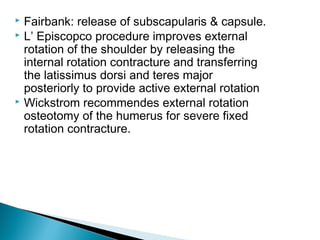
 Fairbank: release of subscapularis & capsule.
 L’ Episcopco procedure improves external
rotation of the shoulder by releasing the
internal rotation contracture and transferring
the latissimus dorsi and teres major
posteriorly to provide active external rotation
 Wickstrom recommendes external rotation
osteotomy of the humerus for severe fixed
rotation contracture.
 In flaccid paralysis of complete lesion
 Difficult to manage & difficult to rehabilitation
 If no active wrist extension & no possible transfers
– W. fusion with comb inter-metacarpal
arthrodesis.
 Elbow flexion and forearm supination
deformities
 weak or absent triceps, pronator teres, and
pronator quadratus muscles with an intact
biceps muscle
 Radial head dislocation
 wrist & hand usually in extreme dorsiflexion –
unopposed DF
 biceps tendon, Z-lengthened and rerouted
around the radius to convert it from a
supinator to a pronator
 Prevention is better than cure
 Effort made to improve obstetric practice
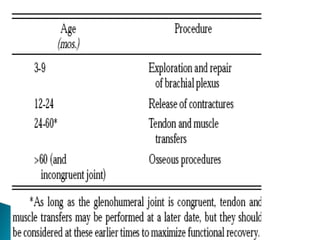
 Group I & II- conservative
 Group III & IV –early surgery
 Late sequale: proper evalu & manage with
tendon transfer or osseous surgry
 Conservative Rx – fruitless.

Obstetric brachial plexus Palsy

  • 2.
     Early days– congenital deformity.  Smillie [1768] – Obstetric origin  Danyau [1851] – Autopsy – lesion  Duchenne [1861]- traction injury, OBPI  ERB [1875]- pointed lesion at upper trunk  Kennedy [1903]- early surgical repair  Narakas [1981]- microsurgical results.
  • 3.
     Incidence: 4/1000in poor OBG care, 0.1-0.3 % in good centers.  1% of OBPP, injury is bilateral  More on one side. [exclusive in breach]
  • 4.
     Formed byanterior primary rami of C5-T1.  Roots – between scalene muscles  Trunks – posterior triangle  Divisions- behind clavicle.  Cords in axilla.  Roots & trunk- supraclavicular part [OBPP]  Cords & branches – infraclavicular part
  • 6.
     Stretching  Overweightbabies with cephalic presentations  Underweight babies with breech  Forceful widening of angle between the neck & shoulder.  Force is more at C5 root  Always supraclavicular  Not associated with vascular damage.
  • 7.
     Large birthweight  Breech presentation  Maternal diabetes  Multiparity  II stage of labour - > 60 min  Assisted delivery [forceps, vacuum ext]  previous child with OBPP  Intrauterine torticollis  Shoulder dystocia
  • 8.
     Lesions rangefrom degree I[neuropraxia] – V [neurotmesis or root avulsions].  Upper trunk –1st affected, most vulnerable part.  Upper trunk – mostly stretched  Lower trunks – mostly ruptured
  • 9.
     U.E isflail & dangling  Look for other extremities  U.R: arm held in IR,add, active abd not possible, elbow extended forearm pronated, thumb flexed.  Complete paralysis- vasomotor impairment, pale & marble like color  Horner’s sign  Associated # [clavicle,humerus,]
  • 11.
     Complete Recovery Extent of paralysis regress, total paralysis limited to U.R  No improvement.
  • 12.
     C5-6: thearm is adducted and internally rotated at the shoulder, elbow extended, forearm pronated, wrist and (sometimes) fingers flexed. (Classic waiter tip/Erb’s palsy/upper roots).  C5-7 : as above, although the elbow may be slightly flexed.  Intermediate root palsy C7.  C5-T1 : the arm is totally flail with a claw hand. marbled appearance, Horner’s syndrome.
  • 13.
     Done at2 months of age  Not anatomic,  Grading overall severity of lesion based on clinical course.  Prognosis.
  • 16.
    X - RAY epiphyseal # of humerus, # clavicle,  Later changes, retardation of growth, deformity of shoulder jt & dislocation of radial head.
  • 17.
    EMG  Performed at3-4 wks- confirm neuropraxia or axonotmesis  At 2 months, signs of re-innervation. EVOKED SENSORY POTENTIAL  Useful to ascertain root avulsions  Can be used preop to test the availability of proximal stumps.
  • 18.
     Fluoroscopy- phrenicnerve injury.  Lumbar puncture- xanthochromic CSF- in root avulsions.  C.T myelogram  Fast spin Echo MRI: preganglionic nerve root injuries.  Large diverticulae and meningoceles are indicative of root avulsions
  • 19.
     Nature ofinjury [rupture better]  Lower plexus paralysis,  global involvement,  persistence of pupillary signs of phrenic nerve palsy  Ass. #.
  • 20.
     Physiotheraphy- cornerstone Rest for first 2 wks,  Arm fixed across the chest by pinning  ROM ex, facilitation of active movt, promotion of sensory awareness.  Avoid abduction & posterior projection of shoulder. Limb to be supported when holding baby  Goals: minimizing bony deformities, Jt contractues.  Weight bearing activity-skeletal growth
  • 21.
    Early nerve repair Indications: 1. Failure of recovery of biceps or deltoid at 3 months 2. Group III& IV lesions 3. Presence of Horners sign.
  • 22.
     Diminishing potentialfor axon regeneration with age  Cross innervation & muscle imbalance aborted  Provide better condition for tendon transfer  Nerve repair is superior to spontaneous recovery.
  • 23.
     Total palsy:3 months  Upper trunk palsy: 5 months TYPE OF SURGERY 1. neurolysis, 2. resection and anastomosis in ruptures 3. nerve grafting using sural nerves as interposition grafts.
  • 24.
     Repair usingthe proximal roots of the plexus itself if the injury is post ganglionic as in a rupture  Extra plexal neurotisation using other donor motor nerves to selectively aim at reinnervating the important muscle groups.
  • 25.
     Spinal accessory(XIth) nerve.  Intercostal nerves (commonly 3rd to 6th)  C4 motor root  Ansa hypoglossi  Opposite C7.
  • 26.
     Suprascapular  Musculocutaneous, Axillary  Median. Order of priority of restoration of function  Elbow flexion  Shoulder stability (rotator cuff via suprascapular nerve)  Shoulder abduction  Hand prehension
  • 27.
     To predictpoor outcomes if microsurgical repair or grafting is not done.  scale consists of grading elbow flexion, elbow extension, wrist extension, finger extension, and thumb extension. [max -12]  score of < 3.5 predicted a poor long-term outcome without microsurgery.
  • 28.
     Fracture ofclavicle or humerus shaft or physeal separation  septic arthritis / osteomyelitis  Congenital malformation of plexus  Postinfectious [varicella] plexopathy of muscles
  • 29.
     Nerve regeneration:some muscles recover earlier, others paretic  muscle imbalance  Recovery results from misdirection of regenerated axons  cross innervation
  • 30.
     Co-contraction ofsynergestic & antagonistic muscles  Diminishing functional recovery  Muscle contracture  deformity
  • 31.
     Sequelae dependson three factors which are additive 1. Paralysis of muscle groups [ext.rot, elbow flexors] 2. Contracture of healthy antagonist muscles 3. Impaired growth  osseous deformities  Sequale – seen in spontaneous recovery in gr III & IV lesion.
  • 32.
     Between shoulderabductors [S.S, I.S ,del] & adductors [pect maj, ter.m]  limitation of shoulder elevation  Elbow flexors [biceps & brachialis] & elbow extensors [triceps]  Elbow flexors & shoulder abductors  trumpet sign  Shou abd, elb flex,forearm flex
  • 33.
     Putti sign;with shoulder abduction, medial edge of scapula, often seen protruding above shoulder jt line  Reduction of shou abd – deltoid weakness or lack of ER.  Trumpet sign  Mild shortening & atrophy of limb  Posterior sublux of shoulder – IR overpower ER.  Bitting of nail & hand (47%) –total obp.
  • 34.
     UPPER ARM:mainly in shoulder & occ elbow & forearm  LOWER ARM: hand more affected  WHOLE ARM; flaccid paralysis
  • 35.
     Group I:joint contracture due to nerve lesions & simultaneous trauma to shoulder Jt  Group II Flaccid; flaccid paralysis- upper trunk injury.  Group I: subdivided in to 4 groups
  • 36.
     I –internalrotation & adduction contracture with preservation of Jt  II – with Jt deformity – posterior subluxation & dilocation  III – external rotation & abd contracture- anterior & inferior disloc  IV –pure abduction contracture.
  • 38.
     Grade I,II, mild grade III (slight posterior subluxation) glenohumeral deformities have an anterior musculotendinous lengthening of the pectoralis major and posterior latissimus dorsi and teres major transfer to the rotator cuff  Advanced grade III, IV, or V glenohumeral deformities should have a humeral derotation osteotomy.
  • 39.
     Fairbank: releaseof subscapularis & capsule.  L’ Episcopco procedure improves external rotation of the shoulder by releasing the internal rotation contracture and transferring the latissimus dorsi and teres major posteriorly to provide active external rotation  Wickstrom recommendes external rotation osteotomy of the humerus for severe fixed rotation contracture.
  • 41.
     In flaccidparalysis of complete lesion  Difficult to manage & difficult to rehabilitation  If no active wrist extension & no possible transfers – W. fusion with comb inter-metacarpal arthrodesis.
  • 42.
     Elbow flexionand forearm supination deformities  weak or absent triceps, pronator teres, and pronator quadratus muscles with an intact biceps muscle  Radial head dislocation  wrist & hand usually in extreme dorsiflexion – unopposed DF  biceps tendon, Z-lengthened and rerouted around the radius to convert it from a supinator to a pronator
  • 43.
     Prevention isbetter than cure  Effort made to improve obstetric practice  Group I & II- conservative  Group III & IV –early surgery  Late sequale: proper evalu & manage with tendon transfer or osseous surgry  Conservative Rx – fruitless.