




2
Introduction
Independent Events
Disjoint Events
General Multiplication Rule
Contingency Tables
Introduction
In a group of 100 sports car buyers, 40 bought
alarm systems, 30 purchased bucket seats, and
20 purchased an alarm system and bucket seats.
If a car buyer chosen at random bought an alarm
system, what is the probability they also bought
bucket seats?
P(B|A) = P(A∩B) / P(A) = 0.2 / 0.4 = 0.5.
The probability that a buyer bought bucket seats, given that
they purchased an alarm system, is 50%.
A ∩ B
A B
◍ A probability that takes into account a given condition is called a conditional probability.
◍ To find the probability of the event B given the event A, we restrict our attention to the
outcomes in A. We then find in what fraction of those outcomes B also occurred.
◍ P(B/A) = P(A and B)/P(A) ; P(A) ≠ 0
Independent Events
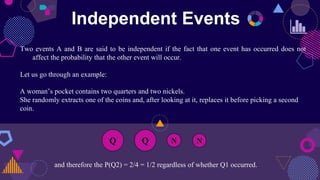
Two events A and B are said to be independent if the fact that one event has occurred does not
affect the probability that the other event will occur.
Let us go through an example:
A woman’s pocket contains two quarters and two nickels.
She randomly extracts one of the coins and, after looking at it, replaces it before picking a second
coin.
and therefore the P(Q2) = 2/4 = 1/2 regardless of whether Q1 occurred.
Q
Q N N
General Multiplication Rule
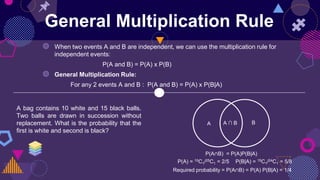
A bag contains 10 white and 15 black balls.
Two balls are drawn in succession without
replacement. What is the probability that the
first is white and second is black?
A ∩ B
A B
◍ When two events A and B are independent, we can use the multiplication rule for
independent events:
P(A and B) = P(A) x P(B)
◍ General Multiplication Rule:
For any 2 events A and B : P(A and B) = P(A) x P(B|A)
P(A) = 10C1/25C1 = 2/5 P(B|A) = 15C1/24C1 = 5/8
Required probability = P(A∩B) = P(A) P(B|A) = 1/4
P(A∩B) = P(A)P(B|A)
Disjoint Events
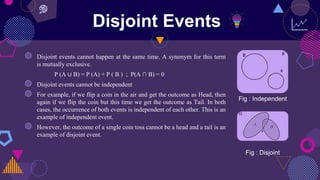
◍ Disjoint events cannot happen at the same time. A synonym for this term
is mutually exclusive.
P (A ∪ B) = P (A) + P ( B ) ; P(A ∩ B) = 0
◍ Disjoint events cannot be independent
◍ For example, if we flip a coin in the air and get the outcome as Head, then
again if we flip the coin but this time we get the outcome as Tail. In both
cases, the occurrence of both events is independent of each other. This is an
example of independent event.
◍ However, the outcome of a single coin toss cannot be a head and a tail is an
example of disjoint event.
Fig : Independent
Fig : Disjoint
🎨
Contingency Tables
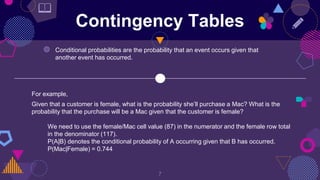
◍ Conditional probabilities are the probability that an event occurs given that
another event has occurred.
For example,
Given that a customer is female, what is the probability she’ll purchase a Mac? What is the
probability that the purchase will be a Mac given that the customer is female?
We need to use the female/Mac cell value (87) in the numerator and the female row total
in the denominator (117).
P(A|B) denotes the conditional probability of A occurring given that B has occurred.
P(Mac|Female) = 0.744
7
📖
8
Conclusion
Some Real life Examples”
 The weatherman might state that your area has
a probability of rain of 40 percent. However, this
fact is conditional on many things, such as the
probability of…
 …a cold front coming to your area.
…rain clouds forming.
…another front pushing the rain clouds away.
Conclusion:
Conditional probability is defined as the
likelihood of an event or outcome
occurring, based on the occurrence of a
previous event or outcome. Conditional
probability is calculated by multiplying
the probability of the preceding event by
the updated probability of the
succeeding, or conditional event.
“
◍ www.investopedia.com
◍ www.wikipedia.org/conditionalprobability
◍ Engineering Mathematics Textbook
9
Reference
Gracias!
👍

Conditional Probability

  • 2.
    2 Introduction Independent Events Disjoint Events GeneralMultiplication Rule Contingency Tables
  • 3.
    Introduction In a groupof 100 sports car buyers, 40 bought alarm systems, 30 purchased bucket seats, and 20 purchased an alarm system and bucket seats. If a car buyer chosen at random bought an alarm system, what is the probability they also bought bucket seats? P(B|A) = P(A∩B) / P(A) = 0.2 / 0.4 = 0.5. The probability that a buyer bought bucket seats, given that they purchased an alarm system, is 50%. A ∩ B A B ◍ A probability that takes into account a given condition is called a conditional probability. ◍ To find the probability of the event B given the event A, we restrict our attention to the outcomes in A. We then find in what fraction of those outcomes B also occurred. ◍ P(B/A) = P(A and B)/P(A) ; P(A) ≠ 0
  • 4.
    Independent Events Two eventsA and B are said to be independent if the fact that one event has occurred does not affect the probability that the other event will occur. Let us go through an example: A woman’s pocket contains two quarters and two nickels. She randomly extracts one of the coins and, after looking at it, replaces it before picking a second coin. and therefore the P(Q2) = 2/4 = 1/2 regardless of whether Q1 occurred. Q Q N N
  • 5.
    General Multiplication Rule Abag contains 10 white and 15 black balls. Two balls are drawn in succession without replacement. What is the probability that the first is white and second is black? A ∩ B A B ◍ When two events A and B are independent, we can use the multiplication rule for independent events: P(A and B) = P(A) x P(B) ◍ General Multiplication Rule: For any 2 events A and B : P(A and B) = P(A) x P(B|A) P(A) = 10C1/25C1 = 2/5 P(B|A) = 15C1/24C1 = 5/8 Required probability = P(A∩B) = P(A) P(B|A) = 1/4 P(A∩B) = P(A)P(B|A)
  • 6.
    Disjoint Events ◍ Disjointevents cannot happen at the same time. A synonym for this term is mutually exclusive. P (A ∪ B) = P (A) + P ( B ) ; P(A ∩ B) = 0 ◍ Disjoint events cannot be independent ◍ For example, if we flip a coin in the air and get the outcome as Head, then again if we flip the coin but this time we get the outcome as Tail. In both cases, the occurrence of both events is independent of each other. This is an example of independent event. ◍ However, the outcome of a single coin toss cannot be a head and a tail is an example of disjoint event. Fig : Independent Fig : Disjoint 🎨
  • 7.
    Contingency Tables ◍ Conditionalprobabilities are the probability that an event occurs given that another event has occurred. For example, Given that a customer is female, what is the probability she’ll purchase a Mac? What is the probability that the purchase will be a Mac given that the customer is female? We need to use the female/Mac cell value (87) in the numerator and the female row total in the denominator (117). P(A|B) denotes the conditional probability of A occurring given that B has occurred. P(Mac|Female) = 0.744 7 📖
  • 8.
    8 Conclusion Some Real lifeExamples”  The weatherman might state that your area has a probability of rain of 40 percent. However, this fact is conditional on many things, such as the probability of…  …a cold front coming to your area. …rain clouds forming. …another front pushing the rain clouds away. Conclusion: Conditional probability is defined as the likelihood of an event or outcome occurring, based on the occurrence of a previous event or outcome. Conditional probability is calculated by multiplying the probability of the preceding event by the updated probability of the succeeding, or conditional event.
  • 9.
  • 10.