DIJKSTRA’S ALGORITHM
Represented by Group: 3
• Arijit Dhali
• Ipsita Raha
Department : Electronic & Communication Engineering
Year : 2nd
Session : 2021-22
Data Structure and Algorithm
ES – CSS 301
TABLE OF CONTENTS
01
Understanding
Dijkstra
02
Algorithm and
Pseudocode
03
Decoding
04
Complexity
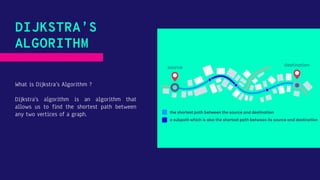
What is Dijkstra’s Algorithm ?
Dijkstra's algorithm is an algorithm that
allows us to find the shortest path between
any two vertices of a graph.
DIJKSTRA’S
ALGORITHM
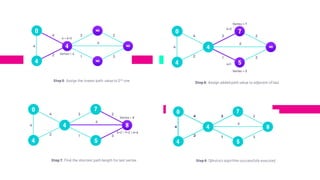
Dijkstra's Algorithm works on the basis that any subpath B -> D of the
shortest path A -> D between vertices A and D is also the shortest path
between vertices B and D.
Dijkstra used this property in the opposite direction i.e we
overestimate the distance of each vertex from the starting vertex. Then
we visit each node and its neighbors to find the shortest subpath to
those neighbors.
The algorithm uses a greedy approach in the sense that we find the
next best solution hoping that the end result is the best solution for
the whole problem.
HOW DIJKSTRA’S ALGORITHM
WORK?
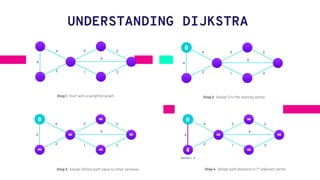
UNDERSTANDING DIJKSTRA
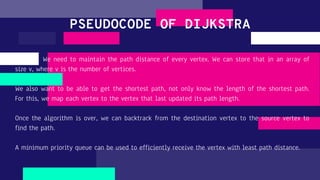
We need to maintain the path distance of every vertex. We can store that in an array of
size v, where v is the number of vertices.
We also want to be able to get the shortest path, not only know the length of the shortest path.
For this, we map each vertex to the vertex that last updated its path length.
Once the algorithm is over, we can backtrack from the destination vertex to the source vertex to
find the path.
A minimum priority queue can be used to efficiently receive the vertex with least path distance.
PSEUDOCODE OF DIJKSTRA
1 function Dijkstra(Graph, source):
2
3 create vertex set Q
4
5 for each vertex v in Graph:
6 dist[v] ← INFINITY
7 prev[v] ← UNDEFINED
8 add v to Q
9 dist[source] ← 0
10
11 while Q is not empty:
12 u ← vertex in Q with min dist[u]
13
14 remove u from Q
15
16 for each neighbor v of u still in Q:
17 alt ← dist[u] + length(u, v)
18 if alt < dist[v]:
19 dist[v] ← alt
20 prev[v] ← u
21
22 return dist[], prev[]
PSEUDOCODE
CODE FOR DIJKSTRA’S ALGORITHM
The implementation of Dijkstra's Algorithm in C
is given. The complexity of the code can be
improved, but the abstractions are convenient to
relate the code with the algorithm.
Scan this
QR Code using Google Lens to get access to the
drive containing necessary coding files
Log in using College ID
Time Complexity: O(E Log V)
where, E is the number of edges and V is the number of vertices.
Space Complexity: O(V)
DIJKSTRA’S ALGORITHM COMPLEXITY
APPLICATIONS OF DIJKSTRA’S
ALGORITHM
• To find the shortest path
• In social networking applications
• In a telephone network
• To find the locations in the map
CONCLUSION
When the algorithm finishes, each vertex reachable from the
source has v. distance set to the length of the shortest path
from the source, and v. parent set to its parent in the tree of
shortest paths.
• https://www.programiz.com/dsa/dijkstra-algorithm
• https://en.wikipedia.org/wiki/Dijkstra%27s_algorithm
• https://www.quora.com/What-is-the-conclusion-of-Dijkstras-algorithm
BIBLIOGRAPHY
For your precious time towards our
presentation
THANK
YOU!

Dijkstra's Algorithm

  • 1.
    DIJKSTRA’S ALGORITHM Represented byGroup: 3 • Arijit Dhali • Ipsita Raha Department : Electronic & Communication Engineering Year : 2nd Session : 2021-22 Data Structure and Algorithm ES – CSS 301
  • 2.
    TABLE OF CONTENTS 01 Understanding Dijkstra 02 Algorithmand Pseudocode 03 Decoding 04 Complexity
  • 3.
    What is Dijkstra’sAlgorithm ? Dijkstra's algorithm is an algorithm that allows us to find the shortest path between any two vertices of a graph. DIJKSTRA’S ALGORITHM
  • 4.
    Dijkstra's Algorithm workson the basis that any subpath B -> D of the shortest path A -> D between vertices A and D is also the shortest path between vertices B and D. Dijkstra used this property in the opposite direction i.e we overestimate the distance of each vertex from the starting vertex. Then we visit each node and its neighbors to find the shortest subpath to those neighbors. The algorithm uses a greedy approach in the sense that we find the next best solution hoping that the end result is the best solution for the whole problem. HOW DIJKSTRA’S ALGORITHM WORK?
  • 5.
  • 7.
    We need tomaintain the path distance of every vertex. We can store that in an array of size v, where v is the number of vertices. We also want to be able to get the shortest path, not only know the length of the shortest path. For this, we map each vertex to the vertex that last updated its path length. Once the algorithm is over, we can backtrack from the destination vertex to the source vertex to find the path. A minimum priority queue can be used to efficiently receive the vertex with least path distance. PSEUDOCODE OF DIJKSTRA
  • 8.
    1 function Dijkstra(Graph,source): 2 3 create vertex set Q 4 5 for each vertex v in Graph: 6 dist[v] ← INFINITY 7 prev[v] ← UNDEFINED 8 add v to Q 9 dist[source] ← 0 10 11 while Q is not empty: 12 u ← vertex in Q with min dist[u] 13 14 remove u from Q 15 16 for each neighbor v of u still in Q: 17 alt ← dist[u] + length(u, v) 18 if alt < dist[v]: 19 dist[v] ← alt 20 prev[v] ← u 21 22 return dist[], prev[] PSEUDOCODE
  • 9.
    CODE FOR DIJKSTRA’SALGORITHM The implementation of Dijkstra's Algorithm in C is given. The complexity of the code can be improved, but the abstractions are convenient to relate the code with the algorithm. Scan this QR Code using Google Lens to get access to the drive containing necessary coding files Log in using College ID
  • 10.
    Time Complexity: O(ELog V) where, E is the number of edges and V is the number of vertices. Space Complexity: O(V) DIJKSTRA’S ALGORITHM COMPLEXITY
  • 11.
    APPLICATIONS OF DIJKSTRA’S ALGORITHM •To find the shortest path • In social networking applications • In a telephone network • To find the locations in the map
  • 12.
    CONCLUSION When the algorithmfinishes, each vertex reachable from the source has v. distance set to the length of the shortest path from the source, and v. parent set to its parent in the tree of shortest paths.
  • 13.
    • https://www.programiz.com/dsa/dijkstra-algorithm • https://en.wikipedia.org/wiki/Dijkstra%27s_algorithm •https://www.quora.com/What-is-the-conclusion-of-Dijkstras-algorithm BIBLIOGRAPHY
  • 14.
    For your precioustime towards our presentation THANK YOU!