Space Solar Power
“Energy is one of the most fundamental
components of nature. Energy demonstrates its
importance in human society from calorie-filled
food at dinner to wars over oil in the Middle-
East. The beauty of energy is embodied in the
simple glow of a flame or a gentle ripple from a
leaf falling upon water. Its ugly face is seen in the
pollution caused by utilizing fossil fuels,
processing nuclear fuel, and manufacturing solar
cells”
Represented By : Ipsita Raha
Contents
• Introduction
• What is Space Solar Power and How It Works
• Requirements for Space Solar Power
• Advantages and Disadvantages
• Conclusions
• References
Introduction
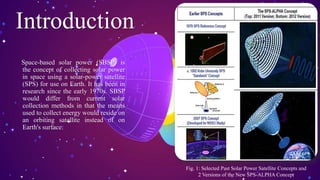
Space-based solar power (SBSP) is
the concept of collecting solar power
in space using a solar-power satellite
(SPS) for use on Earth. It has been in
research since the early 1970s. SBSP
would differ from current solar
collection methods in that the means
used to collect energy would reside on
an orbiting satellite instead of on
Earth's surface.
Fig. 1: Selected Past Solar Power Satellite Concepts and
2 Versions of the New SPS-ALPHA Concept
What is Space Solar Power and How It Works ?
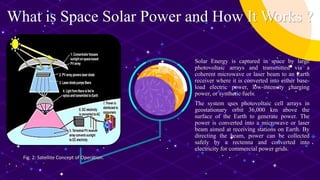
Solar Energy is captured in space by large
photovoltaic arrays and transmitted via a
coherent microwave or laser beam to an Earth
receiver where it is converted into either base-
load electric power, low-intensity charging
power, or synthetic fuels.
The system uses photovoltaic cell arrays in
geostationary orbit 36,000 km above the
surface of the Earth to generate power. The
power is converted into a microwave or laser
beam aimed at receiving stations on Earth. By
directing the beam, power can be collected
safely by a rectenna and converted into
electricity for commercial power grids.
Fig. 2: Satellite Concept of Operation.
In space, solar energy could be collected
continually, regardless of weather and time of
the day, enabling stable, efficient power
generation.
Vallbracht, (2011) proposed that the space-
based portion of the system should consist of
a constellation of solar energy harvesting
satellites (SunSats). These would collect solar
power and transmit the energy via a 5.8 GHz
beam back to Earth.
On Earth, ground stations featuring large
rectennas will be capable of converting the
broadcasted microwave frequency back into
DC power. Once converted DC, the power
will then be transformed into AC and pumped
into the electrical grid, at which point its use
becomes transparent to the end-user.
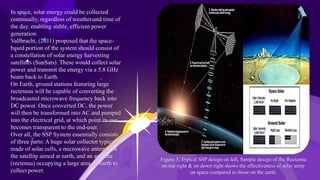
Over all, the SSP System essentially consists
of three parts: A huge solar collector typically
made of solar cells, a microwave antenna on
the satellite aimed at earth, and an antenna
(rectenna) occupying a large area on earth to
collect power.
Figure 3. Typical SSP design on left, Sample design of the Rectenna
on top right & on down right shows the effectiveness of solar array
on space compared to those on the earth.
Requirements for Space Solar Power
According to the National Space Society the
technologies and infrastructure required to
make space solar power feasible include:
• Low-cost, and environmentally-friendly
launch vehicles.
• Large scale in-orbit construction and
operations.
• Power transmission from satellites to the
Earth’s surface with minimal
environmental impact.
Advantages and Disadvantages
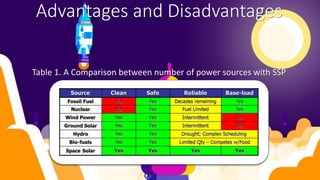
Table 1. A Comparison between number of power sources with SSP
Advantages of SSP (SBSP) :
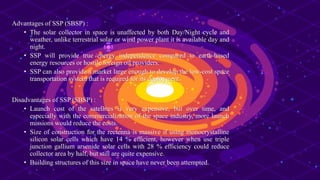
• The solar collector in space is unaffected by both Day/Night cycle and
weather, unlike terrestrial solar or wind power plant it is available day and
night.
• SSP will provide true energy independence compared to earth-based
energy resources or hostile foreign oil providers.
• SSP can also provide a market large enough to develop the low-cost space
transportation system that is required for its deployment.
Disadvantages of SSP (SBSP) :
• Launch cost of the satellites is very expensive, but over time, and
especially with the commercialization of the space industry, more launch
missions would reduce the costs.
• Size of construction for the rectenna is massive if using monocrystalline
silicon solar cells which have 14 % efficient, however when use triple
junction gallium arsenide solar cells with 28 % efficiency could reduce
collector area by half, but still are quite expensive.
• Building structures of this size in space have never been attempted.
Conclusion
The increasing global energy demand is likely to continue for many decades as many renewable
energy sources are limited. The best alternative energy source is solar power, which possesses many
significant environmental advantages when compared to alternative approaches to meet increasing
the demands for energy on Earth.
There is a high development cost, although it is much smaller than the ongoing American military
presence in the Persian Gulf, or the costs of global warming, climate change, or carbon sequestration.
The cost of space solar power development always needs to be compared to the cost of not
developing space solar power.
Finally, in order for SSP to become a reality; it needs government support, cheaper launch prices, and
involvement of the private sector.
References
• Space-Based Solar Energy, A Brief Review and Analysis, 1998: http://userwww.sfsu.edu/ciotola/solar/
• Zerta, M., Blandow, V., Collins, P., Guillet, J., Nordmann, T., Schmidt, P., & Zittel, W. (2004, December). Earth &
Space-Based Power Generation Systems-A Comparison Study. In Solar Power from Space-SPS'04 (Vol. 567, p.
29).
• BP, 2012. BP Statistical Review of World Energy: http://bp.com.
• Rouge, J. D. (2007). Space-Based Solar Power As an Opportunity for Strategic Security. National Security Space
Office. Department of Defense.
• National Space Society: http://www.nss.org/settlement/ssp/index.htm (seen in Nov. 2013).
Gracias

Space Solar Power

  • 1.
    Space Solar Power “Energyis one of the most fundamental components of nature. Energy demonstrates its importance in human society from calorie-filled food at dinner to wars over oil in the Middle- East. The beauty of energy is embodied in the simple glow of a flame or a gentle ripple from a leaf falling upon water. Its ugly face is seen in the pollution caused by utilizing fossil fuels, processing nuclear fuel, and manufacturing solar cells” Represented By : Ipsita Raha
  • 2.
    Contents • Introduction • Whatis Space Solar Power and How It Works • Requirements for Space Solar Power • Advantages and Disadvantages • Conclusions • References
  • 3.
    Introduction Space-based solar power(SBSP) is the concept of collecting solar power in space using a solar-power satellite (SPS) for use on Earth. It has been in research since the early 1970s. SBSP would differ from current solar collection methods in that the means used to collect energy would reside on an orbiting satellite instead of on Earth's surface. Fig. 1: Selected Past Solar Power Satellite Concepts and 2 Versions of the New SPS-ALPHA Concept
  • 4.
    What is SpaceSolar Power and How It Works ? Solar Energy is captured in space by large photovoltaic arrays and transmitted via a coherent microwave or laser beam to an Earth receiver where it is converted into either base- load electric power, low-intensity charging power, or synthetic fuels. The system uses photovoltaic cell arrays in geostationary orbit 36,000 km above the surface of the Earth to generate power. The power is converted into a microwave or laser beam aimed at receiving stations on Earth. By directing the beam, power can be collected safely by a rectenna and converted into electricity for commercial power grids. Fig. 2: Satellite Concept of Operation.
  • 5.
    In space, solarenergy could be collected continually, regardless of weather and time of the day, enabling stable, efficient power generation. Vallbracht, (2011) proposed that the space- based portion of the system should consist of a constellation of solar energy harvesting satellites (SunSats). These would collect solar power and transmit the energy via a 5.8 GHz beam back to Earth. On Earth, ground stations featuring large rectennas will be capable of converting the broadcasted microwave frequency back into DC power. Once converted DC, the power will then be transformed into AC and pumped into the electrical grid, at which point its use becomes transparent to the end-user. Over all, the SSP System essentially consists of three parts: A huge solar collector typically made of solar cells, a microwave antenna on the satellite aimed at earth, and an antenna (rectenna) occupying a large area on earth to collect power. Figure 3. Typical SSP design on left, Sample design of the Rectenna on top right & on down right shows the effectiveness of solar array on space compared to those on the earth.
  • 6.
    Requirements for SpaceSolar Power According to the National Space Society the technologies and infrastructure required to make space solar power feasible include: • Low-cost, and environmentally-friendly launch vehicles. • Large scale in-orbit construction and operations. • Power transmission from satellites to the Earth’s surface with minimal environmental impact.
  • 7.
    Advantages and Disadvantages Table1. A Comparison between number of power sources with SSP
  • 8.
    Advantages of SSP(SBSP) : • The solar collector in space is unaffected by both Day/Night cycle and weather, unlike terrestrial solar or wind power plant it is available day and night. • SSP will provide true energy independence compared to earth-based energy resources or hostile foreign oil providers. • SSP can also provide a market large enough to develop the low-cost space transportation system that is required for its deployment. Disadvantages of SSP (SBSP) : • Launch cost of the satellites is very expensive, but over time, and especially with the commercialization of the space industry, more launch missions would reduce the costs. • Size of construction for the rectenna is massive if using monocrystalline silicon solar cells which have 14 % efficient, however when use triple junction gallium arsenide solar cells with 28 % efficiency could reduce collector area by half, but still are quite expensive. • Building structures of this size in space have never been attempted.
  • 9.
    Conclusion The increasing globalenergy demand is likely to continue for many decades as many renewable energy sources are limited. The best alternative energy source is solar power, which possesses many significant environmental advantages when compared to alternative approaches to meet increasing the demands for energy on Earth. There is a high development cost, although it is much smaller than the ongoing American military presence in the Persian Gulf, or the costs of global warming, climate change, or carbon sequestration. The cost of space solar power development always needs to be compared to the cost of not developing space solar power. Finally, in order for SSP to become a reality; it needs government support, cheaper launch prices, and involvement of the private sector.
  • 10.
    References • Space-Based SolarEnergy, A Brief Review and Analysis, 1998: http://userwww.sfsu.edu/ciotola/solar/ • Zerta, M., Blandow, V., Collins, P., Guillet, J., Nordmann, T., Schmidt, P., & Zittel, W. (2004, December). Earth & Space-Based Power Generation Systems-A Comparison Study. In Solar Power from Space-SPS'04 (Vol. 567, p. 29). • BP, 2012. BP Statistical Review of World Energy: http://bp.com. • Rouge, J. D. (2007). Space-Based Solar Power As an Opportunity for Strategic Security. National Security Space Office. Department of Defense. • National Space Society: http://www.nss.org/settlement/ssp/index.htm (seen in Nov. 2013).
  • 11.