Presented By: Group 3
Ipsita Raha – Dibyendu Banik – Arijit Dhali
11500120054 – 11500320062 – 11500320078
Active
Filters
Table of contents
02
01
04
Overview of Active Filter
& its Types
Introduction
Configuration &
Merits – Demirits
03
Conclusion
& References
Introduction
An active filter is a type of analog circuit implementing an electronic
filter using active components, typically an amplifier. Amplifiers included in a
filter design can be used to improve the cost, performance and predictability
of a filter.
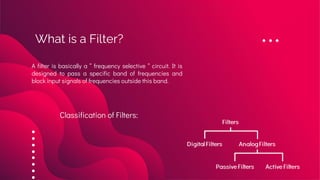
What is a Filter?
A filter is basically a “ frequency selective “ circuit. It is
designed to pass a specific band of frequencies and
block input signals of frequencies outside this band.
Classification of Filters:
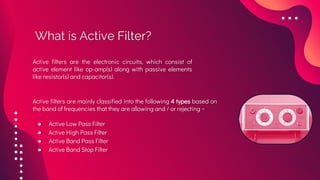
Active filters are the electronic circuits, which consist of
active element like op-amp(s) along with passive elements
like resistor(s) and capacitor(s).
Active filters are mainly classified into the following 4 types based on
the band of frequencies that they are allowing and / or rejecting −
● Active Low Pass Filter
● Active High Pass Filter
● Active Band Pass Filter
● Active Band Stop Filter
What is Active Filter?
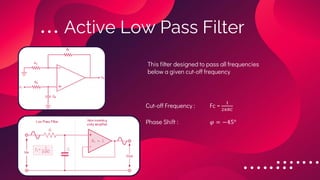
Active Low Pass Filter
This filter designed to pass all frequencies
below a given cut-off frequency
Cut-off Frequency : Fc =
1
2𝜋𝑅𝐶
Phase Shift : 𝜑 = −45°
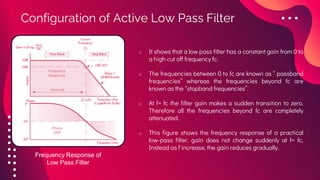
o It shows that a low pass filter has a constant gain from 0 to
a high cut off frequency fc.
o The frequencies between 0 to fc are known as “ passband
frequencies” whereas the frequencies beyond fc are
known as the “stopband frequencies”.
o At f= fc the filter gain makes a sudden transition to zero.
Therefore all the frequencies beyond fc are completely
attenuated.
o This figure shows the frequency response of a practical
low-pass filter. gain does not change suddenly at f= fc.
Instead as f increase, the gain reduces gradually.
Configuration of Active Low Pass Filter
Frequency Response of
Low Pass Filter
Active High Pass Filter
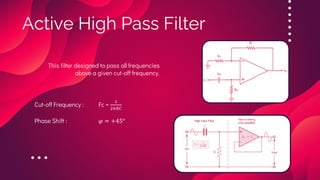
This filter designed to pass all frequencies
above a given cut-off frequency.
Cut-off Frequency : Fc =
1
2𝜋𝑅𝐶
Phase Shift : 𝜑 = +45°
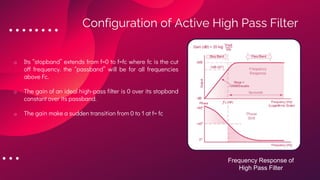
o Its “stopband” extends from f=0 to f=fc where fc is the cut
off frequency. the “passband” will be for all frequencies
above Fc.
o The gain of an ideal high-pass filter is 0 over its stopband
constant over its passband.
o The gain make a sudden transition from 0 to 1 at f= fc
Configuration of Active High Pass Filter
Frequency Response of
High Pass Filter
Active Band Pass Filter
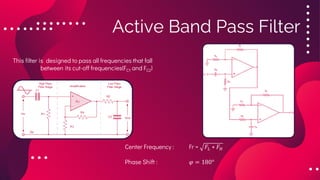
This filter is designed to pass all frequencies that fall
between its cut-off frequencies(FC1 and FC2)
Center Frequency : Fr = 𝐹𝐿 ∗ 𝐹𝐻
Phase Shift : 𝜑 = 180°
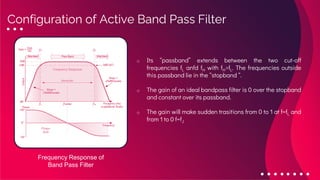
o Its “passband” extends between the two cut-off
frequencies fL anfd fH with fH>fL. The frequencies outside
this passband lie in the “stopband “.
o The gain of an ideal bandpass filter is 0 over the stopband
and constant over its passband.
o The gain will make sudden trasitions from 0 to 1 at f=fL and
from 1 to 0 f=fJ
Configuration of Active Band Pass Filter
Frequency Response of
Band Pass Filter
Active Band Stop Filter
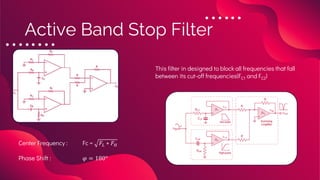
This filter in designed to block all frequencies that fall
between its cut-off frequencies(FC1 and FC2)
Center Frequency : Fc = 𝐹𝐿 ∗ 𝐹𝐻
Phase Shift : 𝜑 = 180°
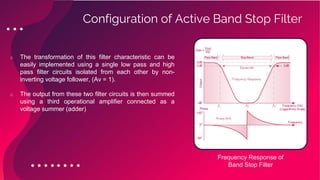
o The transformation of this filter characteristic can be
easily implemented using a single low pass and high
pass filter circuits isolated from each other by non-
inverting voltage follower, (Av = 1).
o The output from these two filter circuits is then summed
using a third operational amplifier connected as a
voltage summer (adder)
Configuration of Active Band Stop Filter
Frequency Response of
Band Stop Filter
Merits & Demerits
Merits
o Flexibility in gain
o No loading problem
o No insertion
o Passband gain
o Small component size
o Use of the inductors can be avoided
o Control impedance
Demerits
o Costs more than Passive Filter
o Its has need dc supply.
o Active filter are limited in their
frequency range .op-amp had a finite
gain bandwidth product.
o Active filters can not handle of large
amount of power.
Active filters are used in communication systems for suppressing noise, to isolate a
communication of signal from various channels to improve the unique message signal
from a modulated signal.
These filters are used in instrumentation systems by the designers to choose a required
frequency apparatus and detach unwanted ones.
These filters can be used to limit the analog signal’s bandwidth before altering them to
digital signals.
Conclusion
• https://www.tutorialspoint.com/linear_integrated_circuits_applications/linear_integrated_circuits_applica
tions_active_filters.htm
• https://www.slideshare.net/Bangulkhanbaloch/active-filter-138582261
• https://www.slideshare.net/RajputManthan/active-filter
• https://www.electronics-tutorials.ws/filter/band-stop-filter.html
• https://www.electronics-tutorials.ws/filter/filter_6.html
• https://www.electronics-tutorials.ws/filter/filter_7.html
• https://www.electronics-tutorials.ws/filter/filter_5.html
Reference
For your precious attention
towards our presentation
Thank
You

Active Filters.pdf

  • 1.
    Presented By: Group3 Ipsita Raha – Dibyendu Banik – Arijit Dhali 11500120054 – 11500320062 – 11500320078 Active Filters
  • 2.
    Table of contents 02 01 04 Overviewof Active Filter & its Types Introduction Configuration & Merits – Demirits 03 Conclusion & References
  • 3.
    Introduction An active filteris a type of analog circuit implementing an electronic filter using active components, typically an amplifier. Amplifiers included in a filter design can be used to improve the cost, performance and predictability of a filter.
  • 4.
    What is aFilter? A filter is basically a “ frequency selective “ circuit. It is designed to pass a specific band of frequencies and block input signals of frequencies outside this band. Classification of Filters:
  • 5.
    Active filters arethe electronic circuits, which consist of active element like op-amp(s) along with passive elements like resistor(s) and capacitor(s). Active filters are mainly classified into the following 4 types based on the band of frequencies that they are allowing and / or rejecting − ● Active Low Pass Filter ● Active High Pass Filter ● Active Band Pass Filter ● Active Band Stop Filter What is Active Filter?
  • 6.
    Active Low PassFilter This filter designed to pass all frequencies below a given cut-off frequency Cut-off Frequency : Fc = 1 2𝜋𝑅𝐶 Phase Shift : 𝜑 = −45°
  • 7.
    o It showsthat a low pass filter has a constant gain from 0 to a high cut off frequency fc. o The frequencies between 0 to fc are known as “ passband frequencies” whereas the frequencies beyond fc are known as the “stopband frequencies”. o At f= fc the filter gain makes a sudden transition to zero. Therefore all the frequencies beyond fc are completely attenuated. o This figure shows the frequency response of a practical low-pass filter. gain does not change suddenly at f= fc. Instead as f increase, the gain reduces gradually. Configuration of Active Low Pass Filter Frequency Response of Low Pass Filter
  • 8.
    Active High PassFilter This filter designed to pass all frequencies above a given cut-off frequency. Cut-off Frequency : Fc = 1 2𝜋𝑅𝐶 Phase Shift : 𝜑 = +45°
  • 9.
    o Its “stopband”extends from f=0 to f=fc where fc is the cut off frequency. the “passband” will be for all frequencies above Fc. o The gain of an ideal high-pass filter is 0 over its stopband constant over its passband. o The gain make a sudden transition from 0 to 1 at f= fc Configuration of Active High Pass Filter Frequency Response of High Pass Filter
  • 10.
    Active Band PassFilter This filter is designed to pass all frequencies that fall between its cut-off frequencies(FC1 and FC2) Center Frequency : Fr = 𝐹𝐿 ∗ 𝐹𝐻 Phase Shift : 𝜑 = 180°
  • 11.
    o Its “passband”extends between the two cut-off frequencies fL anfd fH with fH>fL. The frequencies outside this passband lie in the “stopband “. o The gain of an ideal bandpass filter is 0 over the stopband and constant over its passband. o The gain will make sudden trasitions from 0 to 1 at f=fL and from 1 to 0 f=fJ Configuration of Active Band Pass Filter Frequency Response of Band Pass Filter
  • 12.
    Active Band StopFilter This filter in designed to block all frequencies that fall between its cut-off frequencies(FC1 and FC2) Center Frequency : Fc = 𝐹𝐿 ∗ 𝐹𝐻 Phase Shift : 𝜑 = 180°
  • 13.
    o The transformationof this filter characteristic can be easily implemented using a single low pass and high pass filter circuits isolated from each other by non- inverting voltage follower, (Av = 1). o The output from these two filter circuits is then summed using a third operational amplifier connected as a voltage summer (adder) Configuration of Active Band Stop Filter Frequency Response of Band Stop Filter
  • 14.
    Merits & Demerits Merits oFlexibility in gain o No loading problem o No insertion o Passband gain o Small component size o Use of the inductors can be avoided o Control impedance Demerits o Costs more than Passive Filter o Its has need dc supply. o Active filter are limited in their frequency range .op-amp had a finite gain bandwidth product. o Active filters can not handle of large amount of power.
  • 15.
    Active filters areused in communication systems for suppressing noise, to isolate a communication of signal from various channels to improve the unique message signal from a modulated signal. These filters are used in instrumentation systems by the designers to choose a required frequency apparatus and detach unwanted ones. These filters can be used to limit the analog signal’s bandwidth before altering them to digital signals. Conclusion
  • 16.
    • https://www.tutorialspoint.com/linear_integrated_circuits_applications/linear_integrated_circuits_applica tions_active_filters.htm • https://www.slideshare.net/Bangulkhanbaloch/active-filter-138582261 •https://www.slideshare.net/RajputManthan/active-filter • https://www.electronics-tutorials.ws/filter/band-stop-filter.html • https://www.electronics-tutorials.ws/filter/filter_6.html • https://www.electronics-tutorials.ws/filter/filter_7.html • https://www.electronics-tutorials.ws/filter/filter_5.html Reference
  • 17.
    For your preciousattention towards our presentation Thank You