16 Vector Calculus
22
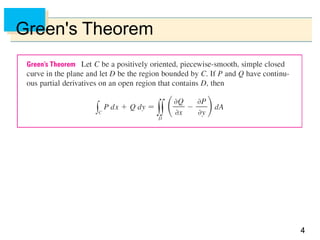
16.4 Green's Theorem
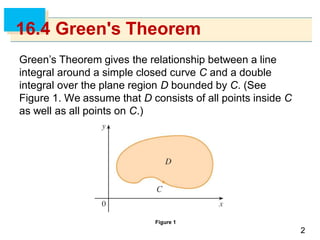
Green’s Theorem gives the relationship between a line
integral around a simple closed curve C and a double
integral over the plane region D bounded by C. (See
Figure 1. We assume that D consists of all points inside C
as well as all points on C.)
Figure 1
33
Green's Theorem
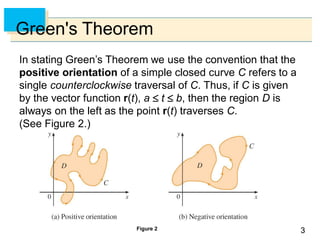
In stating Green’s Theorem we use the convention that the
positive orientation of a simple closed curve C refers to a
single counterclockwise traversal of C. Thus, if C is given
by the vector function r(t), a  t  b, then the region D is
always on the left as the point r(t) traverses C.
(See Figure 2.)
Figure 2
44
Green's Theorem
55
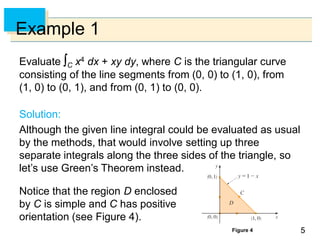
Example 1
Evaluate C x4 dx + xy dy, where C is the triangular curve
consisting of the line segments from (0, 0) to (1, 0), from
(1, 0) to (0, 1), and from (0, 1) to (0, 0).
Solution:
Although the given line integral could be evaluated as usual
by the methods, that would involve setting up three
separate integrals along the three sides of the triangle, so
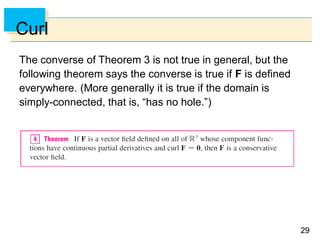
let’s use Green’s Theorem instead.
Notice that the region D enclosed
by C is simple and C has positive
orientation (see Figure 4).
Figure 4
66
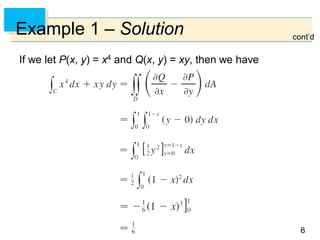
Example 1 – Solution
If we let P(x, y) = x4 and Q(x, y) = xy, then we have
cont’d
77
Green's Theorem
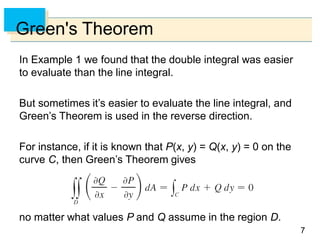
In Example 1 we found that the double integral was easier
to evaluate than the line integral.
But sometimes it’s easier to evaluate the line integral, and
Green’s Theorem is used in the reverse direction.
For instance, if it is known that P(x, y) = Q(x, y) = 0 on the
curve C, then Green’s Theorem gives
no matter what values P and Q assume in the region D.
88
Green's Theorem
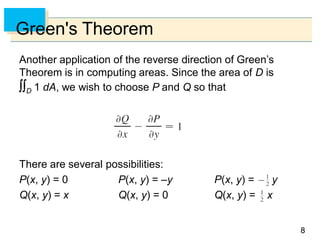
Another application of the reverse direction of Green’s
Theorem is in computing areas. Since the area of D is
D 1 dA, we wish to choose P and Q so that
There are several possibilities:
P(x, y) = 0 P(x, y) = –y P(x, y) = y
Q(x, y) = x Q(x, y) = 0 Q(x, y) = x
99
Green's Theorem
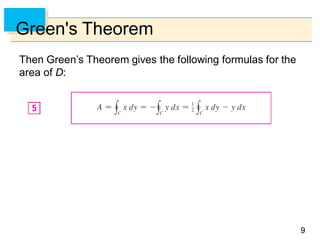
Then Green’s Theorem gives the following formulas for the
area of D:
1010
Green's Theorem
Formula 5 can be used to explain how planimeters work.
A planimeter is a mechanical instrument used for
measuring the area of a region by tracing its boundary
curve.
These devices are useful in all the sciences: in biology for
measuring the area of leaves or wings, in medicine for
measuring the size of cross-sections of organs or tumors,
in forestry for estimating the size of forested regions from
photographs.
1111
Green's Theorem
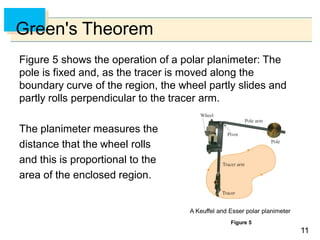
Figure 5 shows the operation of a polar planimeter: The
pole is fixed and, as the tracer is moved along the
boundary curve of the region, the wheel partly slides and
partly rolls perpendicular to the tracer arm.
The planimeter measures the
distance that the wheel rolls
and this is proportional to the
area of the enclosed region.
A Keuffel and Esser polar planimeter
Figure 5
1212
Extended Versions of Green’s Theorem
1313
Extended Versions of Green’s Theorem
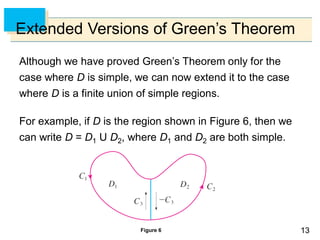
Although we have proved Green’s Theorem only for the
case where D is simple, we can now extend it to the case
where D is a finite union of simple regions.
For example, if D is the region shown in Figure 6, then we
can write D = D1 U D2, where D1 and D2 are both simple.
Figure 6
1414
Extended Versions of Green’s Theorem
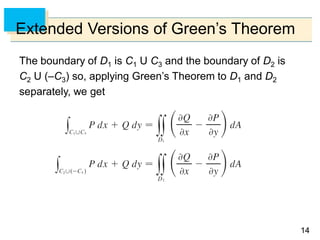
The boundary of D1 is C1 U C3 and the boundary of D2 is
C2 U (–C3) so, applying Green’s Theorem to D1 and D2
separately, we get
1515
Extended Versions of Green’s Theorem
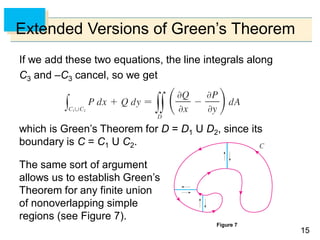
If we add these two equations, the line integrals along
C3 and –C3 cancel, so we get
which is Green’s Theorem for D = D1 U D2, since its
boundary is C = C1 U C2.
The same sort of argument
allows us to establish Green’s
Theorem for any finite union
of nonoverlapping simple
regions (see Figure 7).
Figure 7
1616
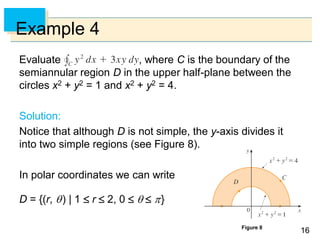
Example 4
Evaluate , where C is the boundary of the
semiannular region D in the upper half-plane between the
circles x2 + y2 = 1 and x2 + y2 = 4.
Solution:
Notice that although D is not simple, the y-axis divides it
into two simple regions (see Figure 8).
In polar coordinates we can write
D = {(r, ) | 1  r  2, 0    }
Figure 8
1717
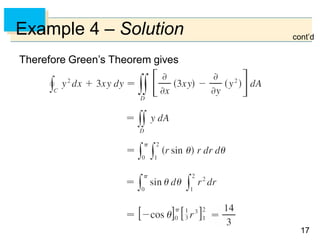
Example 4 – Solution
Therefore Green’s Theorem gives
cont’d
1818
Extended Versions of Green’s Theorem
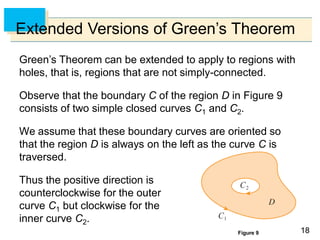
Green’s Theorem can be extended to apply to regions with
holes, that is, regions that are not simply-connected.
Observe that the boundary C of the region D in Figure 9
consists of two simple closed curves C1 and C2.
We assume that these boundary curves are oriented so
that the region D is always on the left as the curve C is
traversed.
Thus the positive direction is
counterclockwise for the outer
curve C1 but clockwise for the
inner curve C2.
Figure 9
1919
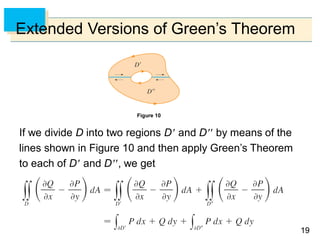
Extended Versions of Green’s Theorem
If we divide D into two regions D and D by means of the
lines shown in Figure 10 and then apply Green’s Theorem
to each of D and D, we get
Figure 10
2020
Extended Versions of Green’s Theorem
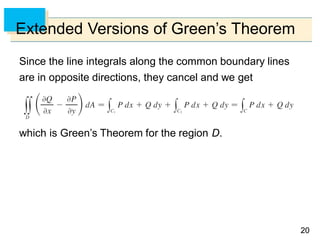
Since the line integrals along the common boundary lines
are in opposite directions, they cancel and we get
which is Green’s Theorem for the region D.
2121
Curl
16.5 Curl and Divergence
2222
Curl
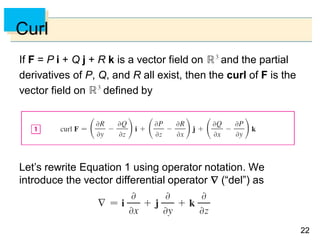
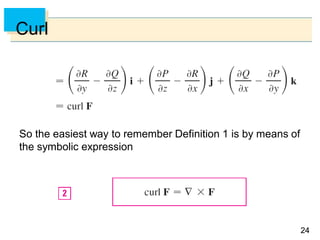
If F = P i + Q j + R k is a vector field on and the partial
derivatives of P, Q, and R all exist, then the curl of F is the
vector field on defined by
Let’s rewrite Equation 1 using operator notation. We
introduce the vector differential operator  (“del”) as
2323
Curl
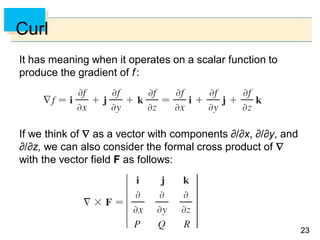
It has meaning when it operates on a scalar function to
produce the gradient of f:
If we think of  as a vector with components ∂/∂x, ∂/∂y, and
∂/∂z, we can also consider the formal cross product of 
with the vector field F as follows:
2424
Curl
So the easiest way to remember Definition 1 is by means of
the symbolic expression
2525
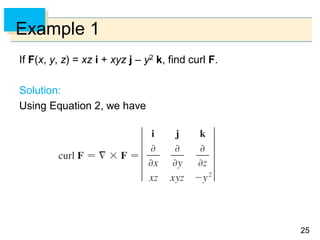
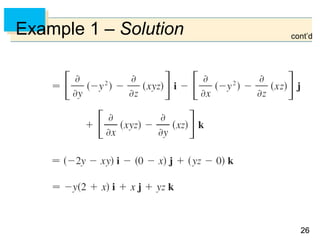
Example 1
If F(x, y, z) = xz i + xyz j – y2 k, find curl F.
Solution:
Using Equation 2, we have
2626
Example 1 – Solution cont’d
2727
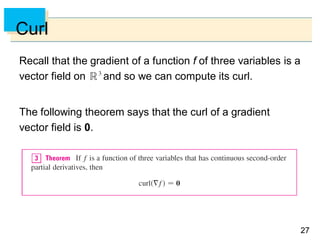
Curl
Recall that the gradient of a function f of three variables is a
vector field on and so we can compute its curl.
The following theorem says that the curl of a gradient
vector field is 0.
2828
Curl
Since a conservative vector field is one for which F = f,
Theorem 3 can be rephrased as follows:
If F is conservative, then curl F = 0.
This gives us a way of verifying that a vector field is not
conservative.
2929
Curl
The converse of Theorem 3 is not true in general, but the
following theorem says the converse is true if F is defined
everywhere. (More generally it is true if the domain is
simply-connected, that is, “has no hole.”)
3030
Curl
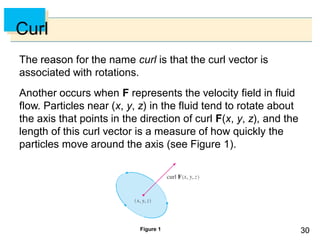
The reason for the name curl is that the curl vector is
associated with rotations.
Another occurs when F represents the velocity field in fluid
flow. Particles near (x, y, z) in the fluid tend to rotate about
the axis that points in the direction of curl F(x, y, z), and the
length of this curl vector is a measure of how quickly the
particles move around the axis (see Figure 1).
Figure 1
3131
Curl
If curl F = 0 at a point P, then the fluid is free from rotations
at P and F is called irrotational at P.
In other words, there is no whirlpool or eddy at P.
If curl F = 0, then a tiny paddle wheel moves with the fluid
but doesn’t rotate about its axis.
If curl F ≠ 0, the paddle wheel rotates about its axis.
3232
Divergence
3333
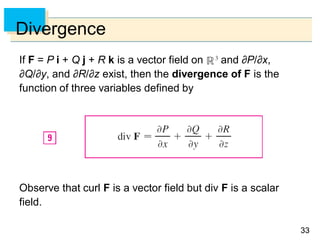
Divergence
If F = P i + Q j + R k is a vector field on and ∂P/∂x,
∂Q/∂y, and ∂R/∂z exist, then the divergence of F is the
function of three variables defined by
Observe that curl F is a vector field but div F is a scalar
field.
3434
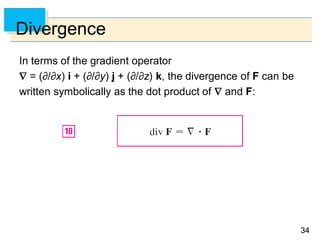
Divergence
In terms of the gradient operator
 = (∂/∂x) i + (∂/∂y) j + (∂/∂z) k, the divergence of F can be
written symbolically as the dot product of  and F:
3535
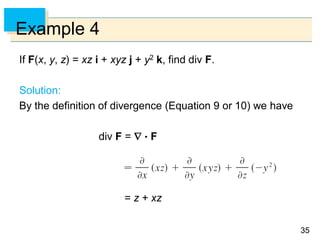
Example 4
If F(x, y, z) = xz i + xyz j + y2 k, find div F.
Solution:
By the definition of divergence (Equation 9 or 10) we have
div F =   F
= z + xz
3636
Divergence
If F is a vector field on , then curl F is also a vector field
on . As such, we can compute its divergence.
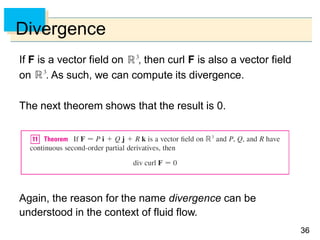
The next theorem shows that the result is 0.
Again, the reason for the name divergence can be
understood in the context of fluid flow.
3737
Divergence
If F(x, y, z) is the velocity of a fluid (or gas), then
div F(x, y, z) represents the net rate of change (with respect
to time) of the mass of fluid (or gas) flowing from the point
(x, y, z) per unit volume.
In other words, div F(x, y, z) measures the tendency of the
fluid to diverge from the point (x, y, z).
If div F = 0, then F is said to be incompressible.
Another differential operator occurs when we compute the
divergence of a gradient vector field f.
3838
Divergence
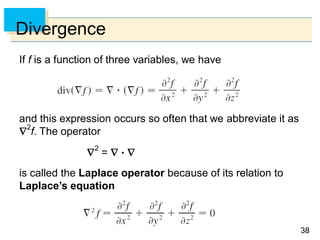
If f is a function of three variables, we have
and this expression occurs so often that we abbreviate it as
2
f. The operator

2
=   
is called the Laplace operator because of its relation to
Laplace’s equation
3939
Divergence
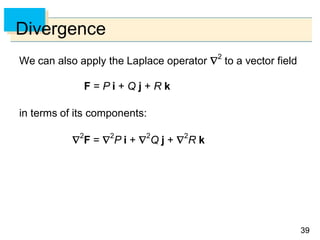
We can also apply the Laplace operator 2
to a vector field
F = P i + Q j + R k
in terms of its components:

2
F = 
2
P i + 
2
Q j + 
2
R k
4040
Vector Forms of Green’s Theorem
4141
Vector Forms of Green’s Theorem
The curl and divergence operators allow us to rewrite
Green’s Theorem in versions that will be useful in our later
work.
We suppose that the plane region D, its boundary curve C,
and the functions P and Q satisfy the hypotheses of
Green’s Theorem.
Then we consider the vector field F = P i + Q j.
4242
Vector Forms of Green’s Theorem
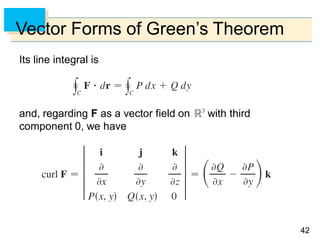
Its line integral is
and, regarding F as a vector field on with third
component 0, we have
4343
Vector Forms of Green’s Theorem
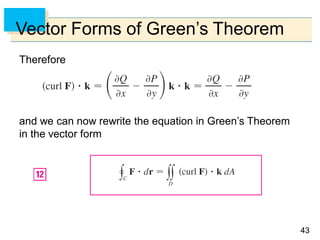
Therefore
and we can now rewrite the equation in Green’s Theorem
in the vector form
4444
Vector Forms of Green’s Theorem
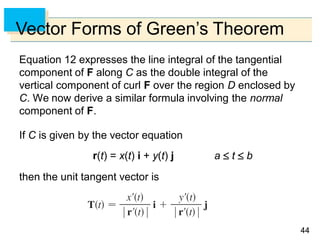
Equation 12 expresses the line integral of the tangential
component of F along C as the double integral of the
vertical component of curl F over the region D enclosed by
C. We now derive a similar formula involving the normal
component of F.
If C is given by the vector equation
r(t) = x(t) i + y(t) j a  t  b
then the unit tangent vector is
4545
Vector Forms of Green’s Theorem
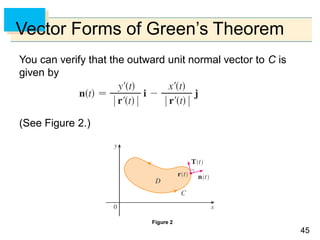
You can verify that the outward unit normal vector to C is
given by
(See Figure 2.)
Figure 2
4646
Vector Forms of Green’s Theorem
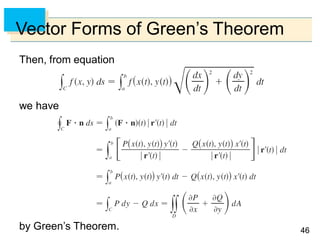
Then, from equation
we have
by Green’s Theorem.
4747
Vector Forms of Green’s Theorem
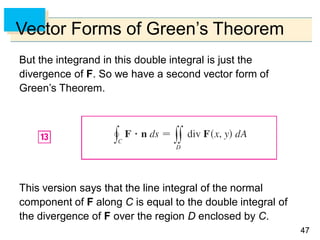
But the integrand in this double integral is just the
divergence of F. So we have a second vector form of
Green’s Theorem.
This version says that the line integral of the normal
component of F along C is equal to the double integral of
the divergence of F over the region D enclosed by C.
4848
16.6 Parametric Surfaces and Their Areas
Here we use vector functions to describe more general
surfaces, called parametric surfaces, and compute their
areas.
Then we take the general surface area formula and see
how it applies to special surfaces.
4949
Parametric Surfaces
5050
Parametric Surfaces
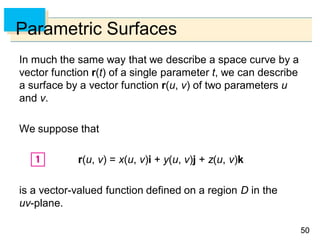
In much the same way that we describe a space curve by a
vector function r(t) of a single parameter t, we can describe
a surface by a vector function r(u, v) of two parameters u
and v.
We suppose that
r(u, v) = x(u, v)i + y(u, v)j + z(u, v)k
is a vector-valued function defined on a region D in the
uv-plane.
5151
Parametric Surfaces
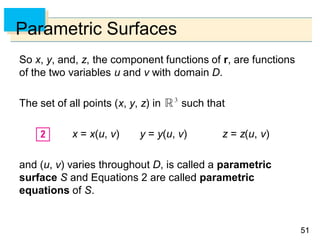
So x, y, and, z, the component functions of r, are functions
of the two variables u and v with domain D.
The set of all points (x, y, z) in such that
x = x(u, v) y = y(u, v) z = z(u, v)
and (u, v) varies throughout D, is called a parametric
surface S and Equations 2 are called parametric
equations of S.
5252
Parametric Surfaces
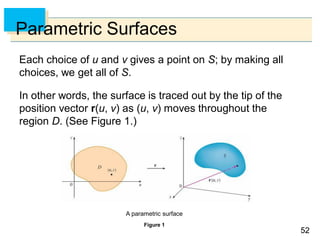
Each choice of u and v gives a point on S; by making all
choices, we get all of S.
In other words, the surface is traced out by the tip of the
position vector r(u, v) as (u, v) moves throughout the
region D. (See Figure 1.)
Figure 1
A parametric surface
5353
Example 1
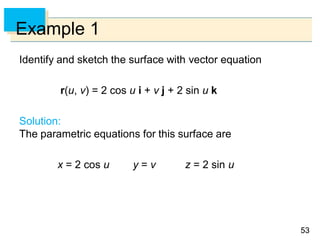
Identify and sketch the surface with vector equation
r(u, v) = 2 cos u i + v j + 2 sin u k
Solution:
The parametric equations for this surface are
x = 2 cos u y = v z = 2 sin u
5454
Example 1 – Solution
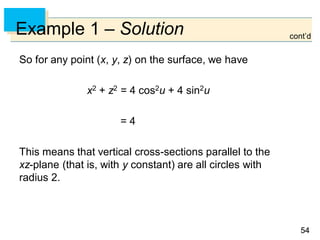
So for any point (x, y, z) on the surface, we have
x2 + z2 = 4 cos2u + 4 sin2u
= 4
This means that vertical cross-sections parallel to the
xz-plane (that is, with y constant) are all circles with
radius 2.
cont’d
5555
Example 1 – Solution
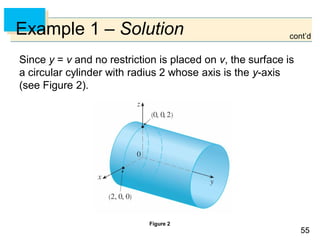
Since y = v and no restriction is placed on v, the surface is
a circular cylinder with radius 2 whose axis is the y-axis
(see Figure 2).
Figure 2
cont’d
5656
Parametric Surfaces
If a parametric surface S is given by a vector function
r(u, v), then there are two useful families of curves that lie
on S, one family with u constant and the other with v
constant.
These families correspond to vertical and horizontal lines in
the uv-plane.
5757
Parametric Surfaces
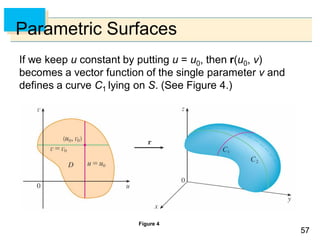
If we keep u constant by putting u = u0, then r(u0, v)
becomes a vector function of the single parameter v and
defines a curve C1 lying on S. (See Figure 4.)
Figure 4
5858
Parametric Surfaces
Similarly, if we keep v constant by putting v = v0, we get a
curve C2 given by r(u, v0) that lies on S.
We call these curves grid curves. (In Example 1, for
instance, the grid curves obtained by letting u be constant
are horizontal lines whereas the grid curves with v constant
are circles.)
In fact, when a computer graphs a parametric surface, it
usually depicts the surface by plotting these grid curves, as
we see in the next example.
5959
Example 2
Use a computer algebra system to graph the surface
r(u, v) = (2 + sin v) cos u, (2 + sin v) sin u, u + cos v
Which grid curves have u constant? Which have v
constant?
6060
Example 2 – Solution
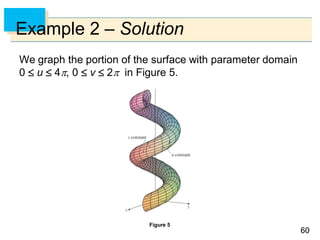
We graph the portion of the surface with parameter domain
0  u  4, 0  v  2 in Figure 5.
Figure 5
6161
Example 2 – Solution
It has the appearance of a spiral tube.
To identify the grid curves, we write the corresponding
parametric equations:
x = (2 + sin v) cos u y = (2 + sin v) sin u z = u + cos v
If v is constant, then sin v and cos v are constant, so the
parametric equations resemble those of the helix.
Thus the grid curves with v constant are the spiral curves in
Figure 5.
cont’d
6262
Example 2 – Solution
We deduce that the grid curves with u constant must be
curves that look like circles in the figure.
Further evidence for this assertion is that if u is kept
constant, u = u0 , then the equation z = u0 + cos v shows
that the z-values vary from u0 – 1 to u0 + 1.
cont’d
6363
Example 4
Find a parametric representation of the sphere
x2 + y2 + z2 = a2
Solution:
The sphere has a simple representation  = a in spherical
coordinates, so let’s choose the angles  and  in spherical
coordinates as the parameters.
6464
Example 4 – Solution
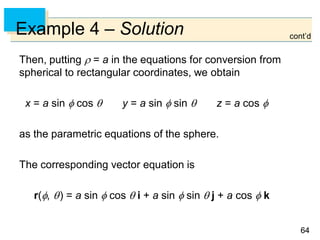
Then, putting  = a in the equations for conversion from
spherical to rectangular coordinates, we obtain
x = a sin  cos  y = a sin  sin  z = a cos 
as the parametric equations of the sphere.
The corresponding vector equation is
r(, ) = a sin  cos  i + a sin  sin  j + a cos  k
cont’d
6565
Example 4 – Solution
We have 0     and 0    2, so the parameter
domain is the rectangle D = [0, ]  [0, 2].
The grid curves with  constant are the circles of constant
latitude (including the equator).
cont’d
6666
Example 4 – Solution
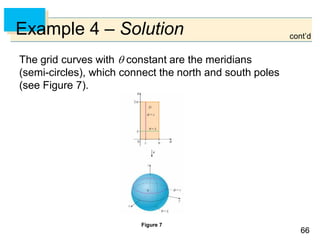
The grid curves with  constant are the meridians
(semi-circles), which connect the north and south poles
(see Figure 7).
Figure 7
cont’d
6767
Parametric Surfaces
Note:
We saw in Example 4 that the grid curves for a sphere are
curves of constant latitude and longitude.
For a general parametric surface we are really making a
map and the grid curves are similar to lines of latitude and
longitude.
Describing a point on a parametric surface (like the one in
Figure 5) by giving specific values of u and v is like giving
the latitude and longitude of a point.
6868
Surfaces of Revolution
6969
Surfaces of Revolution
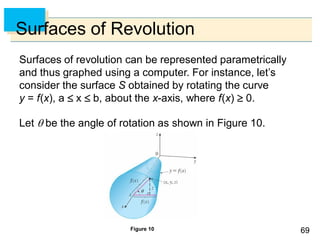
Surfaces of revolution can be represented parametrically
and thus graphed using a computer. For instance, let’s
consider the surface S obtained by rotating the curve
y = f(x), a  x  b, about the x-axis, where f(x)  0.
Let  be the angle of rotation as shown in Figure 10.
Figure 10
7070
Surfaces of Revolution
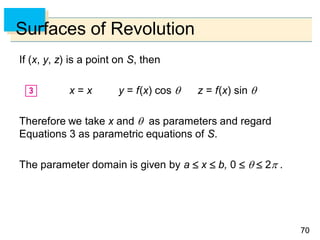
If (x, y, z) is a point on S, then
x = x y = f(x) cos  z = f(x) sin 
Therefore we take x and  as parameters and regard
Equations 3 as parametric equations of S.
The parameter domain is given by a  x  b, 0    2 .
7171
Example 8
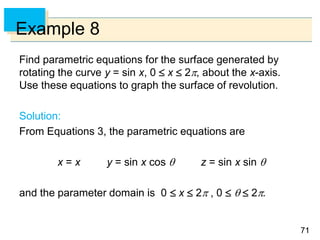
Find parametric equations for the surface generated by
rotating the curve y = sin x, 0  x  2, about the x-axis.
Use these equations to graph the surface of revolution.
Solution:
From Equations 3, the parametric equations are
x = x y = sin x cos  z = sin x sin 
and the parameter domain is 0  x  2 , 0    2.
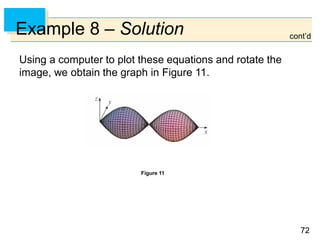
7272
Example 8 – Solution
Using a computer to plot these equations and rotate the
image, we obtain the graph in Figure 11.
Figure 11
cont’d
7373
Tangent Planes
7474
Tangent Planes
We now find the tangent plane to a parametric surface S
traced out by a vector function
r(u, v) = x(u, v) i + y(u, v) j + z(u, v) k
at a point P0 with position vector r(u0, v0).
7575
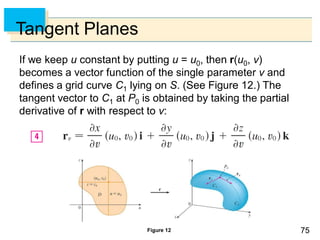
Tangent Planes
If we keep u constant by putting u = u0, then r(u0, v)
becomes a vector function of the single parameter v and
defines a grid curve C1 lying on S. (See Figure 12.) The
tangent vector to C1 at P0 is obtained by taking the partial
derivative of r with respect to v:
Figure 12
7676
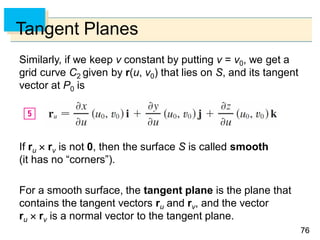
Tangent Planes
Similarly, if we keep v constant by putting v = v0, we get a
grid curve C2 given by r(u, v0) that lies on S, and its tangent
vector at P0 is
If ru  rv is not 0, then the surface S is called smooth
(it has no “corners”).
For a smooth surface, the tangent plane is the plane that
contains the tangent vectors ru and rv, and the vector
ru  rv is a normal vector to the tangent plane.
7777
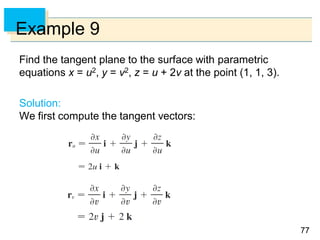
Example 9
Find the tangent plane to the surface with parametric
equations x = u2, y = v2, z = u + 2v at the point (1, 1, 3).
Solution:
We first compute the tangent vectors:
7878
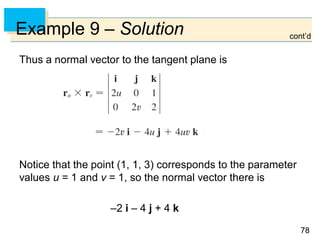
Example 9 – Solution
Thus a normal vector to the tangent plane is
Notice that the point (1, 1, 3) corresponds to the parameter
values u = 1 and v = 1, so the normal vector there is
–2 i – 4 j + 4 k
cont’d
7979
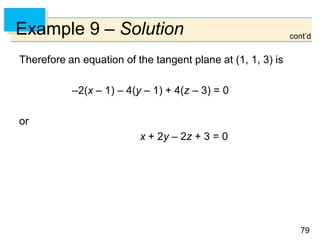
Example 9 – Solution
Therefore an equation of the tangent plane at (1, 1, 3) is
–2(x – 1) – 4(y – 1) + 4(z – 3) = 0
or
x + 2y – 2z + 3 = 0
cont’d
8080
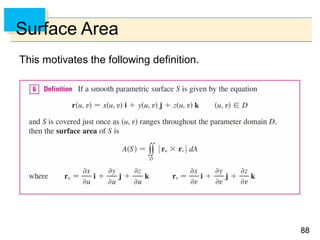
Surface Area
8181
Surface Area
Now we define the surface area of a general parametric
surface given by Equation 1.
For simplicity we start by considering a surface whose
parameter domain D is a rectangle, and we divide it into
subrectangles Rij.
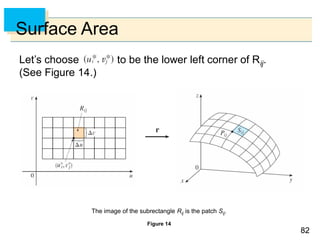
8282
Surface Area
Let’s choose to be the lower left corner of Rij.
(See Figure 14.)
Figure 14
The image of the subrectangle Rij is the patch Sij.
8383
Surface Area
The part of Sij the surface that corresponds to Rij is called a
patch and has the point Pij with position vector
as one of its corners.
Let
and
be the tangent vectors at Pij as given by Equations 5 and 4.
8484
Surface Area
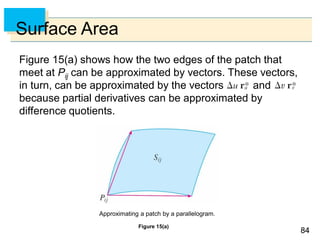
Figure 15(a) shows how the two edges of the patch that
meet at Pij can be approximated by vectors. These vectors,
in turn, can be approximated by the vectors and
because partial derivatives can be approximated by
difference quotients.
Figure 15(a)
Approximating a patch by a parallelogram.
8585
Surface Area
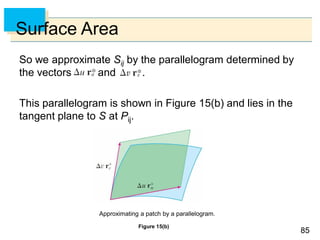
So we approximate Sij by the parallelogram determined by
the vectors and .
This parallelogram is shown in Figure 15(b) and lies in the
tangent plane to S at Pij.
Figure 15(b)
Approximating a patch by a parallelogram.
8686
Surface Area
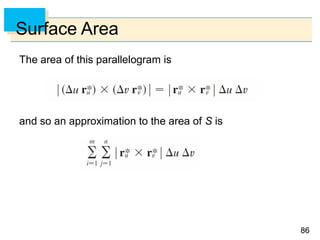
The area of this parallelogram is
and so an approximation to the area of S is
8787
Surface Area
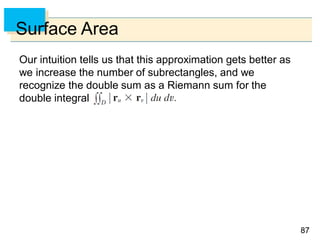
Our intuition tells us that this approximation gets better as
we increase the number of subrectangles, and we
recognize the double sum as a Riemann sum for the
double integral
8888
Surface Area
This motivates the following definition.
8989
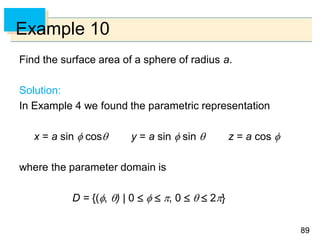
Example 10
Find the surface area of a sphere of radius a.
Solution:
In Example 4 we found the parametric representation
x = a sin  cos y = a sin  sin  z = a cos 
where the parameter domain is
D = {(, ) | 0    , 0    2}
9090
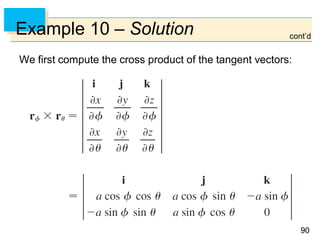
Example 10 – Solution
We first compute the cross product of the tangent vectors:
cont’d
9191
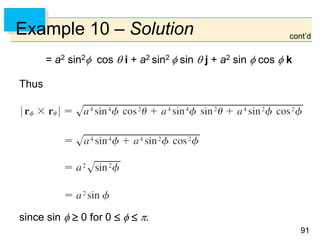
Example 10 – Solution
= a2 sin2 cos  i + a2 sin2  sin  j + a2 sin  cos  k
Thus
since sin   0 for 0    .
cont’d
9292
Example 10 – Solution
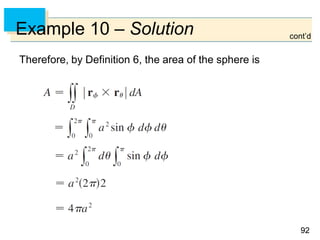
Therefore, by Definition 6, the area of the sphere is
cont’d
9393
Surface Area of the
Graph of a function
9494
Surface Area of the Graph of a Function
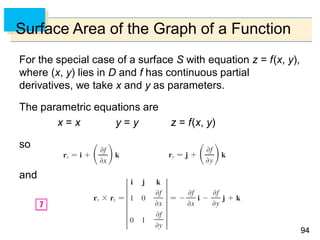
For the special case of a surface S with equation z = f(x, y),
where (x, y) lies in D and f has continuous partial
derivatives, we take x and y as parameters.
The parametric equations are
x = x y = y z = f(x, y)
so
and
9595
Surface Area of the Graph of a Function
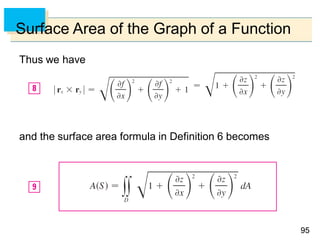
Thus we have
and the surface area formula in Definition 6 becomes
9696
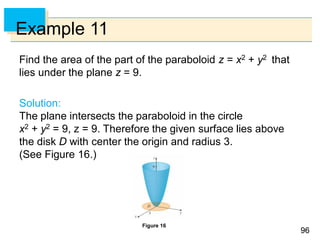
Example 11
Find the area of the part of the paraboloid z = x2 + y2 that
lies under the plane z = 9.
Solution:
The plane intersects the paraboloid in the circle
x2 + y2 = 9, z = 9. Therefore the given surface lies above
the disk D with center the origin and radius 3.
(See Figure 16.)
Figure 16
9797
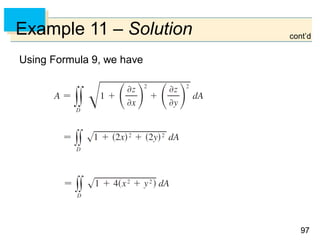
Example 11 – Solution
Using Formula 9, we have
cont’d
9898
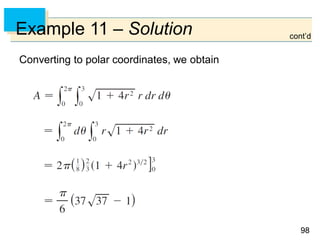
Example 11 – Solution
Converting to polar coordinates, we obtain
cont’d
9999
END OF CHAPTER

Chapter 16 2

  • 1.
  • 2.
    22 16.4 Green's Theorem Green’sTheorem gives the relationship between a line integral around a simple closed curve C and a double integral over the plane region D bounded by C. (See Figure 1. We assume that D consists of all points inside C as well as all points on C.) Figure 1
  • 3.
    33 Green's Theorem In statingGreen’s Theorem we use the convention that the positive orientation of a simple closed curve C refers to a single counterclockwise traversal of C. Thus, if C is given by the vector function r(t), a  t  b, then the region D is always on the left as the point r(t) traverses C. (See Figure 2.) Figure 2
  • 4.
  • 5.
    55 Example 1 Evaluate Cx4 dx + xy dy, where C is the triangular curve consisting of the line segments from (0, 0) to (1, 0), from (1, 0) to (0, 1), and from (0, 1) to (0, 0). Solution: Although the given line integral could be evaluated as usual by the methods, that would involve setting up three separate integrals along the three sides of the triangle, so let’s use Green’s Theorem instead. Notice that the region D enclosed by C is simple and C has positive orientation (see Figure 4). Figure 4
  • 6.
    66 Example 1 –Solution If we let P(x, y) = x4 and Q(x, y) = xy, then we have cont’d
  • 7.
    77 Green's Theorem In Example1 we found that the double integral was easier to evaluate than the line integral. But sometimes it’s easier to evaluate the line integral, and Green’s Theorem is used in the reverse direction. For instance, if it is known that P(x, y) = Q(x, y) = 0 on the curve C, then Green’s Theorem gives no matter what values P and Q assume in the region D.
  • 8.
    88 Green's Theorem Another applicationof the reverse direction of Green’s Theorem is in computing areas. Since the area of D is D 1 dA, we wish to choose P and Q so that There are several possibilities: P(x, y) = 0 P(x, y) = –y P(x, y) = y Q(x, y) = x Q(x, y) = 0 Q(x, y) = x
  • 9.
    99 Green's Theorem Then Green’sTheorem gives the following formulas for the area of D:
  • 10.
    1010 Green's Theorem Formula 5can be used to explain how planimeters work. A planimeter is a mechanical instrument used for measuring the area of a region by tracing its boundary curve. These devices are useful in all the sciences: in biology for measuring the area of leaves or wings, in medicine for measuring the size of cross-sections of organs or tumors, in forestry for estimating the size of forested regions from photographs.
  • 11.
    1111 Green's Theorem Figure 5shows the operation of a polar planimeter: The pole is fixed and, as the tracer is moved along the boundary curve of the region, the wheel partly slides and partly rolls perpendicular to the tracer arm. The planimeter measures the distance that the wheel rolls and this is proportional to the area of the enclosed region. A Keuffel and Esser polar planimeter Figure 5
  • 12.
    1212 Extended Versions ofGreen’s Theorem
  • 13.
    1313 Extended Versions ofGreen’s Theorem Although we have proved Green’s Theorem only for the case where D is simple, we can now extend it to the case where D is a finite union of simple regions. For example, if D is the region shown in Figure 6, then we can write D = D1 U D2, where D1 and D2 are both simple. Figure 6
  • 14.
    1414 Extended Versions ofGreen’s Theorem The boundary of D1 is C1 U C3 and the boundary of D2 is C2 U (–C3) so, applying Green’s Theorem to D1 and D2 separately, we get
  • 15.
    1515 Extended Versions ofGreen’s Theorem If we add these two equations, the line integrals along C3 and –C3 cancel, so we get which is Green’s Theorem for D = D1 U D2, since its boundary is C = C1 U C2. The same sort of argument allows us to establish Green’s Theorem for any finite union of nonoverlapping simple regions (see Figure 7). Figure 7
  • 16.
    1616 Example 4 Evaluate ,where C is the boundary of the semiannular region D in the upper half-plane between the circles x2 + y2 = 1 and x2 + y2 = 4. Solution: Notice that although D is not simple, the y-axis divides it into two simple regions (see Figure 8). In polar coordinates we can write D = {(r, ) | 1  r  2, 0    } Figure 8
  • 17.
    1717 Example 4 –Solution Therefore Green’s Theorem gives cont’d
  • 18.
    1818 Extended Versions ofGreen’s Theorem Green’s Theorem can be extended to apply to regions with holes, that is, regions that are not simply-connected. Observe that the boundary C of the region D in Figure 9 consists of two simple closed curves C1 and C2. We assume that these boundary curves are oriented so that the region D is always on the left as the curve C is traversed. Thus the positive direction is counterclockwise for the outer curve C1 but clockwise for the inner curve C2. Figure 9
  • 19.
    1919 Extended Versions ofGreen’s Theorem If we divide D into two regions D and D by means of the lines shown in Figure 10 and then apply Green’s Theorem to each of D and D, we get Figure 10
  • 20.
    2020 Extended Versions ofGreen’s Theorem Since the line integrals along the common boundary lines are in opposite directions, they cancel and we get which is Green’s Theorem for the region D.
  • 21.
  • 22.
    2222 Curl If F =P i + Q j + R k is a vector field on and the partial derivatives of P, Q, and R all exist, then the curl of F is the vector field on defined by Let’s rewrite Equation 1 using operator notation. We introduce the vector differential operator  (“del”) as
  • 23.
    2323 Curl It has meaningwhen it operates on a scalar function to produce the gradient of f: If we think of  as a vector with components ∂/∂x, ∂/∂y, and ∂/∂z, we can also consider the formal cross product of  with the vector field F as follows:
  • 24.
    2424 Curl So the easiestway to remember Definition 1 is by means of the symbolic expression
  • 25.
    2525 Example 1 If F(x,y, z) = xz i + xyz j – y2 k, find curl F. Solution: Using Equation 2, we have
  • 26.
    2626 Example 1 –Solution cont’d
  • 27.
    2727 Curl Recall that thegradient of a function f of three variables is a vector field on and so we can compute its curl. The following theorem says that the curl of a gradient vector field is 0.
  • 28.
    2828 Curl Since a conservativevector field is one for which F = f, Theorem 3 can be rephrased as follows: If F is conservative, then curl F = 0. This gives us a way of verifying that a vector field is not conservative.
  • 29.
    2929 Curl The converse ofTheorem 3 is not true in general, but the following theorem says the converse is true if F is defined everywhere. (More generally it is true if the domain is simply-connected, that is, “has no hole.”)
  • 30.
    3030 Curl The reason forthe name curl is that the curl vector is associated with rotations. Another occurs when F represents the velocity field in fluid flow. Particles near (x, y, z) in the fluid tend to rotate about the axis that points in the direction of curl F(x, y, z), and the length of this curl vector is a measure of how quickly the particles move around the axis (see Figure 1). Figure 1
  • 31.
    3131 Curl If curl F= 0 at a point P, then the fluid is free from rotations at P and F is called irrotational at P. In other words, there is no whirlpool or eddy at P. If curl F = 0, then a tiny paddle wheel moves with the fluid but doesn’t rotate about its axis. If curl F ≠ 0, the paddle wheel rotates about its axis.
  • 32.
  • 33.
    3333 Divergence If F =P i + Q j + R k is a vector field on and ∂P/∂x, ∂Q/∂y, and ∂R/∂z exist, then the divergence of F is the function of three variables defined by Observe that curl F is a vector field but div F is a scalar field.
  • 34.
    3434 Divergence In terms ofthe gradient operator  = (∂/∂x) i + (∂/∂y) j + (∂/∂z) k, the divergence of F can be written symbolically as the dot product of  and F:
  • 35.
    3535 Example 4 If F(x,y, z) = xz i + xyz j + y2 k, find div F. Solution: By the definition of divergence (Equation 9 or 10) we have div F =   F = z + xz
  • 36.
    3636 Divergence If F isa vector field on , then curl F is also a vector field on . As such, we can compute its divergence. The next theorem shows that the result is 0. Again, the reason for the name divergence can be understood in the context of fluid flow.
  • 37.
    3737 Divergence If F(x, y,z) is the velocity of a fluid (or gas), then div F(x, y, z) represents the net rate of change (with respect to time) of the mass of fluid (or gas) flowing from the point (x, y, z) per unit volume. In other words, div F(x, y, z) measures the tendency of the fluid to diverge from the point (x, y, z). If div F = 0, then F is said to be incompressible. Another differential operator occurs when we compute the divergence of a gradient vector field f.
  • 38.
    3838 Divergence If f isa function of three variables, we have and this expression occurs so often that we abbreviate it as 2 f. The operator  2 =    is called the Laplace operator because of its relation to Laplace’s equation
  • 39.
    3939 Divergence We can alsoapply the Laplace operator 2 to a vector field F = P i + Q j + R k in terms of its components:  2 F =  2 P i +  2 Q j +  2 R k
  • 40.
    4040 Vector Forms ofGreen’s Theorem
  • 41.
    4141 Vector Forms ofGreen’s Theorem The curl and divergence operators allow us to rewrite Green’s Theorem in versions that will be useful in our later work. We suppose that the plane region D, its boundary curve C, and the functions P and Q satisfy the hypotheses of Green’s Theorem. Then we consider the vector field F = P i + Q j.
  • 42.
    4242 Vector Forms ofGreen’s Theorem Its line integral is and, regarding F as a vector field on with third component 0, we have
  • 43.
    4343 Vector Forms ofGreen’s Theorem Therefore and we can now rewrite the equation in Green’s Theorem in the vector form
  • 44.
    4444 Vector Forms ofGreen’s Theorem Equation 12 expresses the line integral of the tangential component of F along C as the double integral of the vertical component of curl F over the region D enclosed by C. We now derive a similar formula involving the normal component of F. If C is given by the vector equation r(t) = x(t) i + y(t) j a  t  b then the unit tangent vector is
  • 45.
    4545 Vector Forms ofGreen’s Theorem You can verify that the outward unit normal vector to C is given by (See Figure 2.) Figure 2
  • 46.
    4646 Vector Forms ofGreen’s Theorem Then, from equation we have by Green’s Theorem.
  • 47.
    4747 Vector Forms ofGreen’s Theorem But the integrand in this double integral is just the divergence of F. So we have a second vector form of Green’s Theorem. This version says that the line integral of the normal component of F along C is equal to the double integral of the divergence of F over the region D enclosed by C.
  • 48.
    4848 16.6 Parametric Surfacesand Their Areas Here we use vector functions to describe more general surfaces, called parametric surfaces, and compute their areas. Then we take the general surface area formula and see how it applies to special surfaces.
  • 49.
  • 50.
    5050 Parametric Surfaces In muchthe same way that we describe a space curve by a vector function r(t) of a single parameter t, we can describe a surface by a vector function r(u, v) of two parameters u and v. We suppose that r(u, v) = x(u, v)i + y(u, v)j + z(u, v)k is a vector-valued function defined on a region D in the uv-plane.
  • 51.
    5151 Parametric Surfaces So x,y, and, z, the component functions of r, are functions of the two variables u and v with domain D. The set of all points (x, y, z) in such that x = x(u, v) y = y(u, v) z = z(u, v) and (u, v) varies throughout D, is called a parametric surface S and Equations 2 are called parametric equations of S.
  • 52.
    5252 Parametric Surfaces Each choiceof u and v gives a point on S; by making all choices, we get all of S. In other words, the surface is traced out by the tip of the position vector r(u, v) as (u, v) moves throughout the region D. (See Figure 1.) Figure 1 A parametric surface
  • 53.
    5353 Example 1 Identify andsketch the surface with vector equation r(u, v) = 2 cos u i + v j + 2 sin u k Solution: The parametric equations for this surface are x = 2 cos u y = v z = 2 sin u
  • 54.
    5454 Example 1 –Solution So for any point (x, y, z) on the surface, we have x2 + z2 = 4 cos2u + 4 sin2u = 4 This means that vertical cross-sections parallel to the xz-plane (that is, with y constant) are all circles with radius 2. cont’d
  • 55.
    5555 Example 1 –Solution Since y = v and no restriction is placed on v, the surface is a circular cylinder with radius 2 whose axis is the y-axis (see Figure 2). Figure 2 cont’d
  • 56.
    5656 Parametric Surfaces If aparametric surface S is given by a vector function r(u, v), then there are two useful families of curves that lie on S, one family with u constant and the other with v constant. These families correspond to vertical and horizontal lines in the uv-plane.
  • 57.
    5757 Parametric Surfaces If wekeep u constant by putting u = u0, then r(u0, v) becomes a vector function of the single parameter v and defines a curve C1 lying on S. (See Figure 4.) Figure 4
  • 58.
    5858 Parametric Surfaces Similarly, ifwe keep v constant by putting v = v0, we get a curve C2 given by r(u, v0) that lies on S. We call these curves grid curves. (In Example 1, for instance, the grid curves obtained by letting u be constant are horizontal lines whereas the grid curves with v constant are circles.) In fact, when a computer graphs a parametric surface, it usually depicts the surface by plotting these grid curves, as we see in the next example.
  • 59.
    5959 Example 2 Use acomputer algebra system to graph the surface r(u, v) = (2 + sin v) cos u, (2 + sin v) sin u, u + cos v Which grid curves have u constant? Which have v constant?
  • 60.
    6060 Example 2 –Solution We graph the portion of the surface with parameter domain 0  u  4, 0  v  2 in Figure 5. Figure 5
  • 61.
    6161 Example 2 –Solution It has the appearance of a spiral tube. To identify the grid curves, we write the corresponding parametric equations: x = (2 + sin v) cos u y = (2 + sin v) sin u z = u + cos v If v is constant, then sin v and cos v are constant, so the parametric equations resemble those of the helix. Thus the grid curves with v constant are the spiral curves in Figure 5. cont’d
  • 62.
    6262 Example 2 –Solution We deduce that the grid curves with u constant must be curves that look like circles in the figure. Further evidence for this assertion is that if u is kept constant, u = u0 , then the equation z = u0 + cos v shows that the z-values vary from u0 – 1 to u0 + 1. cont’d
  • 63.
    6363 Example 4 Find aparametric representation of the sphere x2 + y2 + z2 = a2 Solution: The sphere has a simple representation  = a in spherical coordinates, so let’s choose the angles  and  in spherical coordinates as the parameters.
  • 64.
    6464 Example 4 –Solution Then, putting  = a in the equations for conversion from spherical to rectangular coordinates, we obtain x = a sin  cos  y = a sin  sin  z = a cos  as the parametric equations of the sphere. The corresponding vector equation is r(, ) = a sin  cos  i + a sin  sin  j + a cos  k cont’d
  • 65.
    6565 Example 4 –Solution We have 0     and 0    2, so the parameter domain is the rectangle D = [0, ]  [0, 2]. The grid curves with  constant are the circles of constant latitude (including the equator). cont’d
  • 66.
    6666 Example 4 –Solution The grid curves with  constant are the meridians (semi-circles), which connect the north and south poles (see Figure 7). Figure 7 cont’d
  • 67.
    6767 Parametric Surfaces Note: We sawin Example 4 that the grid curves for a sphere are curves of constant latitude and longitude. For a general parametric surface we are really making a map and the grid curves are similar to lines of latitude and longitude. Describing a point on a parametric surface (like the one in Figure 5) by giving specific values of u and v is like giving the latitude and longitude of a point.
  • 68.
  • 69.
    6969 Surfaces of Revolution Surfacesof revolution can be represented parametrically and thus graphed using a computer. For instance, let’s consider the surface S obtained by rotating the curve y = f(x), a  x  b, about the x-axis, where f(x)  0. Let  be the angle of rotation as shown in Figure 10. Figure 10
  • 70.
    7070 Surfaces of Revolution If(x, y, z) is a point on S, then x = x y = f(x) cos  z = f(x) sin  Therefore we take x and  as parameters and regard Equations 3 as parametric equations of S. The parameter domain is given by a  x  b, 0    2 .
  • 71.
    7171 Example 8 Find parametricequations for the surface generated by rotating the curve y = sin x, 0  x  2, about the x-axis. Use these equations to graph the surface of revolution. Solution: From Equations 3, the parametric equations are x = x y = sin x cos  z = sin x sin  and the parameter domain is 0  x  2 , 0    2.
  • 72.
    7272 Example 8 –Solution Using a computer to plot these equations and rotate the image, we obtain the graph in Figure 11. Figure 11 cont’d
  • 73.
  • 74.
    7474 Tangent Planes We nowfind the tangent plane to a parametric surface S traced out by a vector function r(u, v) = x(u, v) i + y(u, v) j + z(u, v) k at a point P0 with position vector r(u0, v0).
  • 75.
    7575 Tangent Planes If wekeep u constant by putting u = u0, then r(u0, v) becomes a vector function of the single parameter v and defines a grid curve C1 lying on S. (See Figure 12.) The tangent vector to C1 at P0 is obtained by taking the partial derivative of r with respect to v: Figure 12
  • 76.
    7676 Tangent Planes Similarly, ifwe keep v constant by putting v = v0, we get a grid curve C2 given by r(u, v0) that lies on S, and its tangent vector at P0 is If ru  rv is not 0, then the surface S is called smooth (it has no “corners”). For a smooth surface, the tangent plane is the plane that contains the tangent vectors ru and rv, and the vector ru  rv is a normal vector to the tangent plane.
  • 77.
    7777 Example 9 Find thetangent plane to the surface with parametric equations x = u2, y = v2, z = u + 2v at the point (1, 1, 3). Solution: We first compute the tangent vectors:
  • 78.
    7878 Example 9 –Solution Thus a normal vector to the tangent plane is Notice that the point (1, 1, 3) corresponds to the parameter values u = 1 and v = 1, so the normal vector there is –2 i – 4 j + 4 k cont’d
  • 79.
    7979 Example 9 –Solution Therefore an equation of the tangent plane at (1, 1, 3) is –2(x – 1) – 4(y – 1) + 4(z – 3) = 0 or x + 2y – 2z + 3 = 0 cont’d
  • 80.
  • 81.
    8181 Surface Area Now wedefine the surface area of a general parametric surface given by Equation 1. For simplicity we start by considering a surface whose parameter domain D is a rectangle, and we divide it into subrectangles Rij.
  • 82.
    8282 Surface Area Let’s chooseto be the lower left corner of Rij. (See Figure 14.) Figure 14 The image of the subrectangle Rij is the patch Sij.
  • 83.
    8383 Surface Area The partof Sij the surface that corresponds to Rij is called a patch and has the point Pij with position vector as one of its corners. Let and be the tangent vectors at Pij as given by Equations 5 and 4.
  • 84.
    8484 Surface Area Figure 15(a)shows how the two edges of the patch that meet at Pij can be approximated by vectors. These vectors, in turn, can be approximated by the vectors and because partial derivatives can be approximated by difference quotients. Figure 15(a) Approximating a patch by a parallelogram.
  • 85.
    8585 Surface Area So weapproximate Sij by the parallelogram determined by the vectors and . This parallelogram is shown in Figure 15(b) and lies in the tangent plane to S at Pij. Figure 15(b) Approximating a patch by a parallelogram.
  • 86.
    8686 Surface Area The areaof this parallelogram is and so an approximation to the area of S is
  • 87.
    8787 Surface Area Our intuitiontells us that this approximation gets better as we increase the number of subrectangles, and we recognize the double sum as a Riemann sum for the double integral
  • 88.
    8888 Surface Area This motivatesthe following definition.
  • 89.
    8989 Example 10 Find thesurface area of a sphere of radius a. Solution: In Example 4 we found the parametric representation x = a sin  cos y = a sin  sin  z = a cos  where the parameter domain is D = {(, ) | 0    , 0    2}
  • 90.
    9090 Example 10 –Solution We first compute the cross product of the tangent vectors: cont’d
  • 91.
    9191 Example 10 –Solution = a2 sin2 cos  i + a2 sin2  sin  j + a2 sin  cos  k Thus since sin   0 for 0    . cont’d
  • 92.
    9292 Example 10 –Solution Therefore, by Definition 6, the area of the sphere is cont’d
  • 93.
    9393 Surface Area ofthe Graph of a function
  • 94.
    9494 Surface Area ofthe Graph of a Function For the special case of a surface S with equation z = f(x, y), where (x, y) lies in D and f has continuous partial derivatives, we take x and y as parameters. The parametric equations are x = x y = y z = f(x, y) so and
  • 95.
    9595 Surface Area ofthe Graph of a Function Thus we have and the surface area formula in Definition 6 becomes
  • 96.
    9696 Example 11 Find thearea of the part of the paraboloid z = x2 + y2 that lies under the plane z = 9. Solution: The plane intersects the paraboloid in the circle x2 + y2 = 9, z = 9. Therefore the given surface lies above the disk D with center the origin and radius 3. (See Figure 16.) Figure 16
  • 97.
    9797 Example 11 –Solution Using Formula 9, we have cont’d
  • 98.
    9898 Example 11 –Solution Converting to polar coordinates, we obtain cont’d
  • 99.