Ch 5.6: Series Solutions
Near a Regular Singular Point, Part I
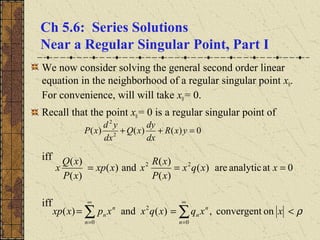
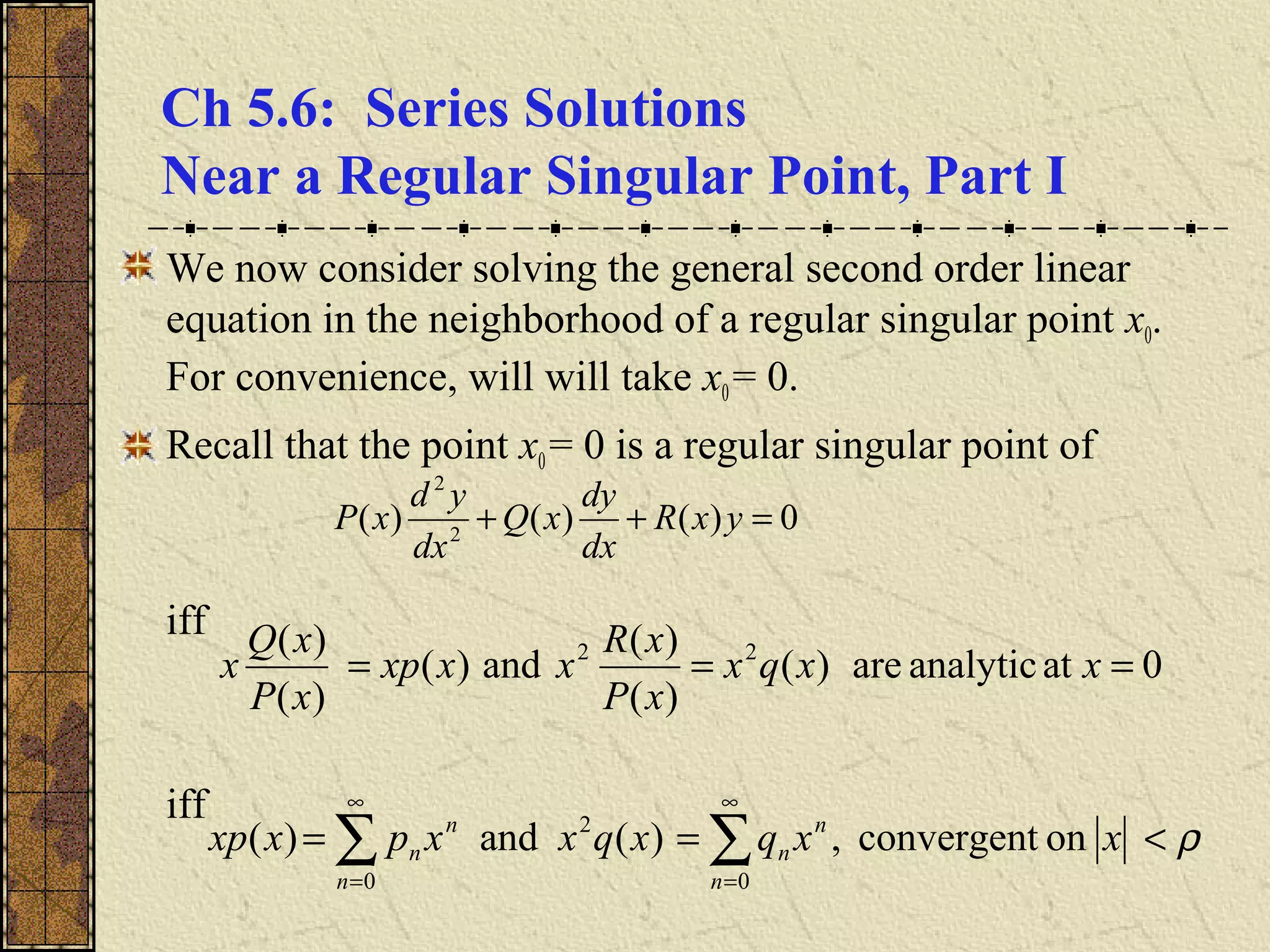
We now consider solving the general second order linear
equation in the neighborhood of a regular singular point x0.
For convenience, will will take x0= 0.
Recall that the point x0= 0 is a regular singular point of
iff
iff
0)()()( 2
2
=++ yxR
dx
dy
xQ
dx
yd
xP
0atanalyticare)(
)(
)(
and)(
)(
)( 22
=== xxqx
xP
xR
xxxp
xP
xQ
x
onconvergent,)(and)(
0
2
0
ρ<== ∑∑
∞
=
∞
= n
n
n
n
n
n xxqxqxxpxxp
Transforming Differential Equation
Our differential equation has the form
Dividing by P(x) and multiplying by x2
, we obtain
Substituting in the power series representations of p and q,
we obtain
0)()()( =+′+′′ yxRyxQyxP
∑∑
∞
=
∞
=
==
0
2
0
,)(,)(
n
n
n
n
n
n xqxqxxpxxp
[ ] [ ] 0)()( 22
=+′+′′ yxqxyxxpxyx
( ) ( ) 02
210
2
210
2
=++++′++++′′ yxqxqqyxpxppxyx 
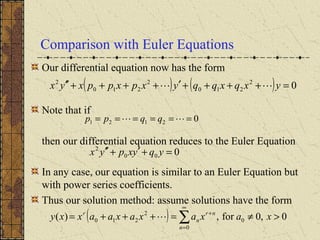
Comparison with Euler Equations
Our differential equation now has the form
Note that if
then our differential equation reduces to the Euler Equation
In any case, our equation is similar to an Euler Equation but
with power series coefficients.
Thus our solution method: assume solutions have the form
( ) 0,0for,)(
0
0
2
210 ∑
∞
=
+
>≠=+++=
n
nr
n
r
xaxaxaxaaxxy 
( ) ( ) 02
210
2
210
2
=++++′++++′′ yxqxqqyxpxppxyx 
02121 ======  qqpp
000
2
=+′+′′ yqyxpyx
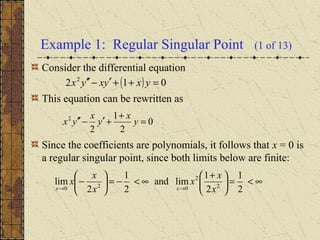
Example 1: Regular Singular Point (1 of 13)
Consider the differential equation
This equation can be rewritten as
Since the coefficients are polynomials, it follows that x = 0 is
a regular singular point, since both limits below are finite:
( ) 012 2
=++′−′′ yxyxyx
0
2
1
2
2
=
+
+′−′′ y
x
y
x
yx
∞<=




 +
∞<−=





−
→→ 2
1
2
1
limand
2
1
2
lim 2
2
020 x
x
x
x
x
x
xx
Example 1: Euler Equation (2 of 13)
Now xp(x) = -1/2 and x2
q(x) = (1 + x )/2, and thus for
it follows that
Thus the corresponding Euler Equation is
As in Section 5.5, we obtain
We will refer to this result later.
0,2/1,2/1,2/1 3221100 ========−=  qqppqqp
∑∑
∞
=
∞
=
==
0
2
0
,)(,)(
n
n
n
n
n
n xqxqxxpxxp
020 2
00
2
=+′−′′⇔=+′+′′ yyxyxyqyxpyx
[ ] ( )( ) 2/1,1011201)1(2 ==⇔=−−⇔=+−− rrrrrrrxr
( ) 012 2
=++′−′′ yxyxyx
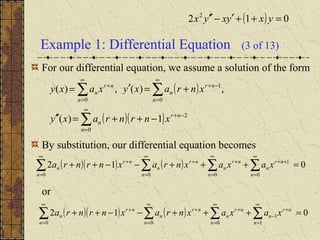
Example 1: Differential Equation (3 of 13)
For our differential equation, we assume a solution of the form
By substitution, our differential equation becomes
or
( ) 012 2
=++′−′′ yxyxyx
( )
( )( )∑
∑ ∑
∞
=
−+
∞
=
∞
=
−++
−++=′′
+=′=
0
2
0 0
1
1)(
,)(,)(
n
nr
n
n n
nr
n
nr
n
xnrnraxy
xnraxyxaxy
( )( ) ( ) 012
0
1
000
=+++−−++ ∑∑∑∑
∞
=
++
∞
=
+
∞
=
+
∞
=
+
n
nr
n
n
nr
n
n
nr
n
n
nr
n xaxaxnraxnrnra
( )( ) ( ) 012
1
1
000
=+++−−++ ∑∑∑∑
∞
=
+
−
∞
=
+
∞
=
+
∞
=
+
n
nr
n
n
nr
n
n
nr
n
n
nr
n xaxaxnraxnrnra
Example 1: Combining Series (4 of 13)
Our equation
can next be written as
It follows that
and
( )( ) ( ) 012
1
1
000
=+++−−++ ∑∑∑∑
∞
=
+
−
∞
=
+
∞
=
+
∞
=
+
n
nr
n
n
nr
n
n
nr
n
n
nr
n xaxaxnraxnrnra
[ ] ( )( )[ ]{ } 01)(121)1(2
1
10 =+++−−++++−− ∑
∞
=
+
−
n
nr
nn
r
xanrnrnraxrrra
[ ] 01)1(20 =+−− rrra
( )( )[ ] ,2,1,01)(12 1 ==+++−−++ − nanrnrnra nn
Example 1: Indicial Equation (5 of 13)
From the previous slide, we have
The equation
is called the indicial equation, and was obtained earlier when
we examined the corresponding Euler Equation.
The roots r1= 1, r2 = ½, of the indicial equation are called the
exponents of the singularity, for regular singular point x = 0.
The exponents of the singularity determine the qualitative
behavior of solution in neighborhood of regular singular point.
[ ] 0)1)(12(13201)1(2 2
0
0
0
=−−=+−⇔=+−−
≠
rrrrrrra
a
[ ] ( )( )[ ]{ } 01)(121)1(2
1
10 =+++−−++++−− ∑
∞
=
+
−
n
nr
nn
r
xanrnrnraxrrra
Example 1: Recursion Relation (6 of 13)
Recall that
We now work with the coefficient on xr+n
:
It follows that
[ ] ( )( )[ ]{ } 01)(121)1(2
1
10 =+++−−++++−− ∑
∞
=
+
−
n
nr
nn
r
xanrnrnraxrrra
( )( )[ ] 01)(12 1 =+++−−++ −nn anrnrnra
( )( )
( )
( )[ ] ( )[ ]
1,
112
1)(32
1)(12
1
2
1
1
≥
−+−+
−=
++−+
−=
++−−++
−=
−
−
−
n
nrnr
a
nrnr
a
nrnrnr
a
a
n
n
n
n
Example 1: First Root (7 of 13)
We have
Starting with r1= 1, this recursion becomes
Thus
( )[ ] ( )[ ]
2/1and1,1for,
112
11
1
==≥
−+−+
−= −
rrn
nrnr
a
a n
n
( )[ ] ( )[ ] ( )
1,
1211112
11
≥
+
−=
−+−+
−= −−
n
nn
a
nn
a
a nn
n
( )( )215325
13
01
2
0
1
⋅⋅
=
⋅
−=
⋅
−=
aa
a
a
a
( )( )
( )( )
1,
!12753
)1(
etc,
32175337
0
02
3
≥
+⋅⋅
−
=
⋅⋅⋅⋅
−=
⋅
−=
n
nn
a
a
aa
a
n
n

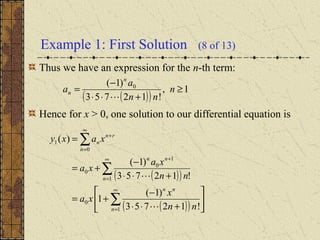
Example 1: First Solution (8 of 13)
Thus we have an expression for the n-th term:
Hence for x > 0, one solution to our differential equation is
( )( )
1,
!12753
)1( 0
≥
+⋅⋅
−
= n
nn
a
a
n
n

( )( )
( )( ) 





+⋅⋅
−
+=
+⋅⋅
−
+=
=
∑
∑
∑
∞
=
∞
=
+
+
∞
=
1
0
1
1
0
0
0
1
!12753
)1(
1
!12753
)1(
)(
n
nn
n
nn
rn
n
n
nn
x
xa
nn
xa
xa
xaxy


Example 1: Radius of Convergence for
First Solution (9 of 13)
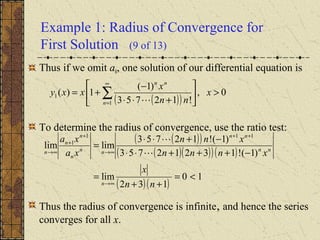
Thus if we omit a0, one solution of our differential equation is
To determine the radius of convergence, use the ratio test:
Thus the radius of convergence is infinite, and hence the series
converges for all x.
( )( )
0,
!12753
)1(
1)(
1
1 >





+⋅⋅
−
+= ∑
∞
=
x
nn
x
xxy
n
nn

( )( )
( )( )( )( )
( )( )
10
132
lim
)1(!13212753
)1(!12753
limlim
111
1
<=
++
=
−+++⋅⋅
−+⋅⋅
=
∞→
++
∞→
+
+
∞→
nn
x
xnnn
xnn
xa
xa
n
nn
nn
nn
n
n
n
n 

Example 1: Second Root (10 of 13)
Recall that
When r1= 1/2, this recursion becomes
Thus
( )[ ] ( )[ ]
2/1and1,1for,
112
11
1
==≥
−+−+
−= −
rrn
nrnr
a
a n
n
( )[ ] ( )[ ] ( ) ( )
1,
122/1212/112/12
111
≥
−
−=
−
−=
−+−+
−= −−−
n
nn
a
nn
a
nn
a
a nnn
n
( )( )312132
11
01
2
0
1
⋅⋅
=
⋅
−=
⋅
−=
aa
a
a
a
( )( )
( ) ( )( )
1,
!12531
)1(
etc,
53132153
0
02
3
≥
−⋅⋅
−
=
⋅⋅⋅⋅
−=
⋅
−=
n
nn
a
a
aa
a
n
n

Example 1: Second Solution (11 of 13)
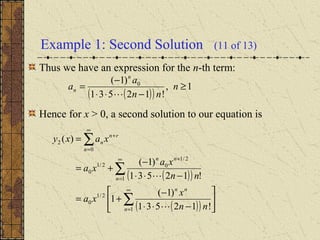
Thus we have an expression for the n-th term:
Hence for x > 0, a second solution to our equation is
( )( )
1,
!12531
)1( 0
≥
−⋅⋅
−
= n
nn
a
a
n
n

( )( )
( )( ) 





−⋅⋅
−
+=
−⋅⋅
−
+=
=
∑
∑
∑
∞
=
∞
=
+
+
∞
=
1
2/1
0
1
2/1
02/1
0
0
2
!12531
)1(
1
!12531
)1(
)(
n
nn
n
nn
rn
n
n
nn
x
xa
nn
xa
xa
xaxy


Example 1: Radius of Convergence for
Second Solution (12 of 13)
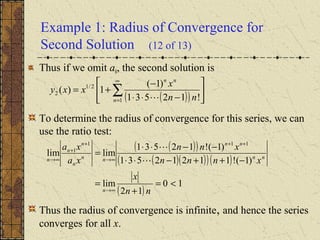
Thus if we omit a0, the second solution is
To determine the radius of convergence for this series, we can
use the ratio test:
Thus the radius of convergence is infinite, and hence the series
converges for all x.
( )( )
( )( )( )( )
( )
10
12
lim
)1(!11212531
)1(!12531
limlim
111
1
<=
+
=
−++−⋅⋅
−−⋅⋅
=
∞→
++
∞→
+
+
∞→
nn
x
xnnn
xnn
xa
xa
n
nn
nn
nn
n
n
n
n 

( )( ) 





−⋅⋅
−
+= ∑
∞
=1
2/1
2
!12531
)1(
1)(
n
nn
nn
x
xxy

Example 1: General Solution (13 of 13)
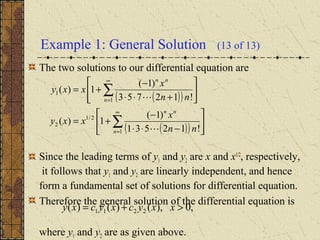
The two solutions to our differential equation are
Since the leading terms of y1 and y2 are x and x1/2
, respectively,
it follows that y1 and y2 are linearly independent, and hence
form a fundamental set of solutions for differential equation.
Therefore the general solution of the differential equation is
where y1 and y2 are as given above.
( )( )
( )( ) 





−⋅⋅
−
+=






+⋅⋅
−
+=
∑
∑
∞
=
∞
=
1
2/1
2
1
1
!12531
)1(
1)(
!12753
)1(
1)(
n
nn
n
nn
nn
x
xxy
nn
x
xxy


,0),()()( 2211 >+= xxycxycxy
Shifted Expansions & Discussion
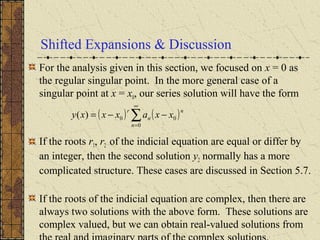
For the analysis given in this section, we focused on x = 0 as
the regular singular point. In the more general case of a
singular point at x = x0, our series solution will have the form
If the roots r1, r2 of the indicial equation are equal or differ by
an integer, then the second solution y2 normally has a more
complicated structure. These cases are discussed in Section 5.7.
If the roots of the indicial equation are complex, then there are
always two solutions with the above form. These solutions are
complex valued, but we can obtain real-valued solutions from
( ) ( )n
n
n
r
xxaxxxy 0
0
0)( −−= ∑
∞
=

Ch05 6

  • 1.
    Ch 5.6: SeriesSolutions Near a Regular Singular Point, Part I We now consider solving the general second order linear equation in the neighborhood of a regular singular point x0. For convenience, will will take x0= 0. Recall that the point x0= 0 is a regular singular point of iff iff 0)()()( 2 2 =++ yxR dx dy xQ dx yd xP 0atanalyticare)( )( )( and)( )( )( 22 === xxqx xP xR xxxp xP xQ x onconvergent,)(and)( 0 2 0 ρ<== ∑∑ ∞ = ∞ = n n n n n n xxqxqxxpxxp
  • 2.
    Transforming Differential Equation Ourdifferential equation has the form Dividing by P(x) and multiplying by x2 , we obtain Substituting in the power series representations of p and q, we obtain 0)()()( =+′+′′ yxRyxQyxP ∑∑ ∞ = ∞ = == 0 2 0 ,)(,)( n n n n n n xqxqxxpxxp [ ] [ ] 0)()( 22 =+′+′′ yxqxyxxpxyx ( ) ( ) 02 210 2 210 2 =++++′++++′′ yxqxqqyxpxppxyx 
  • 3.
    Comparison with EulerEquations Our differential equation now has the form Note that if then our differential equation reduces to the Euler Equation In any case, our equation is similar to an Euler Equation but with power series coefficients. Thus our solution method: assume solutions have the form ( ) 0,0for,)( 0 0 2 210 ∑ ∞ = + >≠=+++= n nr n r xaxaxaxaaxxy  ( ) ( ) 02 210 2 210 2 =++++′++++′′ yxqxqqyxpxppxyx  02121 ======  qqpp 000 2 =+′+′′ yqyxpyx
  • 4.
    Example 1: RegularSingular Point (1 of 13) Consider the differential equation This equation can be rewritten as Since the coefficients are polynomials, it follows that x = 0 is a regular singular point, since both limits below are finite: ( ) 012 2 =++′−′′ yxyxyx 0 2 1 2 2 = + +′−′′ y x y x yx ∞<=      + ∞<−=      − →→ 2 1 2 1 limand 2 1 2 lim 2 2 020 x x x x x x xx
  • 5.
    Example 1: EulerEquation (2 of 13) Now xp(x) = -1/2 and x2 q(x) = (1 + x )/2, and thus for it follows that Thus the corresponding Euler Equation is As in Section 5.5, we obtain We will refer to this result later. 0,2/1,2/1,2/1 3221100 ========−=  qqppqqp ∑∑ ∞ = ∞ = == 0 2 0 ,)(,)( n n n n n n xqxqxxpxxp 020 2 00 2 =+′−′′⇔=+′+′′ yyxyxyqyxpyx [ ] ( )( ) 2/1,1011201)1(2 ==⇔=−−⇔=+−− rrrrrrrxr ( ) 012 2 =++′−′′ yxyxyx
  • 6.
    Example 1: DifferentialEquation (3 of 13) For our differential equation, we assume a solution of the form By substitution, our differential equation becomes or ( ) 012 2 =++′−′′ yxyxyx ( ) ( )( )∑ ∑ ∑ ∞ = −+ ∞ = ∞ = −++ −++=′′ +=′= 0 2 0 0 1 1)( ,)(,)( n nr n n n nr n nr n xnrnraxy xnraxyxaxy ( )( ) ( ) 012 0 1 000 =+++−−++ ∑∑∑∑ ∞ = ++ ∞ = + ∞ = + ∞ = + n nr n n nr n n nr n n nr n xaxaxnraxnrnra ( )( ) ( ) 012 1 1 000 =+++−−++ ∑∑∑∑ ∞ = + − ∞ = + ∞ = + ∞ = + n nr n n nr n n nr n n nr n xaxaxnraxnrnra
  • 7.
    Example 1: CombiningSeries (4 of 13) Our equation can next be written as It follows that and ( )( ) ( ) 012 1 1 000 =+++−−++ ∑∑∑∑ ∞ = + − ∞ = + ∞ = + ∞ = + n nr n n nr n n nr n n nr n xaxaxnraxnrnra [ ] ( )( )[ ]{ } 01)(121)1(2 1 10 =+++−−++++−− ∑ ∞ = + − n nr nn r xanrnrnraxrrra [ ] 01)1(20 =+−− rrra ( )( )[ ] ,2,1,01)(12 1 ==+++−−++ − nanrnrnra nn
  • 8.
    Example 1: IndicialEquation (5 of 13) From the previous slide, we have The equation is called the indicial equation, and was obtained earlier when we examined the corresponding Euler Equation. The roots r1= 1, r2 = ½, of the indicial equation are called the exponents of the singularity, for regular singular point x = 0. The exponents of the singularity determine the qualitative behavior of solution in neighborhood of regular singular point. [ ] 0)1)(12(13201)1(2 2 0 0 0 =−−=+−⇔=+−− ≠ rrrrrrra a [ ] ( )( )[ ]{ } 01)(121)1(2 1 10 =+++−−++++−− ∑ ∞ = + − n nr nn r xanrnrnraxrrra
  • 9.
    Example 1: RecursionRelation (6 of 13) Recall that We now work with the coefficient on xr+n : It follows that [ ] ( )( )[ ]{ } 01)(121)1(2 1 10 =+++−−++++−− ∑ ∞ = + − n nr nn r xanrnrnraxrrra ( )( )[ ] 01)(12 1 =+++−−++ −nn anrnrnra ( )( ) ( ) ( )[ ] ( )[ ] 1, 112 1)(32 1)(12 1 2 1 1 ≥ −+−+ −= ++−+ −= ++−−++ −= − − − n nrnr a nrnr a nrnrnr a a n n n n
  • 10.
    Example 1: FirstRoot (7 of 13) We have Starting with r1= 1, this recursion becomes Thus ( )[ ] ( )[ ] 2/1and1,1for, 112 11 1 ==≥ −+−+ −= − rrn nrnr a a n n ( )[ ] ( )[ ] ( ) 1, 1211112 11 ≥ + −= −+−+ −= −− n nn a nn a a nn n ( )( )215325 13 01 2 0 1 ⋅⋅ = ⋅ −= ⋅ −= aa a a a ( )( ) ( )( ) 1, !12753 )1( etc, 32175337 0 02 3 ≥ +⋅⋅ − = ⋅⋅⋅⋅ −= ⋅ −= n nn a a aa a n n 
  • 11.
    Example 1: FirstSolution (8 of 13) Thus we have an expression for the n-th term: Hence for x > 0, one solution to our differential equation is ( )( ) 1, !12753 )1( 0 ≥ +⋅⋅ − = n nn a a n n  ( )( ) ( )( )       +⋅⋅ − += +⋅⋅ − += = ∑ ∑ ∑ ∞ = ∞ = + + ∞ = 1 0 1 1 0 0 0 1 !12753 )1( 1 !12753 )1( )( n nn n nn rn n n nn x xa nn xa xa xaxy  
  • 12.
    Example 1: Radiusof Convergence for First Solution (9 of 13) Thus if we omit a0, one solution of our differential equation is To determine the radius of convergence, use the ratio test: Thus the radius of convergence is infinite, and hence the series converges for all x. ( )( ) 0, !12753 )1( 1)( 1 1 >      +⋅⋅ − += ∑ ∞ = x nn x xxy n nn  ( )( ) ( )( )( )( ) ( )( ) 10 132 lim )1(!13212753 )1(!12753 limlim 111 1 <= ++ = −+++⋅⋅ −+⋅⋅ = ∞→ ++ ∞→ + + ∞→ nn x xnnn xnn xa xa n nn nn nn n n n n  
  • 13.
    Example 1: SecondRoot (10 of 13) Recall that When r1= 1/2, this recursion becomes Thus ( )[ ] ( )[ ] 2/1and1,1for, 112 11 1 ==≥ −+−+ −= − rrn nrnr a a n n ( )[ ] ( )[ ] ( ) ( ) 1, 122/1212/112/12 111 ≥ − −= − −= −+−+ −= −−− n nn a nn a nn a a nnn n ( )( )312132 11 01 2 0 1 ⋅⋅ = ⋅ −= ⋅ −= aa a a a ( )( ) ( ) ( )( ) 1, !12531 )1( etc, 53132153 0 02 3 ≥ −⋅⋅ − = ⋅⋅⋅⋅ −= ⋅ −= n nn a a aa a n n 
  • 14.
    Example 1: SecondSolution (11 of 13) Thus we have an expression for the n-th term: Hence for x > 0, a second solution to our equation is ( )( ) 1, !12531 )1( 0 ≥ −⋅⋅ − = n nn a a n n  ( )( ) ( )( )       −⋅⋅ − += −⋅⋅ − += = ∑ ∑ ∑ ∞ = ∞ = + + ∞ = 1 2/1 0 1 2/1 02/1 0 0 2 !12531 )1( 1 !12531 )1( )( n nn n nn rn n n nn x xa nn xa xa xaxy  
  • 15.
    Example 1: Radiusof Convergence for Second Solution (12 of 13) Thus if we omit a0, the second solution is To determine the radius of convergence for this series, we can use the ratio test: Thus the radius of convergence is infinite, and hence the series converges for all x. ( )( ) ( )( )( )( ) ( ) 10 12 lim )1(!11212531 )1(!12531 limlim 111 1 <= + = −++−⋅⋅ −−⋅⋅ = ∞→ ++ ∞→ + + ∞→ nn x xnnn xnn xa xa n nn nn nn n n n n   ( )( )       −⋅⋅ − += ∑ ∞ =1 2/1 2 !12531 )1( 1)( n nn nn x xxy 
  • 16.
    Example 1: GeneralSolution (13 of 13) The two solutions to our differential equation are Since the leading terms of y1 and y2 are x and x1/2 , respectively, it follows that y1 and y2 are linearly independent, and hence form a fundamental set of solutions for differential equation. Therefore the general solution of the differential equation is where y1 and y2 are as given above. ( )( ) ( )( )       −⋅⋅ − +=       +⋅⋅ − += ∑ ∑ ∞ = ∞ = 1 2/1 2 1 1 !12531 )1( 1)( !12753 )1( 1)( n nn n nn nn x xxy nn x xxy   ,0),()()( 2211 >+= xxycxycxy
  • 17.
    Shifted Expansions &Discussion For the analysis given in this section, we focused on x = 0 as the regular singular point. In the more general case of a singular point at x = x0, our series solution will have the form If the roots r1, r2 of the indicial equation are equal or differ by an integer, then the second solution y2 normally has a more complicated structure. These cases are discussed in Section 5.7. If the roots of the indicial equation are complex, then there are always two solutions with the above form. These solutions are complex valued, but we can obtain real-valued solutions from ( ) ( )n n n r xxaxxxy 0 0 0)( −−= ∑ ∞ =