Ch 5.7: Series Solutions
Near a Regular Singular Point, Part II
Recall from Section 5.6 (Part I): The point x0= 0 is a regular
singular point of
with
and corresponding Euler Equation
We assume solutions have the form
[ ] [ ] 0)()( 22
=+′+′′ yxqxyxxpxyx
onconvergent,)(,)(
0
2
0
ρ<== ∑∑
∞
=
∞
= n
n
n
n
n
n xxqxqxxpxxp
000
2
=+′+′′ yqyxpyx
( ) 0,0for,,)(
0
0∑
∞
=
+
>≠==
n
nr
n xaxaxrxy φ
Substitute Derivatives into ODE
Taking derivatives, we have
Substituting these derivatives into the differential equation,
we obtain
( )
( )( )∑
∑ ∑
∞
=
−+
∞
=
∞
=
−++
−++=′′
+=′=
0
2
0 0
1
1)(
,)(,)(
n
nr
n
n n
nr
n
nr
n
xnrnraxy
xnraxyxaxy
( )( )
( ) 0
1
0000
0
=











+





+





+−++
∑∑∑∑
∑
∞
=
+
∞
=
∞
=
+
∞
=
∞
=
+
n
nr
n
n
r
n
n
nr
n
n
r
n
n
nr
n
xaxqxnraxp
xnrnra
[ ] [ ] 0)()( 22
=+′+′′ yxqxyxxpxyx
Multiplying Series
( )
[ ] ( ) ( )[ ]
[ ] [ ]
[ ] ( )[ ]
( ) ( )[ ]
( )[ ] ( ) ( )( )[ ]
( ) ( )( ) ( )( )[ ] 





+++++−++++
++++++++=
+++++++−+++
++++++++=
++++++++
+++++++++++=












+





+





+
−
+
+
−−
+
++
++
∞
=
+
∞
=
∞
=
+
∞
=
∑∑∑∑
nr
nnnn
rr
nr
nnnnnn
rr
nr
n
rrn
n
nr
n
rrn
n
n
nr
n
n
r
n
n
nr
n
n
r
n
xqnrpaqnrpaqrpa
xqrpaqrpaxqrpa
xaqaqaqrapnrapnrap
xaqaqraprapxaqrp
xaxaxaxqxqq
xnraxrarxaxpxpp
xaxqxnraxp
001110
1
001110000
01100110
1
01100110000
1
1010
1
1010
0000
1
1
1
1
1
Combining Terms in ODE
Our equation then becomes
( )( )
( )
( )( )
( )[ ] ( ) ( )( )[ ]
( ) ( )( ) ( )( )[ ]
( )[ ] ( ) ( )( )[ ]
( ) ( )( ) ( )( )[ ] 01
1)1()1(
01
1
1
0
1
000
1
001110000
001110
1
001110000
0
0000
0
=++++−++++++
++++++++++−=
=+++++−+++++
++++++++
−++=
=











+





+





+
−++
+
+
+
−
+
∞
=
+
∞
=
+
∞
=
∞
=
+
∞
=
∞
=
+
∑
∑∑∑∑
∑




nr
nnn
rr
nr
nnnn
rr
n
nr
n
n
nr
n
n
r
n
n
nr
n
n
r
n
n
nr
n
xqnrpnrnraqrpa
xqrprraqrpaxqrprra
xqnrpaqnrpaqrpa
xqrpaqrpaxqrpa
xnrnra
xaxqxnraxp
xnrnra
Rewriting ODE
Define F(r) by
We can then rewrite our equation
in more compact form:
( )[ ] ( ) ( )( )[ ]
( ) ( )( ) ( )( )[ ] 01
1)1()1(
000
1
001110000
=++++−+++++++
+++++++++−
+
+
 nr
nnn
rr
xqnrpnrnraqrpa
xqrprraqrpaxqrprra
00)1()( qrprrrF ++−=
[ ] 0)()()(
1
1
0
0 =






+++++ +
∞
=
−
=
−∑ ∑ nr
n
n
k
kknkn
r
xqpkranrFaxrFa
Indicial Equation
Thus our equation is
Since a0 ≠ 0, we must have
This indicial equation is the same one obtained when
seeking solutions y = xr
to the corresponding Euler Equation.
Note that F(r) is quadratic in r, and hence has two roots,
r1 and r2. If r1 and r2 are real, then assume r1 ≥ r2.
These roots are called the exponents at the singularity, and
they determine behavior of solution near singular point.
0)1()( 00 =++−= qrprrrF
[ ] 0)()()(
1
1
0
0 =






+++++ +
∞
=
−
=
−∑ ∑ nr
n
n
k
kknkn
r
xqpkranrFaxrFa
Recurrence Relation
From our equation,
the recurrence relation is
This recurrence relation shows that in general, an depends on
r and the previous coefficients a0, a1, …, an-1.
Note that we must have r = r1 or r = r2.
[ ] 0)()()(
1
1
0
0 =






+++++ +
∞
=
−
=
−∑ ∑ nr
n
n
k
kknkn
r
xqpkranrFaxrFa
[ ] 0)()(
1
0
=++++ ∑
−
=
−
n
k
kknkn qpkranrFa
Recurrence Relation & First Solution
With the recurrence relation
we can compute a1, …, an-1 in terms of a0, pm and qm, provided
F(r + 1), F(r + 2), …, F(r + n), … are not zero.
Recall r = r1 or r = r2, and these are the only roots of F(r).
Since r1 ≥ r2, we have r1+ n ≠ r1 and r1+ n ≠ r2 for n ≥ 1.
Thus F(r1+ n) ≠ 0 for n ≥ 1, and at least one solution exists:
where the notation an(r1) indicates that an has been determined
[ ] ,0)()(
1
0
=++++ ∑
−
=
−
n
k
kknkn qpkranrFa
0,1,)(1)( 0
1
11
1
>=





+= ∑
∞
=
xaxraxxy
n
n
n
r
Recurrence Relation & Second Solution
Now consider r = r2. Using the recurrence relation
we compute a1, …, an-1 in terms of a0, pm and qm, provided F(r2+
1), F(r2 + 2), …, F(r2+ n), … are not zero.
If r2 ≠ r1, and r2 - r1 ≠ n for n ≥ 1, then r2+ n ≠ r1 for n ≥ 1.
Thus F(r2+ n) ≠ 0 for n ≥ 1, and a second solution exists:
where the notation an(r2) indicates that an has been determined
using r = r2.
[ ] ,0)()(
1
0
=++++ ∑
−
=
−
n
k
kknkn qpkranrFa
0,1,)(1)( 0
1
22
2
>=





+= ∑
∞
=
xaxraxxy
n
n
n
r
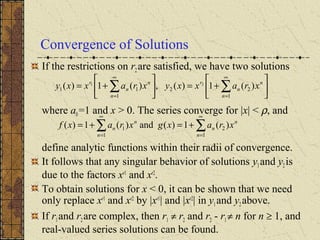
Convergence of Solutions
If the restrictions on r2 are satisfied, we have two solutions
where a0=1 and x > 0. The series converge for |x| < ρ, and
define analytic functions within their radii of convergence.
It follows that any singular behavior of solutions y1and y2is
due to the factors xr1
and xr2
.
To obtain solutions for x < 0, it can be shown that we need
only replace xr1
and xr2
by |xr1
| and |xr2
| in y1and y2 above.
If r1and r2are complex, then r1 ≠ r2 and r2 - r1 ≠ n for n ≥ 1, and
real-valued series solutions can be found.






+=





+= ∑∑
∞
=
∞
= 1
22
1
11 )(1)(,)(1)( 21
n
n
n
r
n
n
n
r
xraxxyxraxxy
∑∑
∞
=
∞
=
+=+=
1
2
1
1 )(1)(and)(1)(
n
n
n
n
n
n xraxgxraxf
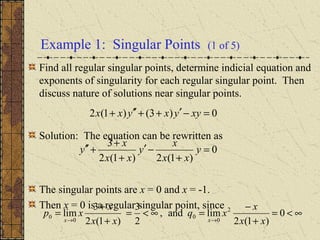
Example 1: Singular Points (1 of 5)
Find all regular singular points, determine indicial equation and
exponents of singularity for each regular singular point. Then
discuss nature of solutions near singular points.
Solution: The equation can be rewritten as
The singular points are x = 0 and x = -1.
Then x = 0 is a regular singular point, since
0)3()1(2 =−′++′′+ xyyxyxx
0
)1(2)1(2
3
=
+
−′
+
+
+′′ y
xx
x
y
xx
x
y
∞<=
+
−
=∞<=
+
+
=
→→
0
)1(2
limand,
2
3
)1(2
3
lim 2
0
0
0
0
xx
x
xq
xx
x
xp
xx
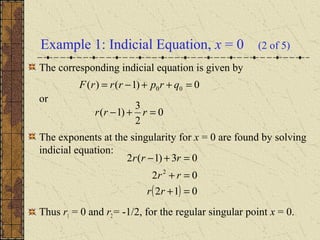
Example 1: Indicial Equation, x = 0 (2 of 5)
The corresponding indicial equation is given by
or
The exponents at the singularity for x = 0 are found by solving
indicial equation:
Thus r1 = 0 and r2= -1/2, for the regular singular point x = 0.
0)1()( 00 =++−= qrprrrF
0
2
3
)1( =+− rrr
( ) 012
02
03)1(2
2
=+
=+
=+−
rr
rr
rrr
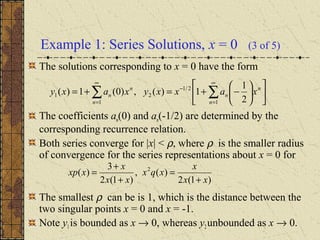
Example 1: Series Solutions, x = 0 (3 of 5)
The solutions corresponding to x = 0 have the form
The coefficients an(0) and an(-1/2) are determined by the
corresponding recurrence relation.
Both series converge for |x| < ρ, where ρ is the smaller radius
of convergence for the series representations about x = 0 for
The smallest ρ can be is 1, which is the distance between the
two singular points x = 0 and x = -1.
Note y1is bounded as x → 0, whereas y2unbounded as x → 0.












−+=+= ∑∑
∞
=
−
∞
= 1
2/1
2
1
1
2
1
1)(,)0(1)(
n
n
n
n
n
n xaxxyxaxy
)1(2
)(,
)1(2
3
)( 2
xx
x
xqx
xx
x
xxp
+
=
+
+
=
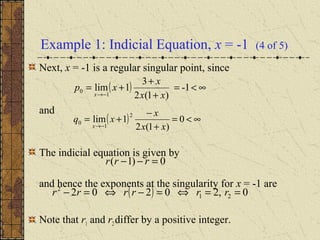
Example 1: Indicial Equation, x = -1 (4 of 5)
Next, x = -1 is a regular singular point, since
and
The indicial equation is given by
and hence the exponents at the singularity for x = -1 are
Note that r1 and r2 differ by a positive integer.
( ) ∞<=
+
+
+=
−→
1-
)1(2
3
1lim
1
0
xx
x
xp
x
( ) ∞<=
+
−
+=
−→
0
)1(2
1lim
2
1
0
xx
x
xq
x
0)1( =−− rrr
( ) 0,20202 21
2
==⇔=−⇔=− rrrrrr
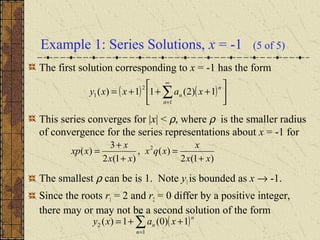
Example 1: Series Solutions, x = -1 (5 of 5)
The first solution corresponding to x = -1 has the form
This series converges for |x| < ρ, where ρ is the smaller radius
of convergence for the series representations about x = -1 for
The smallest ρ can be is 1. Note y1 is bounded as x → -1.
Since the roots r1 = 2 and r2 = 0 differ by a positive integer,
there may or may not be a second solution of the form
( ) ( ) 





+++= ∑
∞
=1
2
1 1)2(11)(
n
n
n xaxxy
)1(2
)(,
)1(2
3
)( 2
xx
x
xqx
xx
x
xxp
+
=
+
+
=
( )∑
∞
=
++=
1
2 1)0(1)(
n
n
n xaxy
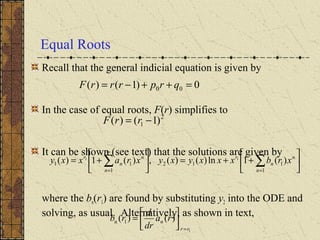
Equal Roots
Recall that the general indicial equation is given by
In the case of equal roots, F(r) simplifies to
It can be shown (see text) that the solutions are given by
where the bn(r1) are found by substituting y2 into the ODE and
solving, as usual. Alternatively, as shown in text,
0)1()( 00 =++−= qrprrrF
2
1 )1()( −= rrF






++=





+= ∑∑
∞
=
∞
= 1
112
1
11 )(1ln)()(,)(1)( 11
n
n
n
r
n
n
n
r
xrbxxxyxyxraxxy
1
)()( 1
rr
nn ra
dr
d
rb
=






=
Roots Differing by an Integer
If roots of indicial equation differ by a positive integer, i.e.,
r1 – r2 = N, it can be shown that the ODE solns are given by
where the cn(r1) are found by substituting y2 into the
differential equation and solving, as usual. Alternatively,
and
See Theorem 5.7.1 for a summary of results in this section.






++=





+= ∑∑
∞
=
∞
= 1
212
1
11 )(1ln)()(,)(1)( 21
n
n
n
r
n
n
n
r
xrcxxxayxyxraxxy
( )[ ] ,2,1,)()( 221 =−= =
nrarr
dr
d
rc rrnn
( )[ ] Nrrrarra rrN
rr
=−−= =→
212 where,)(lim 2
2

Ch05 7

  • 1.
    Ch 5.7: SeriesSolutions Near a Regular Singular Point, Part II Recall from Section 5.6 (Part I): The point x0= 0 is a regular singular point of with and corresponding Euler Equation We assume solutions have the form [ ] [ ] 0)()( 22 =+′+′′ yxqxyxxpxyx onconvergent,)(,)( 0 2 0 ρ<== ∑∑ ∞ = ∞ = n n n n n n xxqxqxxpxxp 000 2 =+′+′′ yqyxpyx ( ) 0,0for,,)( 0 0∑ ∞ = + >≠== n nr n xaxaxrxy φ
  • 2.
    Substitute Derivatives intoODE Taking derivatives, we have Substituting these derivatives into the differential equation, we obtain ( ) ( )( )∑ ∑ ∑ ∞ = −+ ∞ = ∞ = −++ −++=′′ +=′= 0 2 0 0 1 1)( ,)(,)( n nr n n n nr n nr n xnrnraxy xnraxyxaxy ( )( ) ( ) 0 1 0000 0 =            +      +      +−++ ∑∑∑∑ ∑ ∞ = + ∞ = ∞ = + ∞ = ∞ = + n nr n n r n n nr n n r n n nr n xaxqxnraxp xnrnra [ ] [ ] 0)()( 22 =+′+′′ yxqxyxxpxyx
  • 3.
    Multiplying Series ( ) [] ( ) ( )[ ] [ ] [ ] [ ] ( )[ ] ( ) ( )[ ] ( )[ ] ( ) ( )( )[ ] ( ) ( )( ) ( )( )[ ]       +++++−++++ ++++++++= +++++++−+++ ++++++++= ++++++++ +++++++++++=             +      +      + − + + −− + ++ ++ ∞ = + ∞ = ∞ = + ∞ = ∑∑∑∑ nr nnnn rr nr nnnnnn rr nr n rrn n nr n rrn n n nr n n r n n nr n n r n xqnrpaqnrpaqrpa xqrpaqrpaxqrpa xaqaqaqrapnrapnrap xaqaqraprapxaqrp xaxaxaxqxqq xnraxrarxaxpxpp xaxqxnraxp 001110 1 001110000 01100110 1 01100110000 1 1010 1 1010 0000 1 1 1 1 1
  • 4.
    Combining Terms inODE Our equation then becomes ( )( ) ( ) ( )( ) ( )[ ] ( ) ( )( )[ ] ( ) ( )( ) ( )( )[ ] ( )[ ] ( ) ( )( )[ ] ( ) ( )( ) ( )( )[ ] 01 1)1()1( 01 1 1 0 1 000 1 001110000 001110 1 001110000 0 0000 0 =++++−++++++ ++++++++++−= =+++++−+++++ ++++++++ −++= =            +      +      + −++ + + + − + ∞ = + ∞ = + ∞ = ∞ = + ∞ = ∞ = + ∑ ∑∑∑∑ ∑     nr nnn rr nr nnnn rr n nr n n nr n n r n n nr n n r n n nr n xqnrpnrnraqrpa xqrprraqrpaxqrprra xqnrpaqnrpaqrpa xqrpaqrpaxqrpa xnrnra xaxqxnraxp xnrnra
  • 5.
    Rewriting ODE Define F(r)by We can then rewrite our equation in more compact form: ( )[ ] ( ) ( )( )[ ] ( ) ( )( ) ( )( )[ ] 01 1)1()1( 000 1 001110000 =++++−+++++++ +++++++++− + +  nr nnn rr xqnrpnrnraqrpa xqrprraqrpaxqrprra 00)1()( qrprrrF ++−= [ ] 0)()()( 1 1 0 0 =       +++++ + ∞ = − = −∑ ∑ nr n n k kknkn r xqpkranrFaxrFa
  • 6.
    Indicial Equation Thus ourequation is Since a0 ≠ 0, we must have This indicial equation is the same one obtained when seeking solutions y = xr to the corresponding Euler Equation. Note that F(r) is quadratic in r, and hence has two roots, r1 and r2. If r1 and r2 are real, then assume r1 ≥ r2. These roots are called the exponents at the singularity, and they determine behavior of solution near singular point. 0)1()( 00 =++−= qrprrrF [ ] 0)()()( 1 1 0 0 =       +++++ + ∞ = − = −∑ ∑ nr n n k kknkn r xqpkranrFaxrFa
  • 7.
    Recurrence Relation From ourequation, the recurrence relation is This recurrence relation shows that in general, an depends on r and the previous coefficients a0, a1, …, an-1. Note that we must have r = r1 or r = r2. [ ] 0)()()( 1 1 0 0 =       +++++ + ∞ = − = −∑ ∑ nr n n k kknkn r xqpkranrFaxrFa [ ] 0)()( 1 0 =++++ ∑ − = − n k kknkn qpkranrFa
  • 8.
    Recurrence Relation &First Solution With the recurrence relation we can compute a1, …, an-1 in terms of a0, pm and qm, provided F(r + 1), F(r + 2), …, F(r + n), … are not zero. Recall r = r1 or r = r2, and these are the only roots of F(r). Since r1 ≥ r2, we have r1+ n ≠ r1 and r1+ n ≠ r2 for n ≥ 1. Thus F(r1+ n) ≠ 0 for n ≥ 1, and at least one solution exists: where the notation an(r1) indicates that an has been determined [ ] ,0)()( 1 0 =++++ ∑ − = − n k kknkn qpkranrFa 0,1,)(1)( 0 1 11 1 >=      += ∑ ∞ = xaxraxxy n n n r
  • 9.
    Recurrence Relation &Second Solution Now consider r = r2. Using the recurrence relation we compute a1, …, an-1 in terms of a0, pm and qm, provided F(r2+ 1), F(r2 + 2), …, F(r2+ n), … are not zero. If r2 ≠ r1, and r2 - r1 ≠ n for n ≥ 1, then r2+ n ≠ r1 for n ≥ 1. Thus F(r2+ n) ≠ 0 for n ≥ 1, and a second solution exists: where the notation an(r2) indicates that an has been determined using r = r2. [ ] ,0)()( 1 0 =++++ ∑ − = − n k kknkn qpkranrFa 0,1,)(1)( 0 1 22 2 >=      += ∑ ∞ = xaxraxxy n n n r
  • 10.
    Convergence of Solutions Ifthe restrictions on r2 are satisfied, we have two solutions where a0=1 and x > 0. The series converge for |x| < ρ, and define analytic functions within their radii of convergence. It follows that any singular behavior of solutions y1and y2is due to the factors xr1 and xr2 . To obtain solutions for x < 0, it can be shown that we need only replace xr1 and xr2 by |xr1 | and |xr2 | in y1and y2 above. If r1and r2are complex, then r1 ≠ r2 and r2 - r1 ≠ n for n ≥ 1, and real-valued series solutions can be found.       +=      += ∑∑ ∞ = ∞ = 1 22 1 11 )(1)(,)(1)( 21 n n n r n n n r xraxxyxraxxy ∑∑ ∞ = ∞ = +=+= 1 2 1 1 )(1)(and)(1)( n n n n n n xraxgxraxf
  • 11.
    Example 1: SingularPoints (1 of 5) Find all regular singular points, determine indicial equation and exponents of singularity for each regular singular point. Then discuss nature of solutions near singular points. Solution: The equation can be rewritten as The singular points are x = 0 and x = -1. Then x = 0 is a regular singular point, since 0)3()1(2 =−′++′′+ xyyxyxx 0 )1(2)1(2 3 = + −′ + + +′′ y xx x y xx x y ∞<= + − =∞<= + + = →→ 0 )1(2 limand, 2 3 )1(2 3 lim 2 0 0 0 0 xx x xq xx x xp xx
  • 12.
    Example 1: IndicialEquation, x = 0 (2 of 5) The corresponding indicial equation is given by or The exponents at the singularity for x = 0 are found by solving indicial equation: Thus r1 = 0 and r2= -1/2, for the regular singular point x = 0. 0)1()( 00 =++−= qrprrrF 0 2 3 )1( =+− rrr ( ) 012 02 03)1(2 2 =+ =+ =+− rr rr rrr
  • 13.
    Example 1: SeriesSolutions, x = 0 (3 of 5) The solutions corresponding to x = 0 have the form The coefficients an(0) and an(-1/2) are determined by the corresponding recurrence relation. Both series converge for |x| < ρ, where ρ is the smaller radius of convergence for the series representations about x = 0 for The smallest ρ can be is 1, which is the distance between the two singular points x = 0 and x = -1. Note y1is bounded as x → 0, whereas y2unbounded as x → 0.             −+=+= ∑∑ ∞ = − ∞ = 1 2/1 2 1 1 2 1 1)(,)0(1)( n n n n n n xaxxyxaxy )1(2 )(, )1(2 3 )( 2 xx x xqx xx x xxp + = + + =
  • 14.
    Example 1: IndicialEquation, x = -1 (4 of 5) Next, x = -1 is a regular singular point, since and The indicial equation is given by and hence the exponents at the singularity for x = -1 are Note that r1 and r2 differ by a positive integer. ( ) ∞<= + + += −→ 1- )1(2 3 1lim 1 0 xx x xp x ( ) ∞<= + − += −→ 0 )1(2 1lim 2 1 0 xx x xq x 0)1( =−− rrr ( ) 0,20202 21 2 ==⇔=−⇔=− rrrrrr
  • 15.
    Example 1: SeriesSolutions, x = -1 (5 of 5) The first solution corresponding to x = -1 has the form This series converges for |x| < ρ, where ρ is the smaller radius of convergence for the series representations about x = -1 for The smallest ρ can be is 1. Note y1 is bounded as x → -1. Since the roots r1 = 2 and r2 = 0 differ by a positive integer, there may or may not be a second solution of the form ( ) ( )       +++= ∑ ∞ =1 2 1 1)2(11)( n n n xaxxy )1(2 )(, )1(2 3 )( 2 xx x xqx xx x xxp + = + + = ( )∑ ∞ = ++= 1 2 1)0(1)( n n n xaxy
  • 16.
    Equal Roots Recall thatthe general indicial equation is given by In the case of equal roots, F(r) simplifies to It can be shown (see text) that the solutions are given by where the bn(r1) are found by substituting y2 into the ODE and solving, as usual. Alternatively, as shown in text, 0)1()( 00 =++−= qrprrrF 2 1 )1()( −= rrF       ++=      += ∑∑ ∞ = ∞ = 1 112 1 11 )(1ln)()(,)(1)( 11 n n n r n n n r xrbxxxyxyxraxxy 1 )()( 1 rr nn ra dr d rb =       =
  • 17.
    Roots Differing byan Integer If roots of indicial equation differ by a positive integer, i.e., r1 – r2 = N, it can be shown that the ODE solns are given by where the cn(r1) are found by substituting y2 into the differential equation and solving, as usual. Alternatively, and See Theorem 5.7.1 for a summary of results in this section.       ++=      += ∑∑ ∞ = ∞ = 1 212 1 11 )(1ln)()(,)(1)( 21 n n n r n n n r xrcxxxayxyxraxxy ( )[ ] ,2,1,)()( 221 =−= = nrarr dr d rc rrnn ( )[ ] Nrrrarra rrN rr =−−= =→ 212 where,)(lim 2 2