Hotspot of Biodiversity
in India
Presented By:
Arijit Dhali
Introduction
A brief description
about the topic
“Biodiversity Hotspot”
About
Major “Biodiversity
Hotspots” in India
Approach
Strategies to conserve
“Biodiversity Hotspots”
Conclusion
Short recap of the
topic “Biodiversity
Hotspot”
The Contents
Biodiversity is referred to as the variation of plant and animal
species in a particular habitat. Species evenness and species
richness form the major components of biodiversity.
India is known for its rich biodiversity and has around 24.46% of
the geographical area covered by forests and trees.
As coined by Norman Myers, the term “Biodiversity Hotspots”
specifically refers to 25 biologically rich areas around the
world that have lost at least 70 percent of their original
habitat.
Introduction to Biodiversity
Biodiversity Hotspot
in India
Coming to India, it is one of the top mega-diverse countries in the world. There is a vast range of
biodiversity – over 91,000 species of animals, and 45,500 plant species have been documented in
India. In upcoming slides we will discuss the biodiversity distribution in the four hotspots of India. Two
of these: The Indo-Burma region and Sundaland are not strictly confined within the political
boundaries of India but are present in South Asia.
The major reasons for a rich diversity in these Indian biodiversity hotspots are the suitable climatic
conditions, fertile soil, suitable temperature, ample amount of rains, which allows the growth of
different plants. These areas are covered with dense vegetation of tropical, sub-tropical forests,
dense savanna grasslands.
They are marked with major rivers of the country, have the fertile alluvial type of soil and hence support
great animal and plant variety. These regions are highly ecologically and energetically productive.
Biodiversity
Hotspots
in
India
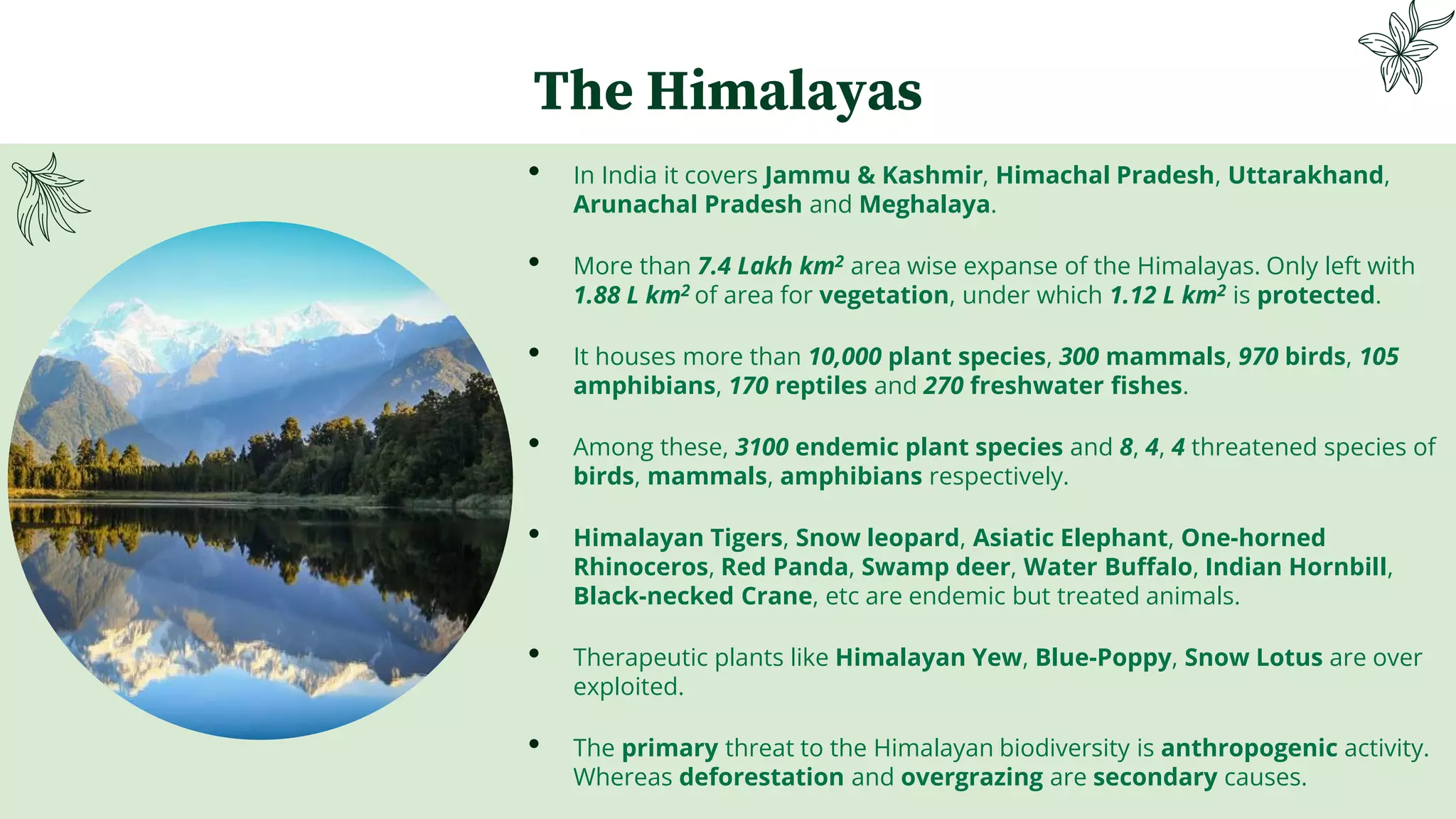
• In India it covers Jammu & Kashmir, Himachal Pradesh, Uttarakhand,
Arunachal Pradesh and Meghalaya.
• More than 7.4 Lakh km2 area wise expanse of the Himalayas. Only left with
1.88 L km2 of area for vegetation, under which 1.12 L km2 is protected.
• It houses more than 10,000 plant species, 300 mammals, 970 birds, 105
amphibians, 170 reptiles and 270 freshwater fishes.
• Among these, 3100 endemic plant species and 8, 4, 4 threatened species of
birds, mammals, amphibians respectively.
• Himalayan Tigers, Snow leopard, Asiatic Elephant, One-horned
Rhinoceros, Red Panda, Swamp deer, Water Buffalo, Indian Hornbill,
Black-necked Crane, etc are endemic but treated animals.
• Therapeutic plants like Himalayan Yew, Blue-Poppy, Snow Lotus are over
exploited.
• The primary threat to the Himalayan biodiversity is anthropogenic activity.
Whereas deforestation and overgrazing are secondary causes.
The Himalayas
• Covers the North-eastern states of India.
• It stretches across 23 Lakh km2 of area. However, the area left for
vegetation is merely 1.18 L km2.
• The region houses over 13,500 plant species, over 430 mammals, 1,260
birds, 520 reptiles, 290 amphibians and 1,260 freshwater fishes.
• Around 7,000 plant species and almost half of each category of animals
are endemic in nature.
• The reason for depletion of diversity is mainly due to agricultural
activities, commercial plantations. Also fisheries have led to a
decrease in mangrove cover. Due to this, only 5% of the original habitat
is remaining.
• Species such as Pygmy Loris, Delacour’s leaf monkey, Saola, the
White-eyed River Martin, Giant Ibis, Vietnamese Gecko, etc lies in
category of critically endangered species.
The Indo-Burma Region
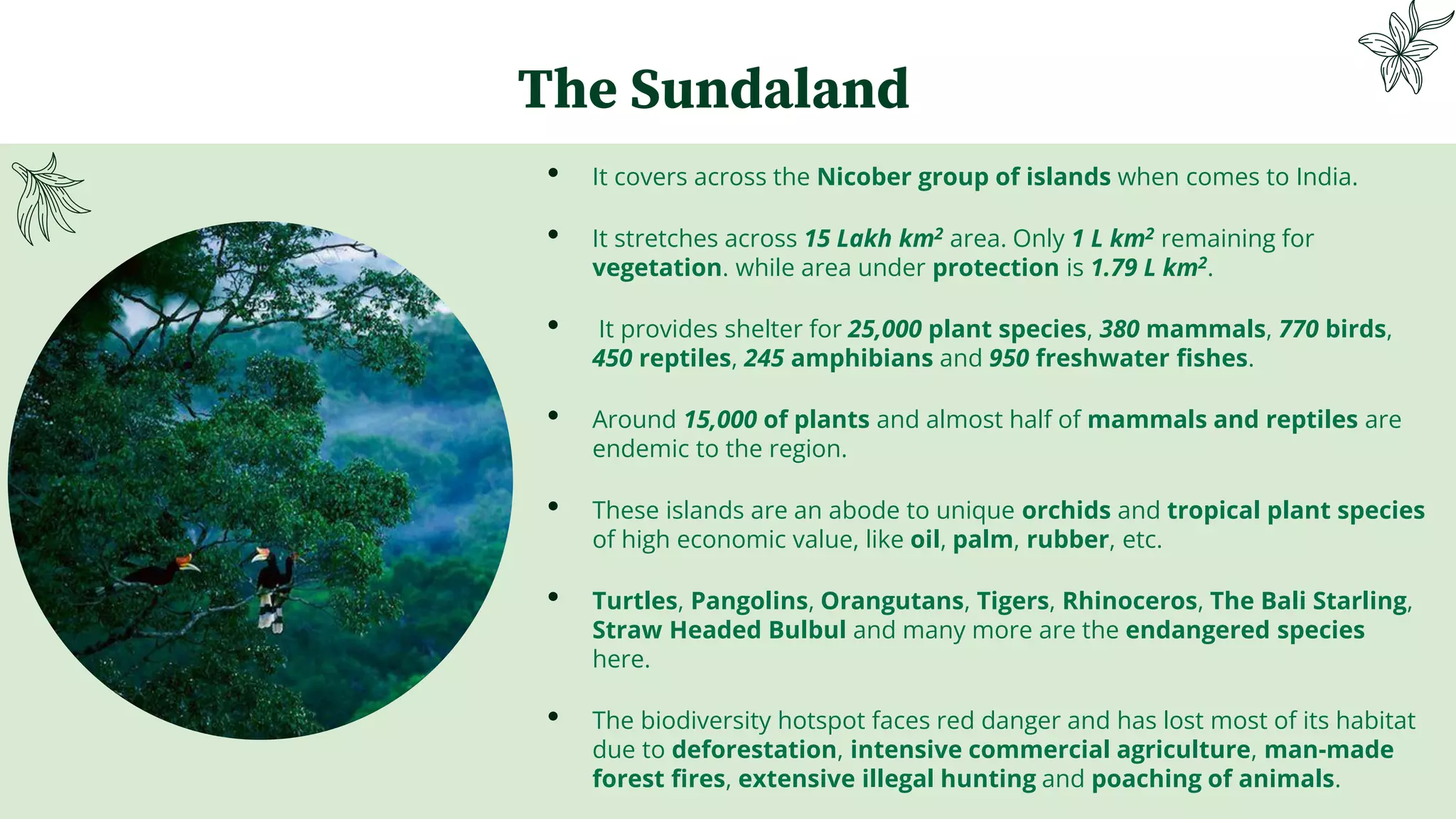
• It covers across the Nicober group of islands when comes to India.
• It stretches across 15 Lakh km2 area. Only 1 L km2 remaining for
vegetation. while area under protection is 1.79 L km2.
• It provides shelter for 25,000 plant species, 380 mammals, 770 birds,
450 reptiles, 245 amphibians and 950 freshwater fishes.
• Around 15,000 of plants and almost half of mammals and reptiles are
endemic to the region.
• These islands are an abode to unique orchids and tropical plant species
of high economic value, like oil, palm, rubber, etc.
• Turtles, Pangolins, Orangutans, Tigers, Rhinoceros, The Bali Starling,
Straw Headed Bulbul and many more are the endangered species
here.
• The biodiversity hotspot faces red danger and has lost most of its habitat
due to deforestation, intensive commercial agriculture, man-made
forest fires, extensive illegal hunting and poaching of animals.
The Sundaland
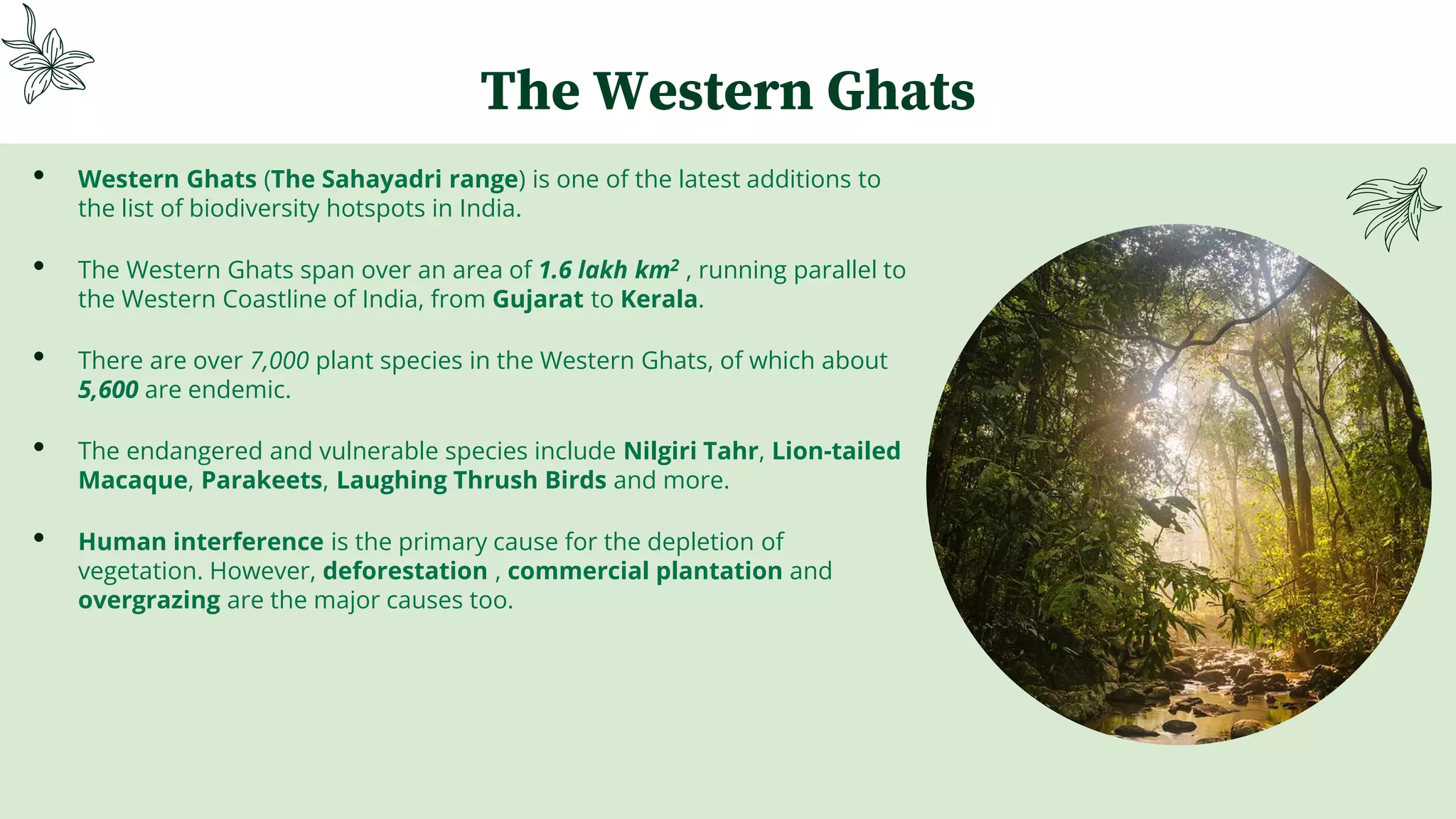
• Western Ghats (The Sahayadri range) is one of the latest additions to
the list of biodiversity hotspots in India.
• The Western Ghats span over an area of 1.6 lakh km2 , running parallel to
the Western Coastline of India, from Gujarat to Kerala.
• There are over 7,000 plant species in the Western Ghats, of which about
5,600 are endemic.
• The endangered and vulnerable species include Nilgiri Tahr, Lion-tailed
Macaque, Parakeets, Laughing Thrush Birds and more.
• Human interference is the primary cause for the depletion of
vegetation. However, deforestation , commercial plantation and
overgrazing are the major causes too.
The Western Ghats
Biodiversity Hotspot Mapping
The Himalayas
The Indo-Burma
Region
The Sundaland
The Western Ghats
Strategies to conserve biodiversity hotspots in India
Abiding the following strategies we can conserve the Biodiversity Hotspots in India:
• All the varieties of food, timber plants, livestock, microbes and agricultural animals should be limited.
• All the economically important organisms should be identified and conserved.
• Unique ecosystems should be preserved first.
• The resources should be utilized efficiently.
• Poaching and hunting of wild animals should be prevented.
• The reserves and protected areas should be developed carefully.
• The levels of pollutants should be reduced in the environment.
• Deforestation should be strictly prohibited.
• Environmental laws should be followed strictly.
• The useful and endangered species of plants and animals should be conserved in their nature as well as
artificial habitats.
• Public awareness should be created regarding biodiversity conservation and its importance.
Conclusion
Most biodiversity resources are consumed by humans, so it is their primary responsibility
to preserve and protect biodiversity to protect the earth. The richness of the species, the
ecosystem, the environment and the sustainable growth of life on earth is important.
Bibliography
• https://pscnotes.in/biodiversity-hotspots-in-india/
• https://byjus.com/free-ias-prep/biodiversity/
• https://byjus.com/biology/biodiversity-conservation/
For your kind attention towards my Presentation

Biodiversity Hotspots in India

  • 1.
    Hotspot of Biodiversity inIndia Presented By: Arijit Dhali
  • 2.
    Introduction A brief description aboutthe topic “Biodiversity Hotspot” About Major “Biodiversity Hotspots” in India Approach Strategies to conserve “Biodiversity Hotspots” Conclusion Short recap of the topic “Biodiversity Hotspot” The Contents
  • 3.
    Biodiversity is referredto as the variation of plant and animal species in a particular habitat. Species evenness and species richness form the major components of biodiversity. India is known for its rich biodiversity and has around 24.46% of the geographical area covered by forests and trees. As coined by Norman Myers, the term “Biodiversity Hotspots” specifically refers to 25 biologically rich areas around the world that have lost at least 70 percent of their original habitat. Introduction to Biodiversity
  • 4.
    Biodiversity Hotspot in India Comingto India, it is one of the top mega-diverse countries in the world. There is a vast range of biodiversity – over 91,000 species of animals, and 45,500 plant species have been documented in India. In upcoming slides we will discuss the biodiversity distribution in the four hotspots of India. Two of these: The Indo-Burma region and Sundaland are not strictly confined within the political boundaries of India but are present in South Asia. The major reasons for a rich diversity in these Indian biodiversity hotspots are the suitable climatic conditions, fertile soil, suitable temperature, ample amount of rains, which allows the growth of different plants. These areas are covered with dense vegetation of tropical, sub-tropical forests, dense savanna grasslands. They are marked with major rivers of the country, have the fertile alluvial type of soil and hence support great animal and plant variety. These regions are highly ecologically and energetically productive.
  • 5.
  • 6.
    • In Indiait covers Jammu & Kashmir, Himachal Pradesh, Uttarakhand, Arunachal Pradesh and Meghalaya. • More than 7.4 Lakh km2 area wise expanse of the Himalayas. Only left with 1.88 L km2 of area for vegetation, under which 1.12 L km2 is protected. • It houses more than 10,000 plant species, 300 mammals, 970 birds, 105 amphibians, 170 reptiles and 270 freshwater fishes. • Among these, 3100 endemic plant species and 8, 4, 4 threatened species of birds, mammals, amphibians respectively. • Himalayan Tigers, Snow leopard, Asiatic Elephant, One-horned Rhinoceros, Red Panda, Swamp deer, Water Buffalo, Indian Hornbill, Black-necked Crane, etc are endemic but treated animals. • Therapeutic plants like Himalayan Yew, Blue-Poppy, Snow Lotus are over exploited. • The primary threat to the Himalayan biodiversity is anthropogenic activity. Whereas deforestation and overgrazing are secondary causes. The Himalayas
  • 7.
    • Covers theNorth-eastern states of India. • It stretches across 23 Lakh km2 of area. However, the area left for vegetation is merely 1.18 L km2. • The region houses over 13,500 plant species, over 430 mammals, 1,260 birds, 520 reptiles, 290 amphibians and 1,260 freshwater fishes. • Around 7,000 plant species and almost half of each category of animals are endemic in nature. • The reason for depletion of diversity is mainly due to agricultural activities, commercial plantations. Also fisheries have led to a decrease in mangrove cover. Due to this, only 5% of the original habitat is remaining. • Species such as Pygmy Loris, Delacour’s leaf monkey, Saola, the White-eyed River Martin, Giant Ibis, Vietnamese Gecko, etc lies in category of critically endangered species. The Indo-Burma Region
  • 8.
    • It coversacross the Nicober group of islands when comes to India. • It stretches across 15 Lakh km2 area. Only 1 L km2 remaining for vegetation. while area under protection is 1.79 L km2. • It provides shelter for 25,000 plant species, 380 mammals, 770 birds, 450 reptiles, 245 amphibians and 950 freshwater fishes. • Around 15,000 of plants and almost half of mammals and reptiles are endemic to the region. • These islands are an abode to unique orchids and tropical plant species of high economic value, like oil, palm, rubber, etc. • Turtles, Pangolins, Orangutans, Tigers, Rhinoceros, The Bali Starling, Straw Headed Bulbul and many more are the endangered species here. • The biodiversity hotspot faces red danger and has lost most of its habitat due to deforestation, intensive commercial agriculture, man-made forest fires, extensive illegal hunting and poaching of animals. The Sundaland
  • 9.
    • Western Ghats(The Sahayadri range) is one of the latest additions to the list of biodiversity hotspots in India. • The Western Ghats span over an area of 1.6 lakh km2 , running parallel to the Western Coastline of India, from Gujarat to Kerala. • There are over 7,000 plant species in the Western Ghats, of which about 5,600 are endemic. • The endangered and vulnerable species include Nilgiri Tahr, Lion-tailed Macaque, Parakeets, Laughing Thrush Birds and more. • Human interference is the primary cause for the depletion of vegetation. However, deforestation , commercial plantation and overgrazing are the major causes too. The Western Ghats
  • 10.
    Biodiversity Hotspot Mapping TheHimalayas The Indo-Burma Region The Sundaland The Western Ghats
  • 11.
    Strategies to conservebiodiversity hotspots in India Abiding the following strategies we can conserve the Biodiversity Hotspots in India: • All the varieties of food, timber plants, livestock, microbes and agricultural animals should be limited. • All the economically important organisms should be identified and conserved. • Unique ecosystems should be preserved first. • The resources should be utilized efficiently. • Poaching and hunting of wild animals should be prevented. • The reserves and protected areas should be developed carefully. • The levels of pollutants should be reduced in the environment. • Deforestation should be strictly prohibited. • Environmental laws should be followed strictly. • The useful and endangered species of plants and animals should be conserved in their nature as well as artificial habitats. • Public awareness should be created regarding biodiversity conservation and its importance.
  • 12.
    Conclusion Most biodiversity resourcesare consumed by humans, so it is their primary responsibility to preserve and protect biodiversity to protect the earth. The richness of the species, the ecosystem, the environment and the sustainable growth of life on earth is important.
  • 13.
  • 14.
    For your kindattention towards my Presentation