DNA POLYMERASE
Content
 Introduction
 Definition
 Types
 Working process
 Functions
Introduction
 DNA polymerase was first identified by Arthur Kornberg in
lysates of Escherichia coli, in 1956.
 The enzyme is found and used in the DNA replication of both
prokaryotic and eukaryotic cells.
 Several types of DNA polymerase enzymes have been
discovered with the first one to be discovered named DNA
polymerase I.
 Each of these types plays a major role in replication and DNA
repair mechanisms.
Definition
 “DNA polymerases are enzymes that catalyze the template-
directed synthesis of DNA.”
 DNA polymerases are a group of enzymes that are used to
make copies of DNA templates, essentially used in DNA
replication mechanisms.
 These enzymes make new copies of DNA from existing
templates and also function by repairing the synthesized DNA
to prevent mutations.
Types of DNA Polymerase
Prokaryotic DNA polymerase:-
 DNA polymerase l
 DNA polymerase ll
 DNA polymerase lll
 DNA polymerase lV
 DNA polymerase V
 DNA polymerase I :-This is a repair polymerase and is involved in excision repair
with 3’-5’ and 5’-3’ exonuclease activity and processing of Okazaki fragments
generated during lagging strand synthesis.
 DNA polymerase ll:- Pol II has 3’-5’ exonuclease activity and participates in DNA
repair. Pol II is also thought to be a backup to Pol III as it can interact with
holoenzyme proteins and assume a high level of processivity.
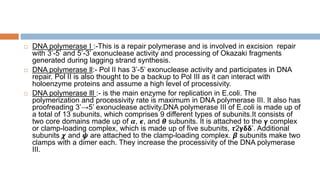
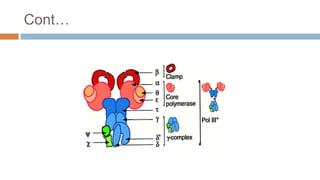
 DNA polymerase lll :- is the main enzyme for replication in E.coli. The
polymerization and processivity rate is maximum in DNA polymerase III. It also has
proofreading 3’→5’ exonuclease activity.DNA polymerase III of E.coli is made up of
a total of 13 subunits, which comprises 9 different types of subunits.It consists of
two core domains made up of 𝜶, 𝟄, and 𝞱 subunits. It is attached to the 𝝲 complex
or clamp-loading complex, which is made up of five subunits, 𝞽2𝝲𝝳𝝳’. Additional
subunits 𝟀 and 𝟁 are attached to the clamp-loading complex. 𝞫 subunits make two
clamps with a dimer each. They increase the processivity of the DNA polymerase
III.
Cont…
Cont….
 DNA Polymerase lV :- DNA polymerase involved in non-
targeted mutagenesis.
During SOS induction, Pol IV production is
increased tenfold and one of the functions during this time is to
interfere with Pol III holoenzyme processivity.
 DNA polymerase V:- Pol V is a Y-family DNA polymerase that is
involved in SOS response and translesion synthesis DNA
repair mechanisms.
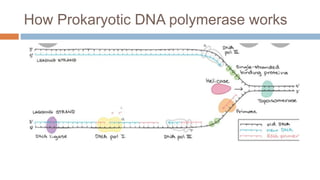
How Prokaryotic DNA polymerase works
 Eukaryotic DNA polymerase:-
 DNA polymerase a :- Enzyme that makes short segment
of initiator DNA during replication of animal chromosomes.
 DNA polymerase β: -Implicated in repairing DNA, in base
excision repair and gap-filling synthesis.
 DNA polymerase γ: - Replicates and repairs mitochondrial
DNA and has proofreading 3’->5’ exonuclease activity.
 DNA polymerase δ :- Enzyme that makes most of the
DNA when animal chromosomes are replicated.
 DNA polymerase ε: -Also highly possessive and has
proofreading 3’->5’ exonuclease activity
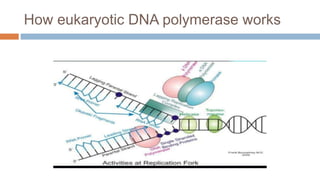
How eukaryotic DNA polymerase works
Functions
 Replication:- The main function of the DNA polymerase is to
synthesize DNA by the process of replication
 Repair:- s, DNA repair is the continuous process to rectify any
errors in the genome due to DNA damage. There are various
mechanisms by which DNA is repaired.
 Proofreading:- DNA polymerases remove incorrect pairs by
exonuclease activity. They move one step back and remove the
mismatched pair by 3’→5’ exonuclease activity. This is known
as proofreading.

polymerase

  • 1.
  • 2.
    Content  Introduction  Definition Types  Working process  Functions
  • 3.
    Introduction  DNA polymerasewas first identified by Arthur Kornberg in lysates of Escherichia coli, in 1956.  The enzyme is found and used in the DNA replication of both prokaryotic and eukaryotic cells.  Several types of DNA polymerase enzymes have been discovered with the first one to be discovered named DNA polymerase I.  Each of these types plays a major role in replication and DNA repair mechanisms.
  • 4.
    Definition  “DNA polymerasesare enzymes that catalyze the template- directed synthesis of DNA.”  DNA polymerases are a group of enzymes that are used to make copies of DNA templates, essentially used in DNA replication mechanisms.  These enzymes make new copies of DNA from existing templates and also function by repairing the synthesized DNA to prevent mutations.
  • 5.
    Types of DNAPolymerase Prokaryotic DNA polymerase:-  DNA polymerase l  DNA polymerase ll  DNA polymerase lll  DNA polymerase lV  DNA polymerase V
  • 6.
     DNA polymeraseI :-This is a repair polymerase and is involved in excision repair with 3’-5’ and 5’-3’ exonuclease activity and processing of Okazaki fragments generated during lagging strand synthesis.  DNA polymerase ll:- Pol II has 3’-5’ exonuclease activity and participates in DNA repair. Pol II is also thought to be a backup to Pol III as it can interact with holoenzyme proteins and assume a high level of processivity.  DNA polymerase lll :- is the main enzyme for replication in E.coli. The polymerization and processivity rate is maximum in DNA polymerase III. It also has proofreading 3’→5’ exonuclease activity.DNA polymerase III of E.coli is made up of a total of 13 subunits, which comprises 9 different types of subunits.It consists of two core domains made up of 𝜶, 𝟄, and 𝞱 subunits. It is attached to the 𝝲 complex or clamp-loading complex, which is made up of five subunits, 𝞽2𝝲𝝳𝝳’. Additional subunits 𝟀 and 𝟁 are attached to the clamp-loading complex. 𝞫 subunits make two clamps with a dimer each. They increase the processivity of the DNA polymerase III.
  • 7.
  • 8.
    Cont….  DNA PolymeraselV :- DNA polymerase involved in non- targeted mutagenesis. During SOS induction, Pol IV production is increased tenfold and one of the functions during this time is to interfere with Pol III holoenzyme processivity.  DNA polymerase V:- Pol V is a Y-family DNA polymerase that is involved in SOS response and translesion synthesis DNA repair mechanisms.
  • 9.
    How Prokaryotic DNApolymerase works
  • 10.
     Eukaryotic DNApolymerase:-  DNA polymerase a :- Enzyme that makes short segment of initiator DNA during replication of animal chromosomes.  DNA polymerase β: -Implicated in repairing DNA, in base excision repair and gap-filling synthesis.  DNA polymerase γ: - Replicates and repairs mitochondrial DNA and has proofreading 3’->5’ exonuclease activity.  DNA polymerase δ :- Enzyme that makes most of the DNA when animal chromosomes are replicated.  DNA polymerase ε: -Also highly possessive and has proofreading 3’->5’ exonuclease activity
  • 11.
    How eukaryotic DNApolymerase works
  • 12.
    Functions  Replication:- Themain function of the DNA polymerase is to synthesize DNA by the process of replication  Repair:- s, DNA repair is the continuous process to rectify any errors in the genome due to DNA damage. There are various mechanisms by which DNA is repaired.  Proofreading:- DNA polymerases remove incorrect pairs by exonuclease activity. They move one step back and remove the mismatched pair by 3’→5’ exonuclease activity. This is known as proofreading.