DNA & RNA POLYMERASES
By,
Ritwick Ranjan Sarma
M.Sc. Bioscience
Yenepoya Research Centre
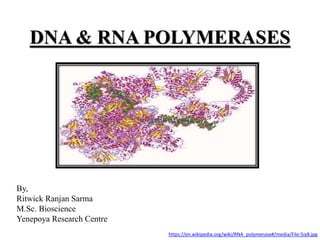
https://en.wikipedia.org/wiki/RNA_polymerase#/media/File:5iy8.jpg
CONTENTS:
• Discovery
• Introduction
• Types of DNA polymerase
• RNA polymerase
• Introduction
• Types of RNA polymerase
• Application and uses of Polymerases
DISCOVERY AND HISTORY
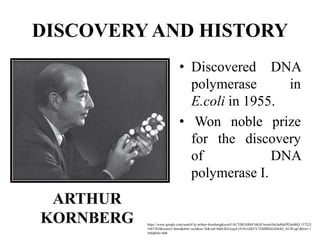
• Discovered DNA
polymerase in
E.coli in 1955.
• Won noble prize
for the discovery
of DNA
polymerase I.
https://www.google.com/search?q=arthur+kornberg&sxsrf=ACYBGNR6F3tK4UmvpvHeOu8lnlf92nibRQ:157323
1667363&source=lnms&tbm=isch&sa=X&ved=0ahUKEwjqzLrViNvlAhVY7XMBHd3eDr4Q_AUIEygC&biw=1
366&bih=608
DNA POLYMERASES
• DNA polymerases are enzymes that catalyse
the template-directed synthesis of DNA.
• EC no.
o 2.7.7.7 – DNA dependent DNA polymerase
o 2.7.7.49 – RNA dependent DNA
polymerase (reverse transcriptase).
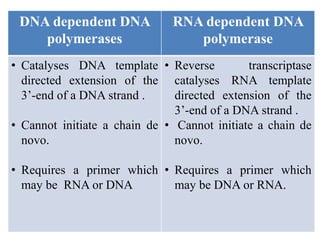
DNA dependent DNA
polymerases
RNA dependent DNA
polymerase
• Catalyses DNA template
directed extension of the
3’-end of a DNA strand .
• Cannot initiate a chain de
novo.
• Requires a primer which
may be RNA or DNA
• Reverse transcriptase
catalyses RNA template
directed extension of the
3’-end of a DNA strand .
• Cannot initiate a chain de
novo.
• Requires a primer which
may be DNA or RNA.
DNA POLYMERASE FAMILY
PROKARYOTES EUKARYOTES
DNA pol I
DNA pol II
DNA pol III
DNA pol IV
DNA pol α
DNA pol δ
DNA pol ϵ
DNA pol γ
DNA POLYMERASES IN PROKARYOTES
• DNA polymerase I
•This is a repair polymerase and is involved in excision repair with 3'-5' and
5'-3‘ exonuclease activity and processing of Okazaki fragments generated
during lagging strand synthesis.
• Most abundant polymerase accounting for >95% of polymerase activity in
E. coli.
• Pol I adds ~15-20 nucleotides per second.
• DNA polymerase II
• Pol II has 3'-5' exonuclease activity and participates in DNA repair.
•Pol II is also thought to be a backup to Pol III as it can interact with
holoenzyme proteins and assume a high level of processivity.
• DNA Pol II is the major polymerase for the repairing of inter-strand cross-
links. Interstrand cross-links are caused by chemicals such as nitrogen
mustard
• DNA polymerase III
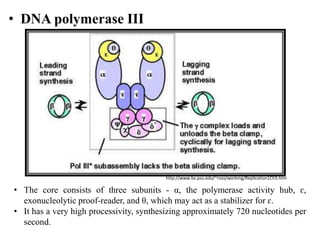
http://www.bx.psu.edu/~ross/workmg/Replication1Ch5.htm
• The core consists of three subunits - α, the polymerase activity hub, ɛ,
exonucleolytic proof-reader, and θ, which may act as a stabilizer for ɛ.
• It has a very high processivity, synthesizing approximately 720 nucleotides per
second.
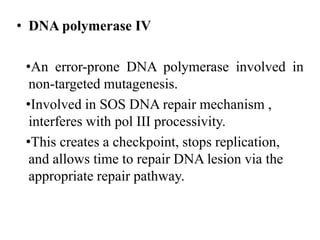
• DNA polymerase IV
•An error-prone DNA polymerase involved in
non-targeted mutagenesis.
•Involved in SOS DNA repair mechanism ,
interferes with pol III processivity.
•This creates a checkpoint, stops replication,
and allows time to repair DNA lesion via the
appropriate repair pathway.
• DNA polymerase a
• Has an associated primase activity capable of
synthesizing short (10 nucleotide)RNA primers.
• DNA polymerase a is the only enzyme that could
be involved in the primer synthesis during
initiation at origins of replication.
• a polymerase is also required during the
elongation step for the priming of synthesis of
Okazaki fragments on the lagging strand.
DNA POLYMERASES IN EUKARYOTES
• DNA polymerase ß
•In base-excision repair, removal of an altered base is
followed by excision of a single base nucleotide.
•DNA polymerase b then serves to fill in the missing
nucleotide
• DNA polymerase δ
• Polymerase d is a multi subunit polymerase and that
functions at the leading and lagging strands of the replication
fork.
• DNA polymerase ε
•consists of four subunits, and its precise role in
chromosomal replication is unclear.
•It has been proposed that the function of DNA
polymerase ε may be restricted to the lagging strand,
perhaps only in the maturation of Okazaki fragments.
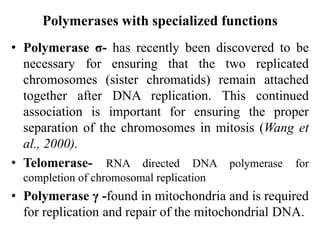
Polymerases with specialized functions
• Polymerase σ- has recently been discovered to be
necessary for ensuring that the two replicated
chromosomes (sister chromatids) remain attached
together after DNA replication. This continued
association is important for ensuring the proper
separation of the chromosomes in mitosis (Wang et
al., 2000).
• Telomerase- RNA directed DNA polymerase for
completion of chromosomal replication
• Polymerase γ -found in mitochondria and is required
for replication and repair of the mitochondrial DNA.
RNA POLYMERASES
• RNA polymerase in simple word means an
enzymes that produce RNA in the cell these
polymerase enzymes is very essential for
transcription.
• It was discovered by Samuel B Weiss & Jerard
Hurwitz in 1960
• The 2006 Nobel Prize in Chemistry was awarded
to Roger D. Kornberg for creating detailed
molecular images of RNA polymerase during
various stages of the transcription process
Products of RNA polymerase
• Messenger RNA
• Non-coding RNA or "RNA genes
• Transfer RNA
• Ribosomal RNA
• Catalytic RNA (Ribozyme)
TYPES OF RNA POLYMERASE
• RNA polymerase I - is located in the
nucleolus and synthesizes 28S, 18S, and 5.8S
rRNAs.
• RNA polymerase II - is located in the
nucleoplasm and synthesizes hnRNA/mRNA
and some snRNA.
• RNA polymerase III - is located in the
nucleoplasm and synthesizes tRNA, some
snRNA, and 5S rRNA
APPLICATIONS OF
POLYMERASES
• The polymerase chain reaction (PCR)
• DNA sequencing
• Single nucleotide polymorphism (SNP)
detection
• Whole genome amplification (WGA)
• Synthetic biology
• Molecular diagnostics.
Dna & rna pol

Dna & rna pol

  • 1.
    DNA & RNAPOLYMERASES By, Ritwick Ranjan Sarma M.Sc. Bioscience Yenepoya Research Centre https://en.wikipedia.org/wiki/RNA_polymerase#/media/File:5iy8.jpg
  • 2.
    CONTENTS: • Discovery • Introduction •Types of DNA polymerase • RNA polymerase • Introduction • Types of RNA polymerase • Application and uses of Polymerases
  • 3.
    DISCOVERY AND HISTORY •Discovered DNA polymerase in E.coli in 1955. • Won noble prize for the discovery of DNA polymerase I. https://www.google.com/search?q=arthur+kornberg&sxsrf=ACYBGNR6F3tK4UmvpvHeOu8lnlf92nibRQ:157323 1667363&source=lnms&tbm=isch&sa=X&ved=0ahUKEwjqzLrViNvlAhVY7XMBHd3eDr4Q_AUIEygC&biw=1 366&bih=608
  • 4.
    DNA POLYMERASES • DNApolymerases are enzymes that catalyse the template-directed synthesis of DNA. • EC no. o 2.7.7.7 – DNA dependent DNA polymerase o 2.7.7.49 – RNA dependent DNA polymerase (reverse transcriptase).
  • 5.
    DNA dependent DNA polymerases RNAdependent DNA polymerase • Catalyses DNA template directed extension of the 3’-end of a DNA strand . • Cannot initiate a chain de novo. • Requires a primer which may be RNA or DNA • Reverse transcriptase catalyses RNA template directed extension of the 3’-end of a DNA strand . • Cannot initiate a chain de novo. • Requires a primer which may be DNA or RNA.
  • 6.
    DNA POLYMERASE FAMILY PROKARYOTESEUKARYOTES DNA pol I DNA pol II DNA pol III DNA pol IV DNA pol α DNA pol δ DNA pol ϵ DNA pol γ
  • 7.
    DNA POLYMERASES INPROKARYOTES • DNA polymerase I •This is a repair polymerase and is involved in excision repair with 3'-5' and 5'-3‘ exonuclease activity and processing of Okazaki fragments generated during lagging strand synthesis. • Most abundant polymerase accounting for >95% of polymerase activity in E. coli. • Pol I adds ~15-20 nucleotides per second. • DNA polymerase II • Pol II has 3'-5' exonuclease activity and participates in DNA repair. •Pol II is also thought to be a backup to Pol III as it can interact with holoenzyme proteins and assume a high level of processivity. • DNA Pol II is the major polymerase for the repairing of inter-strand cross- links. Interstrand cross-links are caused by chemicals such as nitrogen mustard
  • 8.
    • DNA polymeraseIII http://www.bx.psu.edu/~ross/workmg/Replication1Ch5.htm • The core consists of three subunits - α, the polymerase activity hub, ɛ, exonucleolytic proof-reader, and θ, which may act as a stabilizer for ɛ. • It has a very high processivity, synthesizing approximately 720 nucleotides per second.
  • 9.
    • DNA polymeraseIV •An error-prone DNA polymerase involved in non-targeted mutagenesis. •Involved in SOS DNA repair mechanism , interferes with pol III processivity. •This creates a checkpoint, stops replication, and allows time to repair DNA lesion via the appropriate repair pathway.
  • 10.
    • DNA polymerasea • Has an associated primase activity capable of synthesizing short (10 nucleotide)RNA primers. • DNA polymerase a is the only enzyme that could be involved in the primer synthesis during initiation at origins of replication. • a polymerase is also required during the elongation step for the priming of synthesis of Okazaki fragments on the lagging strand. DNA POLYMERASES IN EUKARYOTES
  • 11.
    • DNA polymeraseß •In base-excision repair, removal of an altered base is followed by excision of a single base nucleotide. •DNA polymerase b then serves to fill in the missing nucleotide • DNA polymerase δ • Polymerase d is a multi subunit polymerase and that functions at the leading and lagging strands of the replication fork. • DNA polymerase ε •consists of four subunits, and its precise role in chromosomal replication is unclear. •It has been proposed that the function of DNA polymerase ε may be restricted to the lagging strand, perhaps only in the maturation of Okazaki fragments.
  • 12.
    Polymerases with specializedfunctions • Polymerase σ- has recently been discovered to be necessary for ensuring that the two replicated chromosomes (sister chromatids) remain attached together after DNA replication. This continued association is important for ensuring the proper separation of the chromosomes in mitosis (Wang et al., 2000). • Telomerase- RNA directed DNA polymerase for completion of chromosomal replication • Polymerase γ -found in mitochondria and is required for replication and repair of the mitochondrial DNA.
  • 14.
    RNA POLYMERASES • RNApolymerase in simple word means an enzymes that produce RNA in the cell these polymerase enzymes is very essential for transcription. • It was discovered by Samuel B Weiss & Jerard Hurwitz in 1960 • The 2006 Nobel Prize in Chemistry was awarded to Roger D. Kornberg for creating detailed molecular images of RNA polymerase during various stages of the transcription process
  • 15.
    Products of RNApolymerase • Messenger RNA • Non-coding RNA or "RNA genes • Transfer RNA • Ribosomal RNA • Catalytic RNA (Ribozyme)
  • 16.
    TYPES OF RNAPOLYMERASE • RNA polymerase I - is located in the nucleolus and synthesizes 28S, 18S, and 5.8S rRNAs. • RNA polymerase II - is located in the nucleoplasm and synthesizes hnRNA/mRNA and some snRNA. • RNA polymerase III - is located in the nucleoplasm and synthesizes tRNA, some snRNA, and 5S rRNA
  • 17.
    APPLICATIONS OF POLYMERASES • Thepolymerase chain reaction (PCR) • DNA sequencing • Single nucleotide polymorphism (SNP) detection • Whole genome amplification (WGA) • Synthetic biology • Molecular diagnostics.

Editor's Notes

  • #5 2 transferases , 7 transfers Phosphorus containing group, 7 nucleotidyl transferase
  • #8 Pol 1 both
  • #9 The pol 3 sub assembly lacks b clamp….therefore gamma subunit helps
  • #18 Isothermal amplification techniques such as Loop- Mediated Amplification (LAMP) have been routinely used as diagnostic tests to detect infectious disease.