POWER POINT PRESENTATION ON PLASTIC
MOULDING PROCESSES AND PROCESS
PARAMETERS.
MANTHAN KANANI :- 140050119028
PRATIK KANANI :- 140050119029
DHRUV KHATRI :- 140050119030
DHRUVIT LAKHANI :- 140050119032
INJECTION MOULDING PROCESS
FOR PLASTIC PROCESSING
 It is a manufacturing technique for making parts
from thermoplastic and thermoset materials
 In contrast to the extrusion (which makes
continuous parts of constant cross section),
injection molding make discrete parts (with
complex and variable cross section)
 Molten plastic is injected at high pressure into a
mold, which is the inverse of the desired shape.
 The mold is made from metal, usually either steel
or aluminium
 Widely used for manufacturing a variety of parts,
from the smallest component to entire body panels
of cars
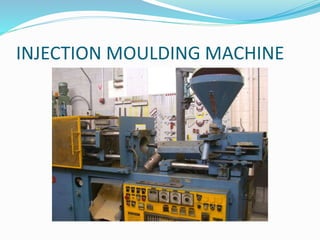
INJECTION MOULDING MACHINE
MACHINE PARTS
 Hopper is a tapered container working with a hopping
motion to transfer grains into cylinder
 Inside the cylinder there is a piston /plunger which is used
to move the material from cylinder into the mold
 Heating arrangement is placed above and below the
cylinder .
 The mold is in two halves , it has a mold cavity and the
mold has two ejector pins.
PROCEDURE
 As soon as the plastic is melted it will be pushed by the
piston into the sprue through which the material
would go into the mold cavity .
 The cavity will be filled by the pressure of the piston
and the mold should not be opened until the plastic
solidifies.
 When the plastic solidifies the ejector pins are
hydraulically moved backwards .
MATERIALS USED
 Acetate
 Acrylonitrile butadiene styrene (ABS)
 Cellulose acetate
 PVC ( poly vinyl chloride)
 Polycarbonate
 Polyesters
e.t.c.
BLOW MOULDING PROCESS FOR
PLASTIC PROCESSING
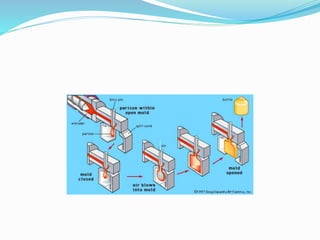
 “It is a plastic processing technique which is used to
produce hollow plastic parts by inflating a heated
plastic until it fills a mold and forms the desired shape”
 The raw material used for processing in blow molding is
called parison
 Parison is a preform tube that is hollow and it has a hole
at one end
TYPES OF BLOW MOULDING
 Injection blow molding
 Stretch blow molding
 Extrusion blow molding
THERMOFORMING PROCESS FOR
PLASTIC PROCESSING
 “ Thermoforming is a plastic processing technique in
which the thermoplastic sheets are formed by applying
temperature and pressure inside the mold .”
 The raw material here is usually plastic sheet
 Different types of this process are
I. Vacuum forming
II. Pressure forming
III. Matched die forming
VACCUME FORMIMG PROCESS
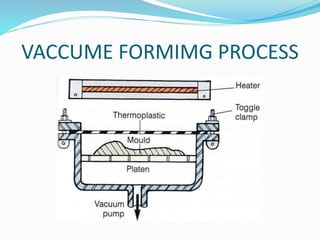
o The vacuum pressure is used to form the heated
thermoplastic sheet into the desired shape.
o Thermoplastic sheet is placed on the mold surface
and fixed with the help of clamping unit.
o The sheet is heated until it softens and there after ,
vacuum needs to be applied quickly.
o There is tank with nozzles that suck air and creates
vacuum in between sheet and mold.
VACCUME FORMIMG PROCESS
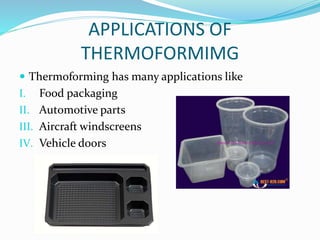
APPLICATIONS OF
THERMOFORMIMG
 Thermoforming has many applications like
I. Food packaging
II. Automotive parts
III. Aircraft windscreens
IV. Vehicle doors
Plastic Process and Processing Parameter

Plastic Process and Processing Parameter

  • 1.
    POWER POINT PRESENTATIONON PLASTIC MOULDING PROCESSES AND PROCESS PARAMETERS.
  • 2.
    MANTHAN KANANI :-140050119028 PRATIK KANANI :- 140050119029 DHRUV KHATRI :- 140050119030 DHRUVIT LAKHANI :- 140050119032
  • 3.
    INJECTION MOULDING PROCESS FORPLASTIC PROCESSING  It is a manufacturing technique for making parts from thermoplastic and thermoset materials  In contrast to the extrusion (which makes continuous parts of constant cross section), injection molding make discrete parts (with complex and variable cross section)  Molten plastic is injected at high pressure into a mold, which is the inverse of the desired shape.  The mold is made from metal, usually either steel or aluminium  Widely used for manufacturing a variety of parts, from the smallest component to entire body panels of cars
  • 4.
  • 5.
    MACHINE PARTS  Hopperis a tapered container working with a hopping motion to transfer grains into cylinder  Inside the cylinder there is a piston /plunger which is used to move the material from cylinder into the mold  Heating arrangement is placed above and below the cylinder .  The mold is in two halves , it has a mold cavity and the mold has two ejector pins.
  • 6.
    PROCEDURE  As soonas the plastic is melted it will be pushed by the piston into the sprue through which the material would go into the mold cavity .  The cavity will be filled by the pressure of the piston and the mold should not be opened until the plastic solidifies.  When the plastic solidifies the ejector pins are hydraulically moved backwards .
  • 7.
    MATERIALS USED  Acetate Acrylonitrile butadiene styrene (ABS)  Cellulose acetate  PVC ( poly vinyl chloride)  Polycarbonate  Polyesters e.t.c.
  • 8.
    BLOW MOULDING PROCESSFOR PLASTIC PROCESSING  “It is a plastic processing technique which is used to produce hollow plastic parts by inflating a heated plastic until it fills a mold and forms the desired shape”  The raw material used for processing in blow molding is called parison  Parison is a preform tube that is hollow and it has a hole at one end
  • 10.
    TYPES OF BLOWMOULDING  Injection blow molding  Stretch blow molding  Extrusion blow molding
  • 11.
    THERMOFORMING PROCESS FOR PLASTICPROCESSING  “ Thermoforming is a plastic processing technique in which the thermoplastic sheets are formed by applying temperature and pressure inside the mold .”  The raw material here is usually plastic sheet  Different types of this process are I. Vacuum forming II. Pressure forming III. Matched die forming
  • 12.
    VACCUME FORMIMG PROCESS oThe vacuum pressure is used to form the heated thermoplastic sheet into the desired shape. o Thermoplastic sheet is placed on the mold surface and fixed with the help of clamping unit. o The sheet is heated until it softens and there after , vacuum needs to be applied quickly. o There is tank with nozzles that suck air and creates vacuum in between sheet and mold.
  • 13.
  • 14.
    APPLICATIONS OF THERMOFORMIMG  Thermoforminghas many applications like I. Food packaging II. Automotive parts III. Aircraft windscreens IV. Vehicle doors