TO. SUBMITTED BY.
MR.PRANAT PAL DUBEY ANKUR YADAV
Course In charge PGD-PPT
2011-13
SUBJECT
STUDY OF OPERATION AND
MAINTENANCE OF ALL ELECTRIC
INJECTION MOULDING MACHINE
CONTENT
 INTRODUCTION
 HISTORY
 MACHINE SPECIFICATION
 OPERATIONS
 MATERIAL S USED
 ADVANTAGE
 DISADVANTAGE
 COMPRITION
 APPLICATIONS
 CONCLUSION
 REFERECES
INTRODUCTION
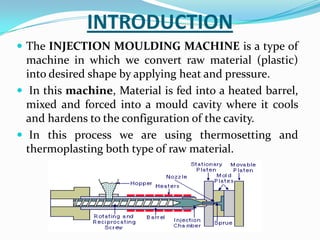
 The INJECTION MOULDING MACHINE is a type of
machine in which we convert raw material (plastic)
into desired shape by applying heat and pressure.
 In this machine, Material is fed into a heated barrel,
mixed and forced into a mould cavity where it cools
and hardens to the configuration of the cavity.
 In this process we are using thermosetting and
thermoplasting both type of raw material.
HISTORY
 Isaiah Hyatt invented the first injection molding
machine in 1872.
 In 1946, American inventor James Watson Hendry
built the first screw injection moulding machine,
 In 1983,Nissei Plastic Industrial Co. LTD introduced
the first all-electric injection molding machine.
 The MILACRON CORPORATION was the first
injection moulding machinery manufacturer which is
introduced ALL ELECTRIC INJECTION
MOULDING MACHINE in 1985.
ALL ELECTRIC INJECTION MOULDING
MACHINE
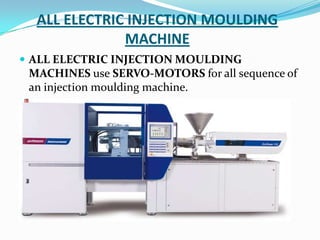
 ALL ELECTRIC INJECTION MOULDING
MACHINES use SERVO-MOTORS for all sequence of
an injection moulding machine.
 The machine use less energy, have greater precision,
accuracy and produce less than hydraulic machine
 In this machine every function was controlled by a
separate electric servo-motor (rather than hydraulics).
 This type of machine have high efficiency factor just
like power consumption.
 This type of machine has not required any type of
hydraulic system.
 This type of machine has not use any type of induction
motor for all sequence of an injection moulding
machine.
 This machine saves 40-80% energy.
 This type of machine has not required any type of
machine cooling so it saves energy in compare to
HIMM.
 This machine has not required hydraulic oil so it saves
money.
MACHINE SPECIFICATION
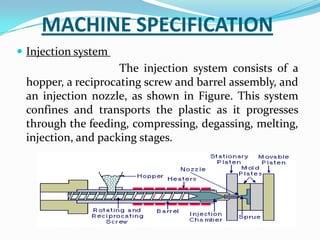
 Injection system
The injection system consists of a
hopper, a reciprocating screw and barrel assembly, and
an injection nozzle, as shown in Figure. This system
confines and transports the plastic as it progresses
through the feeding, compressing, degassing, melting,
injection, and packing stages.
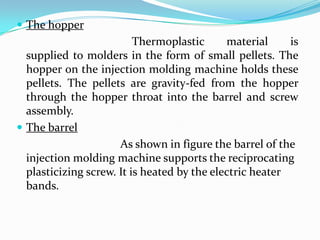
 The hopper
Thermoplastic material is
supplied to molders in the form of small pellets. The
hopper on the injection molding machine holds these
pellets. The pellets are gravity-fed from the hopper
through the hopper throat into the barrel and screw
assembly.
 The barrel
As shown in figure the barrel of the
injection molding machine supports the reciprocating
plasticizing screw. It is heated by the electric heater
bands.
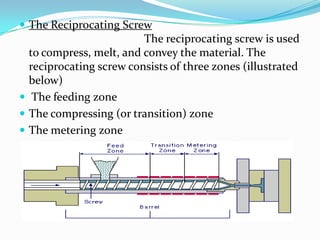
 The Reciprocating Screw
The reciprocating screw is used
to compress, melt, and convey the material. The
reciprocating screw consists of three zones (illustrated
below)
 The feeding zone
 The compressing (or transition) zone
 The metering zone
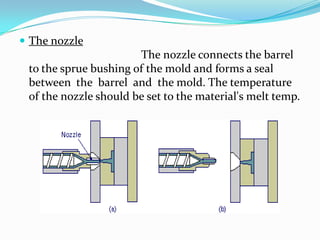
 The nozzle
The nozzle connects the barrel
to the sprue bushing of the mold and forms a seal
between the barrel and the mold. The temperature
of the nozzle should be set to the material's melt temp.
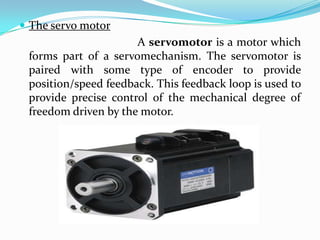
 The servo motor
A servomotor is a motor which
forms part of a servomechanism. The servomotor is
paired with some type of encoder to provide
position/speed feedback. This feedback loop is used to
provide precise control of the mechanical degree of
freedom driven by the motor.
 THE MICROPROCESSOR CONTROL
For the better accuracy of
parameter, we used microprocessor based control system.
To ensure consistency of quality of injection molded parts
one has to look at the controls like pressure, speed, stroke,
and temperatures. This is the repeatability of the product
quality with close tolerance on dimension and weight
throughout long production run.
 There are some images of screen of microprocessor, which
is easily define the work of its. For example –
 Clamping data
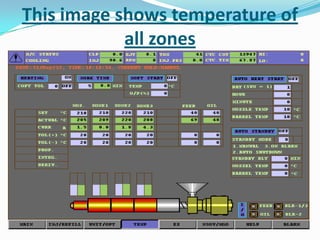
 Temperature data
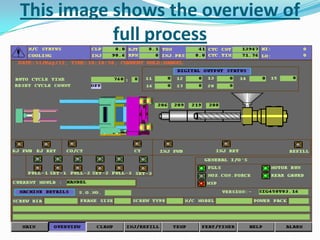
 Overview data
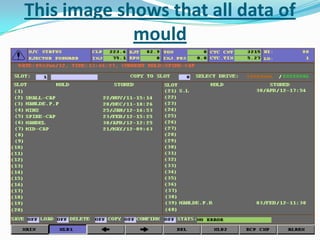
 Mould data
 Process monitoring data
 Mould data
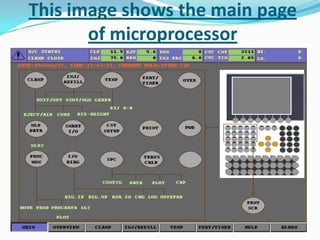
 Main page of Microprocessor
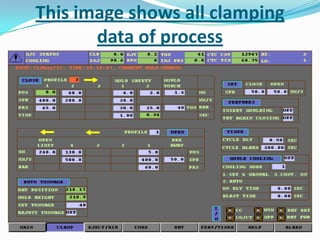
This image shows all clamping
data of process
This image shows temperature of
all zones
This image shows the overview of
full process
This image shows all monitoring
data
This image shows that all data of
mould
This image shows the main page
of microprocessor
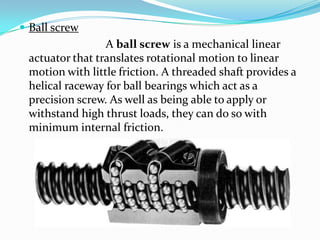
 Ball screw
A ball screw is a mechanical linear
actuator that translates rotational motion to linear
motion with little friction. A threaded shaft provides a
helical raceway for ball bearings which act as a
precision screw. As well as being able to apply or
withstand high thrust loads, they can do so with
minimum internal friction.
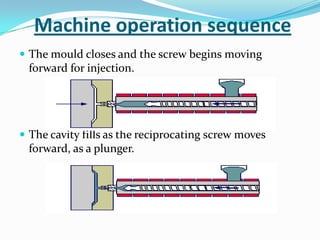
Machine operation sequence
 The mould closes and the screw begins moving
forward for injection.
 The cavity fills as the reciprocating screw moves
forward, as a plunger.
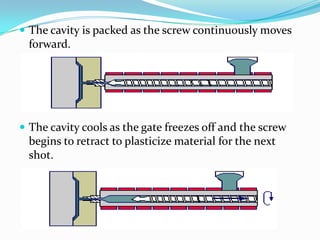
 The cavity is packed as the screw continuously moves
forward.
 The cavity cools as the gate freezes off and the screw
begins to retract to plasticize material for the next
shot.
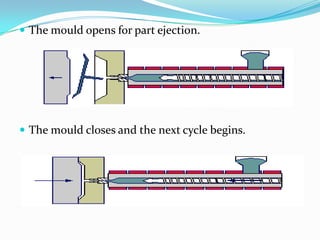
 The mould opens for part ejection.
 The mould closes and the next cycle begins.
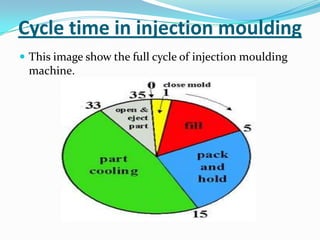
Cycle time in injection moulding
 This image show the full cycle of injection moulding
machine.
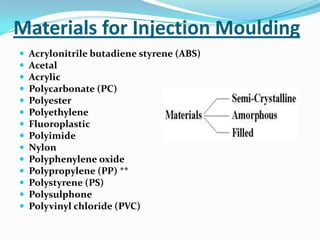
Materials for Injection Moulding
 Acrylonitrile butadiene styrene (ABS)
 Acetal
 Acrylic
 Polycarbonate (PC)
 Polyester
 Polyethylene
 Fluoroplastic
 Polyimide
 Nylon
 Polyphenylene oxide
 Polypropylene (PP) **
 Polystyrene (PS)
 Polysulphone
 Polyvinyl chloride (PVC)
ADVANTAGES OF ALL ELECTRIC
INJECTION MOULDING MACHINE
 These types of machines have not required hydraulic
oil because it has no hydraulic system.
 These types of machine have not required cooling and
plumping of hydraulic oil.
 All electric injection moulding machine have low
noise level in compare to hydraulic injection moulding
machine.
 All Electric injection moulding machine eliminates the
cooling equipments for the hydraulic system.
 Lower operating costs- Whether small or large, all-
electric machines dramatically reduce operating costs,
using 50% to 80% less power than equivalent hydraulic
machines. Connected power requirements for an
electric machine are only 25 percent of those of a
hydraulic machine.
 Accuracy, repeatability, and consistency- Electric
machines are digitally controlled and mechanically
driven. Their processes do not vary over time since
they have no hoses to expand, no valves to potentially
stick and no hydraulic fluid to heat up or compress.
Molders often report that these machines produce
good parts by the third or fourth shot and then run
without attention until it's time for a mold change.
 Higher part quality. Electric machines turn injection
molding into a more predictable operation. With a
more consistent machine, the same process setup can
be used repeatedly, without affecting part consistency
or quality. For example, screw position for fill and pack
is controlled with digital precision, eliminating over
packing and greatly reducing molded-in stress.
 These types of machines are fast compare to hydraulic
moulding machine.
 It has not required cool water for machine cooling.
Disadvantages of all electric
injection moulding machine
 ALL ELECTRIC INJECTION MOULDING MACHINE
is too expensive in compare to conventional hydraulic
injection moulding machine.
 In this machine, we can use only virgin materials. This
is a major disadvantage of ALL ELECTRIC
INJECTION MOULDING MACHINE.
 Its breakdown maintenance is too expensive because
of its parts are so costly.
COMPARISION
between
AEIMM and HIMM
 Hydraulic injection moulding machine is using large
induction motor to drive pump but all electrical
injection moulding machine using small motor to
move each function of the machine.
 The induction motor always has some load put on it
due to pump but in AEIMM using of servo motor use
energy only when they are running.
 The hydraulic injection moulding machines have
required hydraulic system but AEIMM have no
hydraulic system.
 The hydraulic injection moulding machine has high
maintenance but AEIMM has very low maintenance
compare to HIMM.
 In hydraulic injection machine need large amounts of
power required to drive pump up to high pressure for
inject or increased volume for charging but in AEIMM
the servo motors are off during dwell times such as
part cooling time.
 Hydraulic injection moulding machine need cool
water for machine cooling but AEIMM not required
cool water for machine cooling.
 All electric injection moulding machine are
quiet…60db which is 20db lower compare to hydraulic
injection moulding machine.
Maintenance of AEIMM
 Maintenance –
The activity carried out to prevent the
occurrence of failure and activity carried out after failure to
rectify the defect is called MAINTENANCE.
Why Maintenance required -
There are so many cause present,
some cause are following –
 Plant or Machine in any organization is expected to
run continuously without any interruption during
production period.
 Interruptions are frequently felt on account of machine,
breakdowns due to failure of machine parts / components.
 There is always some loss of production on account of m/c
failure.
Types of maintenance
There are two types of maintenance –
1. Preventive Maintenance
2. Breakdown/Corrective Maintenance
Preventive Maintenance- The activities, which are
carried out to prevent the occurrence of failure are
knows as Preventive Maintenance.
PM is further divided in two parts-
A. Direct Preventive Maintenance
B. Indirect preventive Maintenance
Breakdown Maintenance- The activities which are
carried out after the occurrence of failures to correct
the failures are knows as Breakdown/Corrective
Maintenance.
The maintenance of All electric
Injection Moulding machine
 SENSOR
Any sensor used requires a power supply and
an amplifier. A sensor is driven by an input voltage. Usually
called an “excitation” voltage. A resultant output signal is
generated as the sensor responds to the monitored
parameter. An amplifier is used to boost the output signal
the output signal’s strength. Increased signal strength or
amplitude is needed for recording capabilities.
Sensors and electrical systems should be
tested and calibrated before actual before actual use.
Variances to occur between sensors of the same type.
Sensors should be maintained at a “zero” reference.
Electrical “drifting” destroys the accuracy of the
information being obtained.
 Motors
One method of applying the driving
force to turn the screw is attached it to an electric
motor. The available torque of an electric motor
has a pattern of a 100% starting overload. Which
corresponds to the higher torque requirements of
starting with colder plastic material? Safety
devices of varying degrees of effectiveness are used
to prevent the overload from snapping the screw.
 Electric drives do not have independent speed
and torque control. The speed is changed by
gear trains, and because the input and output
power area constant, a change in wither speed
or torque will inversely affect the other. This
relationship makes it difficult to find optimum
molding conditions.
 The electrical system has a high efficiency of
approximately 95% compared to the 60 to 75% of
the hydraulic system.
 LIMIT SWITCH
A limit switch is a means of
interfacing position or mechanical motion with
the electrical circuit. The contacts are mounted in
rugged enclosures and usually consist of one set of
normally closed and one set of normally open
contacts. They can be had in up to for pole
configurations. The most common operator is
rotating lever with a wheel at the end.. They are
widely used on molding machines, being found in
safety control circuits, low pressure closing, platen
speed injection control and mold safety circuits.
Maintenance Schedule
Daily Maintenance
 Clean the machine thoroughly.
 Wipe the toggles with a clean cloth till it is free of the
accumulated grease and dust.
 Check the nozzle area for melt accumulation and clean
if necessary.
 Check the piping of grease lubricating system for loose
connections.
 Check whether the feed throat temperature is
maintained during running If found rising even with
the water supply ‘ON’, check and clean the cooling ring
Weekly Maintenance
 Check the grease pump for sufficient amount of
grease.
 Limit / Proximity switches.
 Check safety devices.
 Check nozzle centering.
 Check for the tightness of connectors on IBED, PLC,
Wiring terminals on the control cabinet, Linear
Potentiometer plugs and Solenoid plugs.
 Rear and front guard door Limit switches.
 Nozzle guard Limit switch.
FUTURE
The All Electric Injection Moulding Machines have a
very bright future due to own accuracy, efficiency,
consistency and repeatability.
These types of machines have very low
maintenance so it is a very useful. In other word it is
future of whole plastic industries, which are related to
injection moulding field.
Its ability of power consumption is very
profitable for a plastic industry because it saves 40-
80% energy in compare to conventional hydraulic
injection machine.
Applications
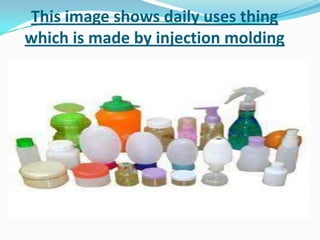
There is various range of injection molded product, some
images are following-
 This image shows various apps. Of injection molding
process
This image shows daily uses thing
which is made by injection molding
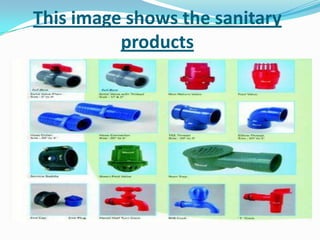
This image shows the sanitary
products
This image shows bathroom thing
C0NCLUSION
The All Electric Injection moulding Machine is very simple,
fast, accurate and easy to use. All electric is primarily
meant for the lowest energy cost, extreme reproducibility,
narrow processing window for thin walled component in
engineering polymers, prolonged accuracy and instant
repeatability, high uptime, smaller shot size utilization, low
emission, water saving, noiseless environment need, clean
room necessity.
Reference
 Injection Moulding Machine.
Edited by – A.S. Athalye
 Introduction to Plastic Processing techniques.
Edited by – S. Sugumar
 Injection moulding book
Edited by – P.K. Sahoo.
 www.google.co.in
 www.wikipedia.com

Seminar on all electrical injection moulding machine main

  • 1.
    TO. SUBMITTED BY. MR.PRANATPAL DUBEY ANKUR YADAV Course In charge PGD-PPT 2011-13
  • 2.
    SUBJECT STUDY OF OPERATIONAND MAINTENANCE OF ALL ELECTRIC INJECTION MOULDING MACHINE
  • 3.
    CONTENT  INTRODUCTION  HISTORY MACHINE SPECIFICATION  OPERATIONS  MATERIAL S USED  ADVANTAGE  DISADVANTAGE  COMPRITION  APPLICATIONS  CONCLUSION  REFERECES
  • 4.
    INTRODUCTION  The INJECTIONMOULDING MACHINE is a type of machine in which we convert raw material (plastic) into desired shape by applying heat and pressure.  In this machine, Material is fed into a heated barrel, mixed and forced into a mould cavity where it cools and hardens to the configuration of the cavity.  In this process we are using thermosetting and thermoplasting both type of raw material.
  • 5.
    HISTORY  Isaiah Hyattinvented the first injection molding machine in 1872.  In 1946, American inventor James Watson Hendry built the first screw injection moulding machine,  In 1983,Nissei Plastic Industrial Co. LTD introduced the first all-electric injection molding machine.  The MILACRON CORPORATION was the first injection moulding machinery manufacturer which is introduced ALL ELECTRIC INJECTION MOULDING MACHINE in 1985.
  • 6.
    ALL ELECTRIC INJECTIONMOULDING MACHINE  ALL ELECTRIC INJECTION MOULDING MACHINES use SERVO-MOTORS for all sequence of an injection moulding machine.
  • 7.
     The machineuse less energy, have greater precision, accuracy and produce less than hydraulic machine  In this machine every function was controlled by a separate electric servo-motor (rather than hydraulics).  This type of machine have high efficiency factor just like power consumption.  This type of machine has not required any type of hydraulic system.  This type of machine has not use any type of induction motor for all sequence of an injection moulding machine.
  • 8.
     This machinesaves 40-80% energy.  This type of machine has not required any type of machine cooling so it saves energy in compare to HIMM.  This machine has not required hydraulic oil so it saves money.
  • 9.
    MACHINE SPECIFICATION  Injectionsystem The injection system consists of a hopper, a reciprocating screw and barrel assembly, and an injection nozzle, as shown in Figure. This system confines and transports the plastic as it progresses through the feeding, compressing, degassing, melting, injection, and packing stages.
  • 10.
     The hopper Thermoplasticmaterial is supplied to molders in the form of small pellets. The hopper on the injection molding machine holds these pellets. The pellets are gravity-fed from the hopper through the hopper throat into the barrel and screw assembly.  The barrel As shown in figure the barrel of the injection molding machine supports the reciprocating plasticizing screw. It is heated by the electric heater bands.
  • 11.
     The ReciprocatingScrew The reciprocating screw is used to compress, melt, and convey the material. The reciprocating screw consists of three zones (illustrated below)  The feeding zone  The compressing (or transition) zone  The metering zone
  • 12.
     The nozzle Thenozzle connects the barrel to the sprue bushing of the mold and forms a seal between the barrel and the mold. The temperature of the nozzle should be set to the material's melt temp.
  • 13.
     The servomotor A servomotor is a motor which forms part of a servomechanism. The servomotor is paired with some type of encoder to provide position/speed feedback. This feedback loop is used to provide precise control of the mechanical degree of freedom driven by the motor.
  • 14.
     THE MICROPROCESSORCONTROL For the better accuracy of parameter, we used microprocessor based control system. To ensure consistency of quality of injection molded parts one has to look at the controls like pressure, speed, stroke, and temperatures. This is the repeatability of the product quality with close tolerance on dimension and weight throughout long production run.  There are some images of screen of microprocessor, which is easily define the work of its. For example –  Clamping data  Temperature data  Overview data  Mould data  Process monitoring data  Mould data  Main page of Microprocessor
  • 15.
    This image showsall clamping data of process
  • 16.
    This image showstemperature of all zones
  • 17.
    This image showsthe overview of full process
  • 18.
    This image showsall monitoring data
  • 19.
    This image showsthat all data of mould
  • 20.
    This image showsthe main page of microprocessor
  • 21.
     Ball screw Aball screw is a mechanical linear actuator that translates rotational motion to linear motion with little friction. A threaded shaft provides a helical raceway for ball bearings which act as a precision screw. As well as being able to apply or withstand high thrust loads, they can do so with minimum internal friction.
  • 22.
    Machine operation sequence The mould closes and the screw begins moving forward for injection.  The cavity fills as the reciprocating screw moves forward, as a plunger.
  • 23.
     The cavityis packed as the screw continuously moves forward.  The cavity cools as the gate freezes off and the screw begins to retract to plasticize material for the next shot.
  • 24.
     The mouldopens for part ejection.  The mould closes and the next cycle begins.
  • 25.
    Cycle time ininjection moulding  This image show the full cycle of injection moulding machine.
  • 26.
    Materials for InjectionMoulding  Acrylonitrile butadiene styrene (ABS)  Acetal  Acrylic  Polycarbonate (PC)  Polyester  Polyethylene  Fluoroplastic  Polyimide  Nylon  Polyphenylene oxide  Polypropylene (PP) **  Polystyrene (PS)  Polysulphone  Polyvinyl chloride (PVC)
  • 27.
    ADVANTAGES OF ALLELECTRIC INJECTION MOULDING MACHINE  These types of machines have not required hydraulic oil because it has no hydraulic system.  These types of machine have not required cooling and plumping of hydraulic oil.  All electric injection moulding machine have low noise level in compare to hydraulic injection moulding machine.  All Electric injection moulding machine eliminates the cooling equipments for the hydraulic system.
  • 28.
     Lower operatingcosts- Whether small or large, all- electric machines dramatically reduce operating costs, using 50% to 80% less power than equivalent hydraulic machines. Connected power requirements for an electric machine are only 25 percent of those of a hydraulic machine.  Accuracy, repeatability, and consistency- Electric machines are digitally controlled and mechanically driven. Their processes do not vary over time since they have no hoses to expand, no valves to potentially stick and no hydraulic fluid to heat up or compress. Molders often report that these machines produce good parts by the third or fourth shot and then run without attention until it's time for a mold change.
  • 29.
     Higher partquality. Electric machines turn injection molding into a more predictable operation. With a more consistent machine, the same process setup can be used repeatedly, without affecting part consistency or quality. For example, screw position for fill and pack is controlled with digital precision, eliminating over packing and greatly reducing molded-in stress.  These types of machines are fast compare to hydraulic moulding machine.  It has not required cool water for machine cooling.
  • 30.
    Disadvantages of allelectric injection moulding machine  ALL ELECTRIC INJECTION MOULDING MACHINE is too expensive in compare to conventional hydraulic injection moulding machine.  In this machine, we can use only virgin materials. This is a major disadvantage of ALL ELECTRIC INJECTION MOULDING MACHINE.  Its breakdown maintenance is too expensive because of its parts are so costly.
  • 31.
    COMPARISION between AEIMM and HIMM Hydraulic injection moulding machine is using large induction motor to drive pump but all electrical injection moulding machine using small motor to move each function of the machine.  The induction motor always has some load put on it due to pump but in AEIMM using of servo motor use energy only when they are running.  The hydraulic injection moulding machines have required hydraulic system but AEIMM have no hydraulic system.
  • 32.
     The hydraulicinjection moulding machine has high maintenance but AEIMM has very low maintenance compare to HIMM.  In hydraulic injection machine need large amounts of power required to drive pump up to high pressure for inject or increased volume for charging but in AEIMM the servo motors are off during dwell times such as part cooling time.  Hydraulic injection moulding machine need cool water for machine cooling but AEIMM not required cool water for machine cooling.  All electric injection moulding machine are quiet…60db which is 20db lower compare to hydraulic injection moulding machine.
  • 33.
    Maintenance of AEIMM Maintenance – The activity carried out to prevent the occurrence of failure and activity carried out after failure to rectify the defect is called MAINTENANCE. Why Maintenance required - There are so many cause present, some cause are following –  Plant or Machine in any organization is expected to run continuously without any interruption during production period.  Interruptions are frequently felt on account of machine, breakdowns due to failure of machine parts / components.  There is always some loss of production on account of m/c failure.
  • 34.
    Types of maintenance Thereare two types of maintenance – 1. Preventive Maintenance 2. Breakdown/Corrective Maintenance Preventive Maintenance- The activities, which are carried out to prevent the occurrence of failure are knows as Preventive Maintenance. PM is further divided in two parts- A. Direct Preventive Maintenance B. Indirect preventive Maintenance Breakdown Maintenance- The activities which are carried out after the occurrence of failures to correct the failures are knows as Breakdown/Corrective Maintenance.
  • 35.
    The maintenance ofAll electric Injection Moulding machine  SENSOR Any sensor used requires a power supply and an amplifier. A sensor is driven by an input voltage. Usually called an “excitation” voltage. A resultant output signal is generated as the sensor responds to the monitored parameter. An amplifier is used to boost the output signal the output signal’s strength. Increased signal strength or amplitude is needed for recording capabilities. Sensors and electrical systems should be tested and calibrated before actual before actual use. Variances to occur between sensors of the same type. Sensors should be maintained at a “zero” reference. Electrical “drifting” destroys the accuracy of the information being obtained.
  • 36.
     Motors One methodof applying the driving force to turn the screw is attached it to an electric motor. The available torque of an electric motor has a pattern of a 100% starting overload. Which corresponds to the higher torque requirements of starting with colder plastic material? Safety devices of varying degrees of effectiveness are used to prevent the overload from snapping the screw.
  • 37.
     Electric drivesdo not have independent speed and torque control. The speed is changed by gear trains, and because the input and output power area constant, a change in wither speed or torque will inversely affect the other. This relationship makes it difficult to find optimum molding conditions.  The electrical system has a high efficiency of approximately 95% compared to the 60 to 75% of the hydraulic system.
  • 38.
     LIMIT SWITCH Alimit switch is a means of interfacing position or mechanical motion with the electrical circuit. The contacts are mounted in rugged enclosures and usually consist of one set of normally closed and one set of normally open contacts. They can be had in up to for pole configurations. The most common operator is rotating lever with a wheel at the end.. They are widely used on molding machines, being found in safety control circuits, low pressure closing, platen speed injection control and mold safety circuits.
  • 39.
    Maintenance Schedule Daily Maintenance Clean the machine thoroughly.  Wipe the toggles with a clean cloth till it is free of the accumulated grease and dust.  Check the nozzle area for melt accumulation and clean if necessary.  Check the piping of grease lubricating system for loose connections.  Check whether the feed throat temperature is maintained during running If found rising even with the water supply ‘ON’, check and clean the cooling ring
  • 40.
    Weekly Maintenance  Checkthe grease pump for sufficient amount of grease.  Limit / Proximity switches.  Check safety devices.  Check nozzle centering.  Check for the tightness of connectors on IBED, PLC, Wiring terminals on the control cabinet, Linear Potentiometer plugs and Solenoid plugs.  Rear and front guard door Limit switches.  Nozzle guard Limit switch.
  • 41.
    FUTURE The All ElectricInjection Moulding Machines have a very bright future due to own accuracy, efficiency, consistency and repeatability. These types of machines have very low maintenance so it is a very useful. In other word it is future of whole plastic industries, which are related to injection moulding field. Its ability of power consumption is very profitable for a plastic industry because it saves 40- 80% energy in compare to conventional hydraulic injection machine.
  • 42.
    Applications There is variousrange of injection molded product, some images are following-  This image shows various apps. Of injection molding process
  • 43.
    This image showsdaily uses thing which is made by injection molding
  • 44.
    This image showsthe sanitary products
  • 45.
    This image showsbathroom thing
  • 46.
    C0NCLUSION The All ElectricInjection moulding Machine is very simple, fast, accurate and easy to use. All electric is primarily meant for the lowest energy cost, extreme reproducibility, narrow processing window for thin walled component in engineering polymers, prolonged accuracy and instant repeatability, high uptime, smaller shot size utilization, low emission, water saving, noiseless environment need, clean room necessity.
  • 47.
    Reference  Injection MouldingMachine. Edited by – A.S. Athalye  Introduction to Plastic Processing techniques. Edited by – S. Sugumar  Injection moulding book Edited by – P.K. Sahoo.  www.google.co.in  www.wikipedia.com