PLASTIC MOULD DESIGN 1
PLASTIC MOULD DESIGN OVERVIEW
PLASTIC MOULD DESIGN 2
Session topics
1. Importance of Plastic parts
2. Design considerations of Plastic parts
3. Injection mould overview
4. Moulding Process
PLASTIC MOULD DESIGN 3
Now a days most of the modern industries are deals with plastic products. Ex.
Aerospace, Automotive, medical, healthcare, Electrical and Electronics, packaging,
Construction and marine etc.
Why the plastic is used mostly?
Plastic can be formed to desired shape by moulding and it can be retained its shape,
dimension and quality under ordinary condition of temperature.
Advantages over the metal
Plastics are lighter than metal, cost wise cheaper, Most of the plastics are reusable,
Good surface properties, smooth and even surface, Good insulation properties, some
plastics are flexible and even available in transparent.
Importance of Plastic Parts
PLASTIC MOULD DESIGN 4
Plastics are divided in to two groups based on Chemical behavior and by the way it
reacts with heat
1.Thermo plastics
2.Thermoset plastics
Difference between Thermo plastic and Thermoset plastics are
Thermo plastics can be soften and re-soften and reused
But Thermoset plastic cannot be re-soften and reused
Thermo plastic is hard but not brittle,
Thermoset plastic hard and brittle
Thermo plastic in general use for injection molding process
Most common used thermo plastic materials are,
ABS -Arylonitride Butadiene Styrene
PA -Polyamide (Nylon)
PC -Polycarbonate
PET - Polyethylene Teraphthalite
PP - Polypropylene
HDPE,LDPE,PS,PVC
Common Plastic Materials
PLASTIC MOULD DESIGN 5
When designing and developing a plastic parts, we need to focus on defining and
maximizing part function and appearance, specifying actual part requirements,
evaluating process options, selecting an appropriate material, reducing manufacturing
costs, and conducting prototype testing.
Design considerations of Plastic parts
During moulding process, there are several factors that may affect the quality of the final
product and the repeatability of the manufacturing process.
1. Wall thickness
2. Corner radii
3. Ribs
4. Bosses
5. Undercuts
6. Draft
7. Parting line
8. Tolerances
9. Defects
PLASTIC MOULD DESIGN 6
Defining plastic part requirements
How the plastic products are made?
There are three general type of moulds are used to produce the plastic
components.
1. Injection moulds
2. Compression moulds
3. Transfer moulds
PLASTIC MOULD DESIGN 7
Injection Mould Overview
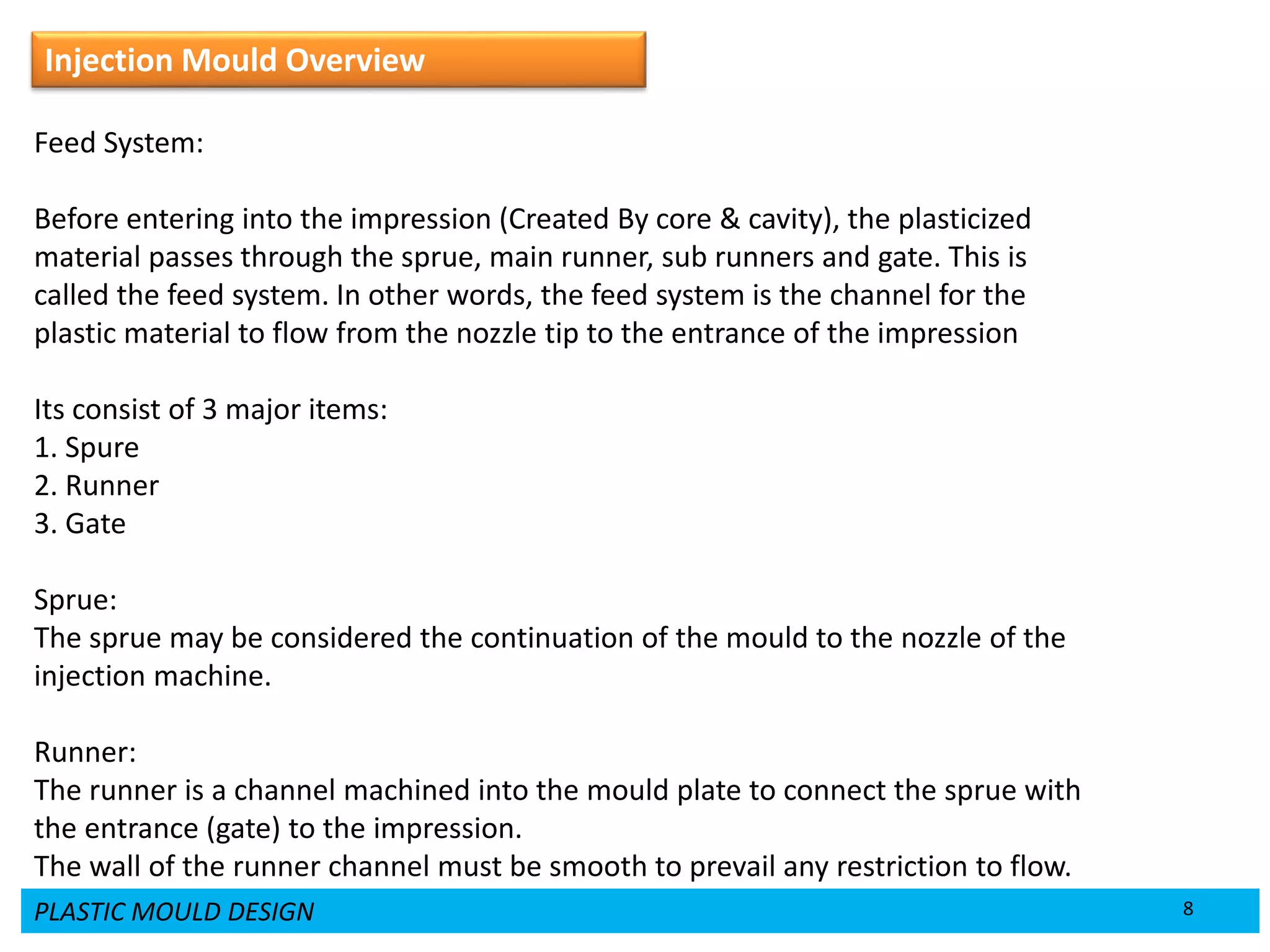
The primary function of a mould is to shape the finished product. In other words, it
is imparting the desired shape to the plasticized polymer and cooling it to get the
molded part(Plastic Product). It is basically made up of two sets of components.
Cavity & core
The cavity
portion of the mould
gives the external form to
the moulding (product).
The core
portion of the mould
forms the internal shape
of moulding(Product)
PLASTIC MOULD DESIGN 8
Injection Mould Overview
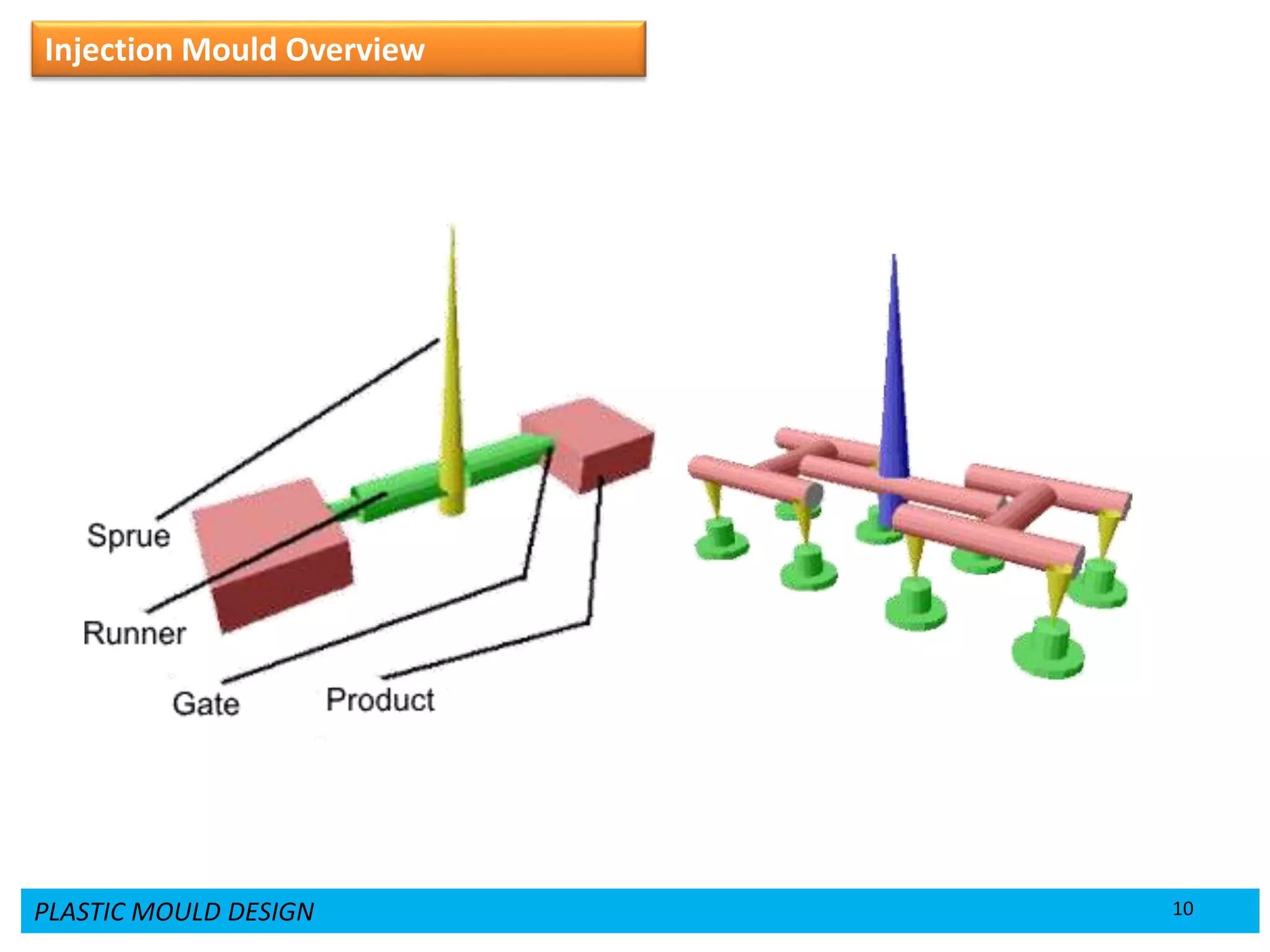
Feed System:
Before entering into the impression (Created By core & cavity), the plasticized
material passes through the sprue, main runner, sub runners and gate. This is
called the feed system. In other words, the feed system is the channel for the
plastic material to flow from the nozzle tip to the entrance of the impression
Its consist of 3 major items:
1. Spure
2. Runner
3. Gate
Sprue:
The sprue may be considered the continuation of the mould to the nozzle of the
injection machine.
Runner:
The runner is a channel machined into the mould plate to connect the sprue with
the entrance (gate) to the impression.
The wall of the runner channel must be smooth to prevail any restriction to flow.
PLASTIC MOULD DESIGN 9
Injection Mould Overview
Gate:
The gate is channel connection the runner with the impression. It has a small cross
- sectional area when compared with rest of the feed system.
1. It allows for simple degating and in some moulds the degating can be automatic.
After degating, only a small degating mark remains.
2. Better control of the filling of multi-impressions can be achieved.
PLASTIC MOULD DESIGN 10
Injection Mould Overview
PLASTIC MOULD DESIGN 11
Injection Moulding Process
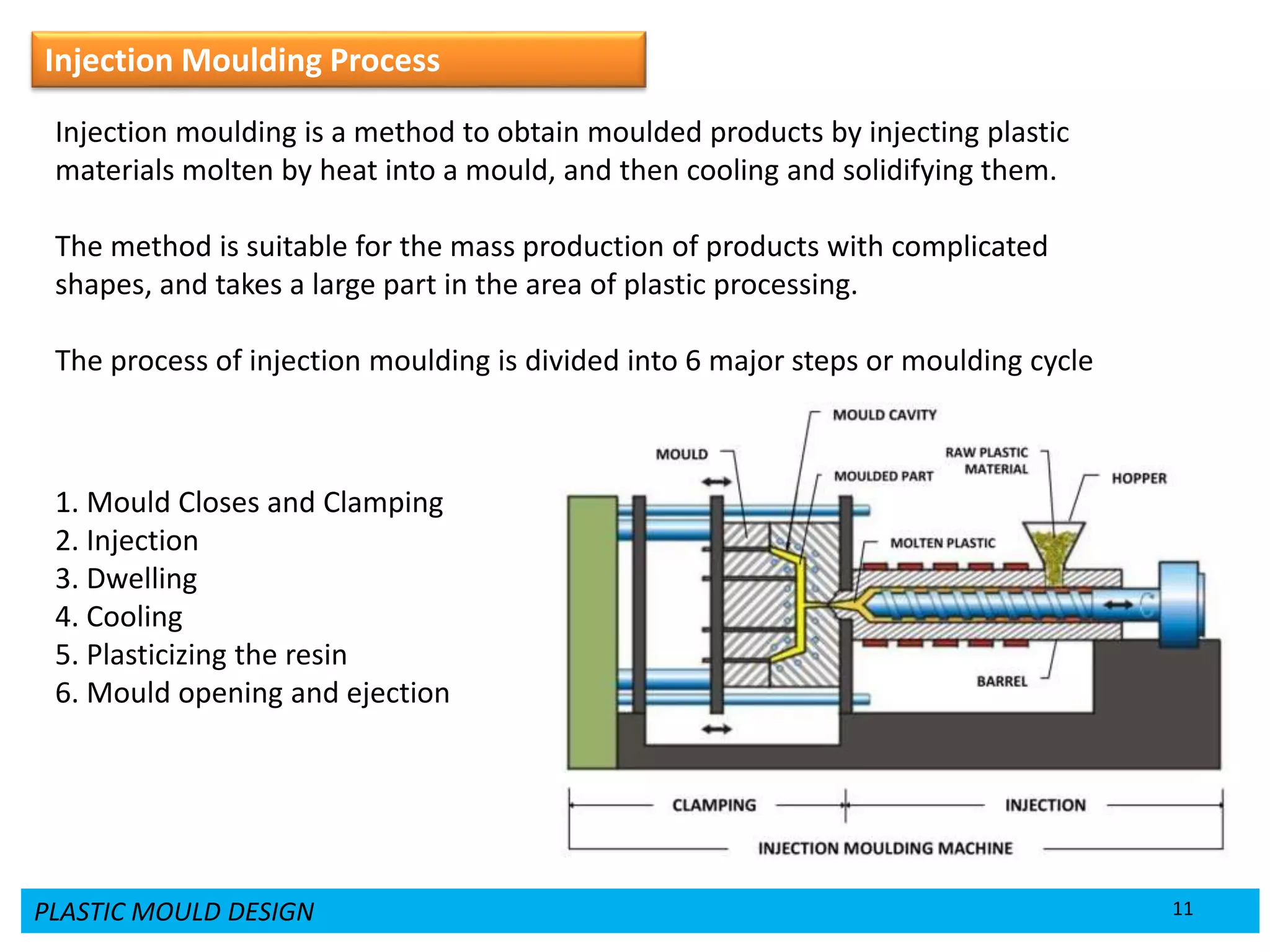
Injection moulding is a method to obtain moulded products by injecting plastic
materials molten by heat into a mould, and then cooling and solidifying them.
The method is suitable for the mass production of products with complicated
shapes, and takes a large part in the area of plastic processing.
The process of injection moulding is divided into 6 major steps or moulding cycle
1. Mould Closes and Clamping
2. Injection
3. Dwelling
4. Cooling
5. Plasticizing the resin
6. Mould opening and ejection
PLASTIC MOULD DESIGN 12
Injection Moulding Process
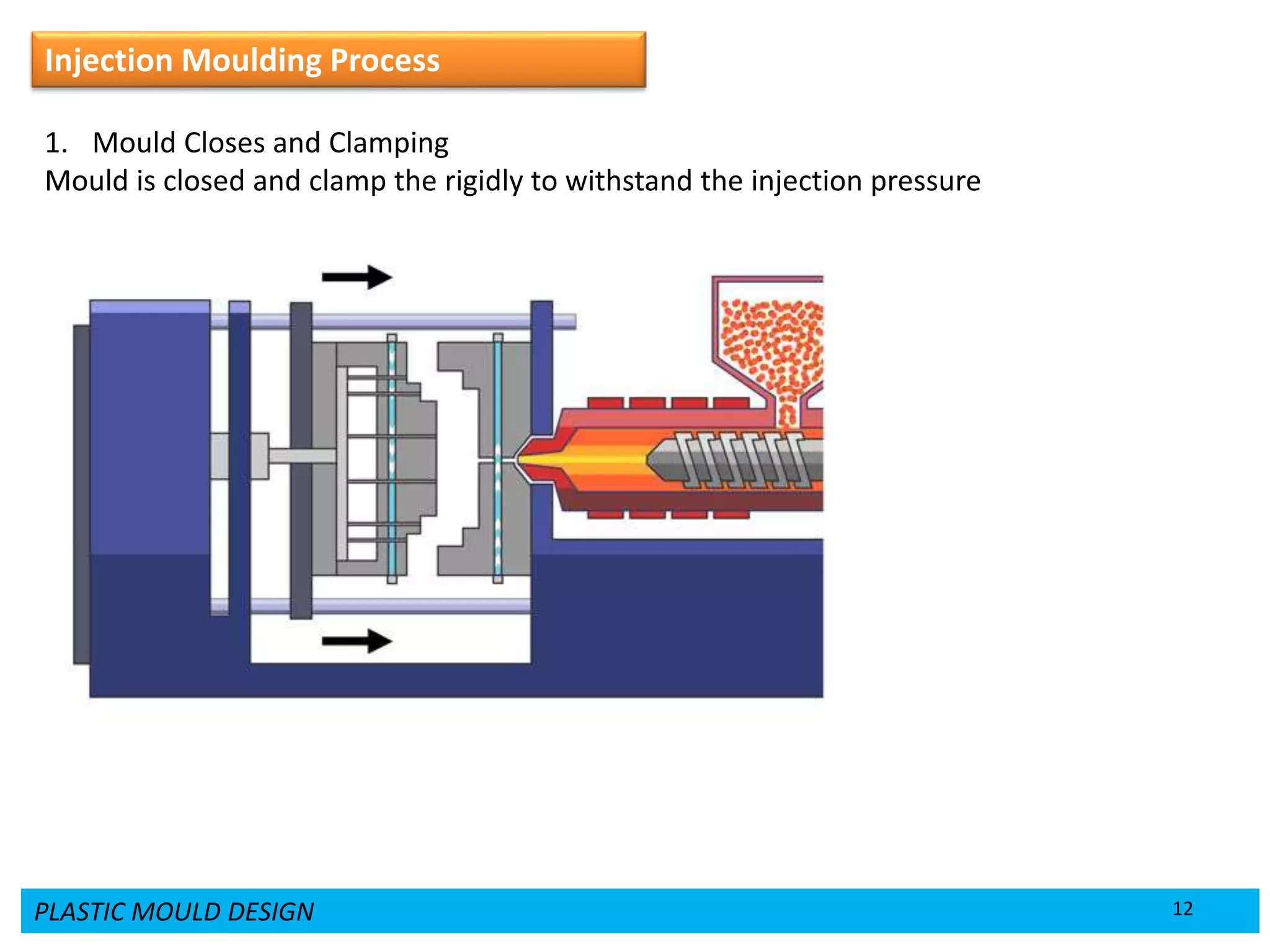
1. Mould Closes and Clamping
Mould is closed and clamp the rigidly to withstand the injection pressure
PLASTIC MOULD DESIGN 13
Injection Moulding Process
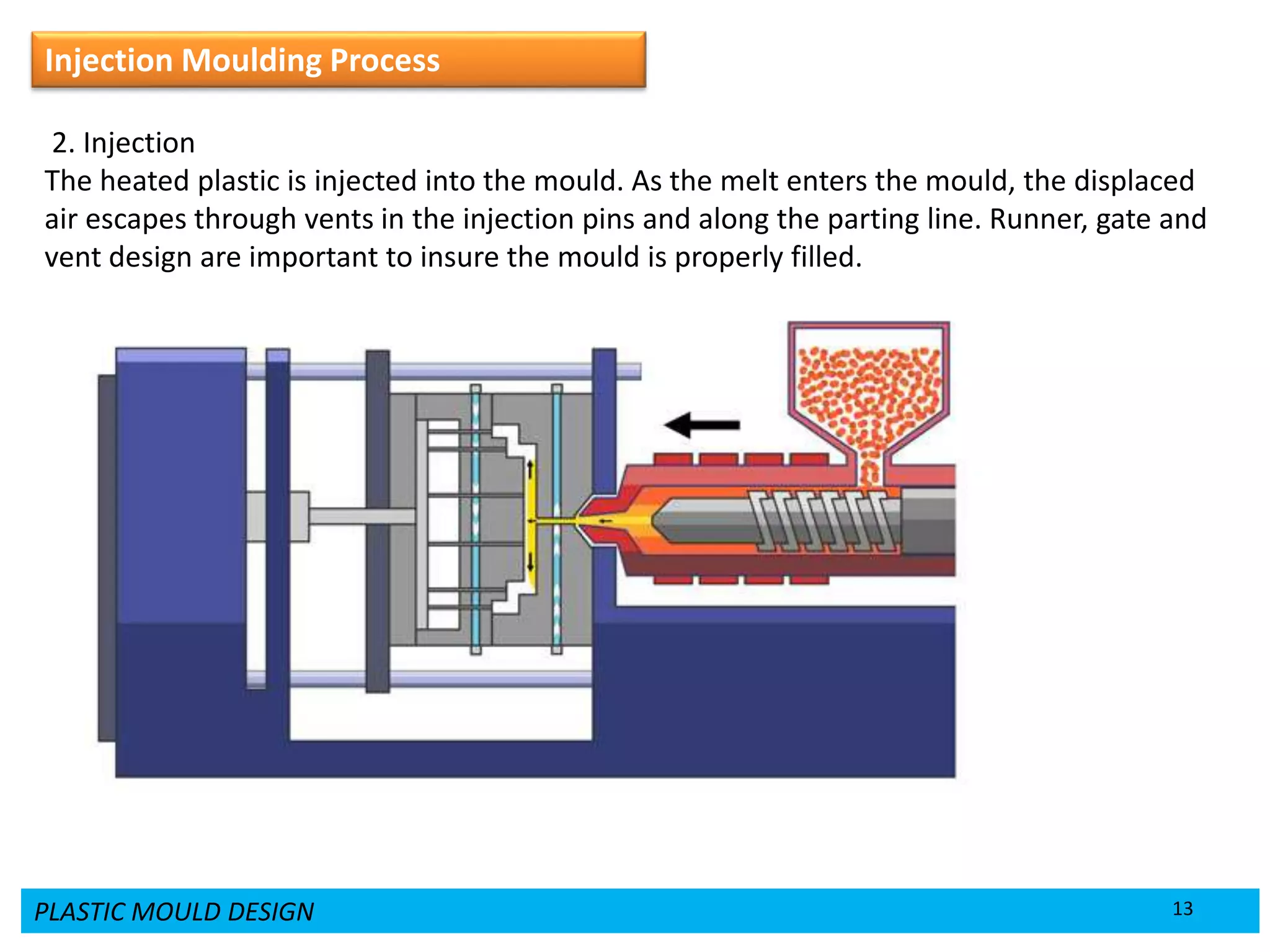
2. Injection
The heated plastic is injected into the mould. As the melt enters the mould, the displaced
air escapes through vents in the injection pins and along the parting line. Runner, gate and
vent design are important to insure the mould is properly filled.
PLASTIC MOULD DESIGN 14
Injection Moulding Process
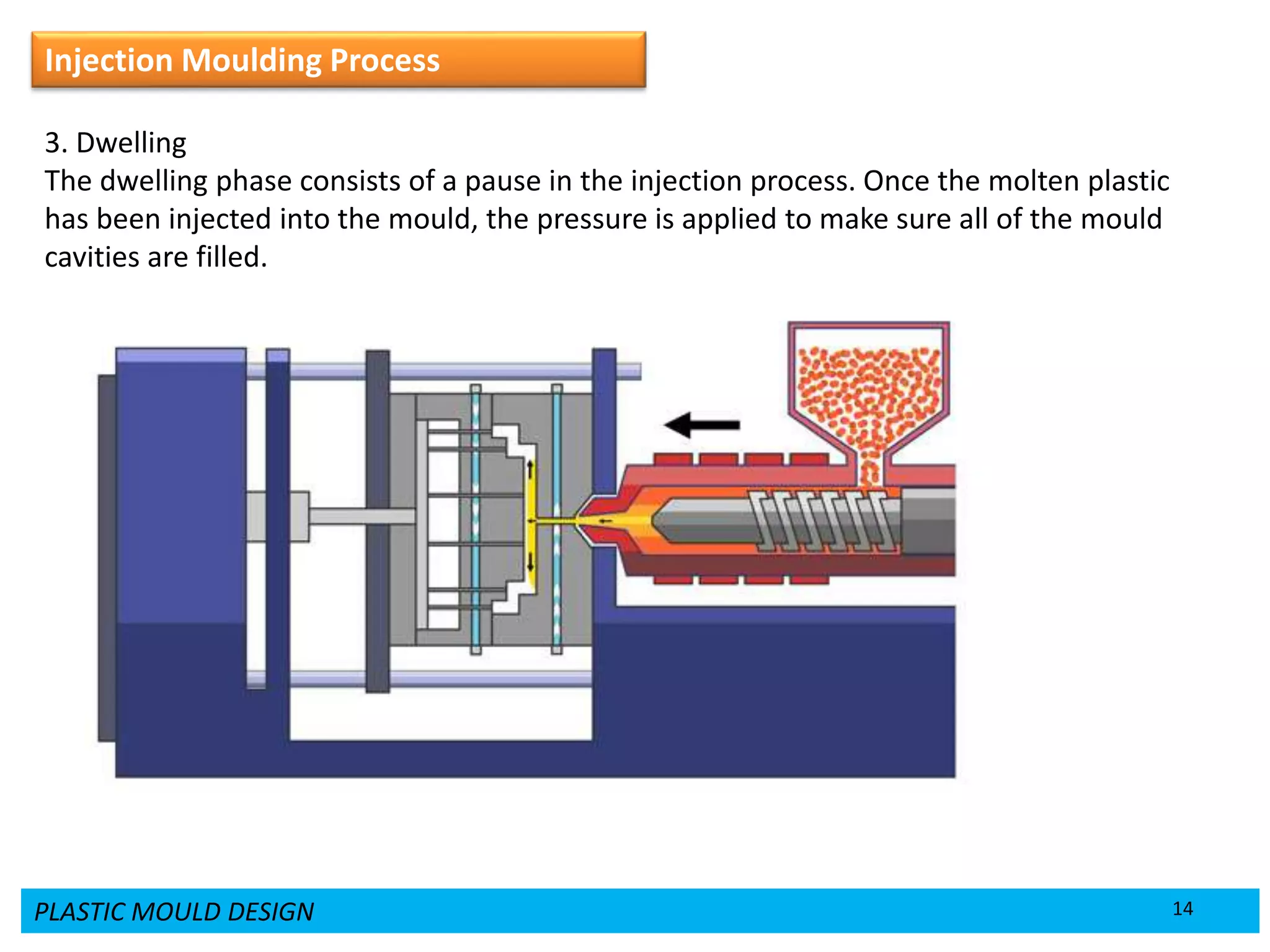
3. Dwelling
The dwelling phase consists of a pause in the injection process. Once the molten plastic
has been injected into the mould, the pressure is applied to make sure all of the mould
cavities are filled.
PLASTIC MOULD DESIGN 15
Injection Moulding Process
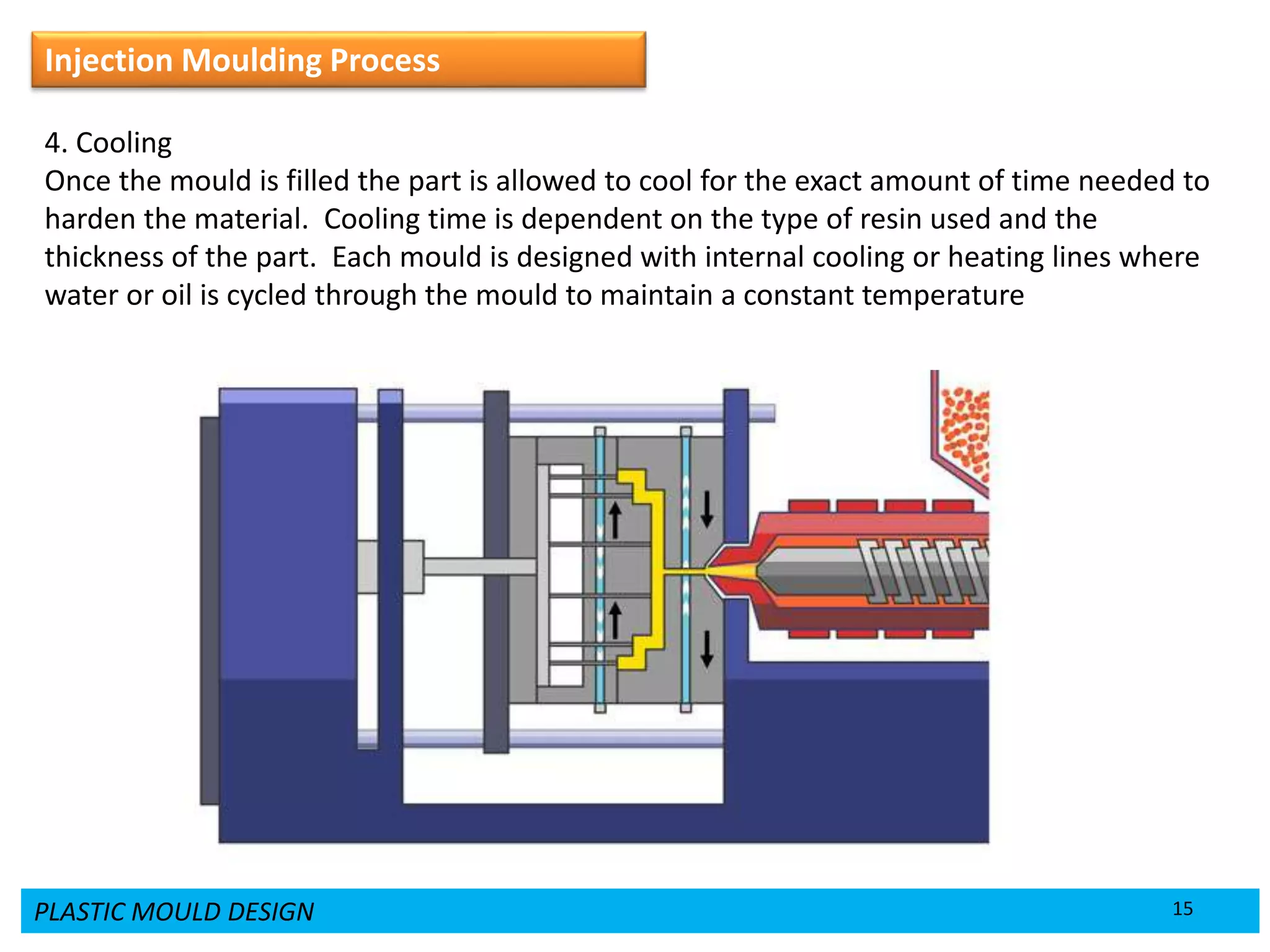
4. Cooling
Once the mould is filled the part is allowed to cool for the exact amount of time needed to
harden the material. Cooling time is dependent on the type of resin used and the
thickness of the part. Each mould is designed with internal cooling or heating lines where
water or oil is cycled through the mould to maintain a constant temperature
PLASTIC MOULD DESIGN 16
Injection Moulding Process
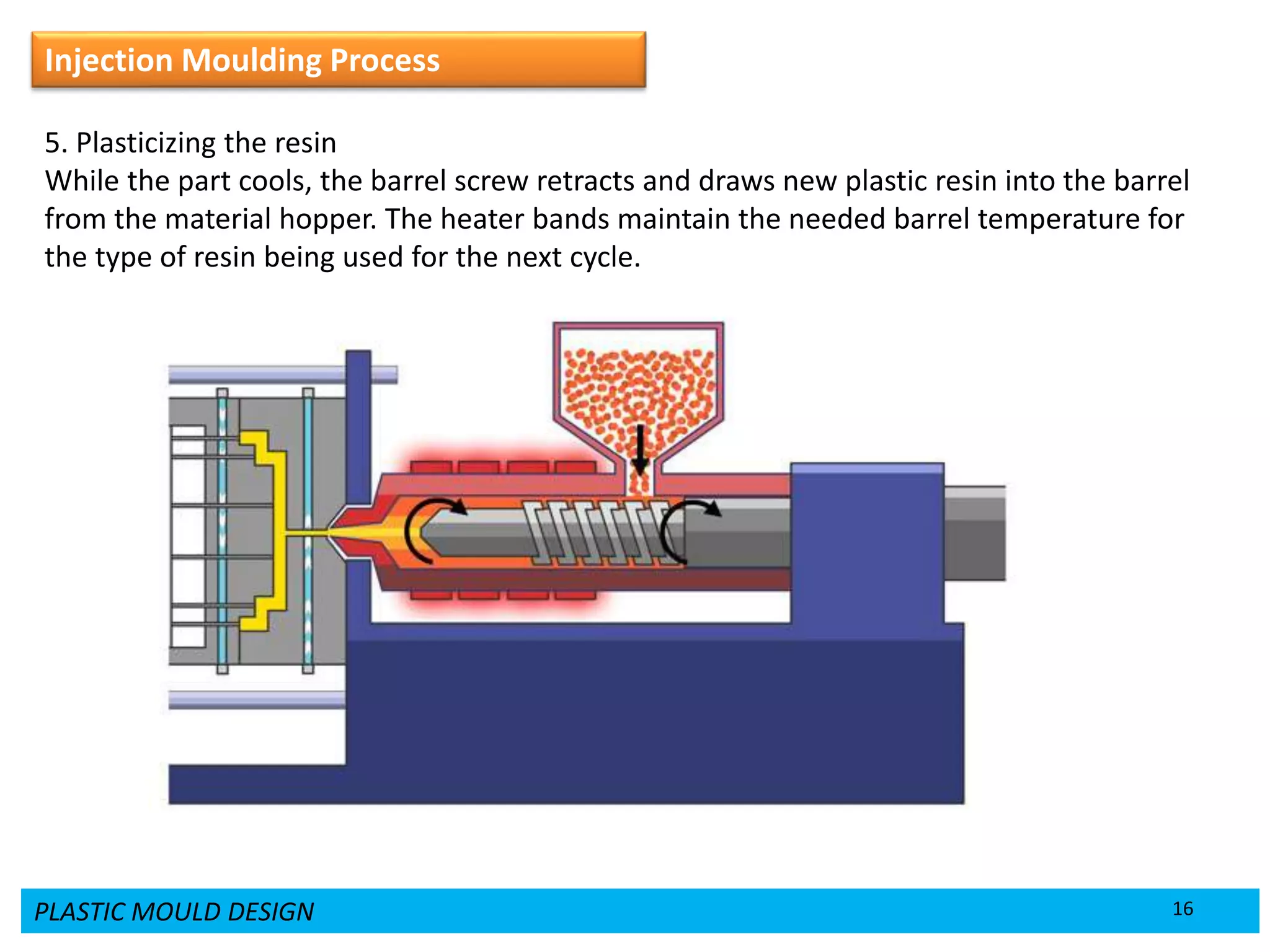
5. Plasticizing the resin
While the part cools, the barrel screw retracts and draws new plastic resin into the barrel
from the material hopper. The heater bands maintain the needed barrel temperature for
the type of resin being used for the next cycle.
PLASTIC MOULD DESIGN 17
Injection Moulding Process
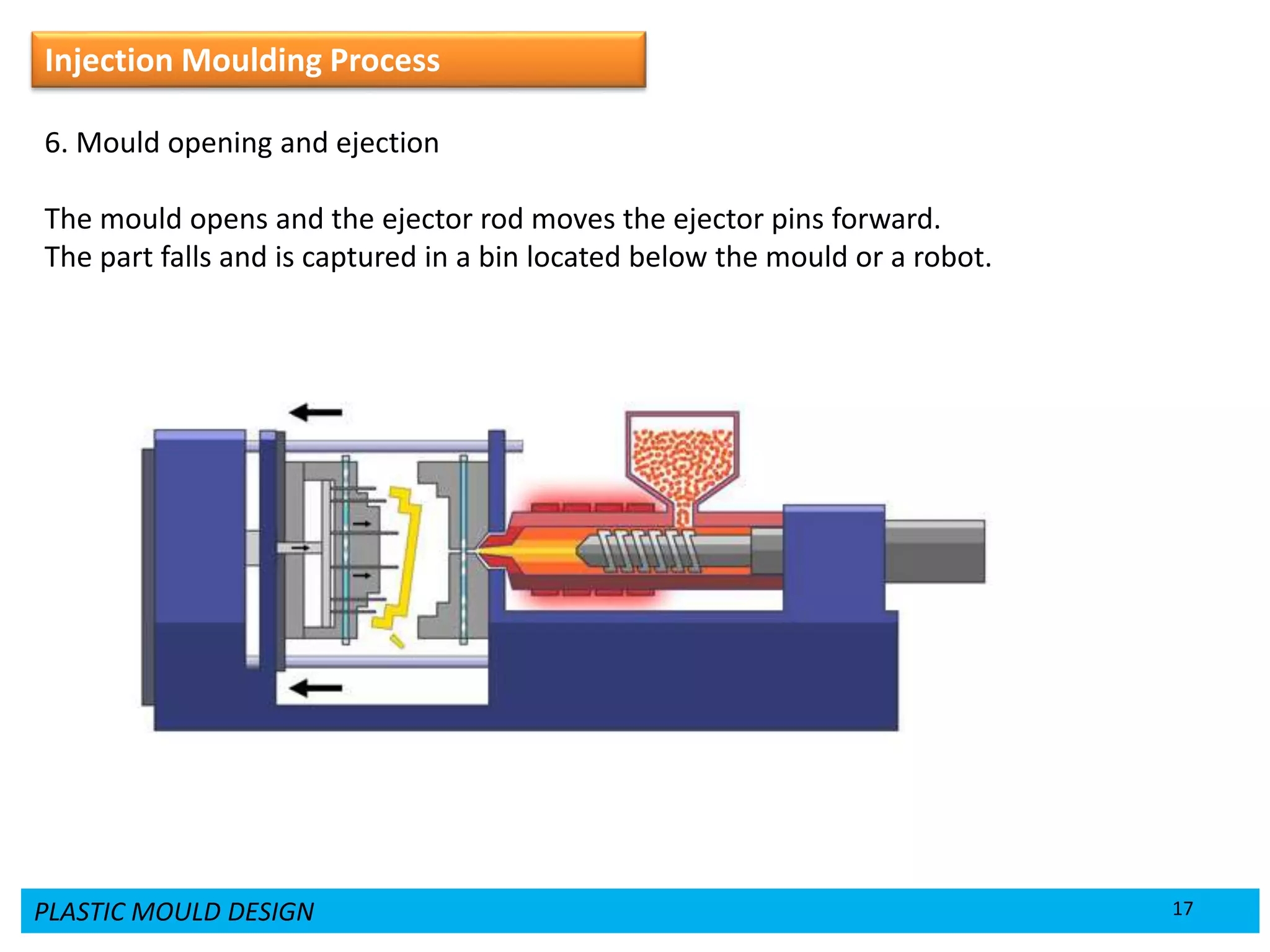
6. Mould opening and ejection
The mould opens and the ejector rod moves the ejector pins forward.
The part falls and is captured in a bin located below the mould or a robot.
PLASTIC MOULD DESIGN 18
Injection Moulding machine
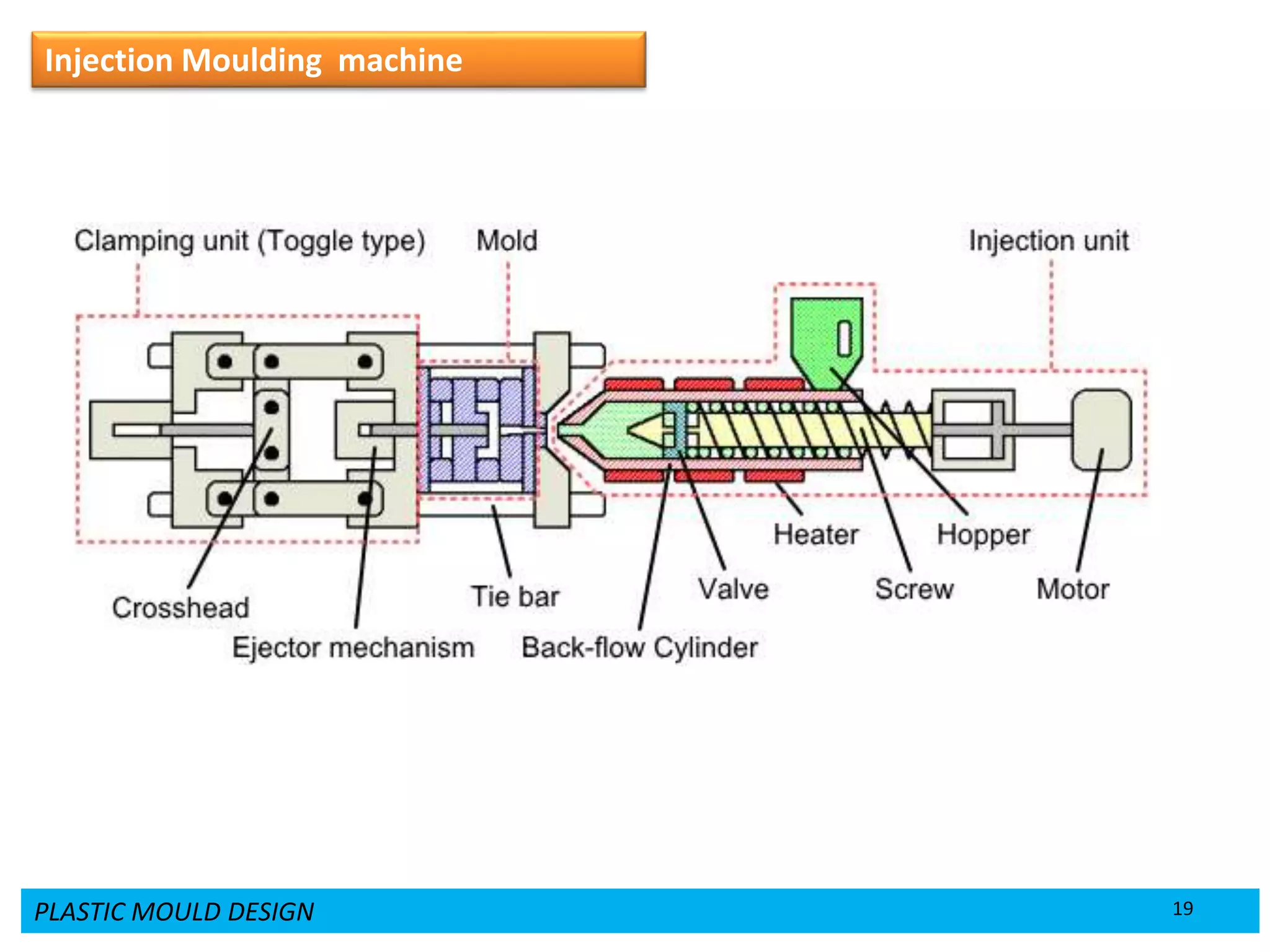
Injection moulding machine is divided into 2 units i.e. a clamping unit and an injection
unit.
The functions of the clamping unit are opening and closing a die, and the ejection of
products. There are 2 types of clamping methods, namely the toggle type and the
straight-hydraulic type in which a mould is directly opened and closed with a hydraulic
cylinder.
The functions of the injection unit are to melt plastic by heat and then to inject molten
plastic into a mould
The screw is rotated to melt plastic introduced from the hopper and to accumulate
molten plastic in front of the screw ( to be called metering ) . After the required amount
of molten plastic is accumulated, injection process is stared.
While molten plastic is flowing in a mould, the machine controls the moving speed of the
screw, or injection speed. On the other hand, it controls dwell pressure after molten
plastic fills out cavities.
The position of change from speed control to pressure control is set at the point where
either screw position or injection pressure reaches a certain fixed value.
PLASTIC MOULD DESIGN 19
Injection Moulding machine
PLASTIC MOULD DESIGN 20

Plastic mold design overview ppt

  • 1.
    PLASTIC MOULD DESIGN1 PLASTIC MOULD DESIGN OVERVIEW
  • 2.
    PLASTIC MOULD DESIGN2 Session topics 1. Importance of Plastic parts 2. Design considerations of Plastic parts 3. Injection mould overview 4. Moulding Process
  • 3.
    PLASTIC MOULD DESIGN3 Now a days most of the modern industries are deals with plastic products. Ex. Aerospace, Automotive, medical, healthcare, Electrical and Electronics, packaging, Construction and marine etc. Why the plastic is used mostly? Plastic can be formed to desired shape by moulding and it can be retained its shape, dimension and quality under ordinary condition of temperature. Advantages over the metal Plastics are lighter than metal, cost wise cheaper, Most of the plastics are reusable, Good surface properties, smooth and even surface, Good insulation properties, some plastics are flexible and even available in transparent. Importance of Plastic Parts
  • 4.
    PLASTIC MOULD DESIGN4 Plastics are divided in to two groups based on Chemical behavior and by the way it reacts with heat 1.Thermo plastics 2.Thermoset plastics Difference between Thermo plastic and Thermoset plastics are Thermo plastics can be soften and re-soften and reused But Thermoset plastic cannot be re-soften and reused Thermo plastic is hard but not brittle, Thermoset plastic hard and brittle Thermo plastic in general use for injection molding process Most common used thermo plastic materials are, ABS -Arylonitride Butadiene Styrene PA -Polyamide (Nylon) PC -Polycarbonate PET - Polyethylene Teraphthalite PP - Polypropylene HDPE,LDPE,PS,PVC Common Plastic Materials
  • 5.
    PLASTIC MOULD DESIGN5 When designing and developing a plastic parts, we need to focus on defining and maximizing part function and appearance, specifying actual part requirements, evaluating process options, selecting an appropriate material, reducing manufacturing costs, and conducting prototype testing. Design considerations of Plastic parts During moulding process, there are several factors that may affect the quality of the final product and the repeatability of the manufacturing process. 1. Wall thickness 2. Corner radii 3. Ribs 4. Bosses 5. Undercuts 6. Draft 7. Parting line 8. Tolerances 9. Defects
  • 6.
    PLASTIC MOULD DESIGN6 Defining plastic part requirements How the plastic products are made? There are three general type of moulds are used to produce the plastic components. 1. Injection moulds 2. Compression moulds 3. Transfer moulds
  • 7.
    PLASTIC MOULD DESIGN7 Injection Mould Overview The primary function of a mould is to shape the finished product. In other words, it is imparting the desired shape to the plasticized polymer and cooling it to get the molded part(Plastic Product). It is basically made up of two sets of components. Cavity & core The cavity portion of the mould gives the external form to the moulding (product). The core portion of the mould forms the internal shape of moulding(Product)
  • 8.
    PLASTIC MOULD DESIGN8 Injection Mould Overview Feed System: Before entering into the impression (Created By core & cavity), the plasticized material passes through the sprue, main runner, sub runners and gate. This is called the feed system. In other words, the feed system is the channel for the plastic material to flow from the nozzle tip to the entrance of the impression Its consist of 3 major items: 1. Spure 2. Runner 3. Gate Sprue: The sprue may be considered the continuation of the mould to the nozzle of the injection machine. Runner: The runner is a channel machined into the mould plate to connect the sprue with the entrance (gate) to the impression. The wall of the runner channel must be smooth to prevail any restriction to flow.
  • 9.
    PLASTIC MOULD DESIGN9 Injection Mould Overview Gate: The gate is channel connection the runner with the impression. It has a small cross - sectional area when compared with rest of the feed system. 1. It allows for simple degating and in some moulds the degating can be automatic. After degating, only a small degating mark remains. 2. Better control of the filling of multi-impressions can be achieved.
  • 10.
    PLASTIC MOULD DESIGN10 Injection Mould Overview
  • 11.
    PLASTIC MOULD DESIGN11 Injection Moulding Process Injection moulding is a method to obtain moulded products by injecting plastic materials molten by heat into a mould, and then cooling and solidifying them. The method is suitable for the mass production of products with complicated shapes, and takes a large part in the area of plastic processing. The process of injection moulding is divided into 6 major steps or moulding cycle 1. Mould Closes and Clamping 2. Injection 3. Dwelling 4. Cooling 5. Plasticizing the resin 6. Mould opening and ejection
  • 12.
    PLASTIC MOULD DESIGN12 Injection Moulding Process 1. Mould Closes and Clamping Mould is closed and clamp the rigidly to withstand the injection pressure
  • 13.
    PLASTIC MOULD DESIGN13 Injection Moulding Process 2. Injection The heated plastic is injected into the mould. As the melt enters the mould, the displaced air escapes through vents in the injection pins and along the parting line. Runner, gate and vent design are important to insure the mould is properly filled.
  • 14.
    PLASTIC MOULD DESIGN14 Injection Moulding Process 3. Dwelling The dwelling phase consists of a pause in the injection process. Once the molten plastic has been injected into the mould, the pressure is applied to make sure all of the mould cavities are filled.
  • 15.
    PLASTIC MOULD DESIGN15 Injection Moulding Process 4. Cooling Once the mould is filled the part is allowed to cool for the exact amount of time needed to harden the material. Cooling time is dependent on the type of resin used and the thickness of the part. Each mould is designed with internal cooling or heating lines where water or oil is cycled through the mould to maintain a constant temperature
  • 16.
    PLASTIC MOULD DESIGN16 Injection Moulding Process 5. Plasticizing the resin While the part cools, the barrel screw retracts and draws new plastic resin into the barrel from the material hopper. The heater bands maintain the needed barrel temperature for the type of resin being used for the next cycle.
  • 17.
    PLASTIC MOULD DESIGN17 Injection Moulding Process 6. Mould opening and ejection The mould opens and the ejector rod moves the ejector pins forward. The part falls and is captured in a bin located below the mould or a robot.
  • 18.
    PLASTIC MOULD DESIGN18 Injection Moulding machine Injection moulding machine is divided into 2 units i.e. a clamping unit and an injection unit. The functions of the clamping unit are opening and closing a die, and the ejection of products. There are 2 types of clamping methods, namely the toggle type and the straight-hydraulic type in which a mould is directly opened and closed with a hydraulic cylinder. The functions of the injection unit are to melt plastic by heat and then to inject molten plastic into a mould The screw is rotated to melt plastic introduced from the hopper and to accumulate molten plastic in front of the screw ( to be called metering ) . After the required amount of molten plastic is accumulated, injection process is stared. While molten plastic is flowing in a mould, the machine controls the moving speed of the screw, or injection speed. On the other hand, it controls dwell pressure after molten plastic fills out cavities. The position of change from speed control to pressure control is set at the point where either screw position or injection pressure reaches a certain fixed value.
  • 19.
    PLASTIC MOULD DESIGN19 Injection Moulding machine
  • 20.