GROUP MEMBERS

  MUAAZ ALI   BSME01113094
  IRFAN ALI   BSME01113098
MUAAZ ALI
INJECTION MOLDING
 BLOW MOLDING
 INJECTION BLOW MOLDING
INJECTION MOLDING
 Injection molding is one of the most commonly used
  processing method for the plastic components

 It is defined as
    “ A manufacturing process for forming objects, as of
  plastic or metal, by heating the molding material to a
  fluid state and injecting it into a mold “.
What does processing of plastic
    means ?
  All the methods used for processing of plastics like
 Injection molding, blow molding , thermoforming ,
 extrusion e.t.c. , have a raw material i.e. plastic in some form
 which is then heated , formed and cooled to get the desired
 design and product.

 So , the term to memorize in all plastic processing methods
 is HFC ( heating , forming , cooling )
INJECTION MOLDING (CONTINUED)
 It is used to process thin walled plastic parts for a
 wide variety of shapes and products .

                   BASIC PRINCIPLE
Plastic material is melted in a heated chamber and
   then injected in the mold , where it cools and
  finally the finished plastic part is ejected out of the
                         cavity .
INJECTION MOLDING MACHINE


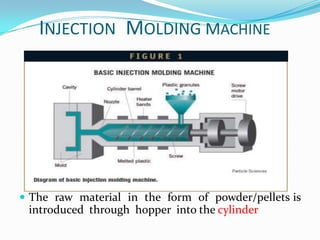
 The raw material in the form of powder/pellets is
 introduced through hopper into the cylinder
Machine parts
 Hopper is a tapered container working with a hopping
  motion to transfer grains into cylinder

 Inside the cylinder there is a piston /plunger which is used
  to move the material from cylinder into the mold

 Heating arrangement is placed above and below the
  cylinder .

 The mold is in two halves , it has a mold cavity and the
  mold has two ejector pins.
Process
 As soon as the plastic is melted it will be pushed by the
  piston into the sprue through which the material
  would go into the mold cavity .

 The cavity will be filled by the pressure of the piston
  and the mold should not be opened until the plastic
  solidifies.

 When the plastic solidifies the ejector pins are
  hydraulically moved backwards .
Stages of Injection molding
 Clamping : The two halves of mold are tightly closed before
  the molten plastic is injected.

 Injection : Injection of raw material from hopper into
  cylinder to the cavity is called the injection stage.

 Cooling : The material is cooled for at least 30-60 sec

 Ejection : The 2nd mold plate moves back by ejector pins
  and the product is tapped out
IMPORTANT POINTS
 PRODUCTION RATE :
 Production rate depends upon the clamping and de-clamping
 time of the mold halves.

 INJECTION TIME:
  The filling process should be optimal not too slow in order to
 stop the production of cracks.

 SHOT VOLUME :
  The amount of material that is injected into the mold is
 referred to as shot volume

 PRESSURE and CYCLE TIME :
  The pressure applied is in the range of 35-140 MPa while the
 cycle completes in 2-60 sec
MATERIALS USED
 Acetate
 Acrylonitrile butadiene styrene (ABS)
 Cellulose acetate
 PVC ( poly vinyl chloride)
 Polycarbonate
 Polyesters
e.t.c.
ADVANTAGES
 Higher production rate
 Minimum wastage of material
 Complex geometry can easily be produced

DISADVANTAGES
• Tooling cost higher
• High setup cost
• Large undercuts can not be formed
APPLICATIONS
 It can be used to produce thin walled plastic products of
    varying size and dimensions e.g.
   Medical devices such as surgical syringes
   Open container like buckets
   Plastic housings of different tools
   Daily use products such as tooth brushes
USED in PAKISTAN
 Faraz industries
Address: WH-3/2, sector 16-B , North Karachi , Karachi

 Siddique sons
Address: WH-2/7 ,Sector 16-B , North Karachi, Karachi
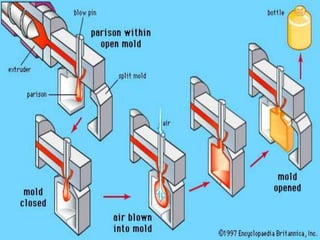
BLOW MOLDING
 “ It is a plastic processing technique which is used to
  produce hollow plastic parts by inflating a heated
  plastic until it fills a mold and forms the desired shape”

 The raw material used for processing in blow molding is
  called parison

 Parison is a preform tube that is hollow and it has a hole
  at one end
PROCEDURE
I.   First the parison is obtained by means of extrusion or
     injection molding process
II. Above the preform there is a blower and the preform is
     positioned between two split halves of the mold.
III. The mold closes over the tube and the hot air is injected
     from the blower into the hollow tube . The air expands the
     tube against the sides of the mold
IV. After sufficient cooling , the mold opens to release the
     product.
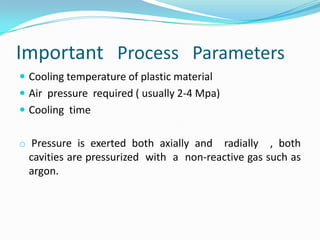
Important Process Parameters
 Cooling temperature of plastic material
 Air pressure required ( usually 2-4 Mpa)
 Cooling time


o Pressure is exerted both axially and   radially , both
  cavities are pressurized with a non-reactive gas such as
  argon.
Types of Blow molding
 Extrusion blow molding
 Injection blow molding
 Stretch blow molding


 MAJOR DIFFERENCE:
 All the types have one primary difference that is
 making of parison by extrusion , injection and
 stretching .
INJECTION BLOW MOLDING
 The injection blow molding is used for the production of
     hollow objects in large quantities . The main applications are
     bottles, jars and other containers.

 The process is divided into three sections
i)   Injection
ii) Blowing
iii) Ejection
IRFAN ALI
 EXTRUSION BLOW MOLDING
 STRETCH BLOW MOLDING
 THERMOFORMING
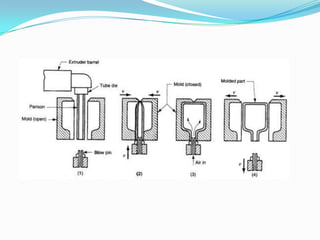
EXTRUSION BLOW MOLDING
 In this process the blow molding machine is based on a standard
  extruder barrel and screw assembly to plasticize the polymer.

 The polymer is heated inside the barrel , the molten polymer is
  led through a right angle and through a die to emerge as a
  hollow section.

 When the parison has moved enough length it is cut through by
  a knife and fits inside the bottle mold .

 The bottle mold moves toward the jet where the air blows and
  the product is obtained after cooling .
Stretch blow molding
 Stretch blow molding is also carried out by injection . Used
  the production of high quality containers.
 This process is divided into four steps
 Injection : The material is injected as discussed before.
 Stretching : One conditioned to correct temperature , the
  parison is stretched by the blow pin/stretch rod that stretches it
  longitudinally .
 Blowing : Using two levels of air pressure , the preform is
  blown circumferentially.
 Discharge : After a set time for cooling the molds open and the
  product is removed .
ADVANTAGES
 Low tooling costs .
 Fast production rates .
 Ability to mold complex parts .
 Little scrap generated .
 Large hollow shape can be produced .
 Produced parts can be recycled .

       DISADVANTAGES
•   Limited to hollow parts .
• Thick parts cannot be manufactured.
Applications
 Different types of plastic products can be
 manufactured by this process such as:
 Bottles in different shapes and sizes
 Jars and containers
 Fluid oil tanks
 Mugs
 Toys etc
THERMOFORMING
 “ Thermoforming is a plastic processing technique in
  which the thermoplastic sheets are formed by applying
  temperature and pressure inside the mold .”

 The raw material here is usually plastic sheet

 Different types of this process are
I. Vacuum forming
II. Pressure forming
III. Matched die forming
VACUUM FORMING
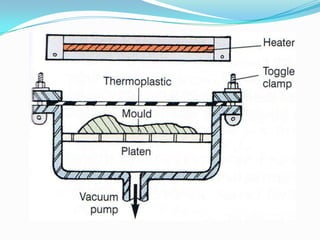
o The vacuum pressure is used to form the heated
  thermoplastic sheet into the desired shape.
o Thermoplastic sheet is placed on the mold surface
  and fixed with the help of clamping unit.
o The sheet is heated until it softens and there after ,
  vacuum needs to be applied quickly.
o There is tank with nozzles that suck air and creates
  vacuum in between sheet and mold.
Few important parameters
 How much heat is required ?
 Amount of vacuum needed .


 These parameters solely depends upon the type of
 thermoforming and the thickness needed.

Video of vacuum forming
PRESSURE FORMING
 The forming process is closely related to the vacuum
    forming .
   The air pressure required is much higher as compared
    to the pressure required in the vacuum forming
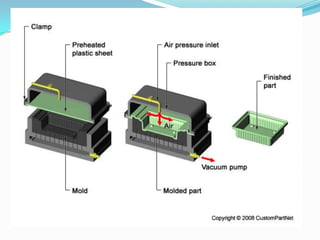
    The preheated plastic sheet is placed on the mold
    surface and then air pressure is applied quickly above
    the sheet.
    The high pressure is developed in between the
    softened sheet and pressure box
    Due to the high pressure, the preheated plastic sheet
    can be deformed into the mold cavity in a fraction of
    second (means high production rate).
 The formed sheet is held in the mold cavity for cooling
  for few seconds
 The formed parts thereby solidifies and is ejected.
MATCHED DIE FORMING
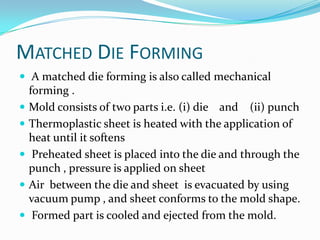
 A matched die forming is also called mechanical
    forming .
   Mold consists of two parts i.e. (i) die and (ii) punch
   Thermoplastic sheet is heated with the application of
    heat until it softens
    Preheated sheet is placed into the die and through the
    punch , pressure is applied on sheet
   Air between the die and sheet is evacuated by using
    vacuum pump , and sheet conforms to the mold shape.
    Formed part is cooled and ejected from the mold.
Materials used

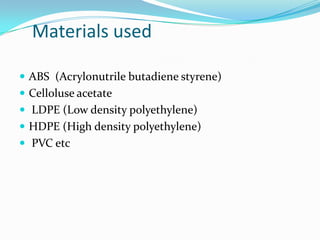
 ABS (Acrylonutrile butadiene styrene)
 Celloluse acetate
 LDPE (Low density polyethylene)
 HDPE (High density polyethylene)
 PVC etc
ADVANTAGES
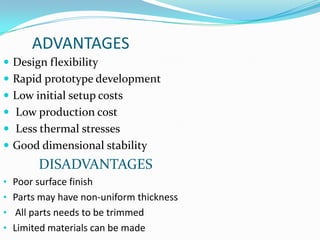
 Design flexibility
 Rapid prototype development
 Low initial setup costs
 Low production cost
 Less thermal stresses
 Good dimensional stability
        DISADVANTAGES
• Poor surface finish
• Parts may have non-uniform thickness
• All parts needs to be trimmed
• Limited materials can be made
Applications
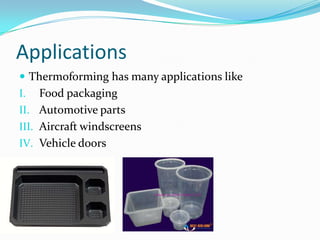
 Thermoforming has many applications like
I.   Food packaging
II. Automotive parts
III. Aircraft windscreens
IV. Vehicle doors
APPLICATIONS IN PAKISTAN
 Ideal Industry
  Mailing Address: Plot # 109, Kerbath Soling, 1 km Off Main Bedian
  Road, Lahore Pakistan.
  Pabx: 92 42 35600211/12
  Cell: 92 344 6001111
  Fax: 92 42 35600209
  Email: sales@idealindustriesm.pk

Injection, blow molding

  • 2.
    GROUP MEMBERS MUAAZ ALI BSME01113094 IRFAN ALI BSME01113098
  • 3.
    MUAAZ ALI INJECTION MOLDING BLOW MOLDING  INJECTION BLOW MOLDING
  • 4.
    INJECTION MOLDING  Injectionmolding is one of the most commonly used processing method for the plastic components  It is defined as “ A manufacturing process for forming objects, as of plastic or metal, by heating the molding material to a fluid state and injecting it into a mold “.
  • 5.
    What does processingof plastic means ?  All the methods used for processing of plastics like Injection molding, blow molding , thermoforming , extrusion e.t.c. , have a raw material i.e. plastic in some form which is then heated , formed and cooled to get the desired design and product.  So , the term to memorize in all plastic processing methods is HFC ( heating , forming , cooling )
  • 6.
    INJECTION MOLDING (CONTINUED) It is used to process thin walled plastic parts for a wide variety of shapes and products . BASIC PRINCIPLE Plastic material is melted in a heated chamber and then injected in the mold , where it cools and finally the finished plastic part is ejected out of the cavity .
  • 7.
    INJECTION MOLDING MACHINE The raw material in the form of powder/pellets is introduced through hopper into the cylinder
  • 8.
    Machine parts  Hopperis a tapered container working with a hopping motion to transfer grains into cylinder  Inside the cylinder there is a piston /plunger which is used to move the material from cylinder into the mold  Heating arrangement is placed above and below the cylinder .  The mold is in two halves , it has a mold cavity and the mold has two ejector pins.
  • 9.
    Process  As soonas the plastic is melted it will be pushed by the piston into the sprue through which the material would go into the mold cavity .  The cavity will be filled by the pressure of the piston and the mold should not be opened until the plastic solidifies.  When the plastic solidifies the ejector pins are hydraulically moved backwards .
  • 10.
    Stages of Injectionmolding  Clamping : The two halves of mold are tightly closed before the molten plastic is injected.  Injection : Injection of raw material from hopper into cylinder to the cavity is called the injection stage.  Cooling : The material is cooled for at least 30-60 sec  Ejection : The 2nd mold plate moves back by ejector pins and the product is tapped out
  • 11.
    IMPORTANT POINTS  PRODUCTIONRATE : Production rate depends upon the clamping and de-clamping time of the mold halves.  INJECTION TIME: The filling process should be optimal not too slow in order to stop the production of cracks.  SHOT VOLUME : The amount of material that is injected into the mold is referred to as shot volume  PRESSURE and CYCLE TIME : The pressure applied is in the range of 35-140 MPa while the cycle completes in 2-60 sec
  • 12.
    MATERIALS USED  Acetate Acrylonitrile butadiene styrene (ABS)  Cellulose acetate  PVC ( poly vinyl chloride)  Polycarbonate  Polyesters e.t.c.
  • 13.
    ADVANTAGES  Higher productionrate  Minimum wastage of material  Complex geometry can easily be produced DISADVANTAGES • Tooling cost higher • High setup cost • Large undercuts can not be formed
  • 14.
    APPLICATIONS  It canbe used to produce thin walled plastic products of varying size and dimensions e.g.  Medical devices such as surgical syringes  Open container like buckets  Plastic housings of different tools  Daily use products such as tooth brushes
  • 15.
    USED in PAKISTAN Faraz industries Address: WH-3/2, sector 16-B , North Karachi , Karachi  Siddique sons Address: WH-2/7 ,Sector 16-B , North Karachi, Karachi
  • 16.
    BLOW MOLDING  “It is a plastic processing technique which is used to produce hollow plastic parts by inflating a heated plastic until it fills a mold and forms the desired shape”  The raw material used for processing in blow molding is called parison  Parison is a preform tube that is hollow and it has a hole at one end
  • 17.
    PROCEDURE I. First the parison is obtained by means of extrusion or injection molding process II. Above the preform there is a blower and the preform is positioned between two split halves of the mold. III. The mold closes over the tube and the hot air is injected from the blower into the hollow tube . The air expands the tube against the sides of the mold IV. After sufficient cooling , the mold opens to release the product.
  • 19.
    Important Process Parameters Cooling temperature of plastic material  Air pressure required ( usually 2-4 Mpa)  Cooling time o Pressure is exerted both axially and radially , both cavities are pressurized with a non-reactive gas such as argon.
  • 20.
    Types of Blowmolding  Extrusion blow molding  Injection blow molding  Stretch blow molding  MAJOR DIFFERENCE: All the types have one primary difference that is making of parison by extrusion , injection and stretching .
  • 21.
    INJECTION BLOW MOLDING The injection blow molding is used for the production of hollow objects in large quantities . The main applications are bottles, jars and other containers.  The process is divided into three sections i) Injection ii) Blowing iii) Ejection
  • 22.
    IRFAN ALI  EXTRUSIONBLOW MOLDING  STRETCH BLOW MOLDING  THERMOFORMING
  • 23.
    EXTRUSION BLOW MOLDING In this process the blow molding machine is based on a standard extruder barrel and screw assembly to plasticize the polymer.  The polymer is heated inside the barrel , the molten polymer is led through a right angle and through a die to emerge as a hollow section.  When the parison has moved enough length it is cut through by a knife and fits inside the bottle mold .  The bottle mold moves toward the jet where the air blows and the product is obtained after cooling .
  • 25.
    Stretch blow molding Stretch blow molding is also carried out by injection . Used the production of high quality containers.  This process is divided into four steps  Injection : The material is injected as discussed before.  Stretching : One conditioned to correct temperature , the parison is stretched by the blow pin/stretch rod that stretches it longitudinally .  Blowing : Using two levels of air pressure , the preform is blown circumferentially.  Discharge : After a set time for cooling the molds open and the product is removed .
  • 26.
    ADVANTAGES  Low toolingcosts .  Fast production rates .  Ability to mold complex parts .  Little scrap generated .  Large hollow shape can be produced .  Produced parts can be recycled . DISADVANTAGES • Limited to hollow parts . • Thick parts cannot be manufactured.
  • 27.
    Applications  Different typesof plastic products can be manufactured by this process such as:  Bottles in different shapes and sizes  Jars and containers  Fluid oil tanks  Mugs  Toys etc
  • 28.
    THERMOFORMING  “ Thermoformingis a plastic processing technique in which the thermoplastic sheets are formed by applying temperature and pressure inside the mold .”  The raw material here is usually plastic sheet  Different types of this process are I. Vacuum forming II. Pressure forming III. Matched die forming
  • 29.
    VACUUM FORMING o Thevacuum pressure is used to form the heated thermoplastic sheet into the desired shape. o Thermoplastic sheet is placed on the mold surface and fixed with the help of clamping unit. o The sheet is heated until it softens and there after , vacuum needs to be applied quickly. o There is tank with nozzles that suck air and creates vacuum in between sheet and mold.
  • 31.
    Few important parameters How much heat is required ?  Amount of vacuum needed .  These parameters solely depends upon the type of thermoforming and the thickness needed. Video of vacuum forming
  • 32.
    PRESSURE FORMING  Theforming process is closely related to the vacuum forming .  The air pressure required is much higher as compared to the pressure required in the vacuum forming  The preheated plastic sheet is placed on the mold surface and then air pressure is applied quickly above the sheet.  The high pressure is developed in between the softened sheet and pressure box  Due to the high pressure, the preheated plastic sheet can be deformed into the mold cavity in a fraction of second (means high production rate).
  • 33.
     The formedsheet is held in the mold cavity for cooling for few seconds  The formed parts thereby solidifies and is ejected.
  • 35.
    MATCHED DIE FORMING A matched die forming is also called mechanical forming .  Mold consists of two parts i.e. (i) die and (ii) punch  Thermoplastic sheet is heated with the application of heat until it softens  Preheated sheet is placed into the die and through the punch , pressure is applied on sheet  Air between the die and sheet is evacuated by using vacuum pump , and sheet conforms to the mold shape.  Formed part is cooled and ejected from the mold.
  • 36.
    Materials used  ABS(Acrylonutrile butadiene styrene)  Celloluse acetate  LDPE (Low density polyethylene)  HDPE (High density polyethylene)  PVC etc
  • 37.
    ADVANTAGES  Design flexibility Rapid prototype development  Low initial setup costs  Low production cost  Less thermal stresses  Good dimensional stability DISADVANTAGES • Poor surface finish • Parts may have non-uniform thickness • All parts needs to be trimmed • Limited materials can be made
  • 38.
    Applications  Thermoforming hasmany applications like I. Food packaging II. Automotive parts III. Aircraft windscreens IV. Vehicle doors
  • 39.
    APPLICATIONS IN PAKISTAN Ideal Industry Mailing Address: Plot # 109, Kerbath Soling, 1 km Off Main Bedian Road, Lahore Pakistan. Pabx: 92 42 35600211/12 Cell: 92 344 6001111 Fax: 92 42 35600209 Email: sales@idealindustriesm.pk