BLOW MOULDING
BY
M. PEER MOHAMED
(Manager)
BLOW MOULDING
A process to Produce Hollow Products like bottles,
containers, jars and jerrycans from thermoplastics.
Advantages
 Moulding extremely irregular (reentrant) curves
 Low stresses in the product
 Possibility of variable wall thickiness
 Use of polymers with high chemical resistance
 Favourable processing costs
Required pressure levels of 25 to 150 psi and with
some resins 200 to 300 psi. But Injection Moulding requires
2000 to 30,000 psi and hence development of high internal
stresses.
Materials Used
Small parts, under 5 litres,
 Polyolefines (LDPE,HDPE,PP )
 polyvinyl Chloride (PVC)
 Polyacrylonitrile (PAN)
 Polystyrene (PS)
 Styrene Acrylonitrile (SAN)
   Polyester (Saturated , PET)
Large parts, over 5 litres including technical parts,
  Poly olefines (HDPE / PP)
 Polycarbonate (PC)
 Polyacetal (POM)
 Polyamides (PA)
 Polyvinylidene Fluoride (PVDF) 
TYPES OF BLOW MOULDING
1.     Extrusion Blow Moulding  (EBM) which pricipally  
    uses an unsupported parison  (75% usages)
2.      Injection  Blow  Moulding  (IBM)  which  principally 
uses  a  preform  supported  by  a  metal  core  pin 
(25%  usages).
3.    Stretch  Blow  Moulding  either  EBM  or  IBM  to 
obtain bioriented products.
 
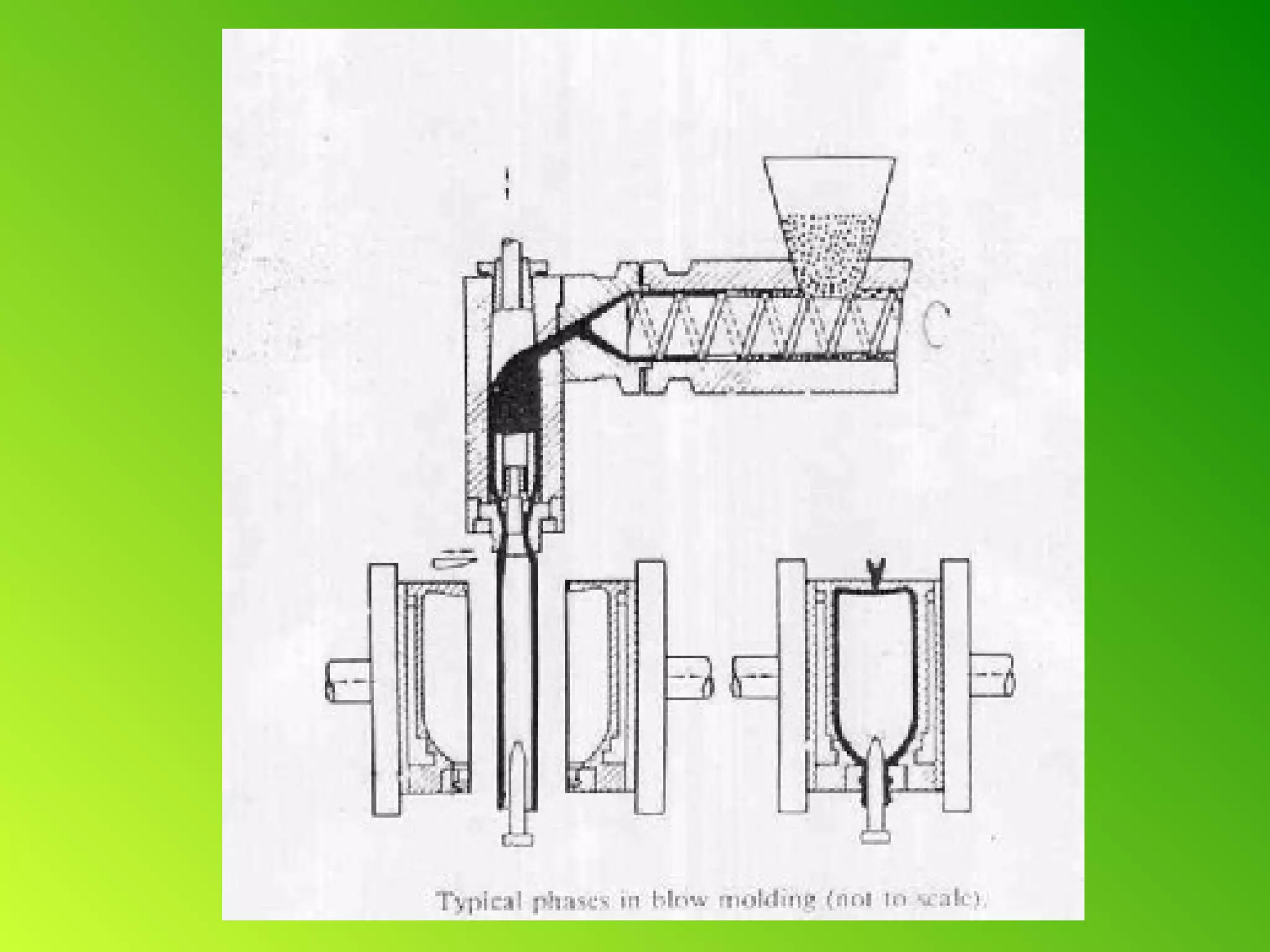
Extrusion Blow Moulding
Extruding a parison and Blowing the same.
Machinery
1. An Extruder
2. A die head and
3. A Blow Mould
Process
 Melting the Plastics in an Extruder.
 Forming the parison (A hot plastics tube).
 Clamping the two mould halves around the parison and
keeping closed.
 Inflating the parison inside the Blow (female) mould.
 Cooling of the expanded parison
 Opening the mould and ejecting the product.
Advantages
 High rate of production.
 Low tooling costs.
 Incorporation of blown handle ware.
 A wide selection of machine manufacturers.
 Disadvantages
 Higher Scrap Rate.
 Use of recycled scrap.
 Limited wall thickness control.
Few Points
 The die head can have one or more openings and hence one or
more parison can be extruded.
 The size and weight of the product dictates whether an
accumulator is required or not.
- Usually a blow pin is located opposite the pinched end of the
tube and compressed air inflates the parison.
 The compressed air can enter through (1) the extrusion die
mandrel or (2) through a blow pin or (3) through blowing
needles that pierce the parison.
 The wall distribution and thickness of the blown part are
controlled by parison programming, the blow ratio and part
configuration.
 The mold clamping can be hydraulic and/or toggle.
 For cooling Co2 systems, air chillers can be used.
Parison Programming
 By  Electronic  Parison  Programming.    (Orifice  modulation 
method)  in  which  the  die  is  fitted  with  hydraulic  positioner 
that  allows  positioning  of  the  inside  die  diameter  during 
parison drop.  The OD to ID relationship of the tapered die 
orifice  opening  is  versed  in  a  programmed  manner  to 
increase or decrease the parison wall thickness.
 Parison Swell
  After leasing the die, the melt – which has been under 
shear pressure – undergoes relaxation that causes cross-
sectional deformation or swell which is called as parison 
swell.
Average parison swell for few commodity plastics
Plastics Swell, present
HDPE (Phillips) 15 - 40
HDPE (zeigler) 25 - 65
LDPE 30 - 65
PVC (rigid) 30 - 35
PS 10 - 20
PC 5 - 10
Pinch-Off
The pinch-off is the very critical part in a Extrusion
Blow Mould where the parison is squeezed and
welded together requiring good thermal
conductivity for rapid cooling and good toughness
to ensure long production runs.
Types
1. Double angle pinch-off with 45 angles and 0.010 in
land.
2. Double angle shallow pinch-off with 15 angles and
0.010 in land.
3. Pinch-off with a dam.
Parison Blowing
Air is used to blow the parison tube against the mold
walls. It does 3 functions
- It expands the parison against the mould.
- Exerts pressure on the expanded parison to
product surface details.
- Aids in cooling the blown parison.
 
HORIZONTAL ROTARY WHEEL
 Uses continuously extruded parisons
 The moulds are mounted and indexed to
the extrusion head where the moulds
pickup the parison and transfer it to a
second station for the introduction of a
pin to blow the bottle.
 Multiple moulds are mounted on a large
wheel and one extruder and one parison
feeds the moulds.
 
VERTICAL ROTARY WHEEL
 Uses continuously extruded parisons
 Uses one extruder with multiple moulds
 The moulds pick the parison and moves around
the axes of the wheel to blow the container,
cool it and discharge it.
 The continuously extruded parison run like a
tube and not cut individually for moulds.
 
3. SHUTTLE CONTINUOUS EXTRUSION
 The extruder and parison head are located in
the center and the moulds are mounted to
each side.
 The moulds shuttle to the parison, pick off
the parison and move back to their original
position.
 This method led to the development of
calibrated neck finish otherwise known as
compression moulded neck finish.
 Suitable for processing of PVC
INTERMITTENT EXTRUSION
 Uses a reciprocating screw extruder similar in
operation to injection moulding.
 The extruder melts and accumulates molten resin
at the end of the barrel while the screw retracts to
allow for this accumulation of plastic. The
moulds are mounted on a platen that only opens
and closes and discharges the bottle. The screw
moves forward and forces the plastics through a
manifold to several extrusion heads as
described above to form parisons for various
moulds. This method provides high speed
production from a single machine. By placing the
blow pin in the centre of the extrusion head
bottleswith a calibrated neck finish are produced.
 This method is very suitable for polyolefins.
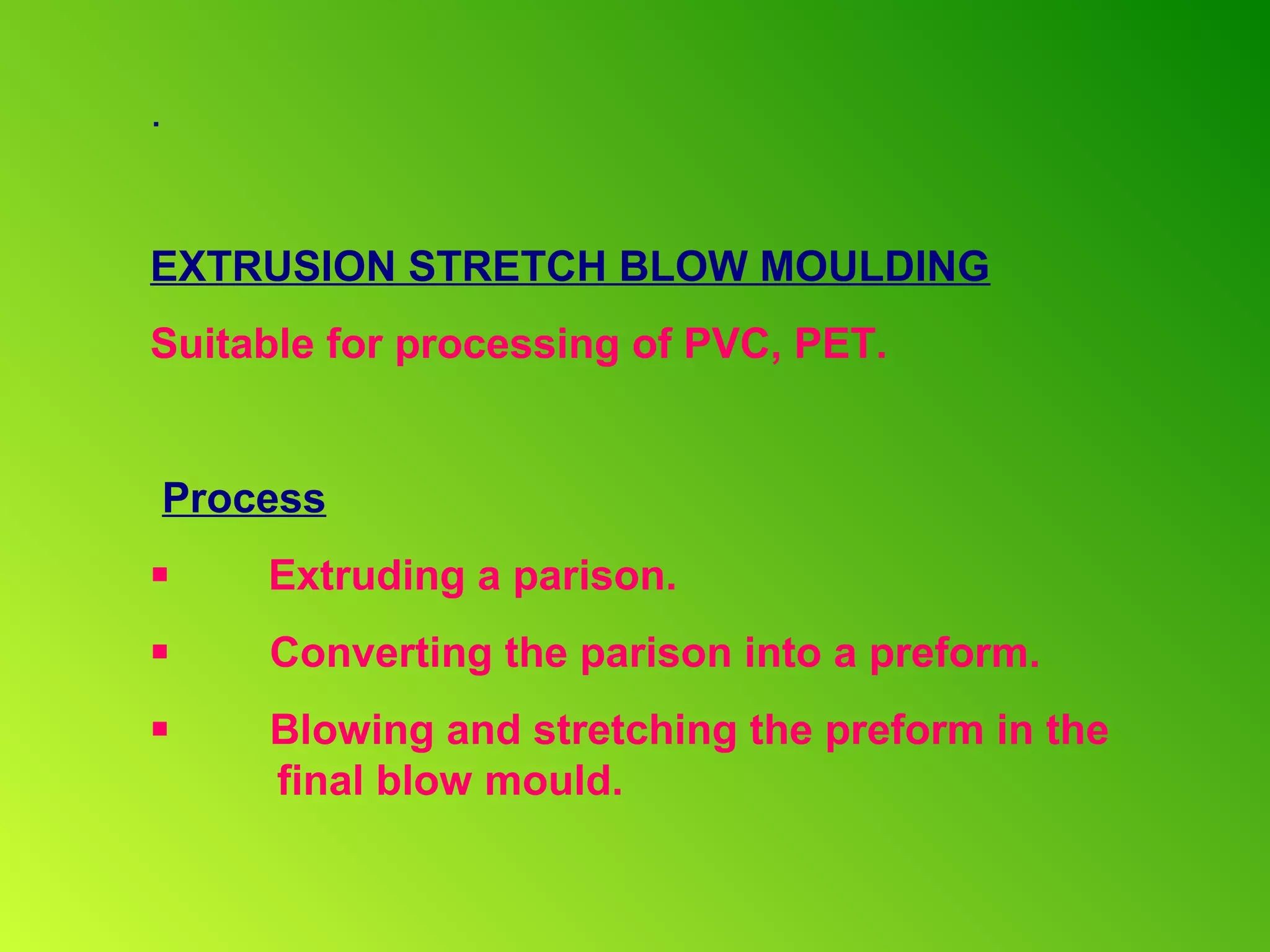
INJECTION BLOW MOULDING
 Injecting a preform and Blowing the same.
Process Steps
 Hot melt in exact amounts is injected through an
injection moulding machine nozzle into one or more
preform cavities. Hot liquid is circulated through
mould heating channels around the preform cavity
and the required preform temperature is achieved.
 The two part mold opens and the core pin carries
the hot plastic to the second stage blow mold station.
 Upon mold closing, air is introduced via the core pin
and the platic blows out and contacts the mold
cavity surface.
 The product cools and the blow mould opens and
the product is ejected.
Advantages
1.   Bottle necks of varying shapes, sizes and wall
thickness can be precisely molded,Free of
flash.
2.   The wall thick nesses of a hollow body can be
predetermined exactly.
3.   There is no seam on the bottom.
4.  There is no regrind to contend with, other than
that generated on state-up and rejected parts,
because there is no neck on bottom trim.
5. It can be used to blow mold almost any type of
plastics that can be injection molded.
Disadvantages
 
1.   High change-over costs from one part to
another. This is caused by the large number of
molds and core pins required.
2.     Size limitations on parts which can be made by
blow molding.
3.     Tooling costs are almost double that of
extrusion blow molding.
STRETCH BLOW MOULDING
       Biaxial Orientation Blow Moulding.
       The container is stretched radially by the blow
air and vertically by a mechanical stretch rod.
Advantages
-         Better Strength
-         Better Clarity
-         Increased Impact Strength
-         Improved gas and water vapour barrier
-         Reduced Creep
Materials used
 PET PAN
PVC PP
ABS ACETALS
PS
Machine Categories
(i)      In-line machines
(ii) Two-stage machines
Inline machines
In this process an extruded or injection moulded
parison passes through conditioning stations which
bring it to the proper orientation temperature and then
stretched and blown in a final stage blow mould.
Advantages
1.    Heat history is minimized (important for heat-
sensitive materials like PVC and PET )
2.    The preform can be programmed for optimum
material distribution when maintained under
continuous control.
Two-stage machines
In this process the extruded or injection moulded
preforms that have been cooled are conveyed through an
oven which reheats them to the proper orientation-blow
temperature.
Advantages
1.    Minimized scrap production
2.    Improved thread finish
3.    Higher output rates
4.   The capability to stockpile preforms, eliminating
dependency between preform and bottle machinery.
TYPES OF STRETCH BLOW MOULDING
       Injection Stretch Blow Moulding.
       Extrusion Stretch Blow Moulding.
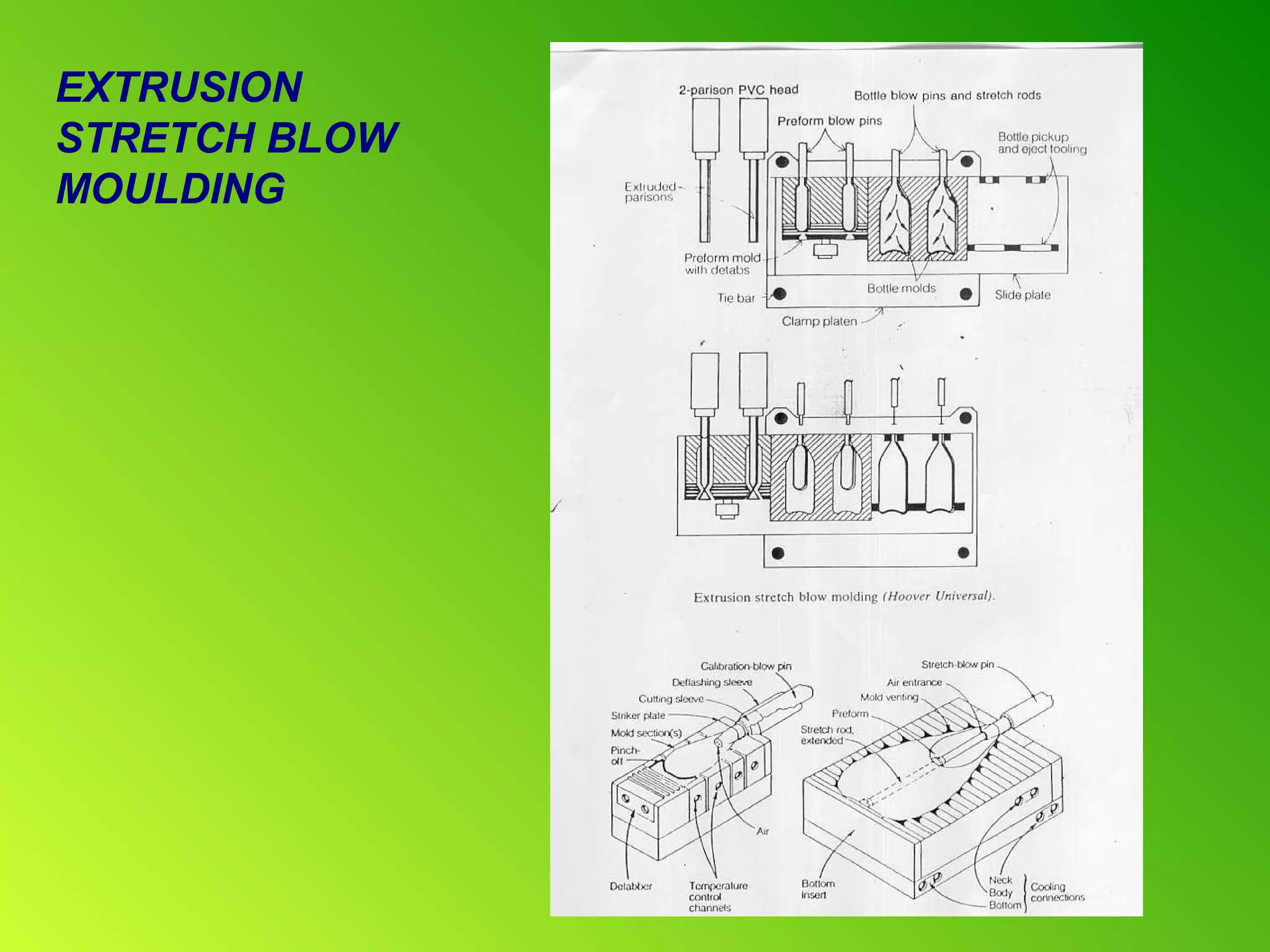
EXTRUSION STRETCH BLOW MOULDING
•         Suitable for processing of PVC, PET.
Process
         Extruding a parison.
         Converting the parison into a preform.
         Blowing and stretching the preform in the
final blow mould.
.
 
EXTRUSION STRETCH BLOW MOULDING
Suitable for processing of PVC, PET.
Process
         Extruding a parison.
         Converting the parison into a preform.
         Blowing and stretching the preform in the
final blow mould.
EXTRUSION
STRETCH BLOW
MOULDING
INJECTION STRETCH BLOW MOULDING
Suitable for processing of PET
Process
        Injecting a preform.
        Reheating the preform if necessary.
        Blowing and stretching of the preform in the final
blow mould.
INJECTION STRETCH BLOW MOULDING
Guide for Air Blowing Pressure
PLASTIC PRESSURE
(Psi)
Acetal 100-150
PMMA 50-80
PC 70-150
LDPE 20-60
HDPE 60-100
PP 75-100
PS 40-100
PVC (rigid) 75-100
THANK YOU

3. Blow moulding process

  • 1.
    BLOW MOULDING BY M. PEERMOHAMED (Manager)
  • 2.
    BLOW MOULDING A processto Produce Hollow Products like bottles, containers, jars and jerrycans from thermoplastics. Advantages  Moulding extremely irregular (reentrant) curves  Low stresses in the product  Possibility of variable wall thickiness  Use of polymers with high chemical resistance  Favourable processing costs Required pressure levels of 25 to 150 psi and with some resins 200 to 300 psi. But Injection Moulding requires 2000 to 30,000 psi and hence development of high internal stresses.
  • 3.
    Materials Used Small parts,under 5 litres,  Polyolefines (LDPE,HDPE,PP )  polyvinyl Chloride (PVC)  Polyacrylonitrile (PAN)  Polystyrene (PS)  Styrene Acrylonitrile (SAN)    Polyester (Saturated , PET) Large parts, over 5 litres including technical parts,   Poly olefines (HDPE / PP)  Polycarbonate (PC)  Polyacetal (POM)  Polyamides (PA)  Polyvinylidene Fluoride (PVDF) 
  • 4.
    TYPES OF BLOWMOULDING 1.     Extrusion Blow Moulding  (EBM) which pricipally       uses an unsupported parison  (75% usages) 2.      Injection  Blow  Moulding  (IBM)  which  principally  uses  a  preform  supported  by  a  metal  core  pin  (25%  usages). 3.    Stretch  Blow  Moulding  either  EBM  or  IBM  to  obtain bioriented products.  
  • 5.
    Extrusion Blow Moulding Extrudinga parison and Blowing the same. Machinery 1. An Extruder 2. A die head and 3. A Blow Mould Process  Melting the Plastics in an Extruder.  Forming the parison (A hot plastics tube).  Clamping the two mould halves around the parison and keeping closed.  Inflating the parison inside the Blow (female) mould.  Cooling of the expanded parison  Opening the mould and ejecting the product.
  • 7.
    Advantages  High rateof production.  Low tooling costs.  Incorporation of blown handle ware.  A wide selection of machine manufacturers.  Disadvantages  Higher Scrap Rate.  Use of recycled scrap.  Limited wall thickness control.
  • 9.
    Few Points  Thedie head can have one or more openings and hence one or more parison can be extruded.  The size and weight of the product dictates whether an accumulator is required or not. - Usually a blow pin is located opposite the pinched end of the tube and compressed air inflates the parison.  The compressed air can enter through (1) the extrusion die mandrel or (2) through a blow pin or (3) through blowing needles that pierce the parison.  The wall distribution and thickness of the blown part are controlled by parison programming, the blow ratio and part configuration.  The mold clamping can be hydraulic and/or toggle.  For cooling Co2 systems, air chillers can be used.
  • 10.
    Parison Programming  By  Electronic Parison  Programming.    (Orifice  modulation  method)  in  which  the  die  is  fitted  with  hydraulic  positioner  that  allows  positioning  of  the  inside  die  diameter  during  parison drop.  The OD to ID relationship of the tapered die  orifice  opening  is  versed  in  a  programmed  manner  to  increase or decrease the parison wall thickness.  Parison Swell   After leasing the die, the melt – which has been under  shear pressure – undergoes relaxation that causes cross- sectional deformation or swell which is called as parison  swell.
  • 11.
    Average parison swellfor few commodity plastics Plastics Swell, present HDPE (Phillips) 15 - 40 HDPE (zeigler) 25 - 65 LDPE 30 - 65 PVC (rigid) 30 - 35 PS 10 - 20 PC 5 - 10
  • 12.
    Pinch-Off The pinch-off isthe very critical part in a Extrusion Blow Mould where the parison is squeezed and welded together requiring good thermal conductivity for rapid cooling and good toughness to ensure long production runs. Types 1. Double angle pinch-off with 45 angles and 0.010 in land. 2. Double angle shallow pinch-off with 15 angles and 0.010 in land. 3. Pinch-off with a dam.
  • 13.
    Parison Blowing Air isused to blow the parison tube against the mold walls. It does 3 functions - It expands the parison against the mould. - Exerts pressure on the expanded parison to product surface details. - Aids in cooling the blown parison.  
  • 16.
    HORIZONTAL ROTARY WHEEL Uses continuously extruded parisons  The moulds are mounted and indexed to the extrusion head where the moulds pickup the parison and transfer it to a second station for the introduction of a pin to blow the bottle.  Multiple moulds are mounted on a large wheel and one extruder and one parison feeds the moulds.  
  • 17.
    VERTICAL ROTARY WHEEL Uses continuously extruded parisons  Uses one extruder with multiple moulds  The moulds pick the parison and moves around the axes of the wheel to blow the container, cool it and discharge it.  The continuously extruded parison run like a tube and not cut individually for moulds.  
  • 18.
    3. SHUTTLE CONTINUOUSEXTRUSION  The extruder and parison head are located in the center and the moulds are mounted to each side.  The moulds shuttle to the parison, pick off the parison and move back to their original position.  This method led to the development of calibrated neck finish otherwise known as compression moulded neck finish.  Suitable for processing of PVC
  • 19.
    INTERMITTENT EXTRUSION  Usesa reciprocating screw extruder similar in operation to injection moulding.  The extruder melts and accumulates molten resin at the end of the barrel while the screw retracts to allow for this accumulation of plastic. The moulds are mounted on a platen that only opens and closes and discharges the bottle. The screw moves forward and forces the plastics through a manifold to several extrusion heads as described above to form parisons for various moulds. This method provides high speed production from a single machine. By placing the blow pin in the centre of the extrusion head bottleswith a calibrated neck finish are produced.  This method is very suitable for polyolefins.
  • 20.
    INJECTION BLOW MOULDING Injecting a preform and Blowing the same. Process Steps  Hot melt in exact amounts is injected through an injection moulding machine nozzle into one or more preform cavities. Hot liquid is circulated through mould heating channels around the preform cavity and the required preform temperature is achieved.  The two part mold opens and the core pin carries the hot plastic to the second stage blow mold station.  Upon mold closing, air is introduced via the core pin and the platic blows out and contacts the mold cavity surface.  The product cools and the blow mould opens and the product is ejected.
  • 23.
    Advantages 1.   Bottle necks ofvarying shapes, sizes and wall thickness can be precisely molded,Free of flash. 2.   The wall thick nesses of a hollow body can be predetermined exactly. 3.   There is no seam on the bottom. 4.  There is no regrind to contend with, other than that generated on state-up and rejected parts, because there is no neck on bottom trim. 5. It can be used to blow mold almost any type of plastics that can be injection molded.
  • 24.
    Disadvantages   1.   High change-overcosts from one part to another. This is caused by the large number of molds and core pins required. 2.     Size limitations on parts which can be made by blow molding. 3.     Tooling costs are almost double that of extrusion blow molding.
  • 25.
    STRETCH BLOW MOULDING        BiaxialOrientation Blow Moulding.        The container is stretched radially by the blow air and vertically by a mechanical stretch rod. Advantages -         Better Strength -         Better Clarity -         Increased Impact Strength -         Improved gas and water vapour barrier -         Reduced Creep
  • 26.
    Materials used  PET PAN PVCPP ABS ACETALS PS Machine Categories (i)      In-line machines (ii) Two-stage machines
  • 27.
    Inline machines In thisprocess an extruded or injection moulded parison passes through conditioning stations which bring it to the proper orientation temperature and then stretched and blown in a final stage blow mould. Advantages 1.    Heat history is minimized (important for heat- sensitive materials like PVC and PET ) 2.    The preform can be programmed for optimum material distribution when maintained under continuous control.
  • 28.
    Two-stage machines In thisprocess the extruded or injection moulded preforms that have been cooled are conveyed through an oven which reheats them to the proper orientation-blow temperature. Advantages 1.    Minimized scrap production 2.    Improved thread finish 3.    Higher output rates 4.   The capability to stockpile preforms, eliminating dependency between preform and bottle machinery.
  • 29.
    TYPES OF STRETCHBLOW MOULDING        Injection Stretch Blow Moulding.        Extrusion Stretch Blow Moulding. EXTRUSION STRETCH BLOW MOULDING •         Suitable for processing of PVC, PET. Process          Extruding a parison.          Converting the parison into a preform.          Blowing and stretching the preform in the final blow mould.
  • 30.
    .   EXTRUSION STRETCH BLOWMOULDING Suitable for processing of PVC, PET. Process          Extruding a parison.          Converting the parison into a preform.          Blowing and stretching the preform in the final blow mould.
  • 31.
  • 32.
    INJECTION STRETCH BLOWMOULDING Suitable for processing of PET Process         Injecting a preform.         Reheating the preform if necessary.         Blowing and stretching of the preform in the final blow mould.
  • 33.
  • 37.
    Guide for AirBlowing Pressure PLASTIC PRESSURE (Psi) Acetal 100-150 PMMA 50-80 PC 70-150 LDPE 20-60 HDPE 60-100 PP 75-100 PS 40-100 PVC (rigid) 75-100
  • 38.