How to select a pimm.

Naik devang
12/01/2012
introduction
• Buying a PIMM is not a small
investment. Too much machine
for the job at hand is wasteful.
Too little machine does not get
job done. Careful matching of
the jobs needs and the
attributes of a PIMM is well
worth the effort.
sHot weigHt
• The shot weight is measured
weight of the plastic injected
when the nozzle is free standing.
the plastic used is usually
polystyrene with a specific
gravity (SG) of 1.05. this is
specified in the specification as
PS.
• Shot weight in terms of a resin=
c*b/1.05 where b=SG of resign & c =
shot wt in terms of PS.
selecting macHine
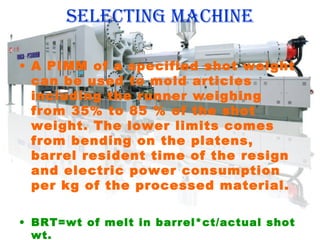
• A PIMM of a specified shot weight
can be used to mold articles
including the runner weighing
from 35% to 85 % of the shot
weight. The lower limits comes
from bending on the platens,
barrel resident time of the resign
and electric power consumption
per kg of the processed material.
• BRT=wt of melt in barrel*ct/actual shot
wt.
clamping force

• Clamping force is an important
attribute of the clamping unit of a
PIMM. It is the maximum force the
machine is capable of to keep the
mold close against cavity pressure
during injection. Insufficient
clamping force gives rise to flash
at the mold joint.
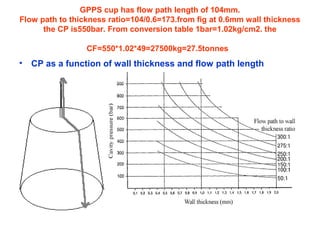
GPPS cup has flow path length of 104mm.
Flow path to thickness ratio=104/0.6=173.from fig at 0.6mm wall thickness
the CP is550bar. From conversion table 1bar=1.02kg/cm2. the
CF=550*1.02*49=27500kg=27.5tonnes

•

CP as a function of wall thickness and flow path length
screw diameter
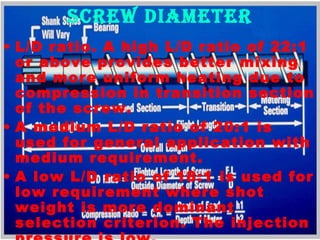
• L/D ratio. A high L/D ratio of 22:1
or above provides better mixing
and more uniform heating due to
compression in transition section
of the screw.
• A medium L/D ratio of 20:1 is
used for general application with
medium requirement.
• A low L/D ratio of 18:1 is used for
low requirement where shot
weight is more dominant
selection criterion. The injection
InjectIon pressure
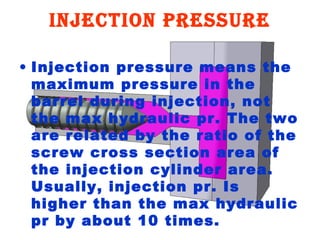
• Injection pressure means the
maximum pressure in the
barrel during injection, not
the max hydraulic pr. The two
are related by the ratio of the
screw cross section area of
the injection cylinder area.
Usually, injection pr. Is
higher than the max hydraulic
pr by about 10 times.
InjectIon speed
• Inj speed is the max speed of
the screw the m/c is capable
of during inj.
• Inj speed effects the inj time.
Moulding thin wall articles
require high inj speed so that
melt does not solidify before
the cavity is completely
filled.
• Machine should have multiply
accumulator
• It is a option to increase inj
speed. An accumulator is an
energy storing device that
stores up pressurized
hydraulic oil in a phase of low
demand to be used in inj
( high demand) phase. While
increasing the electric motor
and hydraulic pump sizes
does increase the inj speed
by 25% an accumulator does
InjectIon rate
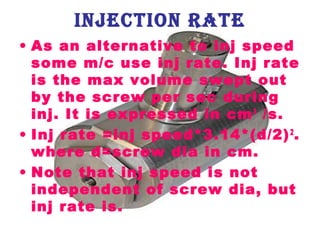
• As an alternative to inj speed
some m/c use inj rate. Inj rate
is the max volume swept out
by the screw per sec during
inj. It is expressed in cm 3 /s.
• Inj rate =inj speed*3.14*(d/2) 2 .
where d=screw dia in cm.
• Note that inj speed is not
independent of screw dia, but
inj rate is.
screw surface
speed
• Screw rotary speed is

specified as a range in rpm.
Screw rotary speed by itself
is not critical as screw
surface speed. The two are
related by screw dia.
• SSS=0.052*screw dia*rpm.
• Each plastic material has a
recommended maximum sss
which must not exceeded.
For example PP and HDPE
should not experience a sss
of higher than 800 mm/s .
plastIcIzIng capacIty
• It is the amount of PS that a
PIMM can uniformly plasticize in
one hour at max screw rotary
speed with 0 back pr.
• To check if the plasticizing
capacity of the PIMM is not being
exceeded calculate the wt of the
component and Sprue per shot W
9g) divided by screw rotation
time t (s) and convert the
quotient to kg/hour.
• W*3600(t*1000) this must be less
plastIcIzIng capacIty
• Since ct is longer than screw
rotation time the shot wt S (g) of
a m/c and its plasticizing
capacity G (kg/hr) set a lower
limit on cycle time t min (s) as
follows.
• T min =S*3600(G*1000).
• It is particularly important to
match shot wt and plasticizing
capacity in the case of fast
cycling m/cs producing thin
walled or close tolerance
Mold opening stroke
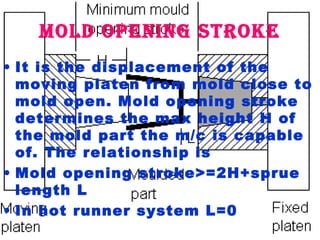
• It is the displacement of the
moving platen from mold close to
mold open. Mold opening stroke
determines the max height H of
the mold part the m/c is capable
of. The relationship is
• Mold opening stroke>=2H+sprue
length L
• In hot runner system L=0
Mold height (thickness )
• Mold height is left over from the
days when press are vertical. In
horizontal press, a more
appropriate description is mold
thickness.
• In toggle clam PIMM
specification, mold height is
expressed as a range, from the
minimum to maximum to the
height the machine could
accommodate. The difference is
MaxiMuM daylight
• The maximum opening between
the fixed and moving platens
when the clamp is wide open. It is
related to mold opening stroke
and minimum/maximum mold
height as follows.
• For a toggle clamp m/c.
• Max daylight=mold opening stroke
+ max mold ht.
• For direct hydraulic clamp
machine
• Max daylight=mold opening stroke
space between tie bar
• Mold width must fit within the
horizontal space between tie
bars if the mold is lowered from
above. The mold length must fit
within the vertical space
between tie bars if the mold is
slit in from the side. It is advise
that there is a clearance of
25mm on each side for small
mold and 50 mm for big mold.
tie bar diaMeter
• If the tie bar tension are even, the
stress in each of them is given by
• Stress= clamping force +1000/ (3.14*
d 2 ) where stress is in kg/mm 2 clamping
force is in tones and dia d is in mm.
• High tensile has a breaking stress of
more than 90kg/mm 2 mild steel 20/ kg 2 .
• Non parcel mold faces, onsymmetrical cavity with respect to
Sprue and maladjustment of mold
height mechanism of a toggle clamp
m/c.
platen thickness
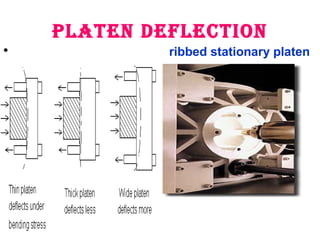
• The moving platen and fixed
platen must have sufficient
stiffness to transmit the force of
tie bar to the mold with minimum
deflection. For a given geometry
a flat platens deflection is
proportional to the cube of its
thickness. Especially for the
moving platen, a compromise has
to be struck between wt and
platen deflection
•

ribbed stationary platen
Dry cycle time
• It is the mold closing time
plus mold opening time plus
ideal time. Dry cycle time is
the ultimate cycle time as
there is no cooling period.
• Running a m/c at max
possible ct is not desirable if
the m/c is not running smooth
and stable.
electric motor ratting
• The current per phase drawn
by a three phase motor at its
rated power is
• i m (A)=motor power rating
(kw) * 1000/ (3*single phase
power voltage (V)
*efficiency * power factor)
• For most three phase motors
efficiency=0.88to 0.91 and
power factor=0.84 to 0.88
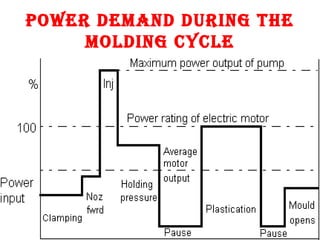
Power DemanD During the
molDing cycle
electric heater rating
• Electric band heater along the
barrel provides heat up to the
resin at start up. It also
supplements the heating by
plasticizing (when screw rotates)
during the molding cycle. A higher
rating per heater has the
advantage of shorting the initial
heat up time.
• i h (A) = electric heater rating (kw)
* 1000/ (3* single phase voltage
(v)
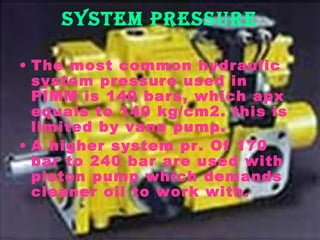
SyStem PreSSure
• The most common hydraulic
system pressure used in
PIMM is 140 bars, which apx
equals to 140 kg/cm2. this is
limited by vane pump.
• A higher system pr. Of 170
bar to 240 bar are used with
piston pump which demands
cleaner oil to work with.
Final concluSion Select
Pimm DePenDing on
article to be molDeD.

• Thank you
•

naik devang

How to select a plastic injection molding machine.

  • 1.
    How to selecta pimm. Naik devang 12/01/2012
  • 2.
    introduction • Buying aPIMM is not a small investment. Too much machine for the job at hand is wasteful. Too little machine does not get job done. Careful matching of the jobs needs and the attributes of a PIMM is well worth the effort.
  • 3.
    sHot weigHt • Theshot weight is measured weight of the plastic injected when the nozzle is free standing. the plastic used is usually polystyrene with a specific gravity (SG) of 1.05. this is specified in the specification as PS. • Shot weight in terms of a resin= c*b/1.05 where b=SG of resign & c = shot wt in terms of PS.
  • 4.
    selecting macHine • APIMM of a specified shot weight can be used to mold articles including the runner weighing from 35% to 85 % of the shot weight. The lower limits comes from bending on the platens, barrel resident time of the resign and electric power consumption per kg of the processed material. • BRT=wt of melt in barrel*ct/actual shot wt.
  • 5.
    clamping force • Clampingforce is an important attribute of the clamping unit of a PIMM. It is the maximum force the machine is capable of to keep the mold close against cavity pressure during injection. Insufficient clamping force gives rise to flash at the mold joint.
  • 6.
    GPPS cup hasflow path length of 104mm. Flow path to thickness ratio=104/0.6=173.from fig at 0.6mm wall thickness the CP is550bar. From conversion table 1bar=1.02kg/cm2. the CF=550*1.02*49=27500kg=27.5tonnes • CP as a function of wall thickness and flow path length
  • 7.
    screw diameter • L/Dratio. A high L/D ratio of 22:1 or above provides better mixing and more uniform heating due to compression in transition section of the screw. • A medium L/D ratio of 20:1 is used for general application with medium requirement. • A low L/D ratio of 18:1 is used for low requirement where shot weight is more dominant selection criterion. The injection
  • 8.
    InjectIon pressure • Injectionpressure means the maximum pressure in the barrel during injection, not the max hydraulic pr. The two are related by the ratio of the screw cross section area of the injection cylinder area. Usually, injection pr. Is higher than the max hydraulic pr by about 10 times.
  • 9.
    InjectIon speed • Injspeed is the max speed of the screw the m/c is capable of during inj. • Inj speed effects the inj time. Moulding thin wall articles require high inj speed so that melt does not solidify before the cavity is completely filled. • Machine should have multiply
  • 10.
    accumulator • It isa option to increase inj speed. An accumulator is an energy storing device that stores up pressurized hydraulic oil in a phase of low demand to be used in inj ( high demand) phase. While increasing the electric motor and hydraulic pump sizes does increase the inj speed by 25% an accumulator does
  • 11.
    InjectIon rate • Asan alternative to inj speed some m/c use inj rate. Inj rate is the max volume swept out by the screw per sec during inj. It is expressed in cm 3 /s. • Inj rate =inj speed*3.14*(d/2) 2 . where d=screw dia in cm. • Note that inj speed is not independent of screw dia, but inj rate is.
  • 12.
    screw surface speed • Screwrotary speed is specified as a range in rpm. Screw rotary speed by itself is not critical as screw surface speed. The two are related by screw dia. • SSS=0.052*screw dia*rpm. • Each plastic material has a recommended maximum sss which must not exceeded. For example PP and HDPE should not experience a sss of higher than 800 mm/s .
  • 13.
    plastIcIzIng capacIty • Itis the amount of PS that a PIMM can uniformly plasticize in one hour at max screw rotary speed with 0 back pr. • To check if the plasticizing capacity of the PIMM is not being exceeded calculate the wt of the component and Sprue per shot W 9g) divided by screw rotation time t (s) and convert the quotient to kg/hour. • W*3600(t*1000) this must be less
  • 14.
    plastIcIzIng capacIty • Sincect is longer than screw rotation time the shot wt S (g) of a m/c and its plasticizing capacity G (kg/hr) set a lower limit on cycle time t min (s) as follows. • T min =S*3600(G*1000). • It is particularly important to match shot wt and plasticizing capacity in the case of fast cycling m/cs producing thin walled or close tolerance
  • 15.
    Mold opening stroke •It is the displacement of the moving platen from mold close to mold open. Mold opening stroke determines the max height H of the mold part the m/c is capable of. The relationship is • Mold opening stroke>=2H+sprue length L • In hot runner system L=0
  • 16.
    Mold height (thickness) • Mold height is left over from the days when press are vertical. In horizontal press, a more appropriate description is mold thickness. • In toggle clam PIMM specification, mold height is expressed as a range, from the minimum to maximum to the height the machine could accommodate. The difference is
  • 17.
    MaxiMuM daylight • Themaximum opening between the fixed and moving platens when the clamp is wide open. It is related to mold opening stroke and minimum/maximum mold height as follows. • For a toggle clamp m/c. • Max daylight=mold opening stroke + max mold ht. • For direct hydraulic clamp machine • Max daylight=mold opening stroke
  • 18.
    space between tiebar • Mold width must fit within the horizontal space between tie bars if the mold is lowered from above. The mold length must fit within the vertical space between tie bars if the mold is slit in from the side. It is advise that there is a clearance of 25mm on each side for small mold and 50 mm for big mold.
  • 19.
    tie bar diaMeter •If the tie bar tension are even, the stress in each of them is given by • Stress= clamping force +1000/ (3.14* d 2 ) where stress is in kg/mm 2 clamping force is in tones and dia d is in mm. • High tensile has a breaking stress of more than 90kg/mm 2 mild steel 20/ kg 2 . • Non parcel mold faces, onsymmetrical cavity with respect to Sprue and maladjustment of mold height mechanism of a toggle clamp m/c.
  • 20.
    platen thickness • Themoving platen and fixed platen must have sufficient stiffness to transmit the force of tie bar to the mold with minimum deflection. For a given geometry a flat platens deflection is proportional to the cube of its thickness. Especially for the moving platen, a compromise has to be struck between wt and
  • 21.
  • 22.
    Dry cycle time •It is the mold closing time plus mold opening time plus ideal time. Dry cycle time is the ultimate cycle time as there is no cooling period. • Running a m/c at max possible ct is not desirable if the m/c is not running smooth and stable.
  • 23.
    electric motor ratting •The current per phase drawn by a three phase motor at its rated power is • i m (A)=motor power rating (kw) * 1000/ (3*single phase power voltage (V) *efficiency * power factor) • For most three phase motors efficiency=0.88to 0.91 and power factor=0.84 to 0.88
  • 24.
    Power DemanD Duringthe molDing cycle
  • 25.
    electric heater rating •Electric band heater along the barrel provides heat up to the resin at start up. It also supplements the heating by plasticizing (when screw rotates) during the molding cycle. A higher rating per heater has the advantage of shorting the initial heat up time. • i h (A) = electric heater rating (kw) * 1000/ (3* single phase voltage (v)
  • 26.
    SyStem PreSSure • Themost common hydraulic system pressure used in PIMM is 140 bars, which apx equals to 140 kg/cm2. this is limited by vane pump. • A higher system pr. Of 170 bar to 240 bar are used with piston pump which demands cleaner oil to work with.
  • 27.
    Final concluSion Select PimmDePenDing on article to be molDeD. • Thank you • naik devang