1.Polyethylene
Properties related to structure
Additives
General properties
Processing behaviour
Processing techniques
Grades available
Applications
1.5 Properties related to structure
-(CH2
– CH2
– CH2
– CH2
) -n
The flexibility of carbon–carbon single bond would leads to
low values for the glass transition temperature.
In the absence of impurities the polymer would be an
excellent high frequency insulator because of its non-polar
nature.
The properties of polyethylene vary due to differences raised
from the following variables.
* Variation in the degree of long/short chain
branching.
* Variation in average molecular weight.
* Variation in molecular weight distribution.
* The presence of impurities or Polymerization
residues.
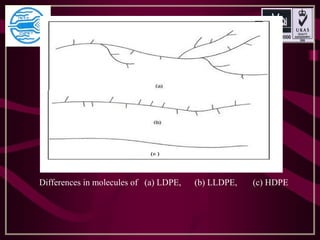
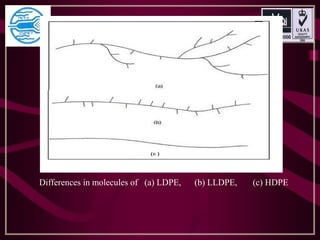
Differences in molecules of (a) LDPE, (b) LLDPE, (c) HDPE
Types of Polyethylene
 Based on densities
 Low Density, (Between 0.916 to 0.930 gm/cc)
 Linear Low Density, (Between 0.916 to 0.930 gm/cc)
 Medium Density, (Between 0.930 to 0.940 gm/cc)
 High Density, (Above 0.940 gm/cc)
Differences in molecules of (a) LDPE, (b) LLDPE, (c) HDPE
Basic Polymer Properties
• Melt Flow Index (MFI)(g/10min) : The number of gms of
resin which can be forced through 2.095 mm orifice when
subjected to 2.16 kg load in 10 mins. At 190oC. MFI is
measured as per ASTM D 1238
• Density(g/cc) : Ratio of mass per unit volume of the material
& is reported in g/cc at given temperature (usually 23oC or
27oC). It is measured as per ASTM D 1505
• Molecular Weight Distribution (MWD): Ratio of weight
average molecular weight (Mw) to number average
molecular weight (Mn) MWD gives general picture of the
ratio of large, medium & small molecular chains in the
polymer.
1.6 Additives
- Carbon black has some reinforcing effect and is of use in cross-
linked polymers. It is also of some use in introducing a
measure of conductivity to the polymer.
- The principle requirements of a pigment are that it should have
a high covering power-cost ratio and that it should withstand
processing and service conditions (pigments based on Co, Cd &
Mn).
- Polyethylene burns readily and a number of materials have been
used as flame retarders (ex. Antimony trioxide & halogenated
material).
- Slip agents may be added to reduce the friction between layers
of film (fatty acid amides such as oleamide and erucamide are
used).
- Antistatic additives are widely used to reduce dust attraction
and also in films to improve handling behavior.
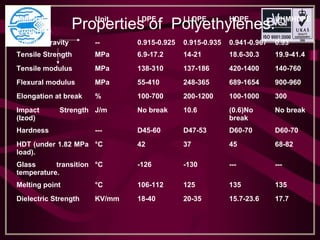
Properties of Polyethylenes.Material Unit LDPE LLDPE HDPE UHMHDPE
Properties
Specific gravity -- 0.915-0.925 0.915-0.935 0.941-0.967 0.93
Tensile Strength MPa 6.9-17.2 14-21 18.6-30.3 19.9-41.4
Tensile modulus MPa 138-310 137-186 420-1400 140-760
Flexural modulus MPa 55-410 248-365 689-1654 900-960
Elongation at break % 100-700 200-1200 100-1000 300
Impact Strength
(Izod)
J/m No break 10.6 (0.6)No
break
No break
Hardness --- D45-60 D47-53 D60-70 D60-70
HDT (under 1.82 MPa
load).
°C 42 37 45 68-82
Glass transition
temperature.
°C -126 -130 --- ---
Melting point °C 106-112 125 135 135
Dielectric Strength KV/mm 18-40 20-35 15.7-23.6 17.7
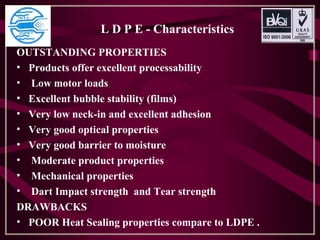
L D P E - Characteristics
OUTSTANDING PROPERTIES
• Products offer excellent processability
• Low motor loads
• Excellent bubble stability (films)
• Very low neck-in and excellent adhesion
• Very good optical properties
• Very good barrier to moisture
• Moderate product properties
• Mechanical properties
• Dart Impact strength and Tear strength
DRAWBACKS
• POOR Heat Sealing properties compare to LDPE .
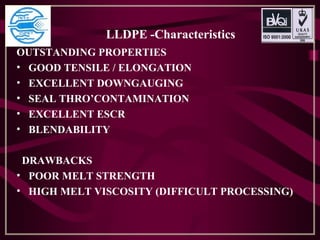
LLDPE -Characteristics
OUTSTANDING PROPERTIES
• GOOD TENSILE / ELONGATION
• EXCELLENT DOWNGAUGING
• SEAL THRO’CONTAMINATION
• EXCELLENT ESCR
• BLENDABILITY
DRAWBACKS
• POOR MELT STRENGTH
• HIGH MELT VISCOSITY (DIFFICULT PROCESSING)
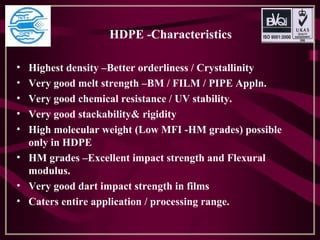
HDPE -Characteristics
• Highest density –Better orderliness / Crystallinity
• Very good melt strength –BM / FILM / PIPE Appln.
• Very good chemical resistance / UV stability.
• Very good stackability& rigidity
• High molecular weight (Low MFI -HM grades) possible
only in HDPE
• HM grades –Excellent impact strength and Flexural
modulus.
• Very good dart impact strength in films
• Caters entire application / processing range.
1.7 General properties
1.7.1 Mechanical Properties
- Stiffness of the material increases with increase
in density because more density means more
crystallanity in which there is a close packing of
molecules causing the stiffness.
- Tensile Strength increases with increase in
density therefore strong intermolecular forces are
present causing the increase in tensile strength.
- Impact Strength decreases with increase in
density therefore higher the crystallanity lower the
impact strength.
- Torsional strength increases with increase in
density.
1.7.2 Thermal Properties
- As density of the polymer increases there is great
increase in its softening point.
- As density increases, viscosity at melt temperature
increases.
1.7.3 Chemical Properties
- The chemical resistance of Polyethylene is just like that
of an alkane. Non-oxidizing acids, alkalis and many aqueous
solutions do not chemically attack on the polymer. Nitric acid
oxidizes the polymer leading to a rise in power factor and to
deterioration in mechanical properties.
- Polyethylene is a crystalline hydrocarbon polymer
incapable of specific interaction with any liquid and there are
no solvents at room temperature. Low density polymers will
dissolve in benzene at about 60°C but more crystalline high
density polymers only dissolves at temperatures some 20-30°C
higher.
1.7.4 Electrical Properties
Polyethylene is a non-polar material.
- Power factor and dielectric constant are independent of
temperature and frequency.
- Reduction in density leads to small reduction of dielectric
constant.
1.8 Processing behaviour
- The low water absorption of the polymer avoids the
necessity of predrying before processing except where
hygroscopic additives are present.
-  Although processing temperatures are low compared
with many plastics the specific heat, which varies with
temperature is high.
-  Flow properties are dependent on molecular weight and
amount of branching but usual moulding grades may be
as easy flow.
1.9 Processing techniques
1.9. 1 Injection Molding
- Injection molding produces a very large number of
products. In this process the polymer is melted and
injected into a mould that is at a temperature below the
freezing point of the polymer. Melt temperatures are of the
order of 160-190°C for LDPE and up to 50°C higher with
high-density materials. Because of the tendency of the
material to crystallize, high shrinkage values are observed
ranging from 0.015-0.050 cm/cm with low density
materials to 0.025–0.060 cm/cm with high density
polymers.
1.9.2 Extrusion Process
- Extrusion process consists of metering polymer
into a heated barrel in which a screw is rotating. The
rotation of the screw causes the granules to move up the
barrel where they are compacted and plasticized. The
resultant melt is then forced under pressure through an
orifice to give a product of constant cross-section. Although
the polymer may be processed on variety of different
machines, the screws usually have a length–diameter (L/D)
ratio in excess of 16:1 and compression ratio between 2.5:1
and 4:1.
1.9.3 Compression molding
- This process is occasionally used with
polyethylene. In this process the polymer is heated in a
mould at about 150°C, compressed to shape and cooled.
The process is slow since heating and cooling of the mould
must be carried out in each cycle and it is employed only for
the manufacturing of large blocks and sheets and for
relatively strain-free objects such as test pieces.
1.9.4 Blow Molding
- Many articles like bottles and containers in
particular are made by blow molding technique. A hollow
tube is extruded vertically downwards on to a spigot. Two
mould halves close on to the parison and air is blown
through the spigot to inflate the parison so that it takes up
the shape of the mould. Recommended melt temperatures
are in the order of 165°C for LDPE and 210°C for HDPE
materials.
1.9.5 Powder Coating
- In fluidized-bed coating, a metal object that is to be
coated is heated to about 160–250°C and then suspended in
a fluidized bed of powdered polymer. Blowing air through a
porous base in the powder container so that in effect the
individual particles are lubricated with a thin film of air
brings about fluidization. Particles coming into contact with
the hot metal fuse and adhere to the metal part. The metal
object together with the adhering particles is then transferred
to a second oven where the particles fuse together to give an
even coating.
1.9.6 Rotational Molding
- In rotational molding, the required amount of
powder is added to the mould that is completely closed and
then rotated in an oven about two axes. The powder melts
and is distributed over the walls of the mould. The mould is
then cooled while the moulds are rotating.
1.10 Grades Available
- Molding Grade
- UV Stabilized grade
- Anti oxidant grade
- Film Grade
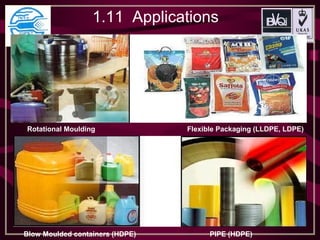
1.11 Applications
Blow Moulded containers (HDPE) PIPE (HDPE)
Rotational Moulding Flexible Packaging (LLDPE, LDPE)
1.11 Applications
CABLE SHEATING (LDPE) GREEN HOUSE FILMS (LDPE)
2. POYPROPYLENE
Properties related to structure
Tacticity
Properties of PP (isotactic form)
General properties
Additives for isotactic PP
Processing behaviour
Processing techniques
Grades of PP
Applications
Copolymers of Polyolefins
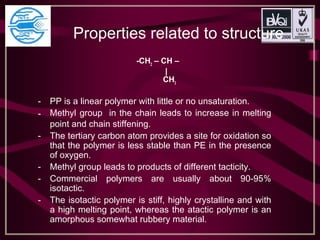
Properties related to structure
-CH2
– CH –
|
CH3
- PP is a linear polymer with little or no unsaturation.
- Methyl group in the chain leads to increase in melting
point and chain stiffening.
- The tertiary carbon atom provides a site for oxidation so
that the polymer is less stable than PE in the presence
of oxygen.
- Methyl group leads to products of different tacticity.
- Commercial polymers are usually about 90-95%
isotactic.
- The isotactic polymer is stiff, highly crystalline and with
a high melting point, whereas the atactic polymer is an
amorphous somewhat rubbery material.
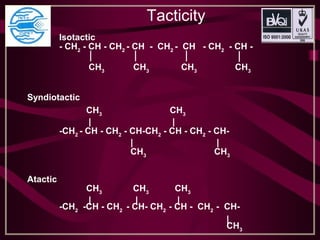
Tacticity
Isotactic
- CH2
- CH - CH2
- CH - CH2
- CH - CH2
- CH -
CH3
CH3
CH3
CH3
Syndiotactic
CH3
CH3
| |
-CH2
- CH - CH2
- CH-CH2
- CH - CH2
- CH-
| |
CH3
CH3
Atactic
CH3
CH3
CH3
| | |
-CH2
-CH - CH2
- CH- CH2
- CH - CH2
- CH-
|
CH3
Properties of PP (Isotactic form)
- It has lower density (0.90 gm / cc).
- It has a higher softening point and hence a higher
maximum service temperature. Articles can withstand
boiling water and can be subjected to steam sterilizing
operations.
- It has a higher brittle point.
- It is more susceptible to oxidation.
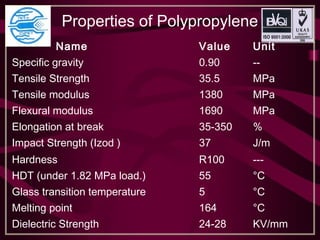
Properties of Polypropylene
Name Value Unit
Specific gravity 0.90 --
Tensile Strength 35.5 MPa
Tensile modulus 1380 MPa
Flexural modulus 1690 MPa
Elongation at break 35-350 %
Impact Strength (Izod ) 37 J/m
Hardness R100 ---
HDT (under 1.82 MPa load.) 55 °C
Glass transition temperature 5 °C
Melting point 164 °C
Dielectric Strength 24-28 KV/mm
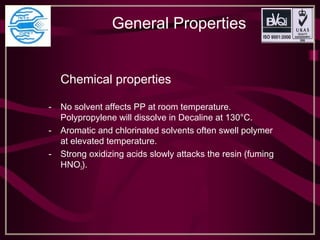
General Properties
Chemical properties
- No solvent affects PP at room temperature.
Polypropylene will dissolve in Decaline at 130°C.
- Aromatic and chlorinated solvents often swell polymer
at elevated temperature.
- Strong oxidizing acids slowly attacks the resin (fuming
HNO3).
Electrical properties
- PP is an excellent insulator due to non-polarity. It is
used in many molded products, as well as in winding
coils and transformers.
Flammability
- PP burns slowly and can be identified by an odour of
crude oil. Flame–retardant grades are available for
specific electrical applications.
Mechanical properties
- Commercial grades of PP is tough and having good impact
resistance. PP becomes more brittle than many other
thermoplastics at zero temperature.
Weathering properties
- Standard grades have shorter life when exposed to the
outdoor. Discoloration, colour fade and crazing occur in
products not stabilized with anti oxidants or carbon black.
Additives for Isotactic PP
Fillers
- About 3% of PP compounds are filled with talc The
improved stiffness and heat deformation resistance
has led to the use of such compounds for the
manufacturing of heater housings, car mounting
components and several domestic appliances. Talc
filled PP sheet is used as an alternative to carton
board.
- In comparison to the talc – filled grades the CaCo3
filled grades claimed to have higher impact strength,
brighter colour, higher thermal stability, improved
fatigue strength but lower stiffness and tensile
strength is markedly reduced with both fillers.
Rubbers
- Particularly butyl rubber is used to reduce the
brittleness of PP.
- Rubbers are used because of their reasonable
price, structure, good weathering properties, negligible
toxicity and easy processability and re-
processability.
Pigments
- The selection of pigments for PP follows the same
considerations as for PE because of the higher
processing temperature and lesser resistance to
oxidation, selection does require more care.
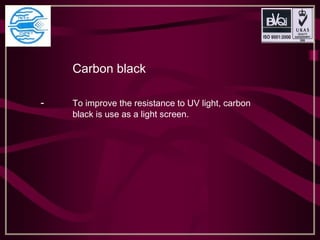
Carbon black
- To improve the resistance to UV light, carbon
black is use as a light screen.
Antioxidants
- Antioxidants are necessary for prevention from
adversity of oxidation.
- For optimum processing stability a single
antioxidant of the phenol alkane type, for e.g., 1,1,3 –
tris (4 hydroxy - 2 methyl, 5 – t – butyl phenyl) butane,
tends to give the best results.
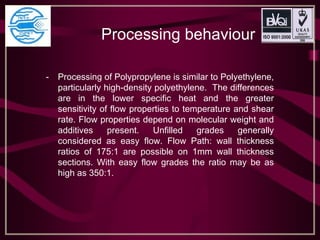
Processing behaviour
- Processing of Polypropylene is similar to Polyethylene,
particularly high-density polyethylene. The differences
are in the lower specific heat and the greater
sensitivity of flow properties to temperature and shear
rate. Flow properties depend on molecular weight and
additives present. Unfilled grades generally
considered as easy flow. Flow Path: wall thickness
ratios of 175:1 are possible on 1mm wall thickness
sections. With easy flow grades the ratio may be as
high as 350:1.
Processing techniques
Injection Molding
- Recommended processing temperatures ranges
from 210 to 275°C and injection pressures are of
150 to 180 MPa depending on the grade of the
material. Thermal stability is quite good in the
absence of oxygen so that there is no need to
purge with another material when shutting down.
Because of crystallanity there is high molding
shrinkage and is reasonably uniform in all
directions.
Blow Moulding
- Blow molding of polypropylene is carried out on
conventional extrusion blow and injection blow systems.
Nonoriented containers are made by conventional process
by using low melt flow rate homopolymers. Random
copolymers overcome low melt strength limitations and also
improve low temperature impact resistance and clarity. In
typical extrusion process, the die temperature should be
about 20 – 25°C below maximum barrel temperature.
- Stretch blow molding, which is generally limited to
homopolymers, produces light weight containers with good
clarity and stiffness that can compete with PVC and HDPE
for household chemical and detergent uses.
Pipe Extrusion
- Pipes are manufactured by extrusion process,
which continuously extrude the molten plastic
horizontally through an annular opening into
one of the several devices for cooling it and
fixing its dimensions. The heart of the extrusion
process is the “screw” which plasticate the
compound and conveys it through a pipe die
head. PP-R has less heat conductivity compare
to PE, therefore needs longer time to melt. This
requires longer L/D ratio 30:1. The melt
temperature is recommended to be 220-230°C.
Manufacturing Process of BOPP Film
- BOPP film is manufactured with the blown method.
Molten resin is extruded from a circular die to form a thick
tube. The tube is stretched with air pressure at controlled
temperature to achieve transverse orientation and
simultaneously pulled by take off nips to achieve machine
direction orientation.
Calendaring
- The calendaring process consists essentially of
rolling out a mass of fluxed plastic between pairs of
large rolls to form a homogeneous and accurately
sized sheet.
Most plastic calendars have been four roles
arranged in an inverted ‘L’ configuration, with three
roles in a vertical stack and the fourth roll
horizontally to the side of top roll of the stack.
Grades of Polypropylene
- Low melt flow grade.
- High melt flow grade.
- Flame retardant grade.
- Impact resistance grade.
- UV resistance grade.
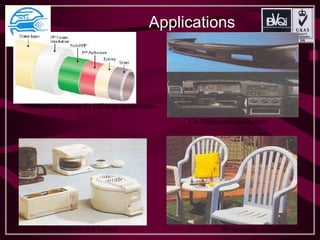
Applications
Multilayer PP coating for Offshore applications
Car Dashboard and Bumper
Coffee Maker and Toaster PP furniture
Copolymers of Polyolefin
1 Ethylene–Vinyl acetate
(EVA) copolymer.
- Both filled and unfilled EVA copolymers have good
low temperature flexibility and toughness.
- EVA with 15-20 mol % Vinyl acetate content are
rubbery copolymers with about 28% Vinyl acetate
content are used as hot–melt adhesives.
- EVA films are used for liquid packaging, frozen
foods, meat wrap, ice bags, drum liner. Molded
and extruded EVA resins are use in flexible toys,
bumper pads, hose,gasketing.
 
Ethylene–acrylate copolymers
- Ethylene – ethyl acrylate (EEA) and ethylene – methyl
acrylate (EMA) copolymers with up to 20% weight EA, MA
content respectively are commercially available.
- EEA resins have higher thermal stability and can
withstand higher processing temperatures than EVA
- EMA resins yield blow film with rubber like limpness and
extremely high dart-drop impact strength. They find useful
applications in extrusion coating, co-extrusion and
laminating applications
Ethylene– acrylic / methacrylic acid
copolymers
- Copolymers up to 6.5% acrylic acid and 15% by
weight of methacrylic acid are used for melt
processing applications.
- The acid group promotes excellent adhesion to
various substrates and increases abrasion
resistance and stress cracking resistance
- These resins are extrusion coating onto
aluminium foil for pouches, for composite tooth-
paste tubes, wire and cable applications, blown or
extruded films for packaging of food and other products
and various lamination applications.
Ethylene–Propylene Copolymers
- Two main types of ethylene (E) propylene (P) resins
are EPM and a terpolymer (EPDM) which includes a
third monomer, a non-conjugated diene. The
rubberiness of EP copolymer depends on the extent to which
the copolymer is random as well as on the
ethylene/propylene ratio (E/P).
- Rubbers which are rich in either ethylene or propylene
have higher tensile strength and elongation at break
(%) in the unvulcanized state than those rubbers
which contain equal amounts of E and P.
- EPM rubbers can be vulcanized only by peroxides or
high energy radiation. This limitation is overcome in
EPDM rubbers where the third monomer has two
double bonds; one enters the polymerization process
and the other C=C bond remains as a side chain
available for vulcanization with sulphur/accelerator
systems.
3. POLYSTYRENE
Available grades
Properties related to structure
General properties
Processing behaviour
Processing techniques
Applications
High Impact Polystyrene (HIPS)
General properties
Properties of HIPS
Applications
Acrylonitrile Butadiene Styrene (ABS)
Preparation of ABS
Properties of ABS
Processing behaviour
Processing techniques
Applications
Styrene Acrylonitile (SAN)
General properties
Properties of SAN
Applications
POLYSTYRENE
Available grades
General purpose polystyrene (GPPS)
Good balance is maintained to have good heat
resistance, reasonably high setting-up temperature, good
flow properties, and moderate impact strength.
 
High molecular weight polystyrene (HMPS)
HMPS gives strength without the loss of clarity.
 
Heat resistant grade
By reducing monomer from 5% to 0%, softening point
may be raised from 700
C to 1000
C.
 
Easy flow grade
It can be obtained by using low molecular material, by
using internal lubricant, by using external lubricant and by
controlling size and shape of granules.
Properties related to structure
-CH2-CH-
C6H5
- PS is linear hydrocarbon polymer being thermoplastic in
nature.
- Specific gravity of polystyrene is 1.054.
- Due to benzene ring causing stiffening effect, the Tg. of
commercial polymer is 90° to 110°C. Consequence of
this Tg value and amorphous nature of material make it
hard and transparent at room temperature.
- Solubility Parameter of PS is 18.6 M Pa½
hence it is
soluble in benzene, styrene, toluene. The presence of
benzene ring results in polystyrene having greater
reactivity than polyethylene.
- Due to phenyl group, polystyrene undergoes chlorination,
nitration, hydrogenation and halogenations etc.
- PS has extremely good electrical insulation properties.
General properties
- Polystyrene is hard, rigid and transparent
thermoplastic. Because of its low cost, good
mouldability, low water absorption, good dimensional
stability, good electrical insulation properties,
colourability and reasonable chemical resistance it is
widely used as an injection moulding and vacuum
forming material. Due to low thermal conductivity of
polystyrene foam, it is used for thermal insulation.
The limitations of the polymer are its brittleness,
inability to withstand the temperature of boiling water
and its mediocre oil resistance.
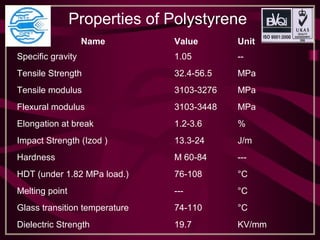
Properties of Polystyrene
Name Value Unit
Specific gravity 1.05 --
Tensile Strength 32.4-56.5 MPa
Tensile modulus 3103-3276 MPa
Flexural modulus 3103-3448 MPa
Elongation at break 1.2-3.6 %
Impact Strength (Izod ) 13.3-24 J/m
Hardness M 60-84 ---
HDT (under 1.82 MPa load.) 76-108 °C
Melting point --- °C
Glass transition temperature 74-110 °C
Dielectric Strength 19.7 KV/mm
Processing behaviour
- The negligible water absorption avoids the
need for predrying granules.
- Specific heat of PS is less, therefore higher
plasticizing capacity machines should be used.
- The strong dependence of apparent viscosity or
shear rate. This necessities particular care in the
design of complex extrusion dies.
- Due to amorphous in nature, polymer gives low
mould shrinkage.
 
Processing Techniques
Injection Moulding
- Polystyrene melts are of medium viscosity but
highly pseudo plastic. Typical flow path : wall thickness
ratio is 150:1 for GPPS and 130:1 for HIPS. Melts have
good stability at processing temperatures. Plastic
temperature in the process range from 200° C to 250°C
for GPPS and 180° to 250°C for HIPS grades. Injection
pressures are of 30 to 275 MPa depends on the grade
of the material. Low viscosity materials required lower
pressures and lower temperatures. High viscosity and
fiber – reinforced and mineral-filled resins require higher
pressure and temperatures.
Extrusion
- High impact polystyrene is widely extruded to
make sheets used in thermoforming. An extruder
having screw L/D ratio 25:1 to 30:1 and compression
ratio 2:1 to 3:1 are recommended to ensure that a
uniform melt temperature. Recommended process
temperature is around 150°C to 220°C
Thermoforming
- HIPS is one of the major thermoforming
materials. Solid sheet of HIPS is extruded and
shaped by a variety of forming methods; the most
common method is in-line vacuum forming. In this
process, vacuum is drawn between sheet and mold
or pressure is applied to the mold plug while air is
drawn out from the space the sheet and mold.
Typical forming temperature range is around 130° to
180°C and temperature at which forming may be
removed from the mould is at 85°C.
Applications
PS Room Partitioner PS Bathroom cell
PS Door fittings CD cover
High Impact Polystyrene (HIPS)
- HIPS are manufactured by dissolving
unsaturated rubber in styrene monomer and
polymerizing the monomer in a solution or
mass-suspension process. The rubber is
generally polybutadiene. In this process the
resultant blend will contain not only rubber and
polystyrene but also a graft polymer where short
styrene side chains have been attached to
the rubber molecules and this enhances
the impact strength. The rubber content in
solution polymerization can go up to 14% by
weight. HIPS obtained by this process are
having impact strength 7 times greater
than GPPS.
 
General Properties
- Good dimensional stability even at low
temperature and high impact strength than the general
purpose polystyrene, good toughness, ease of
processing, higher resistance to stress cracking, high
elongation at break, less resistance to ageing than
GPPS, lower hardness and rigidity than GPPS and
dissolved by alcohols, ketones, ethers etc.
Properties of HIPS
Name Value Unit
Specific gravity 1.05 --
Tensile Strength 16.0-41.3 Mpa
Tensile modulus 1653-2549 Mpa
Flexural modulus 1791-2687 Mpa
Elongation at break 1.0-1.5 %
Impact Strength (Izod ) 48.1-219 J/m
Hardness M 63-88 ---
HDT (under 1.82 MPa load.) 69-76 °C
Melting point --- °C
Glass transition temperature 93-105 °C
Dielectric Strength 11.8-19.7 KV/mm
    Applications  
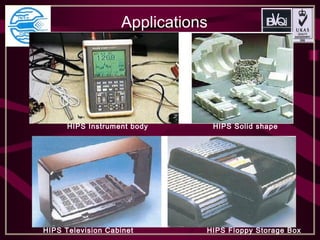
HIPS Television Cabinet HIPS Floppy Storage Box
HIPS Instrument body HIPS Solid shape
      Acrylonitrile Butadiene Styrene
                        (ABS) Copolymer  
- These materials are complex blends and
copolymers of Acrylonitrile, butadiene and styrene. In
most types, Acrylonitrile and styrene are grafted onto a
polybutadiene backbone. The product also contain
unreacted polybutadiene and some acrylo nitrile
styrene copolymer. The reasons for its widespread
acceptance are high impact resistance, good stiffness,
excellent surface quality, high dimensional stability at
elevated temperatures
ABS Preparation
- Styrene and Acrylonitrile are added to polybutadiene
latex and the mixture warmed to about 50°C to allow
absorption of the monomers.
- Water soluble initiator is added to polymerize the
styrene and Acrylonitrile. The resultant materials
will be a mixture of polybutadiene, polybutadiene
grafted with Acrylonitrile and styrene, and styrene-
Acrylonitrile copolymer.
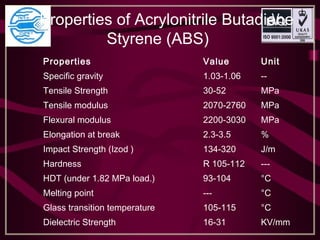
   Properties of Acrylonitrile Butadiene 
Styrene (ABS) 
Properties Value Unit
Specific gravity 1.03-1.06 --
Tensile Strength 30-52 MPa
Tensile modulus 2070-2760 MPa
Flexural modulus 2200-3030 MPa
Elongation at break 2.3-3.5 %
Impact Strength (Izod ) 134-320 J/m
Hardness R 105-112 ---
HDT (under 1.82 MPa load.) 93-104 °C
Melting point --- °C
Glass transition temperature 105-115 °C
Dielectric Strength 16-31 KV/mm
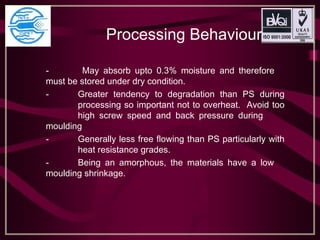
Processing Behaviour
- May absorb upto 0.3% moisture and therefore
must be stored under dry condition.
- Greater tendency to degradation than PS during
processing so important not to overheat. Avoid too
high screw speed and back pressure during
moulding
- Generally less free flowing than PS particularly with
heat resistance grades.
- Being an amorphous, the materials have a low
moulding shrinkage.
Processing Techniques
Injection Moulding
- ABS grades can be injection molded using
reciprocating screw or plunger machines, the
former is preferred because of it provides a
more uniform melt and higher available
pressure. Processing temperatures range
from 177 to 280°C, depending on the specific
grade. Injection pressures of 69 to 138 MPa
and a clamp pressure of 280 to 420 kg/cm²
compression ratio of 2:1 to 3 : 1 and an L/D ratio
of 20: 1 are recommended.
Extrusion
 - An extruder having a min. L/D ratio of 24:1
is recommended to ensure that a uniform
melt temperature is delivered to the die two
stage screws are preferred to aids in
devolatalization. A single lead, full-flighted,
constant pitch screw with a progressively
increasing root diameter and a compression
ratio of 2:1 to 2.5:1 is suitable for most ABS
grades.
Thermoforming
- ABS can be thermoformed over a temperature
range of 130 to 190°C with the optimum
conditions depend on material grade, part
design, draw ratio, sheet thickness and forming
technique. Acceptable techniques include drape
forming, plug asset, snap back, pressure forming or a
combination of these. The depth of draw in simple
forming is usually limited to the width of the part.
Electroplating
- ABS polymer is treated by an acid etching
process which dissolves out some of the
rubber particles at or near the polymer
surface. After sensitization and activation
electroless metal deposition processes are
carried out . The peel-strength between the ABS
and the plating depends on the type of mechanical
press.
Applications 
ABS Car Dashboard ABS car interiors
ABS Car bumper ABS meter box
   Styrene Acrylonitrile Copolymer 
(SAN)
- SAN is a copolymer of styrene and acrylonitrite.
- Because of the polar nature of Acrylonitrile
molecule these copolymers have better resistance to
hydrocarbons, oils and greases than polystyrene.
- SAN is produced by three different polymerization
techniques viz. emulsion, suspension and
continuous mass polymerization.
Properties
- It has excellent dimensional stability, very good
tensile and flexural strength.
- Good abrasion resistance, good impact strength.
- It has high chemical resistance, better resistance
to stress cracking and crazing. It does not react
with bleaches and resistance to water, acid and alkalis
water absorption is greater than PS.
Available grades 
- Standard grade
- UV stabilized grade
- Antistatic grade
- Glass reinforced grade
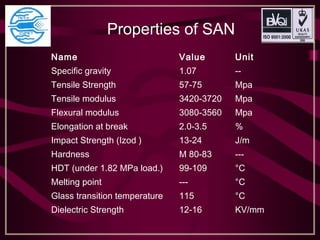
Properties of SAN 
Name Value Unit
Specific gravity 1.07 --
Tensile Strength 57-75 Mpa
Tensile modulus 3420-3720 Mpa
Flexural modulus 3080-3560 Mpa
Elongation at break 2.0-3.5 %
Impact Strength (Izod ) 13-24 J/m
Hardness M 80-83 ---
HDT (under 1.82 MPa load.) 99-109 °C
Melting point --- °C
Glass transition temperature 115 °C
Dielectric Strength 12-16 KV/mm
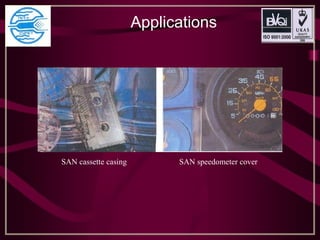
Applications 
SAN cassette casing SAN speedometer cover
         POLYVINYL CHLORIDE
Properties related to structure
Characterization of commercial polymer
Processing behaviour
Processing techniques
Compounding and Ingredients
Formulations
Properties of PVC compound
Applications
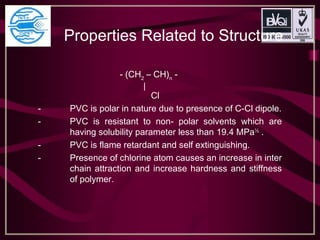
Properties Related to Structure 
- (CH2
– CH)n
-
|
Cl
- PVC is polar in nature due to presence of C-Cl dipole.
- PVC is resistant to non- polar solvents which are
having solubility parameter less than 19.4 MPa½
.
- PVC is flame retardant and self extinguishing.
- Presence of chlorine atom causes an increase in inter
chain attraction and increase hardness and stiffness
of polymer.
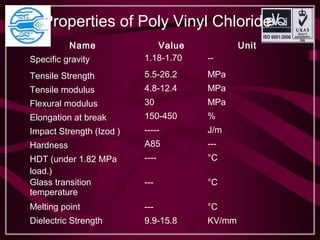
Properties of Poly Vinyl Chloride 
Name Value Unit
Specific gravity 1.18-1.70  --
Tensile Strength 5.5-26.2 MPa
Tensile modulus 4.8-12.4 MPa
Flexural modulus 30 MPa
Elongation at break 150-450 %
Impact Strength (Izod ) ----- J/m
Hardness A85 ---
HDT (under 1.82 MPa
load.)
---- °C
Glass transition 
temperature
--- °C
Melting point --- °C
Dielectric Strength 9.9-15.8 KV/mm
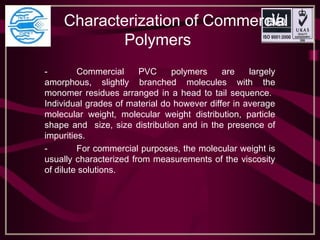
Characterization of Commercial 
Polymers 
- Commercial PVC polymers are largely
amorphous, slightly branched molecules with the
monomer residues arranged in a head to tail sequence.
Individual grades of material do however differ in average
molecular weight, molecular weight distribution, particle
shape and size, size distribution and in the presence of
impurities.
- For commercial purposes, the molecular weight is
usually characterized from measurements of the viscosity
of dilute solutions.
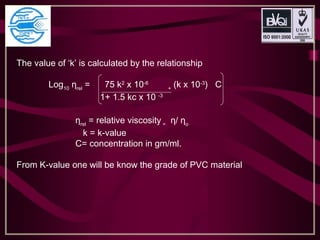
The value of ‘k’ is calculated by the relationship
Log10
ηrel
= 75 k2
x 10-6
+
(k x 10-3
) C
1+ 1.5 kc x 10 -3
ηrel
= relative viscosity =
η/ ηo
k = k-value
C= concentration in gm/ml.
From K-value one will be know the grade of PVC material
Processing Behaviour 
- Polymer doesn’t absorb water but some
plasticizers may do so.
- uPVC melts are viscous and typical flow path ratio
is in the order of 60 : 1 viscosity of plasticized PVC
depends on plasticizer level.
- Polymer lacks thermal stability and degradation is
rapid during processing evolves hydrochloric acid.
All the metal surfaces that come in contact with
the melt should be resistant to this acid. Good ventilation
of the working area is also essential.
- Polymer is amorphous in nature so that shrinkage
is low.
Processing Techniques
Injection Moulding
- Inline screw preplasticizing machines are used
for the injection moulding of UPVC. The main points to
bear in mind are the high melt viscosity, the need to
avoid overheating and steel corrosion by hydrochloric
acid evolved during processing. This demands good
control of operating conditions, short runners, reasonably
generous gates and mould cavities which preferably are
either chrome or gold plated. Recommended processing
temperatures are in the range of 180–200°C for uPVC
and 150–190°C for PPVC and injection pressures are
100–175 MPa for uPVC and 80–120 MPa for PPVC
respectively. Very good temperature control is
necessary.
Extrusion
- Twin screw extruder now dominates the extrusion
field due to their positive pumping action which is so
important with PVC in powder form. An extruder having
screw L/D ratio 14: 1 to 17: 1 and compression ratio 2:1
are recommended for UPVC. Dies must be designed so
that there is no chance of polymer stagnation in all flow
path cross sections. Accurate temperature control is very
important. Recommended process temperatures are in the
order of 150 to 180°C for UPVC and 140 – 175 °C for
PPVC respectively.
 
Blow molding
- Extrusion blow moulding of bottles has been
successfully accomplished . it is to be noted that UPVC
has a much lower average specific heat between the
processing temperature and room temperature than
polyethylene and no latent heat of fusion. This leads to
much less heat needing to be removed on cooling of
mouldings and very short cycle times are possible. Blow
molding is confined to UPVC using general conditions
given under extrusion.
Calendaring
- Calendaring is an important process for making
UPVC film or sheet. High molecular weight PVC is
compounded and partly agglomerated in an extruder
mixer. The heated mix is then fed to an L- type calendar
mixer. The hot calendar rolls simply partly consolidate
the granules so that the resulting film or sheet is strong
enough to be drawn over a train of heated drums which
are well above the fluxing temperature of the compound.
The PVC is therefore subjected to only a very short but
intense heating process. The resulting films with the
high mechanical properties are used for magnetic tapes
and for packaging applications.
Compounding and Ingredients 
A PVC compound may contain the following ingredients.
- Polymer
- Stabilizers
- Plasticizers
- Polymeric Processing Aids
- Impact Modifiers
- Fillers
- Pigments
Some other miscellaneous materials include flame (fire)
retardants, optical bleaches and blowing agents.
Stabilizers
- Heating of PVC at temperature above 70°C has a
number of adverse effects on the properties of the
polymers. Sufficient degradation may take place during
standard processing operations (150-200°C) to make the
product useless.Therefore to avoid degradation
‘stabilizers’ are found useful.
- The compounds of Cd, Ba, Ca and Zn are
prominent as PVC stabilizers.
Plasticizers
Plasticizers are used
- For reducing processing temperature of polymer
below the decomposition temperature.
- To modify the properties of finished products
such as flexibility or extensibility etc.
- To modify processing properties.
All PVC plasticizers have a solubility parameter to that of
PVC.
Di-iso-octyl phthalate (DIOP) and di – ethyl
hexylphthalate (DEHP) are most important
plasticizers used in PVC.
Extenders
- Sometimes plasticizers are not found useful in
PVC because of their limited compatibility with the
polymer. But when mixed with ‘true plasticizer’
(commercially called extenders), a reasonable
compatibility is acquired. They were also cheaper than
‘plasticizers’. Therefore plasticizers can often be
replaced by ‘Extenders’ without any adverse effects on
the properties of compound.
Commonly used extenders in PVC are
- Chlorinated paraffin waxes
- Chlorinated liquid paraffin fraction
- Oil extracts
Lubricants
- In plasticized PVC the main function of a
lubricant is to prevent sticking of the compound to the
processing equipment. This is brought about by
selecting a material of limited compatibility with PVC
which will bleed out from melt during processing to
form a film between the bulk of the compound and the
metal surface of the processing equipment. The
additives used for this purpose are known as ‘external
lubricants’.
- Calcium stearate, normal lead stearate,
dibasic lead stearate, graphite are employed to
improve flow properties.
Fillers
- Fillers are commonly employed in order to
reduce cost. They may also be incorporated for
technical reasons such as to increase the hardness of
a flooring compound, to reduce tackiness of highly
plasticized compounds, to improve electrical insulation
properties and to improve the hot deformation
resistance of cables.
- For electrical insulation, china clay is
commonly employed while various carbonates are
used for general purpose work.
Pigments
To add a pigment, firstly the following facts are to be
considered
- Will it decompose, fade or plate out?
- Will the pigment adversely affect the
functioning of stabilizer and lubricant.
- Will it fade, bleached out or will it bleed.
- Will the pigment adversely affect properties
that are relevant to the end usage (because
many pigments will reduce the volume
resistivity of a compound).
Polymeric Impact Modifiers &
Processing Aids
- Unplasticized PVC has a high melt viscosity
leading to some difficulties in processing. The finished
product is also too brittle for some applications. In
order to overcome these problems it has become
common practice to add certain polymeric additives to
the PVC. The ‘impact modifiers’ generally are semi-
compatible and often somewhat rubbery in nature.
- Chlorinated Polyethylene is being widely used
as an ‘impact modifier’ particularly where good aging
properties are required.
Formulations
The formulation given below is intended as a general
guide but not for a specific application.
Suspension polymer ( K- 65) 100
DIOP 40
Trixylyl Phosphate 20
China clay 20
Tribasic lead sulphate 7
Staeric Acid 0.5
Pigment 2
Properties of PVC compounds
- Unplasticized PVC is a rigid material
whilst the plasticized material is flexible and even
rubber at high plasticizer loadings.
- PVC has a good resistance to
hydrocarbons but some plasticizers, particularly the
less polar ones such as dibutyl sebacate are extracted
by materials such as iso-octane. The polymer is also
resistant to most aqueous solutions including those of
alkalis and dilute mineral acids.
- Below the second order transition
temperature, PVC compounds are reasonably good
electrical insulators over a wide range of frequencies
but above the second order transition temperature their
values as an insulator is limited to low frequency
applications. More the plasticizer present lowers the
volume resistivity.
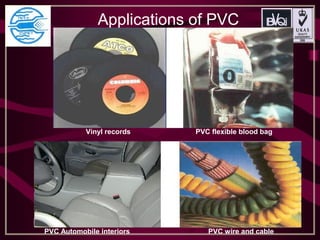
Applications of PVC
Vinyl records PVC flexible blood bag
PVC Automobile interiors PVC wire and cable
4.12.2 Polymerization
- Vinylidene Chloride can be polymerized by
bulk, emulsion and suspension techniques but
suspension technique is very common in
industries. In suspension process, glass-lined
reactor with a water jacket for temperature control
is used. In this process, comonomers, water, a
methocel cellulose and free radical initiator
(Benzoyl peroxide or louryl peroxide) are loaded
and heated in a sealed reactor. The polymer
precipitates and crystallizes giving a hard, porous
bead.
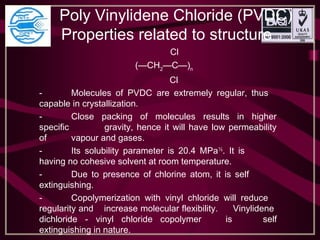
Poly Vinylidene Chloride (PVDC)
Properties related to structure
Cl
(—CH2
—C—)n
Cl
- Molecules of PVDC are extremely regular, thus
capable in crystallization.
- Close packing of molecules results in higher
specific gravity, hence it will have low permeability
of vapour and gases.
- Its solubility parameter is 20.4 MPa½
. It is
having no cohesive solvent at room temperature.
- Due to presence of chlorine atom, it is self
extinguishing.
- Copolymerization with vinyl chloride will reduce
regularity and increase molecular flexibility. Vinylidene
dichloride - vinyl chloride copolymer is self
extinguishing in nature.
Processing behaviour
- Vinylidene Chloride copolymers are thermally
sensitive. Overheating during processing evolves HCl.
Hence processing of Vinylidene Chloride copolymers require
careful control of the melt temperature and minimum melt
residence time. To prevent degradation during melt
processing, resins are formulated with thermal stabilizers
like inorganic or organic salts, organic phosphates or
phenolic antioxidants are also used. In the processing of
VDC copolymers, materials’ feeding is accomplished by air
venting or by gravity feed. Mold Shrinkage is 0.005 – 0.025
in/in.
Applications
- Copolymers may be used in the manufacturing of
extruded pipe and moulded fittings and in
chemical plants.
- Copolymers are used in the manufacture of
filament which may be extruded from steam heated
extruders with L/D ratio 10:1 and compression ratio
5:1 into a quench bath. These filaments are used for
deck chair fabrics, car upholstery, decorative radio grills,
dolls hair, filter brushes.
- Biaxially oriented film is used in packaging for
exceptional clarity, brilliance, toughness, and water gas
impermeability.
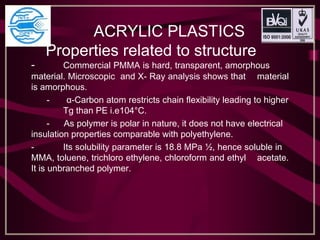
ACRYLIC PLASTICS
Properties related to structure
- Commercial PMMA is hard, transparent, amorphous
material. Microscopic and X- Ray analysis shows that material
is amorphous.
- α-Carbon atom restricts chain flexibility leading to higher
Tg than PE i.e104°C.
- As polymer is polar in nature, it does not have electrical
insulation properties comparable with polyethylene.
- Its solubility parameter is 18.8 MPa ½, hence soluble in
MMA, toluene, trichloro ethylene, chloroform and ethyl acetate.
It is unbranched polymer.
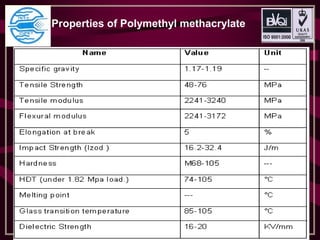
Properties of Polymethyl methacrylate
General Properties
- It is hard, rigid and amorphous transparent
material.
- It is having good weathering resistance.
- As it is polar thermoplastic material, it’s
mechanical, electrical and other properties are
strongly dependent on temperature, testing rate and
humidity.
- It is somewhat tougher than Polystyrene but less
tougher than Cellulose Acetate and Acrylonitrile
Butadiene Styrene Copolymer.
Additives
- In general Di butyl phthalate is used as a
plasticizer in the quantity of 5% which will improve melt
flow with some what decrease in mechanical
properties. In order to improve light stability, phenyl
sallicilate, 2–4–di hydroxy–benzo–phenone and methyl
sallicilate are used.
Processing behaviour
- The polymer absorbs moisture upto 0.3%, hence
pre drying is required before processing and
care must be taken with reground.
- Melt viscosity is higher than polystyrene,
polyethylene,polyvinyl chloride during processing.
Hence the equipment used must be robust and capable
of generating high extrusion and injection
pressure.
- The material is amorphous and the moulding
shrinkage is low and normally less than 0.08 cm/cm.
Processing Techniques
Injection Moulding
- PMMA granules tend to pick up moisture
and care should be taken in storage. Polymer has
limited thermal stability and may depolymerize during
prolonged exposure to high processing
temperatures. Screws with decompression zones
may be used to help remove volatile monomer
produced during processing. Recommended
processing temperatures ranges between 200 to
240°C and injection pressures in the range of 150 to
175 MPa. The higher temperatures are required for
large, thin walled parts molded from stiff grades of
PMMA. A cold mould could produce hazy and stress
parts. Recommended mould temperatures are in the
range of 21 to 60°C.
  Extrusion
- PMMA can be processed on single screw or
multiple screw extruders. Sheets, rods, tubes and
sections are commonly produced. Twin-screw
extruders offer improved feeding and degassing
characteristics. Proper screw design is necessary for
trouble free-operation and the best results are
achieved with longer barrels (30:1 to 40:1 L/D ratio).
A metering type screw with a gradual compression
(compression ratio 3:1) and constant pitch is
preferred. The processing temperature should be
between 227 to 249°C for flat sheet and 210 to
230°C for profiles.
  Thermoforming
- PMMA can be formed by vacuum forming when it
is heated above the Tg of the polymer .
- The formed shape will recover about 90% of the
deformation.
- Typical forming temperatures are in the range of
150 to 190°C.
- Parts should be cooled to at least 66°C before
they are removed from the mold.
Applications
Vegetable tray Sign boards
Dental application
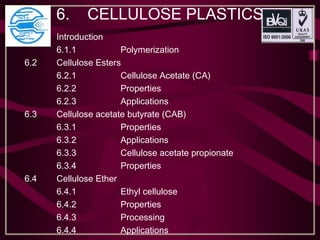
6. CELLULOSE PLASTICS
6.1 Introduction
6.1.1 Polymerization
6.2 Cellulose Esters
6.2.1 Cellulose Acetate (CA)
6.2.2 Properties
6.2.3 Applications
6.3 Cellulose acetate butyrate (CAB)
6.3.1 Properties
6.3.2 Applications
6.3.3 Cellulose acetate propionate
6.3.4 Properties
6.4 Cellulose Ether
6.4.1 Ethyl cellulose
6.4.2 Properties
6.4.3 Processing
6.4.4 Applications
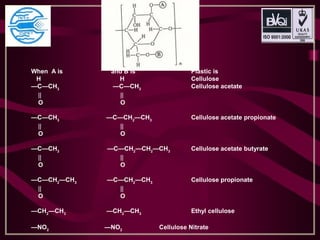
When A is and B is Plastic is
H H Cellulose
—C—CH3
—C—CH3
Cellulose acetate
|| ||
O O
—C—CH3
—C—CH2
—CH3
Cellulose acetate propionate
|| ||
O O
—C—CH3
—C—CH2
—CH2
—CH3
Cellulose acetate butyrate
|| ||
O O
—C—CH2
—CH3
—C—CH2
—CH3
Cellulose propionate
|| ||
O O
—CH2
—CH3
—CH2
—CH3
Ethyl cellulose
—NO2
—NO2
Cellulose Nitrate
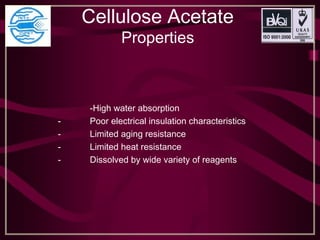
Cellulose Acetate
Properties
-High water absorption
- Poor electrical insulation characteristics
- Limited aging resistance
- Limited heat resistance
- Dissolved by wide variety of reagents
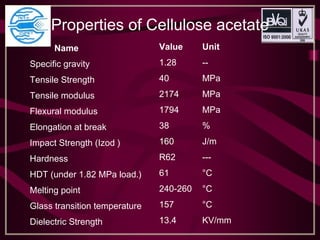
Properties of Cellulose acetate
Name Value Unit
Specific gravity 1.28 --
Tensile Strength 40 MPa
Tensile modulus 2174 MPa
Flexural modulus 1794 MPa
Elongation at break 38 %
Impact Strength (Izod ) 160 J/m
Hardness R62 ---
HDT (under 1.82 MPa load.) 61 °C
Melting point 240-260 °C
Glass transition temperature 157 °C
Dielectric Strength 13.4 KV/mm
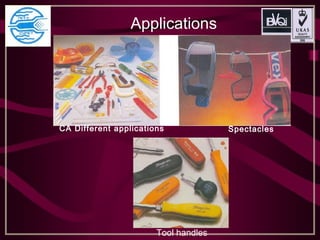
Applications
Tool handles
SpectaclesCA Different applications
- CAB has been prepared for a number of
years in United States.In the manufacturing in
commercial scale bleached wood pulp or cotton
linters are pretreated for 12 hours with 40-50 %
sulphuric acid and then after drying with acetic
acid. After these etherification of treated cellulose
with mixture of butyric acid and acetic anhydride
with sulphuric acid as a catalyst. Cellulose
acetate butyrate varies from the ratio of acetate /
butyrate.
Cellulose Acetate Butyrate (CAB)
Properties
-Good toughness
- Excellent appearance
- Giving good coating with hard glossy surface
- Lower water absorption
- Better flow properties
- Lower density
Applications
-Toys, tools handles, tabular keys, telephone housing,
pipes for conveying water, outdoor display signs,
vacuum formed products and protective coating for
metals.
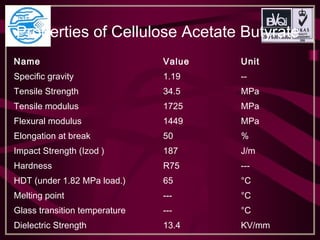
Properties of Cellulose Acetate Butyrate
Name Value Unit
Specific gravity 1.19 --
Tensile Strength 34.5 MPa
Tensile modulus 1725 MPa
Flexural modulus 1449 MPa
Elongation at break 50 %
Impact Strength (Izod ) 187 J/m
Hardness R75 ---
HDT (under 1.82 MPa load.) 65 °C
Melting point --- °C
Glass transition temperature --- °C
Dielectric Strength 13.4 KV/mm
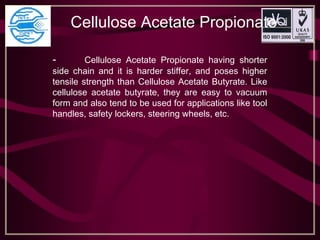
Cellulose Acetate Propionate
- Cellulose Acetate Propionate having shorter
side chain and it is harder stiffer, and poses higher
tensile strength than Cellulose Acetate Butyrate. Like
cellulose acetate butyrate, they are easy to vacuum
form and also tend to be used for applications like tool
handles, safety lockers, steering wheels, etc.
Properties
- Cellulose Acetate Propionate have shorter side
chain and it is harder, stiffer and possess higher tensile
strength than Cellulose Acetate Butyrate. Like cellulose
acetate butyrate, this is easy to vacuum form and also
tends to be used for applications like tool handles, safety
lockers, steering wheels, etc.
- Cellulose Nitrate is manufactured by the reaction
between cellulose, nitric acid and sulphuric acid.
It is possible to vary degree of etherification
according to the root hydroxyl group which is replaced
by nitrate group. Fully nitrated cellulose, cellulose tri-
nitriate is an explosive. Cellulose nitrate is
precipiticised with camphor in order to make it easy
processable.
Cellulose Nitrate
Properties
-It has good rigidity, water white transparency, poor
chemical resistance, reasonable toughness, capable
of forming highly attractive multi coloured sheeting,
highly inflammable.
Applications
- The one time important application was in
photographic film. Today the principal
outlet are knife handles, table tennis ball
and spectacle frames.


Commodity plastics

  • 1.
    1.Polyethylene Properties related tostructure Additives General properties Processing behaviour Processing techniques Grades available Applications
  • 2.
    1.5 Properties relatedto structure -(CH2 – CH2 – CH2 – CH2 ) -n The flexibility of carbon–carbon single bond would leads to low values for the glass transition temperature. In the absence of impurities the polymer would be an excellent high frequency insulator because of its non-polar nature. The properties of polyethylene vary due to differences raised from the following variables. * Variation in the degree of long/short chain branching. * Variation in average molecular weight. * Variation in molecular weight distribution. * The presence of impurities or Polymerization residues.
  • 3.
    Differences in moleculesof (a) LDPE, (b) LLDPE, (c) HDPE
  • 4.
    Types of Polyethylene Based on densities  Low Density, (Between 0.916 to 0.930 gm/cc)  Linear Low Density, (Between 0.916 to 0.930 gm/cc)  Medium Density, (Between 0.930 to 0.940 gm/cc)  High Density, (Above 0.940 gm/cc)
  • 5.
    Differences in moleculesof (a) LDPE, (b) LLDPE, (c) HDPE
  • 6.
    Basic Polymer Properties •Melt Flow Index (MFI)(g/10min) : The number of gms of resin which can be forced through 2.095 mm orifice when subjected to 2.16 kg load in 10 mins. At 190oC. MFI is measured as per ASTM D 1238 • Density(g/cc) : Ratio of mass per unit volume of the material & is reported in g/cc at given temperature (usually 23oC or 27oC). It is measured as per ASTM D 1505 • Molecular Weight Distribution (MWD): Ratio of weight average molecular weight (Mw) to number average molecular weight (Mn) MWD gives general picture of the ratio of large, medium & small molecular chains in the polymer.
  • 7.
    1.6 Additives - Carbonblack has some reinforcing effect and is of use in cross- linked polymers. It is also of some use in introducing a measure of conductivity to the polymer. - The principle requirements of a pigment are that it should have a high covering power-cost ratio and that it should withstand processing and service conditions (pigments based on Co, Cd & Mn). - Polyethylene burns readily and a number of materials have been used as flame retarders (ex. Antimony trioxide & halogenated material). - Slip agents may be added to reduce the friction between layers of film (fatty acid amides such as oleamide and erucamide are used). - Antistatic additives are widely used to reduce dust attraction and also in films to improve handling behavior.
  • 8.
    Properties of Polyethylenes.MaterialUnit LDPE LLDPE HDPE UHMHDPE Properties Specific gravity -- 0.915-0.925 0.915-0.935 0.941-0.967 0.93 Tensile Strength MPa 6.9-17.2 14-21 18.6-30.3 19.9-41.4 Tensile modulus MPa 138-310 137-186 420-1400 140-760 Flexural modulus MPa 55-410 248-365 689-1654 900-960 Elongation at break % 100-700 200-1200 100-1000 300 Impact Strength (Izod) J/m No break 10.6 (0.6)No break No break Hardness --- D45-60 D47-53 D60-70 D60-70 HDT (under 1.82 MPa load). °C 42 37 45 68-82 Glass transition temperature. °C -126 -130 --- --- Melting point °C 106-112 125 135 135 Dielectric Strength KV/mm 18-40 20-35 15.7-23.6 17.7
  • 9.
    L D PE - Characteristics OUTSTANDING PROPERTIES • Products offer excellent processability • Low motor loads • Excellent bubble stability (films) • Very low neck-in and excellent adhesion • Very good optical properties • Very good barrier to moisture • Moderate product properties • Mechanical properties • Dart Impact strength and Tear strength DRAWBACKS • POOR Heat Sealing properties compare to LDPE .
  • 10.
    LLDPE -Characteristics OUTSTANDING PROPERTIES •GOOD TENSILE / ELONGATION • EXCELLENT DOWNGAUGING • SEAL THRO’CONTAMINATION • EXCELLENT ESCR • BLENDABILITY DRAWBACKS • POOR MELT STRENGTH • HIGH MELT VISCOSITY (DIFFICULT PROCESSING)
  • 11.
    HDPE -Characteristics • Highestdensity –Better orderliness / Crystallinity • Very good melt strength –BM / FILM / PIPE Appln. • Very good chemical resistance / UV stability. • Very good stackability& rigidity • High molecular weight (Low MFI -HM grades) possible only in HDPE • HM grades –Excellent impact strength and Flexural modulus. • Very good dart impact strength in films • Caters entire application / processing range.
  • 12.
    1.7 General properties 1.7.1Mechanical Properties - Stiffness of the material increases with increase in density because more density means more crystallanity in which there is a close packing of molecules causing the stiffness. - Tensile Strength increases with increase in density therefore strong intermolecular forces are present causing the increase in tensile strength. - Impact Strength decreases with increase in density therefore higher the crystallanity lower the impact strength. - Torsional strength increases with increase in density.
  • 13.
    1.7.2 Thermal Properties -As density of the polymer increases there is great increase in its softening point. - As density increases, viscosity at melt temperature increases.
  • 14.
    1.7.3 Chemical Properties -The chemical resistance of Polyethylene is just like that of an alkane. Non-oxidizing acids, alkalis and many aqueous solutions do not chemically attack on the polymer. Nitric acid oxidizes the polymer leading to a rise in power factor and to deterioration in mechanical properties. - Polyethylene is a crystalline hydrocarbon polymer incapable of specific interaction with any liquid and there are no solvents at room temperature. Low density polymers will dissolve in benzene at about 60°C but more crystalline high density polymers only dissolves at temperatures some 20-30°C higher.
  • 15.
    1.7.4 Electrical Properties Polyethyleneis a non-polar material. - Power factor and dielectric constant are independent of temperature and frequency. - Reduction in density leads to small reduction of dielectric constant.
  • 16.
    1.8 Processing behaviour - Thelow water absorption of the polymer avoids the necessity of predrying before processing except where hygroscopic additives are present. -  Although processing temperatures are low compared with many plastics the specific heat, which varies with temperature is high. -  Flow properties are dependent on molecular weight and amount of branching but usual moulding grades may be as easy flow.
  • 17.
    1.9 Processing techniques 1.9.1 Injection Molding - Injection molding produces a very large number of products. In this process the polymer is melted and injected into a mould that is at a temperature below the freezing point of the polymer. Melt temperatures are of the order of 160-190°C for LDPE and up to 50°C higher with high-density materials. Because of the tendency of the material to crystallize, high shrinkage values are observed ranging from 0.015-0.050 cm/cm with low density materials to 0.025–0.060 cm/cm with high density polymers.
  • 18.
    1.9.2 Extrusion Process -Extrusion process consists of metering polymer into a heated barrel in which a screw is rotating. The rotation of the screw causes the granules to move up the barrel where they are compacted and plasticized. The resultant melt is then forced under pressure through an orifice to give a product of constant cross-section. Although the polymer may be processed on variety of different machines, the screws usually have a length–diameter (L/D) ratio in excess of 16:1 and compression ratio between 2.5:1 and 4:1.
  • 19.
    1.9.3 Compression molding -This process is occasionally used with polyethylene. In this process the polymer is heated in a mould at about 150°C, compressed to shape and cooled. The process is slow since heating and cooling of the mould must be carried out in each cycle and it is employed only for the manufacturing of large blocks and sheets and for relatively strain-free objects such as test pieces.
  • 20.
    1.9.4 Blow Molding -Many articles like bottles and containers in particular are made by blow molding technique. A hollow tube is extruded vertically downwards on to a spigot. Two mould halves close on to the parison and air is blown through the spigot to inflate the parison so that it takes up the shape of the mould. Recommended melt temperatures are in the order of 165°C for LDPE and 210°C for HDPE materials.
  • 21.
    1.9.5 Powder Coating -In fluidized-bed coating, a metal object that is to be coated is heated to about 160–250°C and then suspended in a fluidized bed of powdered polymer. Blowing air through a porous base in the powder container so that in effect the individual particles are lubricated with a thin film of air brings about fluidization. Particles coming into contact with the hot metal fuse and adhere to the metal part. The metal object together with the adhering particles is then transferred to a second oven where the particles fuse together to give an even coating.

  • 22.
    1.9.6 Rotational Molding -In rotational molding, the required amount of powder is added to the mould that is completely closed and then rotated in an oven about two axes. The powder melts and is distributed over the walls of the mould. The mould is then cooled while the moulds are rotating.
  • 23.
    1.10 Grades Available -Molding Grade - UV Stabilized grade - Anti oxidant grade - Film Grade
  • 24.
    1.11 Applications Blow Mouldedcontainers (HDPE) PIPE (HDPE) Rotational Moulding Flexible Packaging (LLDPE, LDPE)
  • 25.
    1.11 Applications CABLE SHEATING(LDPE) GREEN HOUSE FILMS (LDPE)
  • 26.
    2. POYPROPYLENE Properties relatedto structure Tacticity Properties of PP (isotactic form) General properties Additives for isotactic PP Processing behaviour Processing techniques Grades of PP Applications Copolymers of Polyolefins
  • 27.
    Properties related tostructure -CH2 – CH – | CH3 - PP is a linear polymer with little or no unsaturation. - Methyl group in the chain leads to increase in melting point and chain stiffening. - The tertiary carbon atom provides a site for oxidation so that the polymer is less stable than PE in the presence of oxygen. - Methyl group leads to products of different tacticity. - Commercial polymers are usually about 90-95% isotactic. - The isotactic polymer is stiff, highly crystalline and with a high melting point, whereas the atactic polymer is an amorphous somewhat rubbery material.
  • 28.
    Tacticity Isotactic - CH2 - CH- CH2 - CH - CH2 - CH - CH2 - CH - CH3 CH3 CH3 CH3 Syndiotactic CH3 CH3 | | -CH2 - CH - CH2 - CH-CH2 - CH - CH2 - CH- | | CH3 CH3 Atactic CH3 CH3 CH3 | | | -CH2 -CH - CH2 - CH- CH2 - CH - CH2 - CH- | CH3
  • 29.
    Properties of PP(Isotactic form) - It has lower density (0.90 gm / cc). - It has a higher softening point and hence a higher maximum service temperature. Articles can withstand boiling water and can be subjected to steam sterilizing operations. - It has a higher brittle point. - It is more susceptible to oxidation.
  • 30.
    Properties of Polypropylene NameValue Unit Specific gravity 0.90 -- Tensile Strength 35.5 MPa Tensile modulus 1380 MPa Flexural modulus 1690 MPa Elongation at break 35-350 % Impact Strength (Izod ) 37 J/m Hardness R100 --- HDT (under 1.82 MPa load.) 55 °C Glass transition temperature 5 °C Melting point 164 °C Dielectric Strength 24-28 KV/mm
  • 31.
    General Properties Chemical properties -No solvent affects PP at room temperature. Polypropylene will dissolve in Decaline at 130°C. - Aromatic and chlorinated solvents often swell polymer at elevated temperature. - Strong oxidizing acids slowly attacks the resin (fuming HNO3).
  • 32.
    Electrical properties - PPis an excellent insulator due to non-polarity. It is used in many molded products, as well as in winding coils and transformers.
  • 33.
    Flammability - PP burnsslowly and can be identified by an odour of crude oil. Flame–retardant grades are available for specific electrical applications.
  • 34.
    Mechanical properties - Commercialgrades of PP is tough and having good impact resistance. PP becomes more brittle than many other thermoplastics at zero temperature.
  • 35.
    Weathering properties - Standardgrades have shorter life when exposed to the outdoor. Discoloration, colour fade and crazing occur in products not stabilized with anti oxidants or carbon black.
  • 36.
    Additives for IsotacticPP Fillers - About 3% of PP compounds are filled with talc The improved stiffness and heat deformation resistance has led to the use of such compounds for the manufacturing of heater housings, car mounting components and several domestic appliances. Talc filled PP sheet is used as an alternative to carton board. - In comparison to the talc – filled grades the CaCo3 filled grades claimed to have higher impact strength, brighter colour, higher thermal stability, improved fatigue strength but lower stiffness and tensile strength is markedly reduced with both fillers.
  • 37.
    Rubbers - Particularly butylrubber is used to reduce the brittleness of PP. - Rubbers are used because of their reasonable price, structure, good weathering properties, negligible toxicity and easy processability and re- processability.
  • 38.
    Pigments - The selectionof pigments for PP follows the same considerations as for PE because of the higher processing temperature and lesser resistance to oxidation, selection does require more care.
  • 39.
    Carbon black - Toimprove the resistance to UV light, carbon black is use as a light screen.
  • 40.
    Antioxidants - Antioxidants arenecessary for prevention from adversity of oxidation. - For optimum processing stability a single antioxidant of the phenol alkane type, for e.g., 1,1,3 – tris (4 hydroxy - 2 methyl, 5 – t – butyl phenyl) butane, tends to give the best results.
  • 41.
    Processing behaviour - Processingof Polypropylene is similar to Polyethylene, particularly high-density polyethylene. The differences are in the lower specific heat and the greater sensitivity of flow properties to temperature and shear rate. Flow properties depend on molecular weight and additives present. Unfilled grades generally considered as easy flow. Flow Path: wall thickness ratios of 175:1 are possible on 1mm wall thickness sections. With easy flow grades the ratio may be as high as 350:1.
  • 42.
    Processing techniques Injection Molding -Recommended processing temperatures ranges from 210 to 275°C and injection pressures are of 150 to 180 MPa depending on the grade of the material. Thermal stability is quite good in the absence of oxygen so that there is no need to purge with another material when shutting down. Because of crystallanity there is high molding shrinkage and is reasonably uniform in all directions.
  • 43.
    Blow Moulding - Blowmolding of polypropylene is carried out on conventional extrusion blow and injection blow systems. Nonoriented containers are made by conventional process by using low melt flow rate homopolymers. Random copolymers overcome low melt strength limitations and also improve low temperature impact resistance and clarity. In typical extrusion process, the die temperature should be about 20 – 25°C below maximum barrel temperature. - Stretch blow molding, which is generally limited to homopolymers, produces light weight containers with good clarity and stiffness that can compete with PVC and HDPE for household chemical and detergent uses.
  • 44.
    Pipe Extrusion - Pipesare manufactured by extrusion process, which continuously extrude the molten plastic horizontally through an annular opening into one of the several devices for cooling it and fixing its dimensions. The heart of the extrusion process is the “screw” which plasticate the compound and conveys it through a pipe die head. PP-R has less heat conductivity compare to PE, therefore needs longer time to melt. This requires longer L/D ratio 30:1. The melt temperature is recommended to be 220-230°C.
  • 45.
    Manufacturing Process ofBOPP Film - BOPP film is manufactured with the blown method. Molten resin is extruded from a circular die to form a thick tube. The tube is stretched with air pressure at controlled temperature to achieve transverse orientation and simultaneously pulled by take off nips to achieve machine direction orientation.
  • 46.
    Calendaring - The calendaringprocess consists essentially of rolling out a mass of fluxed plastic between pairs of large rolls to form a homogeneous and accurately sized sheet. Most plastic calendars have been four roles arranged in an inverted ‘L’ configuration, with three roles in a vertical stack and the fourth roll horizontally to the side of top roll of the stack.
  • 47.
    Grades of Polypropylene -Low melt flow grade. - High melt flow grade. - Flame retardant grade. - Impact resistance grade. - UV resistance grade.
  • 48.
    Applications Multilayer PP coatingfor Offshore applications Car Dashboard and Bumper Coffee Maker and Toaster PP furniture
  • 49.
    Copolymers of Polyolefin 1Ethylene–Vinyl acetate (EVA) copolymer. - Both filled and unfilled EVA copolymers have good low temperature flexibility and toughness. - EVA with 15-20 mol % Vinyl acetate content are rubbery copolymers with about 28% Vinyl acetate content are used as hot–melt adhesives. - EVA films are used for liquid packaging, frozen foods, meat wrap, ice bags, drum liner. Molded and extruded EVA resins are use in flexible toys, bumper pads, hose,gasketing.  
  • 50.
    Ethylene–acrylate copolymers - Ethylene– ethyl acrylate (EEA) and ethylene – methyl acrylate (EMA) copolymers with up to 20% weight EA, MA content respectively are commercially available. - EEA resins have higher thermal stability and can withstand higher processing temperatures than EVA - EMA resins yield blow film with rubber like limpness and extremely high dart-drop impact strength. They find useful applications in extrusion coating, co-extrusion and laminating applications
  • 51.
    Ethylene– acrylic /methacrylic acid copolymers - Copolymers up to 6.5% acrylic acid and 15% by weight of methacrylic acid are used for melt processing applications. - The acid group promotes excellent adhesion to various substrates and increases abrasion resistance and stress cracking resistance - These resins are extrusion coating onto aluminium foil for pouches, for composite tooth- paste tubes, wire and cable applications, blown or extruded films for packaging of food and other products and various lamination applications.
  • 52.
    Ethylene–Propylene Copolymers - Twomain types of ethylene (E) propylene (P) resins are EPM and a terpolymer (EPDM) which includes a third monomer, a non-conjugated diene. The rubberiness of EP copolymer depends on the extent to which the copolymer is random as well as on the ethylene/propylene ratio (E/P). - Rubbers which are rich in either ethylene or propylene have higher tensile strength and elongation at break (%) in the unvulcanized state than those rubbers which contain equal amounts of E and P. - EPM rubbers can be vulcanized only by peroxides or high energy radiation. This limitation is overcome in EPDM rubbers where the third monomer has two double bonds; one enters the polymerization process and the other C=C bond remains as a side chain available for vulcanization with sulphur/accelerator systems.
  • 53.
    3. POLYSTYRENE Available grades Propertiesrelated to structure General properties Processing behaviour Processing techniques Applications
  • 54.
    High Impact Polystyrene(HIPS) General properties Properties of HIPS Applications Acrylonitrile Butadiene Styrene (ABS) Preparation of ABS Properties of ABS Processing behaviour Processing techniques Applications Styrene Acrylonitile (SAN) General properties Properties of SAN Applications
  • 55.
    POLYSTYRENE Available grades General purposepolystyrene (GPPS) Good balance is maintained to have good heat resistance, reasonably high setting-up temperature, good flow properties, and moderate impact strength.   High molecular weight polystyrene (HMPS) HMPS gives strength without the loss of clarity.   Heat resistant grade By reducing monomer from 5% to 0%, softening point may be raised from 700 C to 1000 C.   Easy flow grade It can be obtained by using low molecular material, by using internal lubricant, by using external lubricant and by controlling size and shape of granules.
  • 56.
    Properties related tostructure -CH2-CH- C6H5 - PS is linear hydrocarbon polymer being thermoplastic in nature. - Specific gravity of polystyrene is 1.054. - Due to benzene ring causing stiffening effect, the Tg. of commercial polymer is 90° to 110°C. Consequence of this Tg value and amorphous nature of material make it hard and transparent at room temperature. - Solubility Parameter of PS is 18.6 M Pa½ hence it is soluble in benzene, styrene, toluene. The presence of benzene ring results in polystyrene having greater reactivity than polyethylene. - Due to phenyl group, polystyrene undergoes chlorination, nitration, hydrogenation and halogenations etc. - PS has extremely good electrical insulation properties.
  • 57.
    General properties - Polystyreneis hard, rigid and transparent thermoplastic. Because of its low cost, good mouldability, low water absorption, good dimensional stability, good electrical insulation properties, colourability and reasonable chemical resistance it is widely used as an injection moulding and vacuum forming material. Due to low thermal conductivity of polystyrene foam, it is used for thermal insulation. The limitations of the polymer are its brittleness, inability to withstand the temperature of boiling water and its mediocre oil resistance.
  • 58.
    Properties of Polystyrene NameValue Unit Specific gravity 1.05 -- Tensile Strength 32.4-56.5 MPa Tensile modulus 3103-3276 MPa Flexural modulus 3103-3448 MPa Elongation at break 1.2-3.6 % Impact Strength (Izod ) 13.3-24 J/m Hardness M 60-84 --- HDT (under 1.82 MPa load.) 76-108 °C Melting point --- °C Glass transition temperature 74-110 °C Dielectric Strength 19.7 KV/mm
  • 59.
    Processing behaviour - Thenegligible water absorption avoids the need for predrying granules. - Specific heat of PS is less, therefore higher plasticizing capacity machines should be used. - The strong dependence of apparent viscosity or shear rate. This necessities particular care in the design of complex extrusion dies. - Due to amorphous in nature, polymer gives low mould shrinkage.  
  • 60.
    Processing Techniques Injection Moulding -Polystyrene melts are of medium viscosity but highly pseudo plastic. Typical flow path : wall thickness ratio is 150:1 for GPPS and 130:1 for HIPS. Melts have good stability at processing temperatures. Plastic temperature in the process range from 200° C to 250°C for GPPS and 180° to 250°C for HIPS grades. Injection pressures are of 30 to 275 MPa depends on the grade of the material. Low viscosity materials required lower pressures and lower temperatures. High viscosity and fiber – reinforced and mineral-filled resins require higher pressure and temperatures.
  • 61.
    Extrusion - High impactpolystyrene is widely extruded to make sheets used in thermoforming. An extruder having screw L/D ratio 25:1 to 30:1 and compression ratio 2:1 to 3:1 are recommended to ensure that a uniform melt temperature. Recommended process temperature is around 150°C to 220°C
  • 62.
    Thermoforming - HIPS isone of the major thermoforming materials. Solid sheet of HIPS is extruded and shaped by a variety of forming methods; the most common method is in-line vacuum forming. In this process, vacuum is drawn between sheet and mold or pressure is applied to the mold plug while air is drawn out from the space the sheet and mold. Typical forming temperature range is around 130° to 180°C and temperature at which forming may be removed from the mould is at 85°C.
  • 63.
    Applications PS Room PartitionerPS Bathroom cell PS Door fittings CD cover
  • 64.
    High Impact Polystyrene(HIPS) - HIPS are manufactured by dissolving unsaturated rubber in styrene monomer and polymerizing the monomer in a solution or mass-suspension process. The rubber is generally polybutadiene. In this process the resultant blend will contain not only rubber and polystyrene but also a graft polymer where short styrene side chains have been attached to the rubber molecules and this enhances the impact strength. The rubber content in solution polymerization can go up to 14% by weight. HIPS obtained by this process are having impact strength 7 times greater than GPPS.  
  • 65.
    General Properties - Gooddimensional stability even at low temperature and high impact strength than the general purpose polystyrene, good toughness, ease of processing, higher resistance to stress cracking, high elongation at break, less resistance to ageing than GPPS, lower hardness and rigidity than GPPS and dissolved by alcohols, ketones, ethers etc.
  • 66.
    Properties of HIPS NameValue Unit Specific gravity 1.05 -- Tensile Strength 16.0-41.3 Mpa Tensile modulus 1653-2549 Mpa Flexural modulus 1791-2687 Mpa Elongation at break 1.0-1.5 % Impact Strength (Izod ) 48.1-219 J/m Hardness M 63-88 --- HDT (under 1.82 MPa load.) 69-76 °C Melting point --- °C Glass transition temperature 93-105 °C Dielectric Strength 11.8-19.7 KV/mm
  • 67.
        Applications   HIPS Television CabinetHIPS Floppy Storage Box HIPS Instrument body HIPS Solid shape
  • 68.
          Acrylonitrile Butadiene Styrene                         (ABS) Copolymer   - Thesematerials are complex blends and copolymers of Acrylonitrile, butadiene and styrene. In most types, Acrylonitrile and styrene are grafted onto a polybutadiene backbone. The product also contain unreacted polybutadiene and some acrylo nitrile styrene copolymer. The reasons for its widespread acceptance are high impact resistance, good stiffness, excellent surface quality, high dimensional stability at elevated temperatures
  • 69.
    ABS Preparation - Styrene andAcrylonitrile are added to polybutadiene latex and the mixture warmed to about 50°C to allow absorption of the monomers. - Water soluble initiator is added to polymerize the styrene and Acrylonitrile. The resultant materials will be a mixture of polybutadiene, polybutadiene grafted with Acrylonitrile and styrene, and styrene- Acrylonitrile copolymer.
  • 70.
       Properties of Acrylonitrile Butadiene  Styrene (ABS)  Properties Value Unit Specificgravity 1.03-1.06 -- Tensile Strength 30-52 MPa Tensile modulus 2070-2760 MPa Flexural modulus 2200-3030 MPa Elongation at break 2.3-3.5 % Impact Strength (Izod ) 134-320 J/m Hardness R 105-112 --- HDT (under 1.82 MPa load.) 93-104 °C Melting point --- °C Glass transition temperature 105-115 °C Dielectric Strength 16-31 KV/mm
  • 71.
    Processing Behaviour - May absorbupto 0.3% moisture and therefore must be stored under dry condition. - Greater tendency to degradation than PS during processing so important not to overheat. Avoid too high screw speed and back pressure during moulding - Generally less free flowing than PS particularly with heat resistance grades. - Being an amorphous, the materials have a low moulding shrinkage.
  • 72.
    Processing Techniques Injection Moulding - ABSgrades can be injection molded using reciprocating screw or plunger machines, the former is preferred because of it provides a more uniform melt and higher available pressure. Processing temperatures range from 177 to 280°C, depending on the specific grade. Injection pressures of 69 to 138 MPa and a clamp pressure of 280 to 420 kg/cm² compression ratio of 2:1 to 3 : 1 and an L/D ratio of 20: 1 are recommended.
  • 73.
    Extrusion  - An extruderhaving a min. L/D ratio of 24:1 is recommended to ensure that a uniform melt temperature is delivered to the die two stage screws are preferred to aids in devolatalization. A single lead, full-flighted, constant pitch screw with a progressively increasing root diameter and a compression ratio of 2:1 to 2.5:1 is suitable for most ABS grades.
  • 74.
    Thermoforming - ABS canbe thermoformed over a temperature range of 130 to 190°C with the optimum conditions depend on material grade, part design, draw ratio, sheet thickness and forming technique. Acceptable techniques include drape forming, plug asset, snap back, pressure forming or a combination of these. The depth of draw in simple forming is usually limited to the width of the part.
  • 75.
    Electroplating - ABS polymeris treated by an acid etching process which dissolves out some of the rubber particles at or near the polymer surface. After sensitization and activation electroless metal deposition processes are carried out . The peel-strength between the ABS and the plating depends on the type of mechanical press.
  • 76.
    Applications  ABS Car DashboardABS car interiors ABS Car bumper ABS meter box
  • 77.
       Styrene Acrylonitrile Copolymer  (SAN) - SAN isa copolymer of styrene and acrylonitrite. - Because of the polar nature of Acrylonitrile molecule these copolymers have better resistance to hydrocarbons, oils and greases than polystyrene. - SAN is produced by three different polymerization techniques viz. emulsion, suspension and continuous mass polymerization.
  • 78.
    Properties - It hasexcellent dimensional stability, very good tensile and flexural strength. - Good abrasion resistance, good impact strength. - It has high chemical resistance, better resistance to stress cracking and crazing. It does not react with bleaches and resistance to water, acid and alkalis water absorption is greater than PS.
  • 79.
    Available grades  - Standard grade -UV stabilized grade - Antistatic grade - Glass reinforced grade
  • 80.
    Properties of SAN  Name Value Unit Specificgravity 1.07 -- Tensile Strength 57-75 Mpa Tensile modulus 3420-3720 Mpa Flexural modulus 3080-3560 Mpa Elongation at break 2.0-3.5 % Impact Strength (Izod ) 13-24 J/m Hardness M 80-83 --- HDT (under 1.82 MPa load.) 99-109 °C Melting point --- °C Glass transition temperature 115 °C Dielectric Strength 12-16 KV/mm
  • 81.
  • 82.
             POLYVINYL CHLORIDE Properties related tostructure Characterization of commercial polymer Processing behaviour Processing techniques Compounding and Ingredients Formulations Properties of PVC compound Applications
  • 83.
    Properties Related to Structure  - (CH2 – CH)n - | Cl -PVC is polar in nature due to presence of C-Cl dipole. - PVC is resistant to non- polar solvents which are having solubility parameter less than 19.4 MPa½ . - PVC is flame retardant and self extinguishing. - Presence of chlorine atom causes an increase in inter chain attraction and increase hardness and stiffness of polymer.
  • 84.
    Properties of Poly Vinyl Chloride  Name Value Unit Specificgravity 1.18-1.70  -- Tensile Strength 5.5-26.2 MPa Tensile modulus 4.8-12.4 MPa Flexural modulus 30 MPa Elongation at break 150-450 % Impact Strength (Izod ) ----- J/m Hardness A85 --- HDT (under 1.82 MPa load.) ---- °C Glass transition  temperature --- °C Melting point --- °C Dielectric Strength 9.9-15.8 KV/mm
  • 85.
    Characterization of Commercial  Polymers  - Commercial PVCpolymers are largely amorphous, slightly branched molecules with the monomer residues arranged in a head to tail sequence. Individual grades of material do however differ in average molecular weight, molecular weight distribution, particle shape and size, size distribution and in the presence of impurities. - For commercial purposes, the molecular weight is usually characterized from measurements of the viscosity of dilute solutions.
  • 86.
    The value of‘k’ is calculated by the relationship Log10 ηrel = 75 k2 x 10-6 + (k x 10-3 ) C 1+ 1.5 kc x 10 -3 ηrel = relative viscosity = η/ ηo k = k-value C= concentration in gm/ml. From K-value one will be know the grade of PVC material
  • 87.
    Processing Behaviour  - Polymer doesn’tabsorb water but some plasticizers may do so. - uPVC melts are viscous and typical flow path ratio is in the order of 60 : 1 viscosity of plasticized PVC depends on plasticizer level. - Polymer lacks thermal stability and degradation is rapid during processing evolves hydrochloric acid. All the metal surfaces that come in contact with the melt should be resistant to this acid. Good ventilation of the working area is also essential. - Polymer is amorphous in nature so that shrinkage is low.
  • 88.
    Processing Techniques Injection Moulding - Inlinescrew preplasticizing machines are used for the injection moulding of UPVC. The main points to bear in mind are the high melt viscosity, the need to avoid overheating and steel corrosion by hydrochloric acid evolved during processing. This demands good control of operating conditions, short runners, reasonably generous gates and mould cavities which preferably are either chrome or gold plated. Recommended processing temperatures are in the range of 180–200°C for uPVC and 150–190°C for PPVC and injection pressures are 100–175 MPa for uPVC and 80–120 MPa for PPVC respectively. Very good temperature control is necessary.
  • 89.
    Extrusion - Twin screwextruder now dominates the extrusion field due to their positive pumping action which is so important with PVC in powder form. An extruder having screw L/D ratio 14: 1 to 17: 1 and compression ratio 2:1 are recommended for UPVC. Dies must be designed so that there is no chance of polymer stagnation in all flow path cross sections. Accurate temperature control is very important. Recommended process temperatures are in the order of 150 to 180°C for UPVC and 140 – 175 °C for PPVC respectively.  
  • 90.
    Blow molding - Extrusionblow moulding of bottles has been successfully accomplished . it is to be noted that UPVC has a much lower average specific heat between the processing temperature and room temperature than polyethylene and no latent heat of fusion. This leads to much less heat needing to be removed on cooling of mouldings and very short cycle times are possible. Blow molding is confined to UPVC using general conditions given under extrusion.
  • 91.
    Calendaring - Calendaring isan important process for making UPVC film or sheet. High molecular weight PVC is compounded and partly agglomerated in an extruder mixer. The heated mix is then fed to an L- type calendar mixer. The hot calendar rolls simply partly consolidate the granules so that the resulting film or sheet is strong enough to be drawn over a train of heated drums which are well above the fluxing temperature of the compound. The PVC is therefore subjected to only a very short but intense heating process. The resulting films with the high mechanical properties are used for magnetic tapes and for packaging applications.
  • 92.
    Compounding and Ingredients  A PVC compoundmay contain the following ingredients. - Polymer - Stabilizers - Plasticizers - Polymeric Processing Aids - Impact Modifiers - Fillers - Pigments Some other miscellaneous materials include flame (fire) retardants, optical bleaches and blowing agents.
  • 93.
    Stabilizers - Heating ofPVC at temperature above 70°C has a number of adverse effects on the properties of the polymers. Sufficient degradation may take place during standard processing operations (150-200°C) to make the product useless.Therefore to avoid degradation ‘stabilizers’ are found useful. - The compounds of Cd, Ba, Ca and Zn are prominent as PVC stabilizers.
  • 94.
    Plasticizers Plasticizers are used -For reducing processing temperature of polymer below the decomposition temperature. - To modify the properties of finished products such as flexibility or extensibility etc. - To modify processing properties. All PVC plasticizers have a solubility parameter to that of PVC. Di-iso-octyl phthalate (DIOP) and di – ethyl hexylphthalate (DEHP) are most important plasticizers used in PVC.
  • 95.
    Extenders - Sometimes plasticizersare not found useful in PVC because of their limited compatibility with the polymer. But when mixed with ‘true plasticizer’ (commercially called extenders), a reasonable compatibility is acquired. They were also cheaper than ‘plasticizers’. Therefore plasticizers can often be replaced by ‘Extenders’ without any adverse effects on the properties of compound. Commonly used extenders in PVC are - Chlorinated paraffin waxes - Chlorinated liquid paraffin fraction - Oil extracts
  • 96.
    Lubricants - In plasticizedPVC the main function of a lubricant is to prevent sticking of the compound to the processing equipment. This is brought about by selecting a material of limited compatibility with PVC which will bleed out from melt during processing to form a film between the bulk of the compound and the metal surface of the processing equipment. The additives used for this purpose are known as ‘external lubricants’. - Calcium stearate, normal lead stearate, dibasic lead stearate, graphite are employed to improve flow properties.
  • 97.
    Fillers - Fillers arecommonly employed in order to reduce cost. They may also be incorporated for technical reasons such as to increase the hardness of a flooring compound, to reduce tackiness of highly plasticized compounds, to improve electrical insulation properties and to improve the hot deformation resistance of cables. - For electrical insulation, china clay is commonly employed while various carbonates are used for general purpose work.
  • 98.
    Pigments To add apigment, firstly the following facts are to be considered - Will it decompose, fade or plate out? - Will the pigment adversely affect the functioning of stabilizer and lubricant. - Will it fade, bleached out or will it bleed. - Will the pigment adversely affect properties that are relevant to the end usage (because many pigments will reduce the volume resistivity of a compound).
  • 99.
    Polymeric Impact Modifiers& Processing Aids - Unplasticized PVC has a high melt viscosity leading to some difficulties in processing. The finished product is also too brittle for some applications. In order to overcome these problems it has become common practice to add certain polymeric additives to the PVC. The ‘impact modifiers’ generally are semi- compatible and often somewhat rubbery in nature. - Chlorinated Polyethylene is being widely used as an ‘impact modifier’ particularly where good aging properties are required.
  • 100.
    Formulations The formulation givenbelow is intended as a general guide but not for a specific application. Suspension polymer ( K- 65) 100 DIOP 40 Trixylyl Phosphate 20 China clay 20 Tribasic lead sulphate 7 Staeric Acid 0.5 Pigment 2
  • 101.
    Properties of PVCcompounds - Unplasticized PVC is a rigid material whilst the plasticized material is flexible and even rubber at high plasticizer loadings. - PVC has a good resistance to hydrocarbons but some plasticizers, particularly the less polar ones such as dibutyl sebacate are extracted by materials such as iso-octane. The polymer is also resistant to most aqueous solutions including those of alkalis and dilute mineral acids. - Below the second order transition temperature, PVC compounds are reasonably good electrical insulators over a wide range of frequencies but above the second order transition temperature their values as an insulator is limited to low frequency applications. More the plasticizer present lowers the volume resistivity.
  • 102.
    Applications of PVC Vinylrecords PVC flexible blood bag PVC Automobile interiors PVC wire and cable
  • 103.
    4.12.2 Polymerization - VinylideneChloride can be polymerized by bulk, emulsion and suspension techniques but suspension technique is very common in industries. In suspension process, glass-lined reactor with a water jacket for temperature control is used. In this process, comonomers, water, a methocel cellulose and free radical initiator (Benzoyl peroxide or louryl peroxide) are loaded and heated in a sealed reactor. The polymer precipitates and crystallizes giving a hard, porous bead.
  • 104.
    Poly Vinylidene Chloride(PVDC) Properties related to structure Cl (—CH2 —C—)n Cl - Molecules of PVDC are extremely regular, thus capable in crystallization. - Close packing of molecules results in higher specific gravity, hence it will have low permeability of vapour and gases. - Its solubility parameter is 20.4 MPa½ . It is having no cohesive solvent at room temperature. - Due to presence of chlorine atom, it is self extinguishing. - Copolymerization with vinyl chloride will reduce regularity and increase molecular flexibility. Vinylidene dichloride - vinyl chloride copolymer is self extinguishing in nature.
  • 105.
    Processing behaviour - VinylideneChloride copolymers are thermally sensitive. Overheating during processing evolves HCl. Hence processing of Vinylidene Chloride copolymers require careful control of the melt temperature and minimum melt residence time. To prevent degradation during melt processing, resins are formulated with thermal stabilizers like inorganic or organic salts, organic phosphates or phenolic antioxidants are also used. In the processing of VDC copolymers, materials’ feeding is accomplished by air venting or by gravity feed. Mold Shrinkage is 0.005 – 0.025 in/in.
  • 106.
    Applications - Copolymers maybe used in the manufacturing of extruded pipe and moulded fittings and in chemical plants. - Copolymers are used in the manufacture of filament which may be extruded from steam heated extruders with L/D ratio 10:1 and compression ratio 5:1 into a quench bath. These filaments are used for deck chair fabrics, car upholstery, decorative radio grills, dolls hair, filter brushes. - Biaxially oriented film is used in packaging for exceptional clarity, brilliance, toughness, and water gas impermeability.
  • 107.
    ACRYLIC PLASTICS Properties relatedto structure - Commercial PMMA is hard, transparent, amorphous material. Microscopic and X- Ray analysis shows that material is amorphous. - α-Carbon atom restricts chain flexibility leading to higher Tg than PE i.e104°C. - As polymer is polar in nature, it does not have electrical insulation properties comparable with polyethylene. - Its solubility parameter is 18.8 MPa ½, hence soluble in MMA, toluene, trichloro ethylene, chloroform and ethyl acetate. It is unbranched polymer.
  • 108.
  • 109.
    General Properties - Itis hard, rigid and amorphous transparent material. - It is having good weathering resistance. - As it is polar thermoplastic material, it’s mechanical, electrical and other properties are strongly dependent on temperature, testing rate and humidity. - It is somewhat tougher than Polystyrene but less tougher than Cellulose Acetate and Acrylonitrile Butadiene Styrene Copolymer.
  • 110.
    Additives - In generalDi butyl phthalate is used as a plasticizer in the quantity of 5% which will improve melt flow with some what decrease in mechanical properties. In order to improve light stability, phenyl sallicilate, 2–4–di hydroxy–benzo–phenone and methyl sallicilate are used.
  • 111.
    Processing behaviour - Thepolymer absorbs moisture upto 0.3%, hence pre drying is required before processing and care must be taken with reground. - Melt viscosity is higher than polystyrene, polyethylene,polyvinyl chloride during processing. Hence the equipment used must be robust and capable of generating high extrusion and injection pressure. - The material is amorphous and the moulding shrinkage is low and normally less than 0.08 cm/cm.
  • 112.
    Processing Techniques Injection Moulding -PMMA granules tend to pick up moisture and care should be taken in storage. Polymer has limited thermal stability and may depolymerize during prolonged exposure to high processing temperatures. Screws with decompression zones may be used to help remove volatile monomer produced during processing. Recommended processing temperatures ranges between 200 to 240°C and injection pressures in the range of 150 to 175 MPa. The higher temperatures are required for large, thin walled parts molded from stiff grades of PMMA. A cold mould could produce hazy and stress parts. Recommended mould temperatures are in the range of 21 to 60°C.
  • 113.
      Extrusion - PMMAcan be processed on single screw or multiple screw extruders. Sheets, rods, tubes and sections are commonly produced. Twin-screw extruders offer improved feeding and degassing characteristics. Proper screw design is necessary for trouble free-operation and the best results are achieved with longer barrels (30:1 to 40:1 L/D ratio). A metering type screw with a gradual compression (compression ratio 3:1) and constant pitch is preferred. The processing temperature should be between 227 to 249°C for flat sheet and 210 to 230°C for profiles.
  • 114.
      Thermoforming - PMMA canbe formed by vacuum forming when it is heated above the Tg of the polymer . - The formed shape will recover about 90% of the deformation. - Typical forming temperatures are in the range of 150 to 190°C. - Parts should be cooled to at least 66°C before they are removed from the mold.
  • 115.
    Applications Vegetable tray Signboards Dental application
  • 116.
    6. CELLULOSE PLASTICS 6.1Introduction 6.1.1 Polymerization 6.2 Cellulose Esters 6.2.1 Cellulose Acetate (CA) 6.2.2 Properties 6.2.3 Applications 6.3 Cellulose acetate butyrate (CAB) 6.3.1 Properties 6.3.2 Applications 6.3.3 Cellulose acetate propionate 6.3.4 Properties 6.4 Cellulose Ether 6.4.1 Ethyl cellulose 6.4.2 Properties 6.4.3 Processing 6.4.4 Applications
  • 117.
    When A isand B is Plastic is H H Cellulose —C—CH3 —C—CH3 Cellulose acetate || || O O —C—CH3 —C—CH2 —CH3 Cellulose acetate propionate || || O O —C—CH3 —C—CH2 —CH2 —CH3 Cellulose acetate butyrate || || O O —C—CH2 —CH3 —C—CH2 —CH3 Cellulose propionate || || O O —CH2 —CH3 —CH2 —CH3 Ethyl cellulose —NO2 —NO2 Cellulose Nitrate
  • 118.
    Cellulose Acetate Properties -High waterabsorption - Poor electrical insulation characteristics - Limited aging resistance - Limited heat resistance - Dissolved by wide variety of reagents
  • 119.
    Properties of Celluloseacetate Name Value Unit Specific gravity 1.28 -- Tensile Strength 40 MPa Tensile modulus 2174 MPa Flexural modulus 1794 MPa Elongation at break 38 % Impact Strength (Izod ) 160 J/m Hardness R62 --- HDT (under 1.82 MPa load.) 61 °C Melting point 240-260 °C Glass transition temperature 157 °C Dielectric Strength 13.4 KV/mm
  • 120.
  • 121.
    - CAB hasbeen prepared for a number of years in United States.In the manufacturing in commercial scale bleached wood pulp or cotton linters are pretreated for 12 hours with 40-50 % sulphuric acid and then after drying with acetic acid. After these etherification of treated cellulose with mixture of butyric acid and acetic anhydride with sulphuric acid as a catalyst. Cellulose acetate butyrate varies from the ratio of acetate / butyrate.
  • 122.
    Cellulose Acetate Butyrate(CAB) Properties -Good toughness - Excellent appearance - Giving good coating with hard glossy surface - Lower water absorption - Better flow properties - Lower density
  • 123.
    Applications -Toys, tools handles,tabular keys, telephone housing, pipes for conveying water, outdoor display signs, vacuum formed products and protective coating for metals.
  • 124.
    Properties of CelluloseAcetate Butyrate Name Value Unit Specific gravity 1.19 -- Tensile Strength 34.5 MPa Tensile modulus 1725 MPa Flexural modulus 1449 MPa Elongation at break 50 % Impact Strength (Izod ) 187 J/m Hardness R75 --- HDT (under 1.82 MPa load.) 65 °C Melting point --- °C Glass transition temperature --- °C Dielectric Strength 13.4 KV/mm
  • 125.
    Cellulose Acetate Propionate -Cellulose Acetate Propionate having shorter side chain and it is harder stiffer, and poses higher tensile strength than Cellulose Acetate Butyrate. Like cellulose acetate butyrate, they are easy to vacuum form and also tend to be used for applications like tool handles, safety lockers, steering wheels, etc.
  • 126.
    Properties - Cellulose AcetatePropionate have shorter side chain and it is harder, stiffer and possess higher tensile strength than Cellulose Acetate Butyrate. Like cellulose acetate butyrate, this is easy to vacuum form and also tends to be used for applications like tool handles, safety lockers, steering wheels, etc.
  • 127.
    - Cellulose Nitrateis manufactured by the reaction between cellulose, nitric acid and sulphuric acid. It is possible to vary degree of etherification according to the root hydroxyl group which is replaced by nitrate group. Fully nitrated cellulose, cellulose tri- nitriate is an explosive. Cellulose nitrate is precipiticised with camphor in order to make it easy processable.
  • 128.
    Cellulose Nitrate Properties -It hasgood rigidity, water white transparency, poor chemical resistance, reasonable toughness, capable of forming highly attractive multi coloured sheeting, highly inflammable.
  • 129.
    Applications - The onetime important application was in photographic film. Today the principal outlet are knife handles, table tennis ball and spectacle frames.    

Editor's Notes

  • #2 HISTORY OF POLYETHYLENE CHRONOLOGIC -Fawcett produced Polyethylene by addition polymerization -Polyethylene (HDPE) produced by Ziegler Natta process -Phillips Petroleum Company and Standard Oil Company produced LDPE -Union Carbide developed LLDPE 1985-Union Carbide introduced VLDPE -
  • #3 LDPE B) LLDPE C) HDPE
  • #49 PP furniture
  • #82 SAN cassette casingSAN speedometer cover
  • #121 CA Different applications