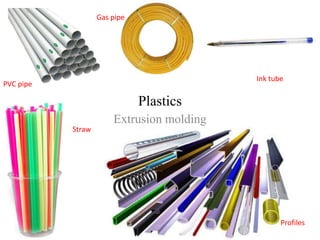
Plastics
Extrusion molding
PVC pipe
Gas pipe
Straw
Ink tube
Profiles
Extrusion Molding
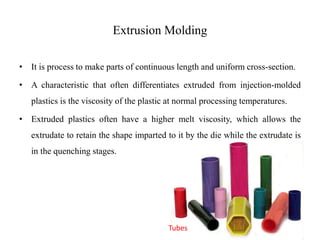
• It is process to make parts of continuous length and uniform cross-section.
• A characteristic that often differentiates extruded from injection-molded
plastics is the viscosity of the plastic at normal processing temperatures.
• Extruded plastics often have a higher melt viscosity, which allows the
extrudate to retain the shape imparted to it by the die while the extrudate is
in the quenching stages.
Tubes
Extrusion Molding
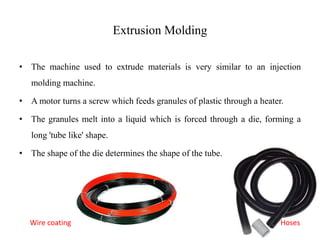
• The machine used to extrude materials is very similar to an injection
molding machine.
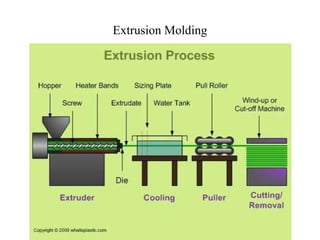
• A motor turns a screw which feeds granules of plastic through a heater.
• The granules melt into a liquid which is forced through a die, forming a
long 'tube like' shape.
• The shape of the die determines the shape of the tube.
HosesWire coating
Extrusion Molding
• The extrusion is then cooled and forms a solid shape.
• The tube may be printed upon, and cut at equal intervals.
• The pieces may be rolled for storage or packed together.
• Shapes that can result from extrusion include T-sections, U-sections, square
sections, I-sections, L-sections and circular sections.
Strips
Rods
Extrusion Molding
Extrusion Molding
Extrusion Molding
• Screw extruders working on then same principle as the ordinary domestic
mincing machines are used.
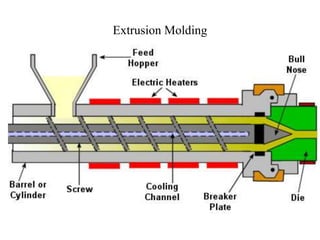
• A plastic extruder consists essentially of a barrel or cylinder fitted with a
screw.
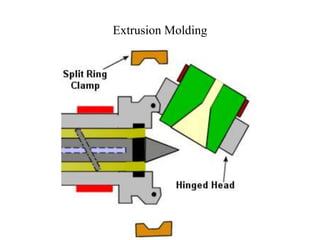
• The die is fitted into the extruder head at the front of the machine; the feed
hole is at the back end.
Curtain tracks
Tape
Extrusion Molding
• The extruder head and barrel are heated and with the screw rotating, plastic
material is fed in, carried along the barrel by the screw and forced through
the die in the extruder head.
• A screw extruder requires a powerful motor to drive the screw and a strong
thrust bearing to take up the back pressure.
• The screw is usually canalled so that water or oil can be passed through it
for the purpose of temperature control.
Shopping bagsAngle sections
Extrusion Molding
Extrusion Molding
Extrusion Molding
• Screw extruders usually have three or four heat zones along the length of
the barrel each of, which can be separately controlled at predetermined
temperatures.
• Heating is affected by means of electric resistance heaters on the barrel and
nozzles, or by passing steam or hot oil through ports built into the machine.
• Electric heating is most usual.
• Different materials require different temperature settings at the heat zones
and for a given material the temperature settings vary from one type of
machine to another.
• The following list gives an indication of the temperature ranges from feed
hopper to die employed with the important thermoplastic materials.
Extrusion Molding
• Cellulose Acetate (Plasticised) 21oC ___ 204 oC
• Cellulose Acetate Butyrate (Plasticised) 21 oC ___ 204 oC
• P.V.C. (Unplasticised) 168 oC ____ 191 oC
• P.V.C. (Plasticised) 152 oC ____ 177 oC
• Polyethylene 135 oC ____ 190 oC
• Nylon 190 oC ____ 290 oC
Sheets
Extrusion Molding
Extrusion Molding
Extrusion Molding
Extrusion Molding
Pipes/Tubes:
• The die for producing a tube or pipe consists of a circular orifice with a
carefully centered mandrel or torpedo, which is held, in the die orifice by,
supports at the back end.
• Generally the mandrel is constructed so that compressed air can be blown
through it into the hot extorted tube with the object of preventing the tube
from collapsing.
Strings
Extrusion Molding
Extrusion Molding
• At the front of the barrel, the molten plastic leaves the screw and travels
through a screen pack to remove any contaminants in the melt.
• The screens are reinforced by a breaker plate (a thick metal puck with
many holes drilled through it) since the pressure at this point can exceed
5000 psi (34 MPa).
Screenpacks
Extrusion Molding
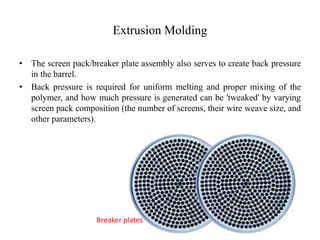
• The screen pack/breaker plate assembly also serves to create back pressure
in the barrel.
• Back pressure is required for uniform melting and proper mixing of the
polymer, and how much pressure is generated can be 'tweaked' by varying
screen pack composition (the number of screens, their wire weave size, and
other parameters).
Breaker plates
Extrusion Molding
Wires:
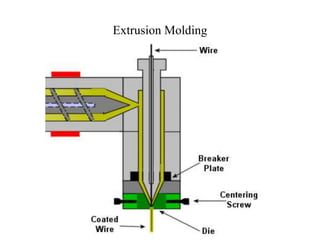
• The coating of wire with thermoplastic material is carried out by using a
special die, which extrudes the plastic material at right angles to the screw
direction.
• Wire is continually fed through the die from which it energies evenly
coated with the plastic material.
Film tape
Extrusion Molding

Extrusion molding

  • 1.
    Plastics Extrusion molding PVC pipe Gaspipe Straw Ink tube Profiles
  • 2.
    Extrusion Molding • Itis process to make parts of continuous length and uniform cross-section. • A characteristic that often differentiates extruded from injection-molded plastics is the viscosity of the plastic at normal processing temperatures. • Extruded plastics often have a higher melt viscosity, which allows the extrudate to retain the shape imparted to it by the die while the extrudate is in the quenching stages. Tubes
  • 3.
    Extrusion Molding • Themachine used to extrude materials is very similar to an injection molding machine. • A motor turns a screw which feeds granules of plastic through a heater. • The granules melt into a liquid which is forced through a die, forming a long 'tube like' shape. • The shape of the die determines the shape of the tube. HosesWire coating
  • 4.
    Extrusion Molding • Theextrusion is then cooled and forms a solid shape. • The tube may be printed upon, and cut at equal intervals. • The pieces may be rolled for storage or packed together. • Shapes that can result from extrusion include T-sections, U-sections, square sections, I-sections, L-sections and circular sections. Strips Rods
  • 5.
  • 6.
  • 7.
    Extrusion Molding • Screwextruders working on then same principle as the ordinary domestic mincing machines are used. • A plastic extruder consists essentially of a barrel or cylinder fitted with a screw. • The die is fitted into the extruder head at the front of the machine; the feed hole is at the back end. Curtain tracks Tape
  • 8.
    Extrusion Molding • Theextruder head and barrel are heated and with the screw rotating, plastic material is fed in, carried along the barrel by the screw and forced through the die in the extruder head. • A screw extruder requires a powerful motor to drive the screw and a strong thrust bearing to take up the back pressure. • The screw is usually canalled so that water or oil can be passed through it for the purpose of temperature control. Shopping bagsAngle sections
  • 9.
  • 10.
  • 11.
    Extrusion Molding • Screwextruders usually have three or four heat zones along the length of the barrel each of, which can be separately controlled at predetermined temperatures. • Heating is affected by means of electric resistance heaters on the barrel and nozzles, or by passing steam or hot oil through ports built into the machine. • Electric heating is most usual. • Different materials require different temperature settings at the heat zones and for a given material the temperature settings vary from one type of machine to another. • The following list gives an indication of the temperature ranges from feed hopper to die employed with the important thermoplastic materials.
  • 12.
    Extrusion Molding • CelluloseAcetate (Plasticised) 21oC ___ 204 oC • Cellulose Acetate Butyrate (Plasticised) 21 oC ___ 204 oC • P.V.C. (Unplasticised) 168 oC ____ 191 oC • P.V.C. (Plasticised) 152 oC ____ 177 oC • Polyethylene 135 oC ____ 190 oC • Nylon 190 oC ____ 290 oC Sheets
  • 13.
  • 14.
  • 15.
  • 16.
    Extrusion Molding Pipes/Tubes: • Thedie for producing a tube or pipe consists of a circular orifice with a carefully centered mandrel or torpedo, which is held, in the die orifice by, supports at the back end. • Generally the mandrel is constructed so that compressed air can be blown through it into the hot extorted tube with the object of preventing the tube from collapsing. Strings
  • 17.
  • 18.
    Extrusion Molding • Atthe front of the barrel, the molten plastic leaves the screw and travels through a screen pack to remove any contaminants in the melt. • The screens are reinforced by a breaker plate (a thick metal puck with many holes drilled through it) since the pressure at this point can exceed 5000 psi (34 MPa). Screenpacks
  • 19.
    Extrusion Molding • Thescreen pack/breaker plate assembly also serves to create back pressure in the barrel. • Back pressure is required for uniform melting and proper mixing of the polymer, and how much pressure is generated can be 'tweaked' by varying screen pack composition (the number of screens, their wire weave size, and other parameters). Breaker plates
  • 20.
    Extrusion Molding Wires: • Thecoating of wire with thermoplastic material is carried out by using a special die, which extrudes the plastic material at right angles to the screw direction. • Wire is continually fed through the die from which it energies evenly coated with the plastic material. Film tape
  • 21.