Thermoforming
What isThermoforming ?
•Thermoforming is a manufacturing process where
sheets of thermoplastic or films are heated to a pliable
forming temperature, formed to a specific shape in a
mold and trimmed to create a usable product.
Pliable temperature:-
Sag point (above the glass-transition
temperature (𝑇𝑔), of the polymer)
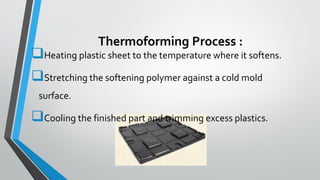
Thermoforming Process :
❑Heating plastic sheet to the temperature where it softens.
❑Stretching the softening polymer against a cold mold
surface.
❑Cooling the finished part and trimming excess plastics.
Materials Used:
▪ABS (Acrylonitrile butadiene styrene)
▪Cellulose acetate
▪LDPE (Low density polyethylene)
▪HDPE (High density polyethylene)
▪PVC etc.
Steps of thermoforming:•
1. Heating:- Heating is accomplished by radiant electric
heater which is located at a distance of 125mm (5 in.)
either on one or both sides of the sheet.
•
2. Forming:- After heating, the polymer sheet is converted
or
formed into various shapes by either air pressure,
vacuum
pressure or by mechanical pressure.
One stage thermoforming machine
Types of thermoforming:
• Basically there are three types of thermoforming processes.
❑Vacuum forming
❑Pressure forming
❑Mechanical thermoforming
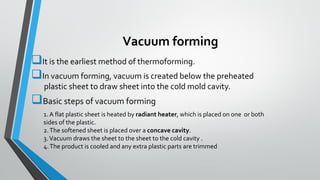
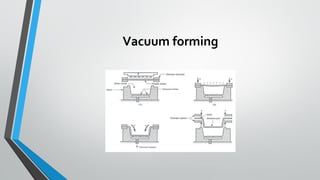
Vacuum forming
❑It is the earliest method of thermoforming.
❑In vacuum forming, vacuum is created below the preheated
plastic sheet to draw sheet into the cold mold cavity.
❑Basic steps of vacuum forming
1. A flat plastic sheet is heated by radiant heater, which is placed on one or both
sides of the plastic.
2.The softened sheet is placed over a concave cavity.
3.Vacuum draws the sheet to the sheet to the cold cavity .
4.The product is cooled and any extra plastic parts are trimmed
Vacuum forming
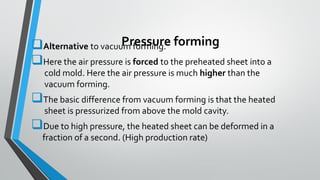
Pressure forming❑Alternative to vacuum forming.
❑Here the air pressure is forced to the preheated sheet into a
cold mold. Here the air pressure is much higher than the
vacuum forming.
❑The basic difference from vacuum forming is that the heated
sheet is pressurized from above the mold cavity.
❑Due to high pressure, the heated sheet can be deformed in a
fraction of a second. (High production rate)
Pressure forming
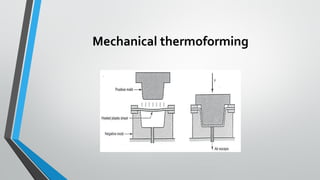
Mechanical thermoforming❑Here, positive (male) and negative (female) molds are brought
against heated plastic sheet forcing it to the assumed shape.
❑In mechanical forming, air pressure or vacuum pressure are
not used to deform the plastic sheet.
❑Air between the die and sheet is evacuated by using
vacuum pump and the sheet conforms to the mold shape.
❑Formed part is cooled and ejected.
Mechanical thermoforming
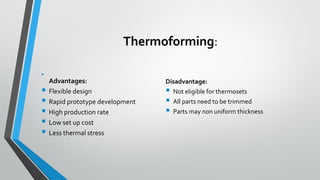
Thermoforming:
•
Advantages:
▪ Flexible design
▪ Rapid prototype development
▪ High production rate
▪ Low set up cost
▪ Less thermal stress
Disadvantage:
▪ Not eligible for thermosets
▪ All parts need to be trimmed
▪ Parts may non uniform thickness
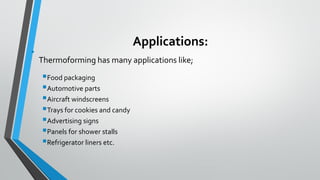
Applications:
•
Thermoforming has many applications like;
▪Food packaging
▪Automotive parts
▪Aircraft windscreens
▪Trays for cookies and candy
▪Advertising signs
▪Panels for shower stalls
▪Refrigerator liners etc.
ThankYou!

Thermoforming

  • 1.
  • 2.
    What isThermoforming ? •Thermoformingis a manufacturing process where sheets of thermoplastic or films are heated to a pliable forming temperature, formed to a specific shape in a mold and trimmed to create a usable product. Pliable temperature:- Sag point (above the glass-transition temperature (𝑇𝑔), of the polymer)
  • 3.
    Thermoforming Process : ❑Heatingplastic sheet to the temperature where it softens. ❑Stretching the softening polymer against a cold mold surface. ❑Cooling the finished part and trimming excess plastics.
  • 4.
    Materials Used: ▪ABS (Acrylonitrilebutadiene styrene) ▪Cellulose acetate ▪LDPE (Low density polyethylene) ▪HDPE (High density polyethylene) ▪PVC etc.
  • 5.
    Steps of thermoforming:• 1.Heating:- Heating is accomplished by radiant electric heater which is located at a distance of 125mm (5 in.) either on one or both sides of the sheet. • 2. Forming:- After heating, the polymer sheet is converted or formed into various shapes by either air pressure, vacuum pressure or by mechanical pressure.
  • 6.
  • 7.
    Types of thermoforming: •Basically there are three types of thermoforming processes. ❑Vacuum forming ❑Pressure forming ❑Mechanical thermoforming
  • 8.
    Vacuum forming ❑It isthe earliest method of thermoforming. ❑In vacuum forming, vacuum is created below the preheated plastic sheet to draw sheet into the cold mold cavity. ❑Basic steps of vacuum forming 1. A flat plastic sheet is heated by radiant heater, which is placed on one or both sides of the plastic. 2.The softened sheet is placed over a concave cavity. 3.Vacuum draws the sheet to the sheet to the cold cavity . 4.The product is cooled and any extra plastic parts are trimmed
  • 9.
  • 10.
    Pressure forming❑Alternative tovacuum forming. ❑Here the air pressure is forced to the preheated sheet into a cold mold. Here the air pressure is much higher than the vacuum forming. ❑The basic difference from vacuum forming is that the heated sheet is pressurized from above the mold cavity. ❑Due to high pressure, the heated sheet can be deformed in a fraction of a second. (High production rate)
  • 11.
  • 12.
    Mechanical thermoforming❑Here, positive(male) and negative (female) molds are brought against heated plastic sheet forcing it to the assumed shape. ❑In mechanical forming, air pressure or vacuum pressure are not used to deform the plastic sheet. ❑Air between the die and sheet is evacuated by using vacuum pump and the sheet conforms to the mold shape. ❑Formed part is cooled and ejected.
  • 13.
  • 14.
    Thermoforming: • Advantages: ▪ Flexible design ▪Rapid prototype development ▪ High production rate ▪ Low set up cost ▪ Less thermal stress Disadvantage: ▪ Not eligible for thermosets ▪ All parts need to be trimmed ▪ Parts may non uniform thickness
  • 15.
    Applications: • Thermoforming has manyapplications like; ▪Food packaging ▪Automotive parts ▪Aircraft windscreens ▪Trays for cookies and candy ▪Advertising signs ▪Panels for shower stalls ▪Refrigerator liners etc.
  • 16.