Pro E/ MOLD DESIGN
By
SREESANKAR.J
CADD ENGINEER
Overview
• Basic about mold & Molding
• Mold Manufacturing & Machining Process
• Plastic Materials
• Molding Process
• Mold Types
• Parts Of Mold
• Single Cavity Mold
• Multi Cavity Mold
• Family Mold
• Methods of Actuation
• Feed System
• Shinkage
• Ejection
• Parting Surface
Basic about Mold & Molding
• Hollowed-out block that is filled with a liquid like plastic, glass, metal or
ceramic raw materials.
• Liquid sets to adopt the shape of the mold.
• Molding: The Process of Creating OR producing commercially accepted
shapes using Mold.
Working principle:
1. The cavity portion of the mold, forms the external shape of the molding.
2. The core portion of the mold, forms the internal form of the molding.
Mold Manufacturing & Maching Process
1. CNC Process (Predominant in making complex molds)
2. EDM- Electrical Discharge Machining Process OR Spark Erosion
Process.(No Heat treatment is required)
Plastic Materials
Synthetic organic material that can be molded under heat and
pressure into a shape that is retained after the heat and pressures are
removed is called plastic.
Types:
1. Thermoplastics:- Can be formed to any shape on application of
heat, harden & cooling. Can be re-transformed to thermoplastic.
2. Thermosets:- Can't be re-transformed to thermosets.
Molding Machine
• Hopper
• Barrel
• Extruder Screw
• Nozzle
Different types of molding process
1. Injection molding
2. Compression & transfer molding
3. Extrusion
4. Blow molding
5. Thermoforming
6. Calendaring
7. Reinforced Plastics
8. Rejection Injection Molding
Injection molding
Injection molding is the process of creating parts by injection materials into
a mold.
Injection molding uses materials like:
1. Thermoplastic
2. Thermosetting plastic
Can be performed with a host of materials, including metals, glasses etc. for
which the process is called die casting.
Classified into 3 according to construction:
1. One plate mold
2. Three plate mold
3. Runnerless mold
Design considerations
Draft: Required in both the core and cavity for easy ejection of the finished
component
Shrinkage allowance: Depends on shrinkage property of material core and
cavity size
Cooling circuit: Reduces the cycle time, water circulates through holes drilled
in both the core and cavity plates.
Ejection gap: The gap between the ejector plate face and core back plate
face should hold dimension within the core. It must allow component to be
fully removed from the mold.
Air vents: Removes gases entrapped between core and cavity (usually less
than 0.05 mm gap excess causes flash defect).
Mold polishing: The core, cavity, runner and sprue should have good surface
finish and should be polished along material flow direction.
Mold filling: The gate should be placed such that the component is filled
from the thicker section to thinner section.
Compression Molding
• Molding is a forming process
• Comprises of two processes
1. Preheating
2. Pressurizing
• Compression molding is generally used for thermosetting plastic.
Types of Compression Molding
• Sheet molding compound(SMC)
• Bulk molding compound(BMC)
Transfer Molding
• Polymer charge is transferred from transfer pot to the mold.
• The mold is cooled and molded part is ejected
• Molding materials
1. Thermoset plastic (Epoxy, Polyester, phenol- Formaldehyde, Phenol ester)
2. Thermoplastic can also be used.
Application
Used to make enclosed parts like, Circuits, Pins, Coils, plugs.
Extrusion Molding
• Process to make parts of continuous length and uniform cross-
section.
• Extruded plastics often have a higher melt viscosity.
• Shapes that can result from extrusion include T-sections, U-sections,
square sections, I-sections, L-sections and circular sections.
• Shapes of the product depends on the die.
Application
To produce products like,
• Pipes
• Hoses
• Drinking Straws
• Curtain Tracks
• Rods
• Fibers
Blow Molding
• Blow Molding, also known as "Blow Forming"
• Manufacturing process, by which hollow plastic parts are formed.
• Material used:
• Polyethylene (LD & HD)
• Polypropylene(PP)
• Polyvinyl Chloride (PVC)
• Types of Blow Molding
1. EXTRUSION BLOW MOLDING.
2. INJECTION BLOW MOLDING.
3. STRETCH BLOW MOLDING.
Thermoforming
• It’s a plastic molding technique where thin plastic sheets are heated
and formed on a male or female die.
Types of Thermoforming
• Vacuum Forming:- uses heat and pressure, vacuum is used to manipulate
heated sheet.
• Pressure forming:- same as vacuum pressure bt additional pressure is applied.
Applications
• Rigid packing of food & consumer goods.
• Toys, lids etc.
Calendaring
• Calendaring is a continuous process, synchronized method.
• Converts raw material into a flex and then handling the plastic like
mass through the nips of a series of cooperative rolls into a sheet of
specified thickness and width.
Application
• Mainly used in forming of rubber.
Parts of Mold
• Core insert
• Cavity insert
• Core retainer or Core plate
• Cavity retainer or cavity plate
• Back plate
• Parallel block
• Ejector plate
• Ejector Block
• Ejector retainer
• Ejector pin
• Return pins
• Reset pins
• Reset button
• Ejector rods
• Ejector rod bush
• Sprue bush
• Sprue Puller
• Register ring
• Guide Pillars
• Guide Bushes
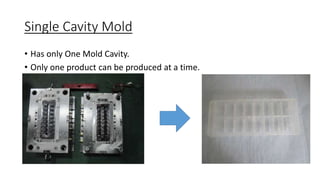
Single Cavity Mold
• Has only One Mold Cavity.
• Only one product can be produced at a time.
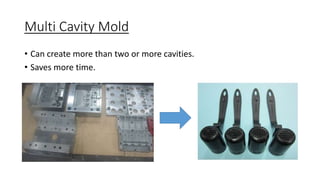
Multi Cavity Mold
• Can create more than two or more cavities.
• Saves more time.
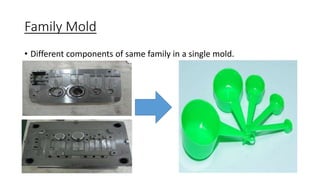
Family Mold
• Different components of same family in a single mold.
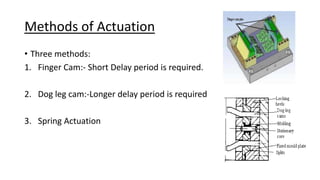
Methods of Actuation
• Three methods:
1. Finger Cam:- Short Delay period is required.
2. Dog leg cam:-Longer delay period is required
3. Spring Actuation
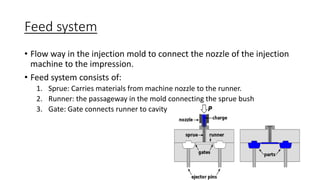
Feed system
• Flow way in the injection mold to connect the nozzle of the injection
machine to the impression.
• Feed system consists of:
1. Sprue: Carries materials from machine nozzle to the runner.
2. Runner: the passageway in the mold connecting the sprue bush
3. Gate: Gate connects runner to cavity
Shrinkage
• The incremental difference between the dimensions of the molding
and the mold from which it was made.
• Shrinking increases with: Decreases with:
• Material temperature * Higher Cavity Pressure
• Mold temperature * Lower Injection Time
• Section thickness
Shrinkage = Dimension * 0.5/100
Ejection
The process of ejecting mold component from the core.
Major ejection systems are:
1. Ejector Pin or sleeve
2. Blades
3. Air Valve
4. Stripper Plate
5. Thread ejection
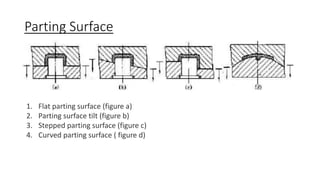
Parting Surface
1. Flat parting surface (figure a)
2. Parting surface tilt (figure b)
3. Stepped parting surface (figure c)
4. Curved parting surface ( figure d)
Parting surface design principles
• Parting surface design directly affects the product quality, ease of
construction and operation of the injection mold.
1. Design the injection mold structure as simple as possible.
2. Ease of de-molding. As far as possible.
3. Ensure the dimensional accuracy of the molded parts.
4. Ensure appearance requirement of the molded parts.
5. Ensure adequate venting.
ProE-Pro/MOLDESIGN
Pro/MOLDESIGN is an optional module for Pro/ENGINEER that
provides the tools to simulate the mold design process. It
provides the functionality to build parting lines and parting
surfaces and extract punch, cavities and slides.
Mold Analysis in ProE
• Pro/MOLDESIGN provides a number of tools to ensure that mold
cavity will perform satisfactorily during actual production. These tools
verify that mold confirms to some minimum criteria set by the mold
designer.
Types:
1. Water Line clearance check
2. Mold opening analysis
3. Parting surface check
4. Projected area calculation
THANK YOU

Pro E/Mold Design (Pro/MOLDESIGN)

  • 1.
    Pro E/ MOLDDESIGN By SREESANKAR.J CADD ENGINEER
  • 2.
    Overview • Basic aboutmold & Molding • Mold Manufacturing & Machining Process • Plastic Materials • Molding Process • Mold Types • Parts Of Mold • Single Cavity Mold • Multi Cavity Mold • Family Mold • Methods of Actuation • Feed System • Shinkage • Ejection • Parting Surface
  • 3.
    Basic about Mold& Molding • Hollowed-out block that is filled with a liquid like plastic, glass, metal or ceramic raw materials. • Liquid sets to adopt the shape of the mold. • Molding: The Process of Creating OR producing commercially accepted shapes using Mold. Working principle: 1. The cavity portion of the mold, forms the external shape of the molding. 2. The core portion of the mold, forms the internal form of the molding.
  • 4.
    Mold Manufacturing &Maching Process 1. CNC Process (Predominant in making complex molds) 2. EDM- Electrical Discharge Machining Process OR Spark Erosion Process.(No Heat treatment is required)
  • 5.
    Plastic Materials Synthetic organicmaterial that can be molded under heat and pressure into a shape that is retained after the heat and pressures are removed is called plastic. Types: 1. Thermoplastics:- Can be formed to any shape on application of heat, harden & cooling. Can be re-transformed to thermoplastic. 2. Thermosets:- Can't be re-transformed to thermosets.
  • 6.
    Molding Machine • Hopper •Barrel • Extruder Screw • Nozzle
  • 7.
    Different types ofmolding process 1. Injection molding 2. Compression & transfer molding 3. Extrusion 4. Blow molding 5. Thermoforming 6. Calendaring 7. Reinforced Plastics 8. Rejection Injection Molding
  • 8.
    Injection molding Injection moldingis the process of creating parts by injection materials into a mold. Injection molding uses materials like: 1. Thermoplastic 2. Thermosetting plastic Can be performed with a host of materials, including metals, glasses etc. for which the process is called die casting. Classified into 3 according to construction: 1. One plate mold 2. Three plate mold 3. Runnerless mold
  • 9.
    Design considerations Draft: Requiredin both the core and cavity for easy ejection of the finished component Shrinkage allowance: Depends on shrinkage property of material core and cavity size Cooling circuit: Reduces the cycle time, water circulates through holes drilled in both the core and cavity plates. Ejection gap: The gap between the ejector plate face and core back plate face should hold dimension within the core. It must allow component to be fully removed from the mold. Air vents: Removes gases entrapped between core and cavity (usually less than 0.05 mm gap excess causes flash defect). Mold polishing: The core, cavity, runner and sprue should have good surface finish and should be polished along material flow direction. Mold filling: The gate should be placed such that the component is filled from the thicker section to thinner section.
  • 10.
    Compression Molding • Moldingis a forming process • Comprises of two processes 1. Preheating 2. Pressurizing • Compression molding is generally used for thermosetting plastic.
  • 11.
    Types of CompressionMolding • Sheet molding compound(SMC) • Bulk molding compound(BMC)
  • 12.
    Transfer Molding • Polymercharge is transferred from transfer pot to the mold. • The mold is cooled and molded part is ejected • Molding materials 1. Thermoset plastic (Epoxy, Polyester, phenol- Formaldehyde, Phenol ester) 2. Thermoplastic can also be used. Application Used to make enclosed parts like, Circuits, Pins, Coils, plugs.
  • 13.
    Extrusion Molding • Processto make parts of continuous length and uniform cross- section. • Extruded plastics often have a higher melt viscosity. • Shapes that can result from extrusion include T-sections, U-sections, square sections, I-sections, L-sections and circular sections. • Shapes of the product depends on the die.
  • 14.
    Application To produce productslike, • Pipes • Hoses • Drinking Straws • Curtain Tracks • Rods • Fibers
  • 15.
    Blow Molding • BlowMolding, also known as "Blow Forming" • Manufacturing process, by which hollow plastic parts are formed. • Material used: • Polyethylene (LD & HD) • Polypropylene(PP) • Polyvinyl Chloride (PVC) • Types of Blow Molding 1. EXTRUSION BLOW MOLDING. 2. INJECTION BLOW MOLDING. 3. STRETCH BLOW MOLDING.
  • 17.
    Thermoforming • It’s aplastic molding technique where thin plastic sheets are heated and formed on a male or female die. Types of Thermoforming • Vacuum Forming:- uses heat and pressure, vacuum is used to manipulate heated sheet. • Pressure forming:- same as vacuum pressure bt additional pressure is applied. Applications • Rigid packing of food & consumer goods. • Toys, lids etc.
  • 18.
    Calendaring • Calendaring isa continuous process, synchronized method. • Converts raw material into a flex and then handling the plastic like mass through the nips of a series of cooperative rolls into a sheet of specified thickness and width. Application • Mainly used in forming of rubber.
  • 19.
    Parts of Mold •Core insert • Cavity insert • Core retainer or Core plate • Cavity retainer or cavity plate • Back plate • Parallel block • Ejector plate • Ejector Block • Ejector retainer • Ejector pin • Return pins • Reset pins • Reset button • Ejector rods • Ejector rod bush • Sprue bush • Sprue Puller • Register ring • Guide Pillars • Guide Bushes
  • 20.
    Single Cavity Mold •Has only One Mold Cavity. • Only one product can be produced at a time.
  • 21.
    Multi Cavity Mold •Can create more than two or more cavities. • Saves more time.
  • 22.
    Family Mold • Differentcomponents of same family in a single mold.
  • 23.
    Methods of Actuation •Three methods: 1. Finger Cam:- Short Delay period is required. 2. Dog leg cam:-Longer delay period is required 3. Spring Actuation
  • 24.
    Feed system • Flowway in the injection mold to connect the nozzle of the injection machine to the impression. • Feed system consists of: 1. Sprue: Carries materials from machine nozzle to the runner. 2. Runner: the passageway in the mold connecting the sprue bush 3. Gate: Gate connects runner to cavity
  • 25.
    Shrinkage • The incrementaldifference between the dimensions of the molding and the mold from which it was made. • Shrinking increases with: Decreases with: • Material temperature * Higher Cavity Pressure • Mold temperature * Lower Injection Time • Section thickness Shrinkage = Dimension * 0.5/100
  • 26.
    Ejection The process ofejecting mold component from the core. Major ejection systems are: 1. Ejector Pin or sleeve 2. Blades 3. Air Valve 4. Stripper Plate 5. Thread ejection
  • 27.
    Parting Surface 1. Flatparting surface (figure a) 2. Parting surface tilt (figure b) 3. Stepped parting surface (figure c) 4. Curved parting surface ( figure d)
  • 28.
    Parting surface designprinciples • Parting surface design directly affects the product quality, ease of construction and operation of the injection mold. 1. Design the injection mold structure as simple as possible. 2. Ease of de-molding. As far as possible. 3. Ensure the dimensional accuracy of the molded parts. 4. Ensure appearance requirement of the molded parts. 5. Ensure adequate venting.
  • 29.
    ProE-Pro/MOLDESIGN Pro/MOLDESIGN is anoptional module for Pro/ENGINEER that provides the tools to simulate the mold design process. It provides the functionality to build parting lines and parting surfaces and extract punch, cavities and slides.
  • 30.
    Mold Analysis inProE • Pro/MOLDESIGN provides a number of tools to ensure that mold cavity will perform satisfactorily during actual production. These tools verify that mold confirms to some minimum criteria set by the mold designer. Types: 1. Water Line clearance check 2. Mold opening analysis 3. Parting surface check 4. Projected area calculation
  • 31.