TECHNOLOGY FINAL REPORT.
NAME: Sarim Ali
CLASS: 3RD YEAR, 5THSEMESTER
SEAT NO: B1898112
(Improvement)
SUBMITTED TO: SIR JAVED
PLASTICS.
Plastic materials are highly formable materials that are artificially made from organic
compounds called polymers, along with additive components. Aside from formability,
plastics are generally known to be lightweight, flexible, durable, corrosion-resistant,
and cost-effective.
Plastic is a material consisting of a wide range of synthetic or semi-synthetic organic
compounds that are malleable and, therefore, can be molded into solid objects.
Plasticity is the general property of all materials that involves permanent deformation
without breaking.
POLYMERIZATION: A polymer is a large single chain-like molecule in which the
repeating units derived from small molecules called monomers are bound together.
The process by which monomers are transformed into a polymer is called
polymerisation. For example ethylene polymerizes to form polyethylene.
APPLICATION: Product made from polymers are all around us: clothing made from
synthetic fibers, polyethylene cups, fiberglass, nylon bearings, plastic bags, polymer-
based paints, epoxy glue, polyurethane foam cushion, silicone heart valves, and
Teflon-coated cookware.
PLASTIC MANUFACTURING PROCESSES.
INJECTION MOLDING: Injection molding is a method to obtain molded
products by injecting plastic materials molten by heat into a mold, and then cooling
and solidifying them. The method is suitable for the mass production of products
with complicated shapes, and takes a large part in the area of plastic processing.
PROCESS: Injection molding is a process in which a thermoplastic polymer is
heated above it’s melting point, resulting in the conversion of the solid polymer into
molten fluid with a reasonably low viscosity. This melt is mechanically forced, that is,
injected, into a mold in the shape of the desired final object. The low viscosity molten
polymer allows complete filling of the mold where the article resides until it is cooled
below the freezing point of the polymer. At last, mold is opened and the part is ejected
and recovered.
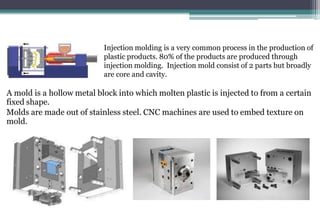
A mold is a hollow metal block into which molten plastic is injected to from a certain
fixed shape.
Molds are made out of stainless steel. CNC machines are used to embed texture on
mold.
Injection molding is a very common process in the production of
plastic products. 80% of the products are produced through
injection molding. Injection mold consist of 2 parts but broadly
are core and cavity.
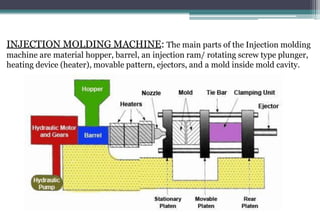
INJECTION MOLDING MACHINE: The main parts of the Injection molding
machine are material hopper, barrel, an injection ram/ rotating screw type plunger,
heating device (heater), movable pattern, ejectors, and a mold inside mold cavity.
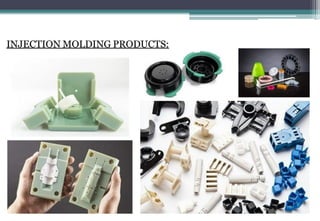
INJECTION MOLDING PRODUCTS:
DESIGN CONSIDERATIONS INJECTION MOLDING:
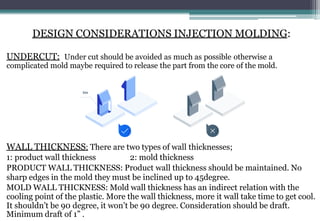
UNDERCUT: Under cut should be avoided as much as possible otherwise a
complicated mold maybe required to release the part from the core of the mold.
WALL THICKNESS: There are two types of wall thicknesses;
1: product wall thickness 2: mold thickness
PRODUCT WALL THICKNESS: Product wall thickness should be maintained. No
sharp edges in the mold they must be inclined up to 45degree.
MOLD WALL THICKNESS: Mold wall thickness has an indirect relation with the
cooling point of the plastic. More the wall thickness, more it wall take time to get cool.
It shouldn’t be 90 degree, it won’t be 90 degree. Consideration should be draft.
Minimum draft of 1” .
KNOCK OUT PINS: It works as piston, pins eject the product of mold. They are
made up of metal, steel. In all the complicated parts, knockout pins are present. They
are located with calculations, so it won’t effect the product.
RIBS:
LETTERING:
HOLES:
INSERTS:
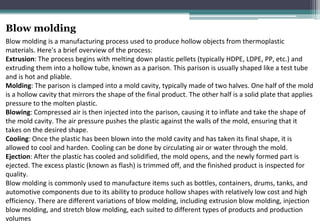
Blow molding
Blow molding is a manufacturing process used to produce hollow objects from thermoplastic
materials. Here's a brief overview of the process:
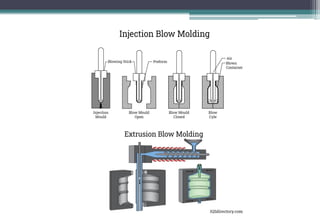
Extrusion: The process begins with melting down plastic pellets (typically HDPE, LDPE, PP, etc.) and
extruding them into a hollow tube, known as a parison. This parison is usually shaped like a test tube
and is hot and pliable.
Molding: The parison is clamped into a mold cavity, typically made of two halves. One half of the mold
is a hollow cavity that mirrors the shape of the final product. The other half is a solid plate that applies
pressure to the molten plastic.
Blowing: Compressed air is then injected into the parison, causing it to inflate and take the shape of
the mold cavity. The air pressure pushes the plastic against the walls of the mold, ensuring that it
takes on the desired shape.
Cooling: Once the plastic has been blown into the mold cavity and has taken its final shape, it is
allowed to cool and harden. Cooling can be done by circulating air or water through the mold.
Ejection: After the plastic has cooled and solidified, the mold opens, and the newly formed part is
ejected. The excess plastic (known as flash) is trimmed off, and the finished product is inspected for
quality.
Blow molding is commonly used to manufacture items such as bottles, containers, drums, tanks, and
automotive components due to its ability to produce hollow shapes with relatively low cost and high
efficiency. There are different variations of blow molding, including extrusion blow molding, injection
blow molding, and stretch blow molding, each suited to different types of products and production
volumes
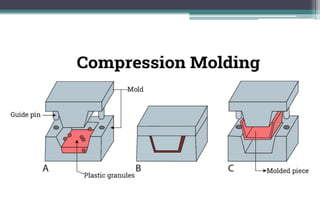
Compression molding
Compression molding is a manufacturing process used to create plastic or composite parts by
compressing a material in a heated mold cavity. Here's how it typically works:
Preparation: The material to be molded, often in the form of pellets, powder, or preforms, is placed
into the mold cavity.
Heating: The mold is closed, and heat and pressure are applied to the material. The heat softens the
material, making it more pliable and allowing it to conform to the shape of the mold.
Compression: Pressure is applied to compress the material within the mold cavity. This compression
ensures that the material fills the mold completely and uniformly.
Cooling: Once the material has been shaped to the desired form, the mold is cooled to solidify the
material. Cooling times vary depending on the material being used and the complexity of the part.
Ejection: After the material has cooled and solidified, the mold is opened, and the finished part is
ejected. The excess material, called flash, may need to be trimmed off.
Compression molding is often used for producing parts with complex geometries, such as automotive
components, electrical enclosures, and appliance parts. It offers advantages such as high production
rates, low tooling costs (compared to injection molding for some applications), and the ability to mold
large parts. However, it may not be suitable for all materials or part designs, and tooling costs can still
be significant for complex parts
Thermoforming molding
Thermoforming molding is a manufacturing process used to shape thermoplastic sheets into specific
forms. It's a versatile method commonly employed in industries such as packaging, automotive,
aerospace, and healthcare to produce a variety of products like trays, containers, packaging, and even
parts for vehicles and aircraft.
Here's how thermoforming molding generally works:
Heating: A flat thermoplastic sheet, usually made of materials like PVC, PET, polystyrene, or acrylic, is
heated until it becomes pliable but not molten.
Forming: The heated sheet is then placed over or into a mold. The mold can be of various materials,
such as aluminum or composite, and can have a single cavity or multiple cavities depending on the
desired product.
Vacuum or Pressure: Once the sheet is in place, vacuum or pressure (or a combination of both) is
applied to force the sheet to conform to the shape of the mold. This ensures that the thermoplastic
material takes on the desired shape and detail.
Cooling: After forming, the mold is cooled, either by air or water, to solidify the thermoplastic
material and maintain its shape.
Trimming: Once the formed part has cooled and solidified, it's removed from the mold and any excess
material is trimmed off to achieve the final desired shape.
Thermoforming offers several advantages, including relatively low tooling costs compared to injection
molding or blow molding, rapid prototyping capabilities, and the ability to produce large parts with
complex geometries. However, it may not be as suitable for high-volume production runs compared
to other molding processes due to longer cycle times.
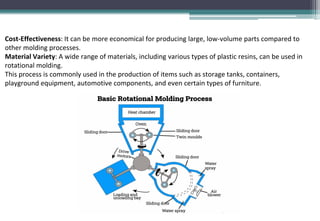
Rotational molding
Rotational molding, also known as rotomolding, is a manufacturing process used for producing hollow
plastic products. It's a versatile technique ideal for creating large, seamless, and complex parts that
are durable and uniform in thickness. Here's a brief overview of how rotational molding works:
Mold Preparation: A hollow mold, usually made of metal, is prepared. It's split into two or more parts
to allow removal of the finished product.
Material Loading: Plastic resin, usually in powdered form, is loaded into the mold. The choice of resin
depends on the desired properties of the final product.
Heating: The mold is slowly rotated in multiple axes within an oven. As the mold rotates, the resin
gradually melts and coats the inner surfaces of the mold, forming a layer.
Cooling: After the resin has completely coated the mold, it is cooled. This can be done by moving the
mold to a cooling chamber or by turning off the heating elements in the oven. Cooling solidifies the
molten resin, forming the desired shape.
Part Removal: Once the part has cooled and solidified, the mold is opened, and the finished product
is removed. Any excess material may need to be trimmed off.
Rotational molding offers several advantages:
Design Flexibility: It allows for the creation of complex shapes and intricate designs without the need
for additional tooling.
Uniform Wall Thickness: The process ensures consistent thickness throughout the part, which is
crucial for structural integrity.
Cost-Effectiveness: It can be more economical for producing large, low-volume parts compared to
other molding processes.
Material Variety: A wide range of materials, including various types of plastic resins, can be used in
rotational molding.
This process is commonly used in the production of items such as storage tanks, containers,
playground equipment, automotive components, and even certain types of furniture.
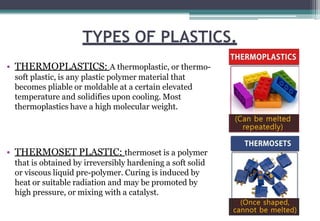
TYPES OF PLASTICS.
• THERMOPLASTICS: A thermoplastic, or thermo-
soft plastic, is any plastic polymer material that
becomes pliable or moldable at a certain elevated
temperature and solidifies upon cooling. Most
thermoplastics have a high molecular weight.
• THERMOSET PLASTIC: thermoset is a polymer
that is obtained by irreversibly hardening a soft solid
or viscous liquid pre-polymer. Curing is induced by
heat or suitable radiation and may be promoted by
high pressure, or mixing with a catalyst.
Acrylic:
Acrylic plastic also known as plexi glass, is a useful, clear material that resembles
glass, but offers better transparency and weighs 50% less than glass of equal
thickness. Acrylic is known as one of the clearest materials, offering a transparency
rate of 93% and can be used in a wide variety of applications.
APPLICATIONS: automotive lights, control knobs, lens, meter cases, pens, hospital
equipments, sign boards, light fittings, skylights, etc.
Polystyrene:
Polystyrene is a versatile plastic used for packaging, insulation, food service items,
disposable utensils, and medical applications. It's lightweight, durable, and insulating.
However, it's criticized for its environmental impact as it's non-biodegradable and
contributes to pollution.
HDP: High density polyethylene plastic is most commonly known and referred to
as HDPE sheet plastic. This thermoplastic is made from a string of ethylene
molecules (hence, the poly part of polyethylene), and is known for being both
lightweight and strong. HDPE is flexible, translucent/waxy, weatherproof, good low
temperature toughness (to -60'C), easy to process by most methods, low cost, good
chemical resistance.
APPLICATIONS: corrugated pipes, containers, toys, buckets, etc.
PVC: Polyvinyl Chloride (PVC) Polyvinyl chloride is a thermoplastics material
which consists of PVC resin compounded with varying proportions of stabilisers,
lubricants, fillers, pigments, plasticisers and processing aids.
APPLICATIONS: pipes, and fittings, toys, foot wares, hand bags, wall coverings, vinyl
sheets, rexine, etc.
PP: Polypropylene (PP) is a tough, rigid, and crystalline thermoplastic. It is made
from propene (or propylene) monomer. This linear hydrocarbon resin is the lightest
polymer among all commodity plastics. PP comes either as a homopolymer or as a
copolymer and can be greatly boosted with additives. Polypropylene (PP)
is considered to be the safest of all plastics, this is a robust plastic that is heat
resistant. Because of its high heat tolerance, Polypropylene is unlikely to leach even
when exposed to warm or hot water. This plastic is approved for use with food and
beverage storage.
APPLICATIONS: carpets, food containers, toys, furniture, pen, etc.
PET: Polyethylene terephthalate, is the most common thermoplastic polymer resin
of the polyester family and is used in fibres for clothing, containers for liquids and
foods, and thermoforming for manufacturing, and in combination with glass fibre for
engineering resins. It is generally considered a “safe” plastic, and does not contain
BPA, in the presence of heat it can leach antimony, a toxic metalloid, into food and
beverages.
APPLICATIONS: mineral oil bottles, edible oil bottles, photographic film, etc.
Fiberglass
Fiberglass is a type of reinforced plastic material made up of extremely fine
fibers of glass. It's known for its strength, durability, and versatility. Fiberglass
is commonly used in a wide range of applications, including construction (for
insulation, roofing, and reinforcement), automotive manufacturing (for car
bodies and components), boat building, aerospace industry (for lightweight
structures), and even in consumer products like surfboards and sporting
equipment. Its properties make it resistant to heat, moisture, and chemicals,
and it can be molded into various shapes and forms, making it an ideal
material for many purposes.
LDP:
LDPE (low density polyethylene) is a soft, flexible, lightweight plastic material.
LDPE is noted for its low temperature flexibility, toughness, and corrosion
resistance.

Sarim Ali Plastic Report template sharing

  • 1.
    TECHNOLOGY FINAL REPORT. NAME:Sarim Ali CLASS: 3RD YEAR, 5THSEMESTER SEAT NO: B1898112 (Improvement) SUBMITTED TO: SIR JAVED
  • 2.
    PLASTICS. Plastic materials arehighly formable materials that are artificially made from organic compounds called polymers, along with additive components. Aside from formability, plastics are generally known to be lightweight, flexible, durable, corrosion-resistant, and cost-effective. Plastic is a material consisting of a wide range of synthetic or semi-synthetic organic compounds that are malleable and, therefore, can be molded into solid objects. Plasticity is the general property of all materials that involves permanent deformation without breaking. POLYMERIZATION: A polymer is a large single chain-like molecule in which the repeating units derived from small molecules called monomers are bound together. The process by which monomers are transformed into a polymer is called polymerisation. For example ethylene polymerizes to form polyethylene. APPLICATION: Product made from polymers are all around us: clothing made from synthetic fibers, polyethylene cups, fiberglass, nylon bearings, plastic bags, polymer- based paints, epoxy glue, polyurethane foam cushion, silicone heart valves, and Teflon-coated cookware.
  • 3.
    PLASTIC MANUFACTURING PROCESSES. INJECTIONMOLDING: Injection molding is a method to obtain molded products by injecting plastic materials molten by heat into a mold, and then cooling and solidifying them. The method is suitable for the mass production of products with complicated shapes, and takes a large part in the area of plastic processing. PROCESS: Injection molding is a process in which a thermoplastic polymer is heated above it’s melting point, resulting in the conversion of the solid polymer into molten fluid with a reasonably low viscosity. This melt is mechanically forced, that is, injected, into a mold in the shape of the desired final object. The low viscosity molten polymer allows complete filling of the mold where the article resides until it is cooled below the freezing point of the polymer. At last, mold is opened and the part is ejected and recovered.
  • 4.
    A mold isa hollow metal block into which molten plastic is injected to from a certain fixed shape. Molds are made out of stainless steel. CNC machines are used to embed texture on mold. Injection molding is a very common process in the production of plastic products. 80% of the products are produced through injection molding. Injection mold consist of 2 parts but broadly are core and cavity.
  • 5.
    INJECTION MOLDING MACHINE:The main parts of the Injection molding machine are material hopper, barrel, an injection ram/ rotating screw type plunger, heating device (heater), movable pattern, ejectors, and a mold inside mold cavity.
  • 6.
  • 7.
    DESIGN CONSIDERATIONS INJECTIONMOLDING: UNDERCUT: Under cut should be avoided as much as possible otherwise a complicated mold maybe required to release the part from the core of the mold. WALL THICKNESS: There are two types of wall thicknesses; 1: product wall thickness 2: mold thickness PRODUCT WALL THICKNESS: Product wall thickness should be maintained. No sharp edges in the mold they must be inclined up to 45degree. MOLD WALL THICKNESS: Mold wall thickness has an indirect relation with the cooling point of the plastic. More the wall thickness, more it wall take time to get cool. It shouldn’t be 90 degree, it won’t be 90 degree. Consideration should be draft. Minimum draft of 1” .
  • 8.
    KNOCK OUT PINS:It works as piston, pins eject the product of mold. They are made up of metal, steel. In all the complicated parts, knockout pins are present. They are located with calculations, so it won’t effect the product.
  • 9.
  • 10.
  • 11.
    Blow molding Blow moldingis a manufacturing process used to produce hollow objects from thermoplastic materials. Here's a brief overview of the process: Extrusion: The process begins with melting down plastic pellets (typically HDPE, LDPE, PP, etc.) and extruding them into a hollow tube, known as a parison. This parison is usually shaped like a test tube and is hot and pliable. Molding: The parison is clamped into a mold cavity, typically made of two halves. One half of the mold is a hollow cavity that mirrors the shape of the final product. The other half is a solid plate that applies pressure to the molten plastic. Blowing: Compressed air is then injected into the parison, causing it to inflate and take the shape of the mold cavity. The air pressure pushes the plastic against the walls of the mold, ensuring that it takes on the desired shape. Cooling: Once the plastic has been blown into the mold cavity and has taken its final shape, it is allowed to cool and harden. Cooling can be done by circulating air or water through the mold. Ejection: After the plastic has cooled and solidified, the mold opens, and the newly formed part is ejected. The excess plastic (known as flash) is trimmed off, and the finished product is inspected for quality. Blow molding is commonly used to manufacture items such as bottles, containers, drums, tanks, and automotive components due to its ability to produce hollow shapes with relatively low cost and high efficiency. There are different variations of blow molding, including extrusion blow molding, injection blow molding, and stretch blow molding, each suited to different types of products and production volumes
  • 13.
    Compression molding Compression moldingis a manufacturing process used to create plastic or composite parts by compressing a material in a heated mold cavity. Here's how it typically works: Preparation: The material to be molded, often in the form of pellets, powder, or preforms, is placed into the mold cavity. Heating: The mold is closed, and heat and pressure are applied to the material. The heat softens the material, making it more pliable and allowing it to conform to the shape of the mold. Compression: Pressure is applied to compress the material within the mold cavity. This compression ensures that the material fills the mold completely and uniformly. Cooling: Once the material has been shaped to the desired form, the mold is cooled to solidify the material. Cooling times vary depending on the material being used and the complexity of the part. Ejection: After the material has cooled and solidified, the mold is opened, and the finished part is ejected. The excess material, called flash, may need to be trimmed off. Compression molding is often used for producing parts with complex geometries, such as automotive components, electrical enclosures, and appliance parts. It offers advantages such as high production rates, low tooling costs (compared to injection molding for some applications), and the ability to mold large parts. However, it may not be suitable for all materials or part designs, and tooling costs can still be significant for complex parts
  • 15.
    Thermoforming molding Thermoforming moldingis a manufacturing process used to shape thermoplastic sheets into specific forms. It's a versatile method commonly employed in industries such as packaging, automotive, aerospace, and healthcare to produce a variety of products like trays, containers, packaging, and even parts for vehicles and aircraft. Here's how thermoforming molding generally works: Heating: A flat thermoplastic sheet, usually made of materials like PVC, PET, polystyrene, or acrylic, is heated until it becomes pliable but not molten. Forming: The heated sheet is then placed over or into a mold. The mold can be of various materials, such as aluminum or composite, and can have a single cavity or multiple cavities depending on the desired product. Vacuum or Pressure: Once the sheet is in place, vacuum or pressure (or a combination of both) is applied to force the sheet to conform to the shape of the mold. This ensures that the thermoplastic material takes on the desired shape and detail. Cooling: After forming, the mold is cooled, either by air or water, to solidify the thermoplastic material and maintain its shape. Trimming: Once the formed part has cooled and solidified, it's removed from the mold and any excess material is trimmed off to achieve the final desired shape. Thermoforming offers several advantages, including relatively low tooling costs compared to injection molding or blow molding, rapid prototyping capabilities, and the ability to produce large parts with complex geometries. However, it may not be as suitable for high-volume production runs compared to other molding processes due to longer cycle times.
  • 17.
    Rotational molding Rotational molding,also known as rotomolding, is a manufacturing process used for producing hollow plastic products. It's a versatile technique ideal for creating large, seamless, and complex parts that are durable and uniform in thickness. Here's a brief overview of how rotational molding works: Mold Preparation: A hollow mold, usually made of metal, is prepared. It's split into two or more parts to allow removal of the finished product. Material Loading: Plastic resin, usually in powdered form, is loaded into the mold. The choice of resin depends on the desired properties of the final product. Heating: The mold is slowly rotated in multiple axes within an oven. As the mold rotates, the resin gradually melts and coats the inner surfaces of the mold, forming a layer. Cooling: After the resin has completely coated the mold, it is cooled. This can be done by moving the mold to a cooling chamber or by turning off the heating elements in the oven. Cooling solidifies the molten resin, forming the desired shape. Part Removal: Once the part has cooled and solidified, the mold is opened, and the finished product is removed. Any excess material may need to be trimmed off. Rotational molding offers several advantages: Design Flexibility: It allows for the creation of complex shapes and intricate designs without the need for additional tooling. Uniform Wall Thickness: The process ensures consistent thickness throughout the part, which is crucial for structural integrity.
  • 18.
    Cost-Effectiveness: It canbe more economical for producing large, low-volume parts compared to other molding processes. Material Variety: A wide range of materials, including various types of plastic resins, can be used in rotational molding. This process is commonly used in the production of items such as storage tanks, containers, playground equipment, automotive components, and even certain types of furniture.
  • 19.
    TYPES OF PLASTICS. •THERMOPLASTICS: A thermoplastic, or thermo- soft plastic, is any plastic polymer material that becomes pliable or moldable at a certain elevated temperature and solidifies upon cooling. Most thermoplastics have a high molecular weight. • THERMOSET PLASTIC: thermoset is a polymer that is obtained by irreversibly hardening a soft solid or viscous liquid pre-polymer. Curing is induced by heat or suitable radiation and may be promoted by high pressure, or mixing with a catalyst.
  • 20.
    Acrylic: Acrylic plastic alsoknown as plexi glass, is a useful, clear material that resembles glass, but offers better transparency and weighs 50% less than glass of equal thickness. Acrylic is known as one of the clearest materials, offering a transparency rate of 93% and can be used in a wide variety of applications. APPLICATIONS: automotive lights, control knobs, lens, meter cases, pens, hospital equipments, sign boards, light fittings, skylights, etc. Polystyrene: Polystyrene is a versatile plastic used for packaging, insulation, food service items, disposable utensils, and medical applications. It's lightweight, durable, and insulating. However, it's criticized for its environmental impact as it's non-biodegradable and contributes to pollution.
  • 21.
    HDP: High densitypolyethylene plastic is most commonly known and referred to as HDPE sheet plastic. This thermoplastic is made from a string of ethylene molecules (hence, the poly part of polyethylene), and is known for being both lightweight and strong. HDPE is flexible, translucent/waxy, weatherproof, good low temperature toughness (to -60'C), easy to process by most methods, low cost, good chemical resistance. APPLICATIONS: corrugated pipes, containers, toys, buckets, etc. PVC: Polyvinyl Chloride (PVC) Polyvinyl chloride is a thermoplastics material which consists of PVC resin compounded with varying proportions of stabilisers, lubricants, fillers, pigments, plasticisers and processing aids. APPLICATIONS: pipes, and fittings, toys, foot wares, hand bags, wall coverings, vinyl sheets, rexine, etc.
  • 22.
    PP: Polypropylene (PP)is a tough, rigid, and crystalline thermoplastic. It is made from propene (or propylene) monomer. This linear hydrocarbon resin is the lightest polymer among all commodity plastics. PP comes either as a homopolymer or as a copolymer and can be greatly boosted with additives. Polypropylene (PP) is considered to be the safest of all plastics, this is a robust plastic that is heat resistant. Because of its high heat tolerance, Polypropylene is unlikely to leach even when exposed to warm or hot water. This plastic is approved for use with food and beverage storage. APPLICATIONS: carpets, food containers, toys, furniture, pen, etc. PET: Polyethylene terephthalate, is the most common thermoplastic polymer resin of the polyester family and is used in fibres for clothing, containers for liquids and foods, and thermoforming for manufacturing, and in combination with glass fibre for engineering resins. It is generally considered a “safe” plastic, and does not contain BPA, in the presence of heat it can leach antimony, a toxic metalloid, into food and beverages. APPLICATIONS: mineral oil bottles, edible oil bottles, photographic film, etc.
  • 23.
    Fiberglass Fiberglass is atype of reinforced plastic material made up of extremely fine fibers of glass. It's known for its strength, durability, and versatility. Fiberglass is commonly used in a wide range of applications, including construction (for insulation, roofing, and reinforcement), automotive manufacturing (for car bodies and components), boat building, aerospace industry (for lightweight structures), and even in consumer products like surfboards and sporting equipment. Its properties make it resistant to heat, moisture, and chemicals, and it can be molded into various shapes and forms, making it an ideal material for many purposes. LDP: LDPE (low density polyethylene) is a soft, flexible, lightweight plastic material. LDPE is noted for its low temperature flexibility, toughness, and corrosion resistance.