“Blow molding, also known as blow forming, is a
manufacturing process by which hollow plastic parts are
formed.”
 It is used to made hollow parts such as plastic bottles.
Process Material
Blow molded parts can be formed from a variety of
thermoplastic materials, including the following:
 Low Density Polyethylene (LDPE)
 High Density Polyethylene (HDPE)
 Polyethylene Terephtalate (PET)
 Polypropylene (PP)
 Polyvinyl Chloride (PVC)
 EXTRUSION BLOW MOLDING.
 INJECTION BLOW MOLDING.
 STRETCH BLOW MOLDING.
COMPNENTS FOR BLOW MOLDING:
6
BASIC PROCESS
TWO MAIN PROCESSES
TO preform (or parison) of hot plastic resin in a
somewhat tubular shape is created.
A pressurized gas, usually air, is used to expand the
hot preform and press it against a mold cavity. The
pressure is held. until the plastic cools.
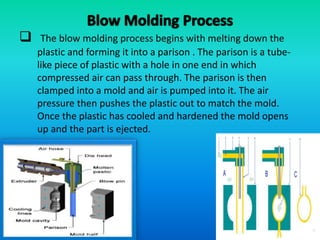
 The blow molding process begins with melting down the
plastic and forming it into a parison . The parison is a tube-
like piece of plastic with a hole in one end in which
compressed air can pass through. The parison is then
clamped into a mold and air is pumped into it. The air
pressure then pushes the plastic out to match the mold.
Once the plastic has cooled and hardened the mold opens
up and the part is ejected.
EXTRUSION BLOW MOLDING:
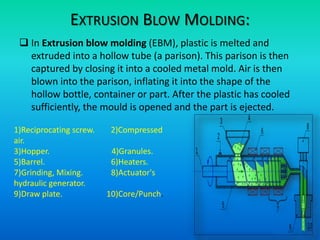
 In Extrusion blow molding (EBM), plastic is melted and
extruded into a hollow tube (a parison). This parison is then
captured by closing it into a cooled metal mold. Air is then
blown into the parison, inflating it into the shape of the
hollow bottle, container or part. After the plastic has cooled
sufficiently, the mould is opened and the part is ejected.
1)Reciprocating screw. 2)Compressed
air.
3)Hopper. 4)Granules.
5)Barrel. 6)Heaters.
7)Grinding, Mixing. 8)Actuator's
hydraulic generator.
9)Draw plate. 10)Core/Punch.
INJECTION BLOW MOLDING
 Injection Stage Molten polymer is injected into a heated preform
mould. The preform is the partly shaped product that will be used to make
the final hollow product by being blown into shape. The preform consists
of a fully formed neck with a thick tube of polymer attached.
 Blowing Stage The preform is passed to the hollow, chilled blow
mould. Compressed air is blown through the core rod into the preform
material, inflating it and forcing it against the sides of the mould.
 Ejection The blow formed polymer is allowed to cool. It is then
removed from the blow mould and stripped off the core rod. The product
then passes to the quality control section and is tested for leaks
Stretch Blow Molding
• In the stretch blow molding (SBM) process, the plastic is first
molded into a "preform" using the injection molding process.
These preforms are produced with the necks of the bottles,
including threads (the "finish") on one end. These preforms
are packaged, and fed later (after cooling) into a reheat
stretch blow moulding machine. In the SBM process, the
preforms are heated (typically using infrared heaters) and
then blown using high pressure air into bottles using metal
blow moulds.
ADVANTAGES:
• Well suited to low and high production rates.
• Quick product revisions for increased flexibility.
• Tooling is less expensive than other molding.
• Each part price is less than Rotational Molding.
• Trim and flash reusable into finished parts.
DISADVANTAGES:
• Environmental Disadvantages effecting.
• Process and Material Limitations.
• Inability to produce bottles with calibrated neck
finishes.
• Machines typically dedicated to a narrow range of
sizes.
• Trimming required
Blow Molding Applications
• Milk bottles
• Pharmaceutical bottles
• Antifreeze bottles
• Polypropylene bottles
• Coliseum seats
• One-piece chair
• Ice chests and coolers
• Double-wall player case
• Garbage cans
• Drums
• Fuel tanks
Tabraiz mold engineering Lahore Pakistan. ( products:
pet blow mold, machine parts, labeling parts)
Thermosole industries (pvt) ltd. Kotlakhpat. (covering
90% of blow molding automotive market in Pakistan)
Kalson engineering in Lahore. (services in mold
making)

Blow molding

  • 3.
    “Blow molding, alsoknown as blow forming, is a manufacturing process by which hollow plastic parts are formed.”  It is used to made hollow parts such as plastic bottles.
  • 4.
    Process Material Blow moldedparts can be formed from a variety of thermoplastic materials, including the following:  Low Density Polyethylene (LDPE)  High Density Polyethylene (HDPE)  Polyethylene Terephtalate (PET)  Polypropylene (PP)  Polyvinyl Chloride (PVC)
  • 5.
     EXTRUSION BLOWMOLDING.  INJECTION BLOW MOLDING.  STRETCH BLOW MOLDING.
  • 6.
  • 7.
    BASIC PROCESS TWO MAINPROCESSES TO preform (or parison) of hot plastic resin in a somewhat tubular shape is created. A pressurized gas, usually air, is used to expand the hot preform and press it against a mold cavity. The pressure is held. until the plastic cools.
  • 8.
     The blowmolding process begins with melting down the plastic and forming it into a parison . The parison is a tube- like piece of plastic with a hole in one end in which compressed air can pass through. The parison is then clamped into a mold and air is pumped into it. The air pressure then pushes the plastic out to match the mold. Once the plastic has cooled and hardened the mold opens up and the part is ejected.
  • 10.
    EXTRUSION BLOW MOLDING: In Extrusion blow molding (EBM), plastic is melted and extruded into a hollow tube (a parison). This parison is then captured by closing it into a cooled metal mold. Air is then blown into the parison, inflating it into the shape of the hollow bottle, container or part. After the plastic has cooled sufficiently, the mould is opened and the part is ejected. 1)Reciprocating screw. 2)Compressed air. 3)Hopper. 4)Granules. 5)Barrel. 6)Heaters. 7)Grinding, Mixing. 8)Actuator's hydraulic generator. 9)Draw plate. 10)Core/Punch.
  • 11.
    INJECTION BLOW MOLDING Injection Stage Molten polymer is injected into a heated preform mould. The preform is the partly shaped product that will be used to make the final hollow product by being blown into shape. The preform consists of a fully formed neck with a thick tube of polymer attached.  Blowing Stage The preform is passed to the hollow, chilled blow mould. Compressed air is blown through the core rod into the preform material, inflating it and forcing it against the sides of the mould.  Ejection The blow formed polymer is allowed to cool. It is then removed from the blow mould and stripped off the core rod. The product then passes to the quality control section and is tested for leaks
  • 12.
    Stretch Blow Molding •In the stretch blow molding (SBM) process, the plastic is first molded into a "preform" using the injection molding process. These preforms are produced with the necks of the bottles, including threads (the "finish") on one end. These preforms are packaged, and fed later (after cooling) into a reheat stretch blow moulding machine. In the SBM process, the preforms are heated (typically using infrared heaters) and then blown using high pressure air into bottles using metal blow moulds.
  • 13.
    ADVANTAGES: • Well suitedto low and high production rates. • Quick product revisions for increased flexibility. • Tooling is less expensive than other molding. • Each part price is less than Rotational Molding. • Trim and flash reusable into finished parts.
  • 14.
    DISADVANTAGES: • Environmental Disadvantageseffecting. • Process and Material Limitations. • Inability to produce bottles with calibrated neck finishes. • Machines typically dedicated to a narrow range of sizes. • Trimming required
  • 15.
    Blow Molding Applications •Milk bottles • Pharmaceutical bottles • Antifreeze bottles • Polypropylene bottles • Coliseum seats • One-piece chair • Ice chests and coolers • Double-wall player case • Garbage cans • Drums • Fuel tanks
  • 16.
    Tabraiz mold engineeringLahore Pakistan. ( products: pet blow mold, machine parts, labeling parts) Thermosole industries (pvt) ltd. Kotlakhpat. (covering 90% of blow molding automotive market in Pakistan) Kalson engineering in Lahore. (services in mold making)