Polymer Processing
There are many processes for plastics. Selection of
  a process depends on many factors including:
- Quantity and production rate
- Dimensional accuracy and surface finish
- Form and detail of the product
- Nature of material
- Size of final product

In general, plastics processes have three phases:
1. Heating - To soften or melt the plastic
2. Shaping / Forming - Under constraint of some kind
3. Cooling - So that it retains its shape
Thermoplastics start as regular pellets or
granules and can be remelted.


Thermosetting materials start as liquids/syrups,
often called "resins", as powders or partially
cured products ("preforms") which need heat for
the shaping phase. The shaping is accompanied
by a chemical reaction, which means that the
material does not soften on reheating. The
reaction may be exothermic (giving heat out), in
which case cooling is required.
Processes
1. Thermoforming
2. Compression and transfer molding
3. Rotational molding and sintering
4. Extrusion
5. Extrusion-based processes
6. Injection molding
7. Blow molding
8. Plastic foam molding
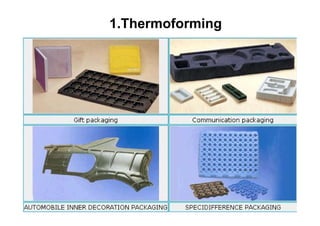
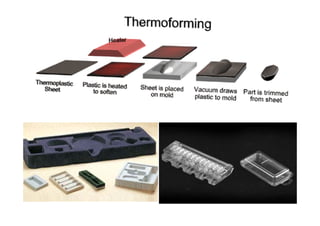
1.Thermoforming
-air pressure and plug
assisted forming of the
softened sheet.
-invariably automated and
faster cycle times
-only thermoplastics sheet
can be processed by this
method.
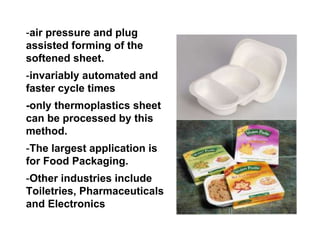
-The largest application is
for Food Packaging.
-Other industries include
Toiletries, Pharmaceuticals
and Electronics
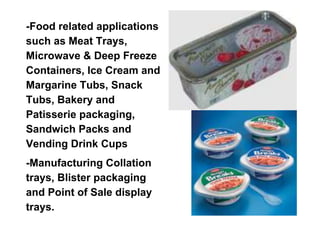
-Food related applications
such as Meat Trays,
Microwave & Deep Freeze
Containers, Ice Cream and
Margarine Tubs, Snack
Tubs, Bakery and
Patisserie packaging,
Sandwich Packs and
Vending Drink Cups
-Manufacturing Collation
trays, Blister packaging
and Point of Sale display
trays.
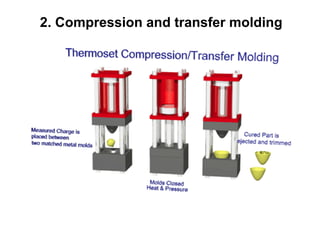
2. Compression and transfer molding
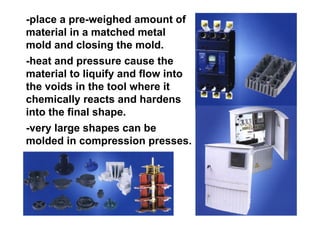
-place a pre-weighed amount of
material in a matched metal
mold and closing the mold.
-heat and pressure cause the
material to liquify and flow into
the voids in the tool where it
chemically reacts and hardens
into the final shape.
-very large shapes can be
molded in compression presses.
Advantages of compression molding (compared
with injection molding)
-Low scrap arisings
-Low orientation in the moldings
  -well distributed fibrous fillers
  -low residual stress product
  -retained mechanical and electrical properties
  -low mold maintenance
  -low capital and tooling costs
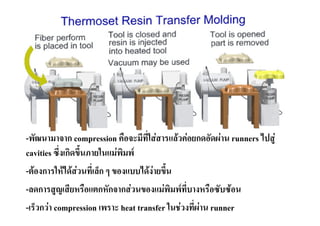
-พัฒนามาจาก compression คือจะมีทใสสารแลวคอยกดอัดผาน runners ไปสู
                                  ี่
cavities ซึ่งเกิดขึ้นภายในแมพมพ
                              ิ
-ตองการใหไดสวนที่เล็ก ๆ ของแบบไดงายขึ้น
-ลดการสูญเสียหรือแตกหักจากสวนของแมพิมพทบางหรือซับซอน
                                          ี่
-เร็วกวา compression เพราะ heat transfer ในชวงทีผาน runner
                                                  ่
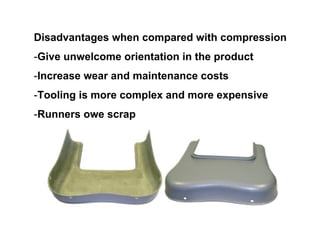
Disadvantages when compared with compression
-Give unwelcome orientation in the product
-Increase wear and maintenance costs
-Tooling is more complex and more expensive
-Runners owe scrap
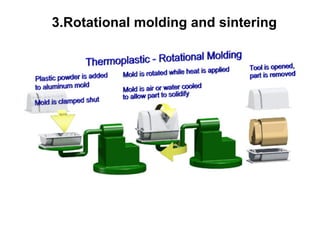
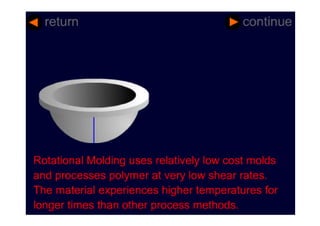
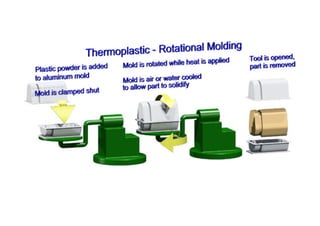
3.Rotational molding and sintering
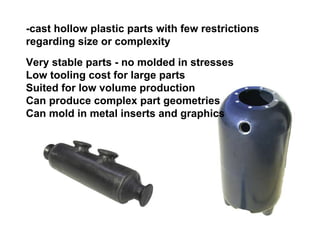
-cast hollow plastic parts with few restrictions
regarding size or complexity
Very stable parts - no molded in stresses
Low tooling cost for large parts
Suited for low volume production
Can produce complex part geometries
Can mold in metal inserts and graphics
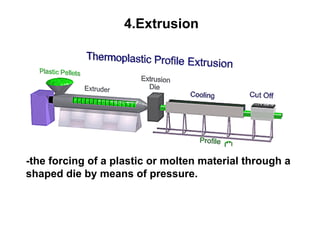
4.Extrusion


-the forcing of a plastic or molten material through a
shaped die by means of pressure.
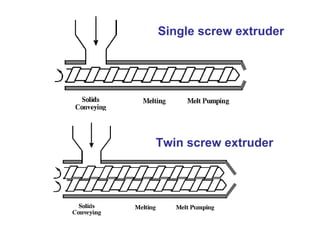
Single screw extruder


Twin screw extruder
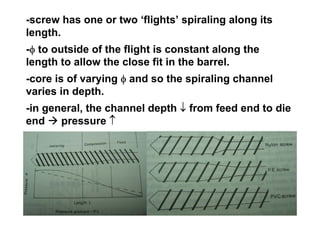
-screw has one or two ‘flights’ spiraling along its
length.
-φ to outside of the flight is constant along the
length to allow the close fit in the barrel.
-core is of varying φ and so the spiraling channel
varies in depth.
-in general, the channel depth ↓ from feed end to die
end    pressure ↑
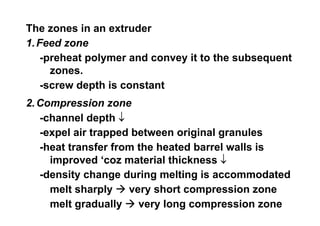
The zones in an extruder
1. Feed zone
    -preheat polymer and convey it to the subsequent
      zones.
    -screw depth is constant
2. Compression zone
   -channel depth ↓
   -expel air trapped between original granules
   -heat transfer from the heated barrel walls is
     improved ‘coz material thickness ↓
   -density change during melting is accommodated
     melt sharply    very short compression zone
     melt gradually    very long compression zone
3.Metering zone
  -constant screw depth
  -homogenize the melt
  -supply to the die region material which is of
     homogeneous quality at constant T & P
4. Die zone
   -breaker plate - screen pack (perforated steel
  plate)
  a) sieve out extraneous material, e.g. ungeled
  polymer, dirt and foreign bodies
  b) allow head P to develop by providing a
         resistance for the pumping action of the
               metering zone
  c) remove ‘turning memory’ from the melt
Flow mechanisms: Conveying
-Drag flow
  -dragging along by the screw of the melt as the
      result of the frictional forces
     -equivalent to viscous drag between stationary and
      moving plates separated by a viscous medium.
    -constitute output component for the extruder.
  -Pressure flow
    -P gradient along the extruder (high P at the output
     end, low at the feed end
-Leak flow
     -finite space between screw and barrel through
     which material can leak backwards.
  Total flow = drag flow – pressure flow – leak flow
The extrusion die
1. Basic flow patterns
     Maintain laminar flow
2. Die entry effects
  Tensile stress exceed the tensile strength of the melt
      extrudate will be of irregular shape
        called melt fracture
The die entrance is tapered:
1. Eliminate the dead spots in the corners,
   maintaining a steady heat and shear history
2. Minimize the development of tensile stresses, and
   minimize distortion of the streamlines
Long die land    extend the process time which
  helps to eliminate memory of earlier processing,
  e.g. screw turning memory
Deborah Number, Ndeb*
Relaxation time – the characteristic timescale for
 which a melt has memory
     -describe as its viscous and elastic responses
 to an applied stress

                       vis cos ity Ns × m      2
   relaxation _ time =            = 2     =s
                       mod ulus m × N
          relaxation _ time _ of _ material , in _ process
N deb   =
                    timescale _ of _ process
If Ndeb>1, process is dominantly elastic.
If Ndeb<1, process is predominantly viscous.
3. Die exit instabilities
  sharkskin
  -roughening of the surface of the extrudate
  -caused by tensile stresses:
      the melt, with max velocity at the center and zero
  at the wall, leaves the die lips
   material at the wall accelerate to the velocity at which
  the extrudate is leaving the die
   generate tensile stress.. If tensile stress exceeds
  tensile strength, surface ruptures.
  orange peel
  -when conditions become more intense, e.g. P at the
  extruder becomes excessive, or the die T drops
  -coarser-grained appearance
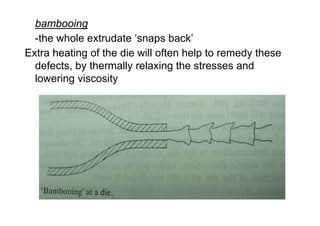
bambooing
  -the whole extrudate ‘snaps back’
Extra heating of the die will often help to remedy these
  defects, by thermally relaxing the stresses and
  lowering viscosity
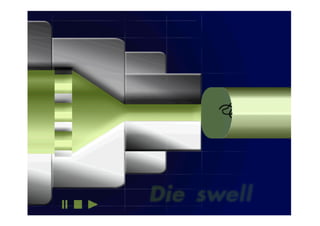
4. Die swell
-Effect in which the polymer swells as it leaves the die.
-Extrudate differs in its dimensions from those of the die
  orifice.
-Extruded rod has larger diameter and pipe has thicker
  walls, e.g. o.d. ↑, i.d. ↓

Result of the elastic component in the overall response
 of the polymer melt to stress.    recovery of the elastic
 deformation as the extrudate leaves the constraint of
 the die channel and before it freezes.
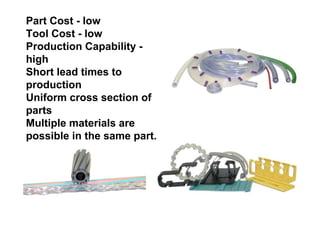
Part Cost - low
Tool Cost - low
Production Capability -
high
Short lead times to
production
Uniform cross section of
parts
Multiple materials are
possible in the same part.
5.Extrusion-based processes

Profile extrusion: pipe, sheet
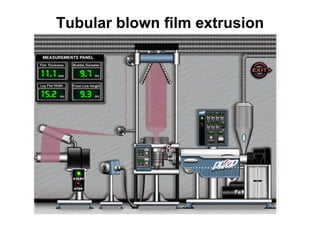
Tubular blown film extrusion: ถุงรอน
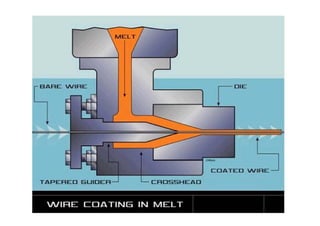
Cross-head extrusion: สายเคเบิ้ล
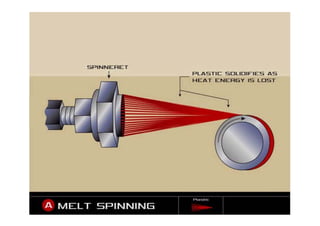
Synthetic fibers: เสนใยสังเคราะห เชน เสนใยโพลิเอสเตอร
Netting: ถุงใสผัก ผลไม
Co-extrusion
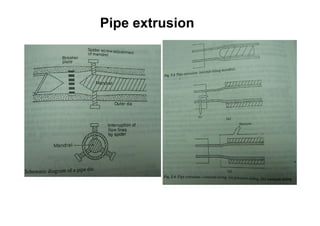
Pipe extrusion
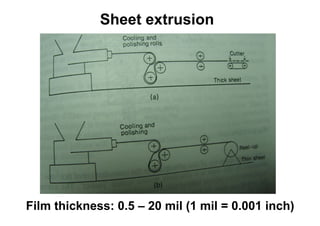
Sheet extrusion


Film thickness: 0.5 – 20 mil (1 mil = 0.001 inch)
Tubular blown film extrusion
Netting
-Garden uses, fruit packaging
-Made with annular dies but with outer die and the
central mandrel counter-rotating and close fitting
-Both parts have slots so that concentric sets of
filaments extrude
-When counter-rotation starts the filaments cross
one another to form welded junctions and a net
pattern.
Co-extrusion
-Extrusion of more than one type of
polymer at once to give a laminate
product.
-Require a separate extruder for each
polymer
-Multilayer product forming at a die
-‘tie-layers’: bond the functional layers
together
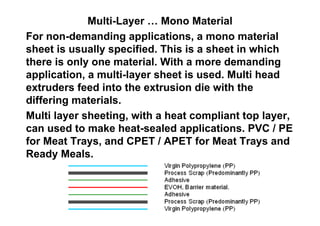
Multi-Layer … Mono Material
For non-demanding applications, a mono material
sheet is usually specified. This is a sheet in which
there is only one material. With a more demanding
application, a multi-layer sheet is used. Multi head
extruders feed into the extrusion die with the
differing materials.
Multi layer sheeting, with a heat compliant top layer,
can used to make heat-sealed applications. PVC / PE
for Meat Trays, and CPET / APET for Meat Trays and
Ready Meals.
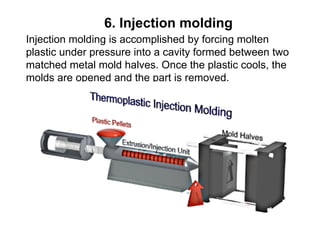
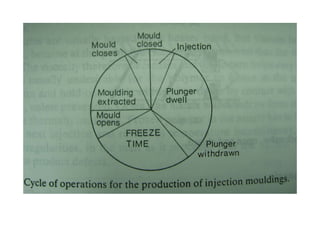
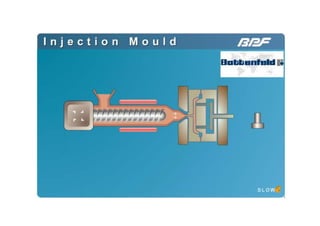
6. Injection molding
Injection molding is accomplished by forcing molten
plastic under pressure into a cavity formed between two
matched metal mold halves. Once the plastic cools, the
molds are opened and the part is removed.
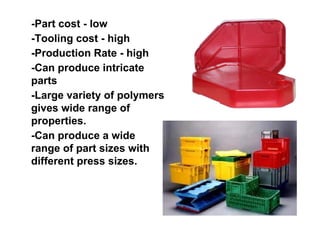
-Part cost - low
-Tooling cost - high
-Production Rate - high
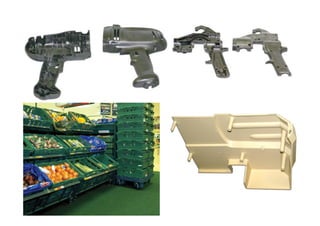
-Can produce intricate
parts
-Large variety of polymers
gives wide range of
properties.
-Can produce a wide
range of part sizes with
different press sizes.
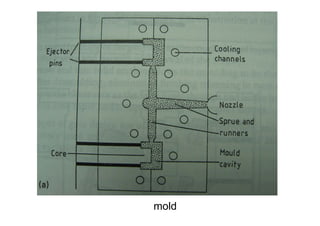
mold
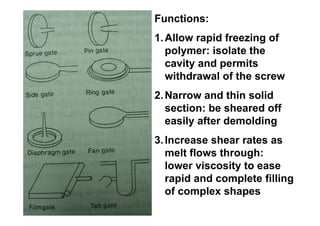
Functions:
1. Allow rapid freezing of
   polymer: isolate the
   cavity and permits
   withdrawal of the screw
2. Narrow and thin solid
   section: be sheared off
   easily after demolding
3. Increase shear rates as
   melt flows through:
   lower viscosity to ease
   rapid and complete filling
   of complex shapes
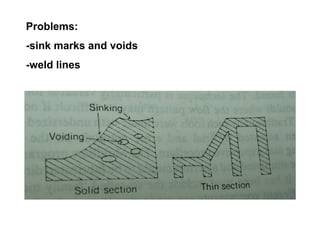
Problems:
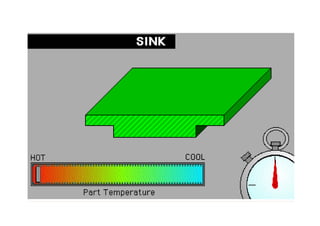
-sink marks and voids
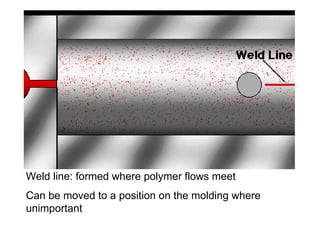
-weld lines
Weld line: formed where polymer flows meet
Can be moved to a position on the molding where
unimportant
7. Blow molding
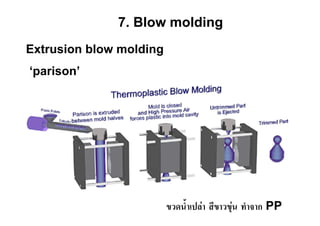
Extrusion blow molding
‘parison’


                         ขวดน้ําเปลา สีขาวขุน ทําจาก PP
Extrusion blow molding
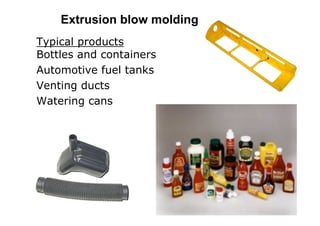
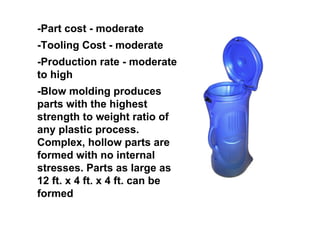
Typical products
Bottles and containers
Automotive fuel tanks
Venting ducts
Watering cans
-Part cost - moderate
-Tooling Cost - moderate
-Production rate - moderate
to high
-Blow molding produces
parts with the highest
strength to weight ratio of
any plastic process.
Complex, hollow parts are
formed with no internal
stresses. Parts as large as
12 ft. x 4 ft. x 4 ft. can be
formed
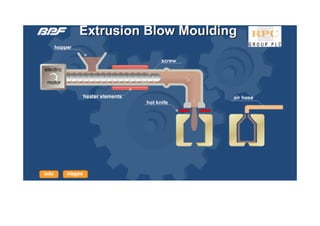
Stages
1. The hot plastic extruded into the mold in pipe form.
2. While still hot, the plastic is trapped in the mold, a
hot knife cuts it off at the top and it is also pinched at
the bottom.
3. The mold then moves to the right. An air hose is
inserted into the top.
4. The plastic in the mold expands to fill the mold.
5. The mold then separates, which releases the plastic
(bottle).
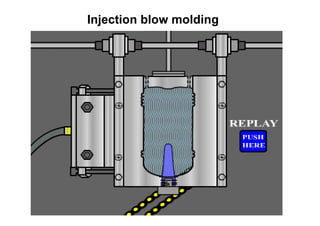
Injection blow molding

Carbonated drinks     using PET
The tube   ‘preform’ made by injection molding to a
very cold mold to quench it in its amorphous state
Is reheated to blowing T (just about its Tg ) and
stretch blown
Develop biaxial orientation in the product
Alternate name for this process is ‘stretch-blow’
Injection blow molding
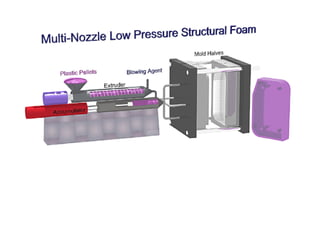
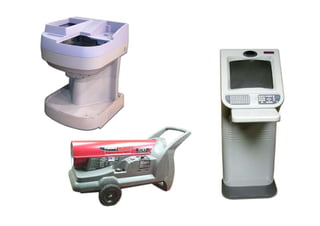
8.Plastic foam molding
-low-pressure injection molding process that is
capable of producing very large structural parts.
-The molten plastic material is injected into a mold
after being mixed with a blowing agent or high-
pressure gas.
-This produces bubbles in the plastic causing it to
foam. The foam retains the properties of the plastic
but weighs less because of reduced density.
Processing polymer
Processing polymer

Processing polymer

  • 1.
    Polymer Processing There aremany processes for plastics. Selection of a process depends on many factors including: - Quantity and production rate - Dimensional accuracy and surface finish - Form and detail of the product - Nature of material - Size of final product In general, plastics processes have three phases: 1. Heating - To soften or melt the plastic 2. Shaping / Forming - Under constraint of some kind 3. Cooling - So that it retains its shape
  • 2.
    Thermoplastics start asregular pellets or granules and can be remelted. Thermosetting materials start as liquids/syrups, often called "resins", as powders or partially cured products ("preforms") which need heat for the shaping phase. The shaping is accompanied by a chemical reaction, which means that the material does not soften on reheating. The reaction may be exothermic (giving heat out), in which case cooling is required.
  • 3.
    Processes 1. Thermoforming 2. Compressionand transfer molding 3. Rotational molding and sintering 4. Extrusion 5. Extrusion-based processes 6. Injection molding 7. Blow molding 8. Plastic foam molding
  • 4.
  • 6.
    -air pressure andplug assisted forming of the softened sheet. -invariably automated and faster cycle times -only thermoplastics sheet can be processed by this method. -The largest application is for Food Packaging. -Other industries include Toiletries, Pharmaceuticals and Electronics
  • 7.
    -Food related applications suchas Meat Trays, Microwave & Deep Freeze Containers, Ice Cream and Margarine Tubs, Snack Tubs, Bakery and Patisserie packaging, Sandwich Packs and Vending Drink Cups -Manufacturing Collation trays, Blister packaging and Point of Sale display trays.
  • 8.
    2. Compression andtransfer molding
  • 9.
    -place a pre-weighedamount of material in a matched metal mold and closing the mold. -heat and pressure cause the material to liquify and flow into the voids in the tool where it chemically reacts and hardens into the final shape. -very large shapes can be molded in compression presses.
  • 10.
    Advantages of compressionmolding (compared with injection molding) -Low scrap arisings -Low orientation in the moldings -well distributed fibrous fillers -low residual stress product -retained mechanical and electrical properties -low mold maintenance -low capital and tooling costs
  • 11.
    -พัฒนามาจาก compression คือจะมีทใสสารแลวคอยกดอัดผานrunners ไปสู ี่ cavities ซึ่งเกิดขึ้นภายในแมพมพ ิ -ตองการใหไดสวนที่เล็ก ๆ ของแบบไดงายขึ้น -ลดการสูญเสียหรือแตกหักจากสวนของแมพิมพทบางหรือซับซอน ี่ -เร็วกวา compression เพราะ heat transfer ในชวงทีผาน runner ่
  • 12.
    Disadvantages when comparedwith compression -Give unwelcome orientation in the product -Increase wear and maintenance costs -Tooling is more complex and more expensive -Runners owe scrap
  • 13.
  • 14.
    -cast hollow plasticparts with few restrictions regarding size or complexity Very stable parts - no molded in stresses Low tooling cost for large parts Suited for low volume production Can produce complex part geometries Can mold in metal inserts and graphics
  • 17.
    4.Extrusion -the forcing ofa plastic or molten material through a shaped die by means of pressure.
  • 18.
  • 19.
    -screw has oneor two ‘flights’ spiraling along its length. -φ to outside of the flight is constant along the length to allow the close fit in the barrel. -core is of varying φ and so the spiraling channel varies in depth. -in general, the channel depth ↓ from feed end to die end pressure ↑
  • 20.
    The zones inan extruder 1. Feed zone -preheat polymer and convey it to the subsequent zones. -screw depth is constant 2. Compression zone -channel depth ↓ -expel air trapped between original granules -heat transfer from the heated barrel walls is improved ‘coz material thickness ↓ -density change during melting is accommodated melt sharply very short compression zone melt gradually very long compression zone
  • 21.
    3.Metering zone -constant screw depth -homogenize the melt -supply to the die region material which is of homogeneous quality at constant T & P 4. Die zone -breaker plate - screen pack (perforated steel plate) a) sieve out extraneous material, e.g. ungeled polymer, dirt and foreign bodies b) allow head P to develop by providing a resistance for the pumping action of the metering zone c) remove ‘turning memory’ from the melt
  • 22.
    Flow mechanisms: Conveying -Dragflow -dragging along by the screw of the melt as the result of the frictional forces -equivalent to viscous drag between stationary and moving plates separated by a viscous medium. -constitute output component for the extruder. -Pressure flow -P gradient along the extruder (high P at the output end, low at the feed end -Leak flow -finite space between screw and barrel through which material can leak backwards. Total flow = drag flow – pressure flow – leak flow
  • 23.
    The extrusion die 1.Basic flow patterns Maintain laminar flow 2. Die entry effects Tensile stress exceed the tensile strength of the melt extrudate will be of irregular shape called melt fracture
  • 24.
    The die entranceis tapered: 1. Eliminate the dead spots in the corners, maintaining a steady heat and shear history 2. Minimize the development of tensile stresses, and minimize distortion of the streamlines Long die land extend the process time which helps to eliminate memory of earlier processing, e.g. screw turning memory Deborah Number, Ndeb*
  • 25.
    Relaxation time –the characteristic timescale for which a melt has memory -describe as its viscous and elastic responses to an applied stress vis cos ity Ns × m 2 relaxation _ time = = 2 =s mod ulus m × N relaxation _ time _ of _ material , in _ process N deb = timescale _ of _ process If Ndeb>1, process is dominantly elastic. If Ndeb<1, process is predominantly viscous.
  • 26.
    3. Die exitinstabilities sharkskin -roughening of the surface of the extrudate -caused by tensile stresses: the melt, with max velocity at the center and zero at the wall, leaves the die lips material at the wall accelerate to the velocity at which the extrudate is leaving the die generate tensile stress.. If tensile stress exceeds tensile strength, surface ruptures. orange peel -when conditions become more intense, e.g. P at the extruder becomes excessive, or the die T drops -coarser-grained appearance
  • 27.
    bambooing -thewhole extrudate ‘snaps back’ Extra heating of the die will often help to remedy these defects, by thermally relaxing the stresses and lowering viscosity
  • 28.
    4. Die swell -Effectin which the polymer swells as it leaves the die. -Extrudate differs in its dimensions from those of the die orifice. -Extruded rod has larger diameter and pipe has thicker walls, e.g. o.d. ↑, i.d. ↓ Result of the elastic component in the overall response of the polymer melt to stress. recovery of the elastic deformation as the extrudate leaves the constraint of the die channel and before it freezes.
  • 30.
    Part Cost -low Tool Cost - low Production Capability - high Short lead times to production Uniform cross section of parts Multiple materials are possible in the same part.
  • 31.
    5.Extrusion-based processes Profile extrusion:pipe, sheet Tubular blown film extrusion: ถุงรอน Cross-head extrusion: สายเคเบิ้ล Synthetic fibers: เสนใยสังเคราะห เชน เสนใยโพลิเอสเตอร Netting: ถุงใสผัก ผลไม Co-extrusion
  • 32.
  • 33.
    Sheet extrusion Film thickness:0.5 – 20 mil (1 mil = 0.001 inch)
  • 34.
  • 38.
    Netting -Garden uses, fruitpackaging -Made with annular dies but with outer die and the central mandrel counter-rotating and close fitting -Both parts have slots so that concentric sets of filaments extrude -When counter-rotation starts the filaments cross one another to form welded junctions and a net pattern.
  • 39.
    Co-extrusion -Extrusion of morethan one type of polymer at once to give a laminate product. -Require a separate extruder for each polymer -Multilayer product forming at a die -‘tie-layers’: bond the functional layers together
  • 40.
    Multi-Layer … MonoMaterial For non-demanding applications, a mono material sheet is usually specified. This is a sheet in which there is only one material. With a more demanding application, a multi-layer sheet is used. Multi head extruders feed into the extrusion die with the differing materials. Multi layer sheeting, with a heat compliant top layer, can used to make heat-sealed applications. PVC / PE for Meat Trays, and CPET / APET for Meat Trays and Ready Meals.
  • 41.
    6. Injection molding Injectionmolding is accomplished by forcing molten plastic under pressure into a cavity formed between two matched metal mold halves. Once the plastic cools, the molds are opened and the part is removed.
  • 42.
    -Part cost -low -Tooling cost - high -Production Rate - high -Can produce intricate parts -Large variety of polymers gives wide range of properties. -Can produce a wide range of part sizes with different press sizes.
  • 44.
  • 45.
    Functions: 1. Allow rapidfreezing of polymer: isolate the cavity and permits withdrawal of the screw 2. Narrow and thin solid section: be sheared off easily after demolding 3. Increase shear rates as melt flows through: lower viscosity to ease rapid and complete filling of complex shapes
  • 48.
    Problems: -sink marks andvoids -weld lines
  • 50.
    Weld line: formedwhere polymer flows meet Can be moved to a position on the molding where unimportant
  • 51.
    7. Blow molding Extrusionblow molding ‘parison’ ขวดน้ําเปลา สีขาวขุน ทําจาก PP
  • 52.
    Extrusion blow molding Typicalproducts Bottles and containers Automotive fuel tanks Venting ducts Watering cans
  • 53.
    -Part cost -moderate -Tooling Cost - moderate -Production rate - moderate to high -Blow molding produces parts with the highest strength to weight ratio of any plastic process. Complex, hollow parts are formed with no internal stresses. Parts as large as 12 ft. x 4 ft. x 4 ft. can be formed
  • 54.
    Stages 1. The hotplastic extruded into the mold in pipe form. 2. While still hot, the plastic is trapped in the mold, a hot knife cuts it off at the top and it is also pinched at the bottom. 3. The mold then moves to the right. An air hose is inserted into the top. 4. The plastic in the mold expands to fill the mold. 5. The mold then separates, which releases the plastic (bottle).
  • 56.
    Injection blow molding Carbonateddrinks using PET The tube ‘preform’ made by injection molding to a very cold mold to quench it in its amorphous state Is reheated to blowing T (just about its Tg ) and stretch blown Develop biaxial orientation in the product Alternate name for this process is ‘stretch-blow’
  • 57.
  • 58.
    8.Plastic foam molding -low-pressureinjection molding process that is capable of producing very large structural parts. -The molten plastic material is injected into a mold after being mixed with a blowing agent or high- pressure gas. -This produces bubbles in the plastic causing it to foam. The foam retains the properties of the plastic but weighs less because of reduced density.