Design of Multiobjective Equivalent Accelerated Life Testing Plans Zhaojun (Steven) Li,  Ph.D. Candidate Industrial and Systems Engineering Department University of Washington
Background Education Ph.D. Candidate, August, 2010 – Present, UW Ph.D. Student at Wichita State University, August, 2005- July 2008 M.S. Business Management, Tianjin University, Feb. 2004 B.S. Materials Science & Engineering, Daliao Jiaotong University, Jul. 1999 Professional Experiences Manager, Shanghai Sany Heavy Industry Co., Ltd, Shanghai, China, 02/2004 – 05/2005 R&D engineer, Tianjin Locomotive & Vehicle Company, Tianjin, China, 07/1999 – 07/2001
Outline Introduction Research Procedure Theory of Equivalent ALT plans  Application of Equivalent ALT plans Algorithm for Multi-objective Decision making Solutions Classification Solutions Reduction Conclusion and Discussion Relationship to the Research at IHME
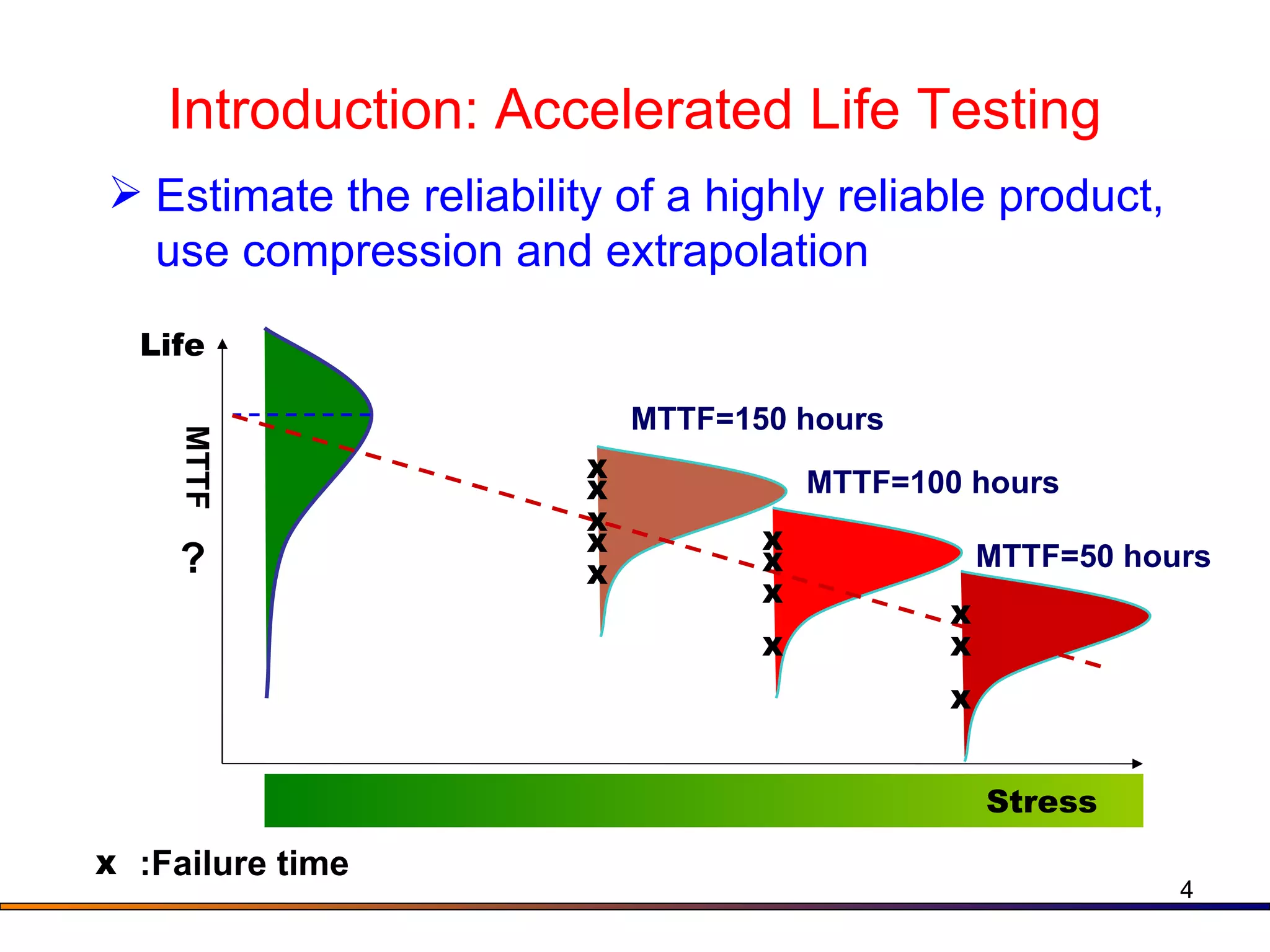
Introduction: Accelerated Life Testing Estimate the reliability of a highly reliable product, use compression and extrapolation Life Stress ? X :Failure time MTTF=50 hours MTTF=100 hours MTTF=150 hours MTTF X X X X X X X X X X X X
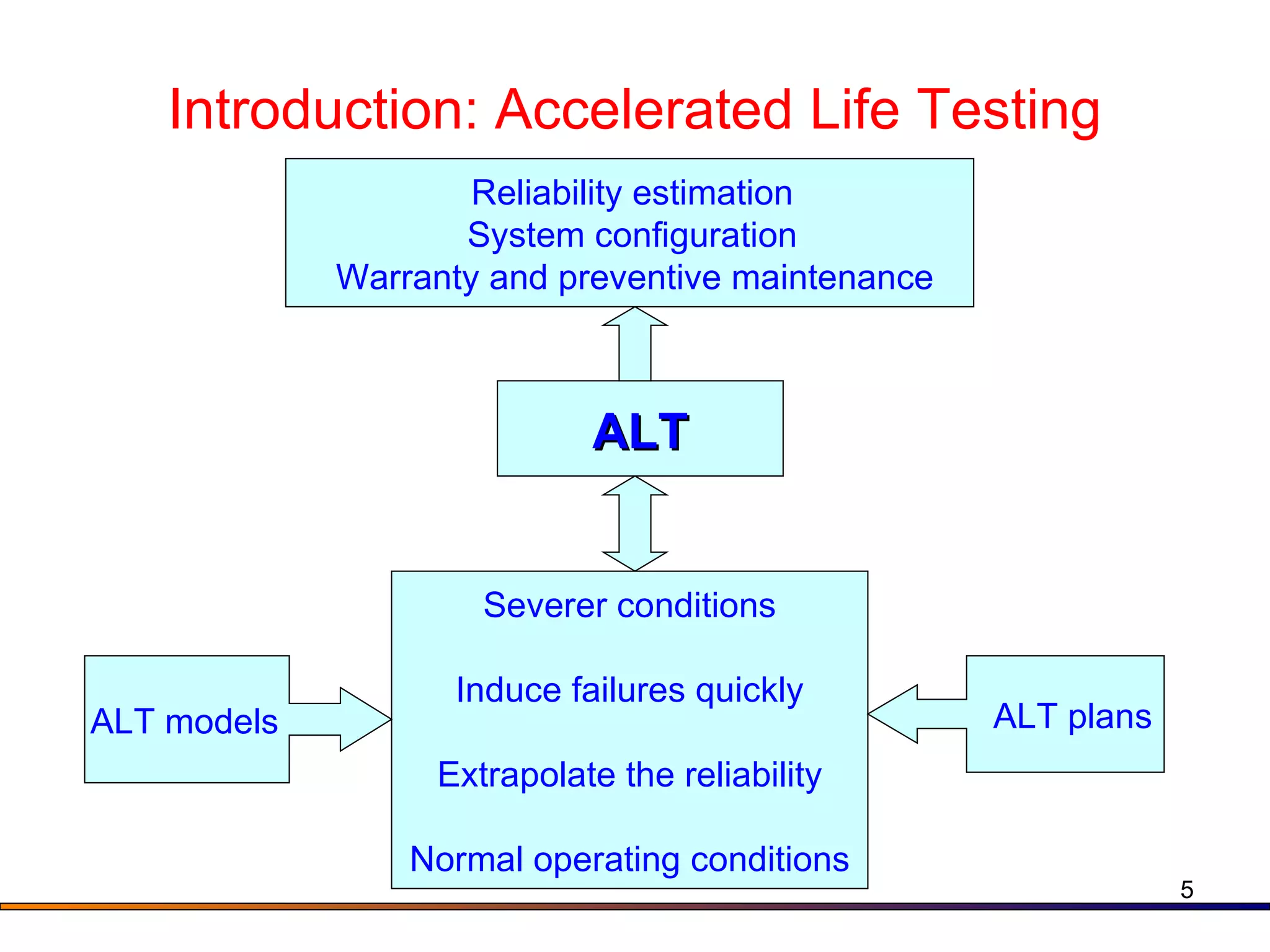
Introduction: Accelerated Life Testing Reliability estimation  System configuration  Warranty and preventive maintenance   ALT Severer conditions Induce failures quickly Extrapolate the reliability Normal operating conditions ALT models  ALT plans
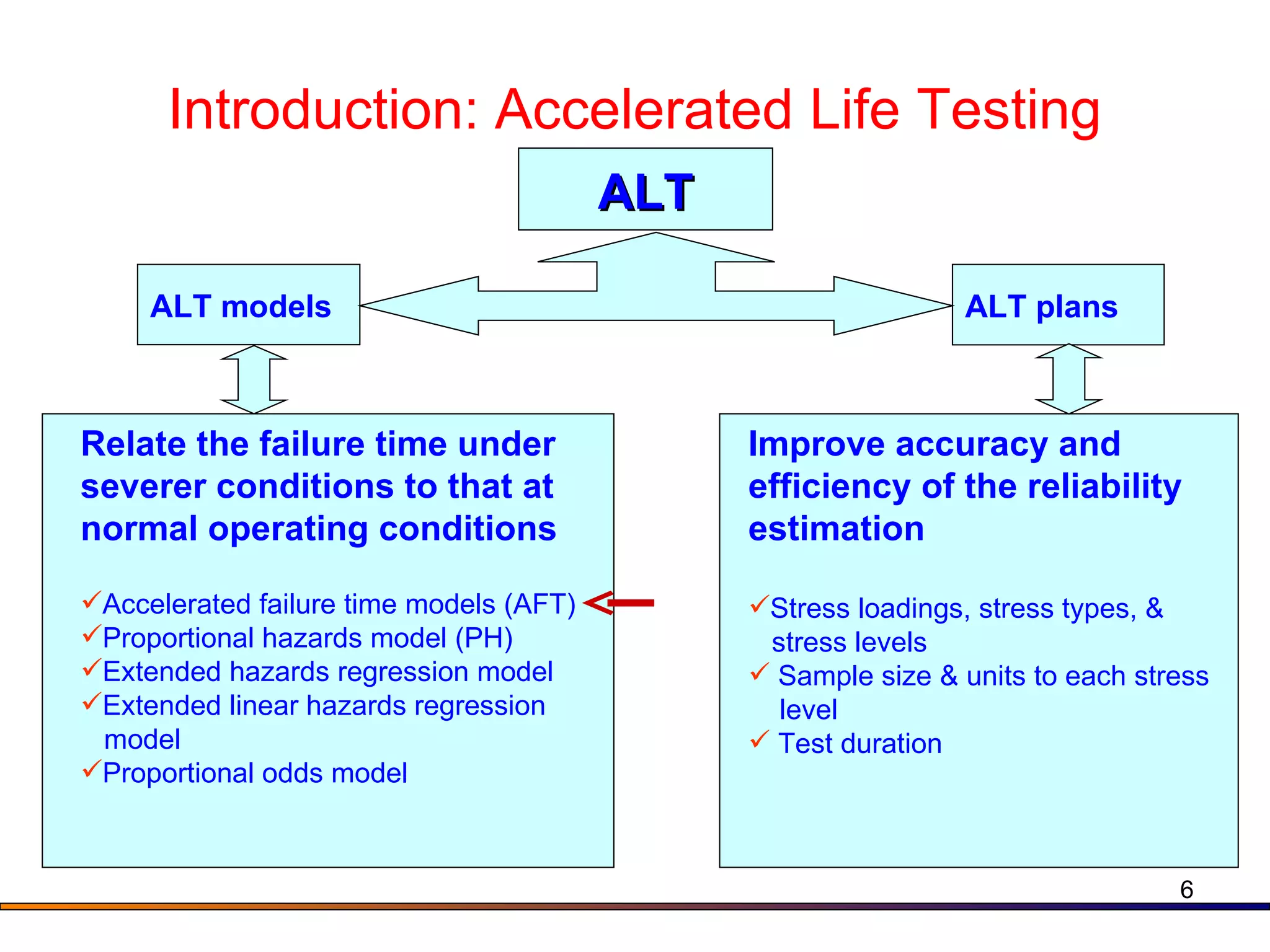
Introduction: Accelerated Life Testing ALT ALT models Relate the failure time under severer conditions to that at normal operating conditions Accelerated failure time models (AFT) Proportional hazards model (PH) Extended hazards regression model Extended linear hazards regression  model  Proportional odds model ALT plans Improve accuracy and efficiency of the reliability estimation Stress loadings, stress types, &  stress levels Sample size & units to each stress level Test duration
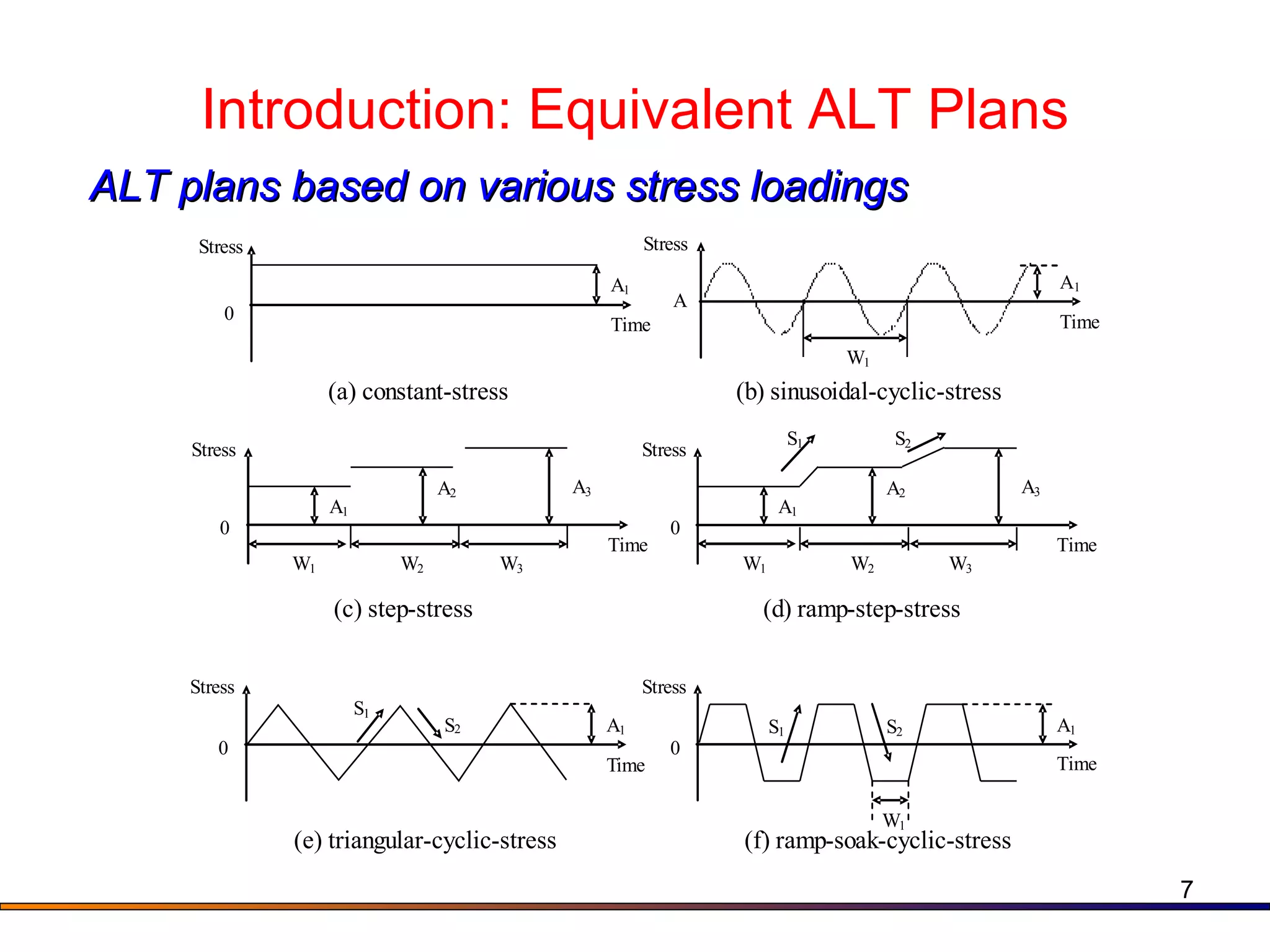
Introduction: Equivalent ALT Plans ALT plans based on various stress loadings
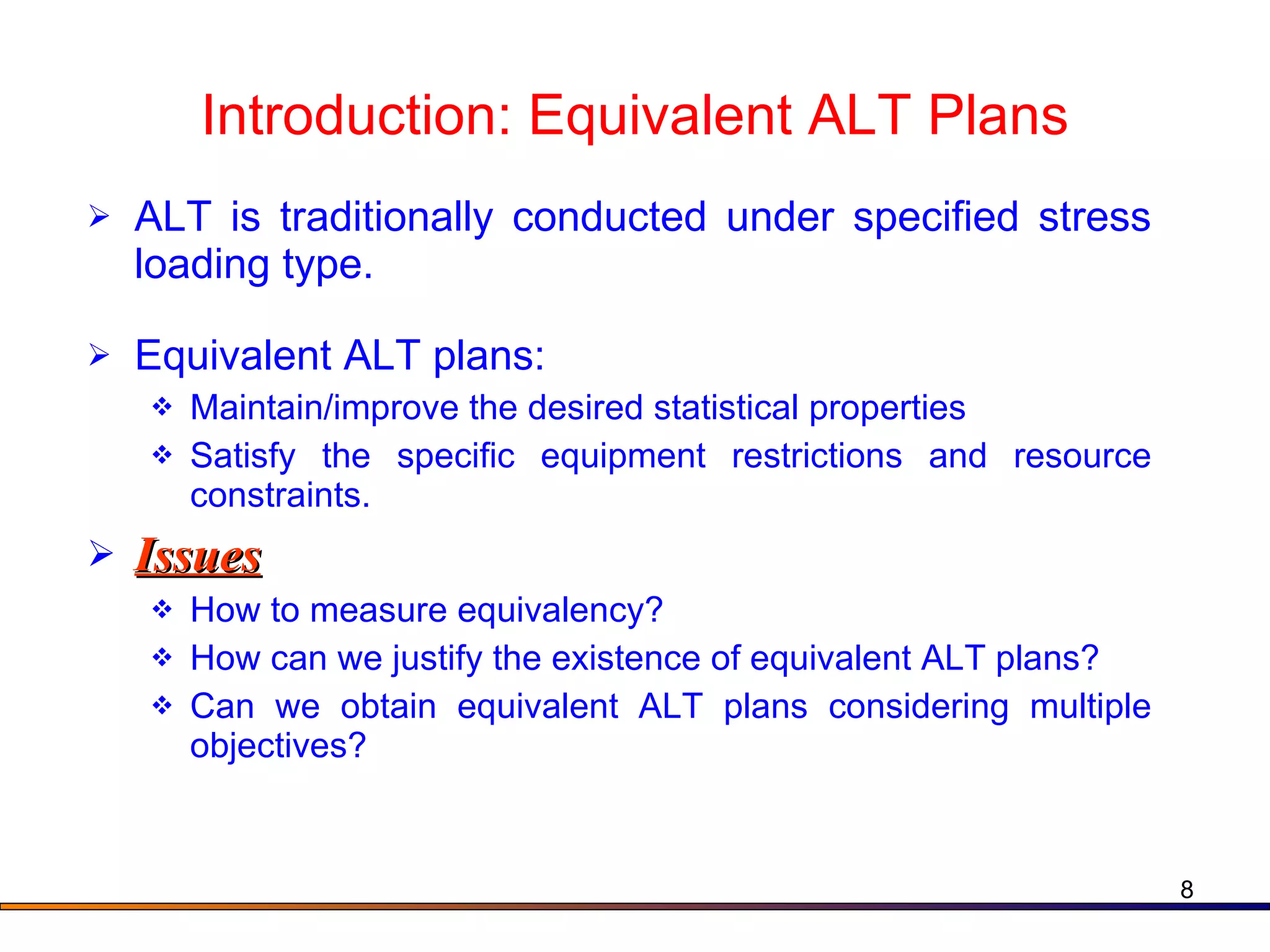
Introduction: Equivalent ALT Plans ALT is traditionally conducted under specified stress loading type.  Equivalent ALT plans: Maintain/improve the desired statistical properties Satisfy the specific equipment restrictions and resource constraints. Issues How to measure equivalency?  How can we justify the existence of equivalent ALT plans? Can we obtain equivalent ALT plans considering multiple objectives?
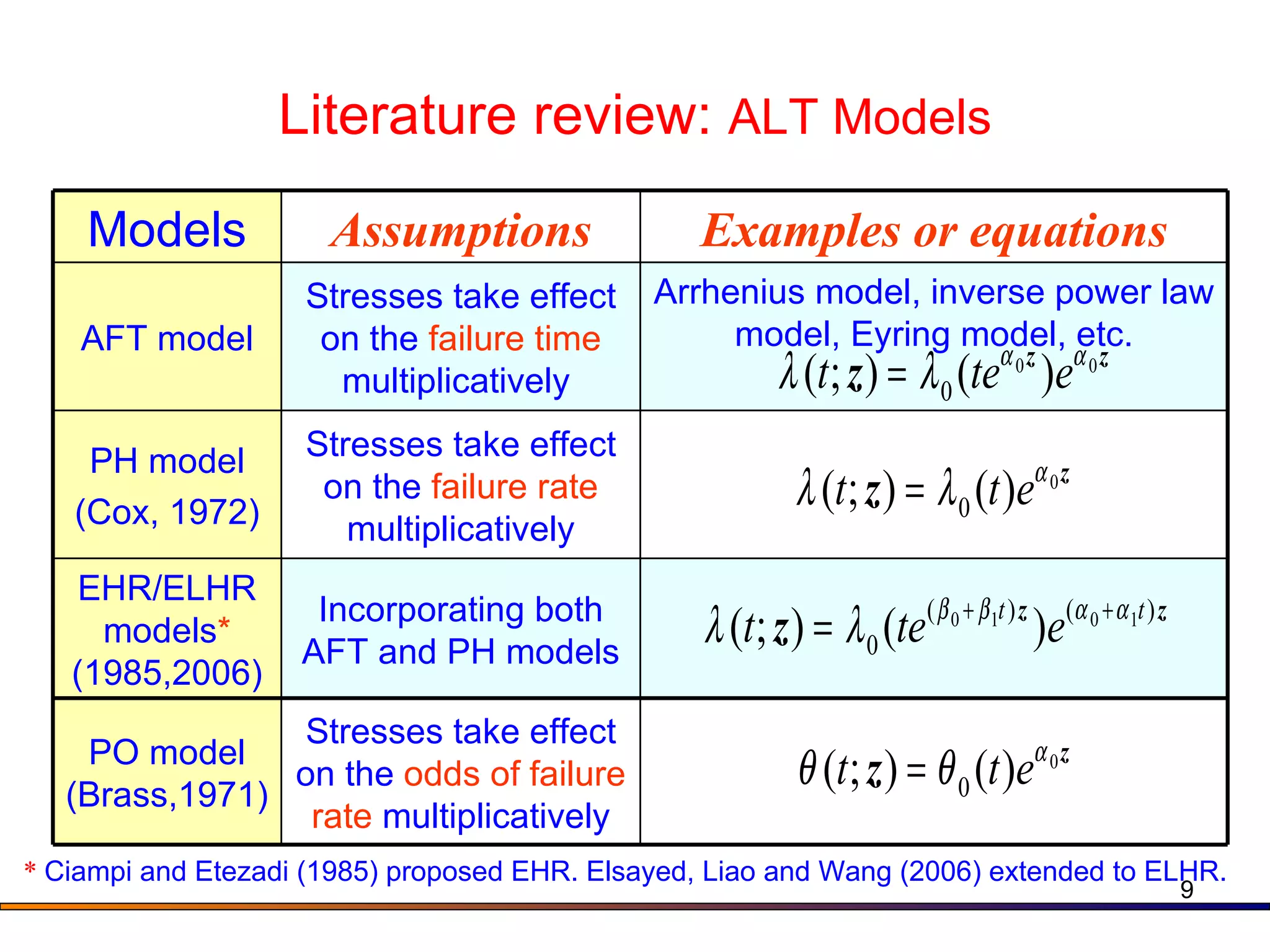
Literature review:  ALT Models *  Ciampi and Etezadi (1985) proposed EHR. Elsayed, Liao and Wang (2006) extended to ELHR. Models Assumptions Examples or equations AFT model Stresses take effect on the  failure time  multiplicatively   Arrhenius model, inverse power law model, Eyring model, etc. PH model ( Cox, 1972 ) Stresses take effect on the  failure rate  multiplicatively EHR/ELHR models *  (1985,2006) Incorporating both AFT and PH models PO model (Brass, 1971 ) Stresses take effect on the  odds of failure rate  multiplicatively
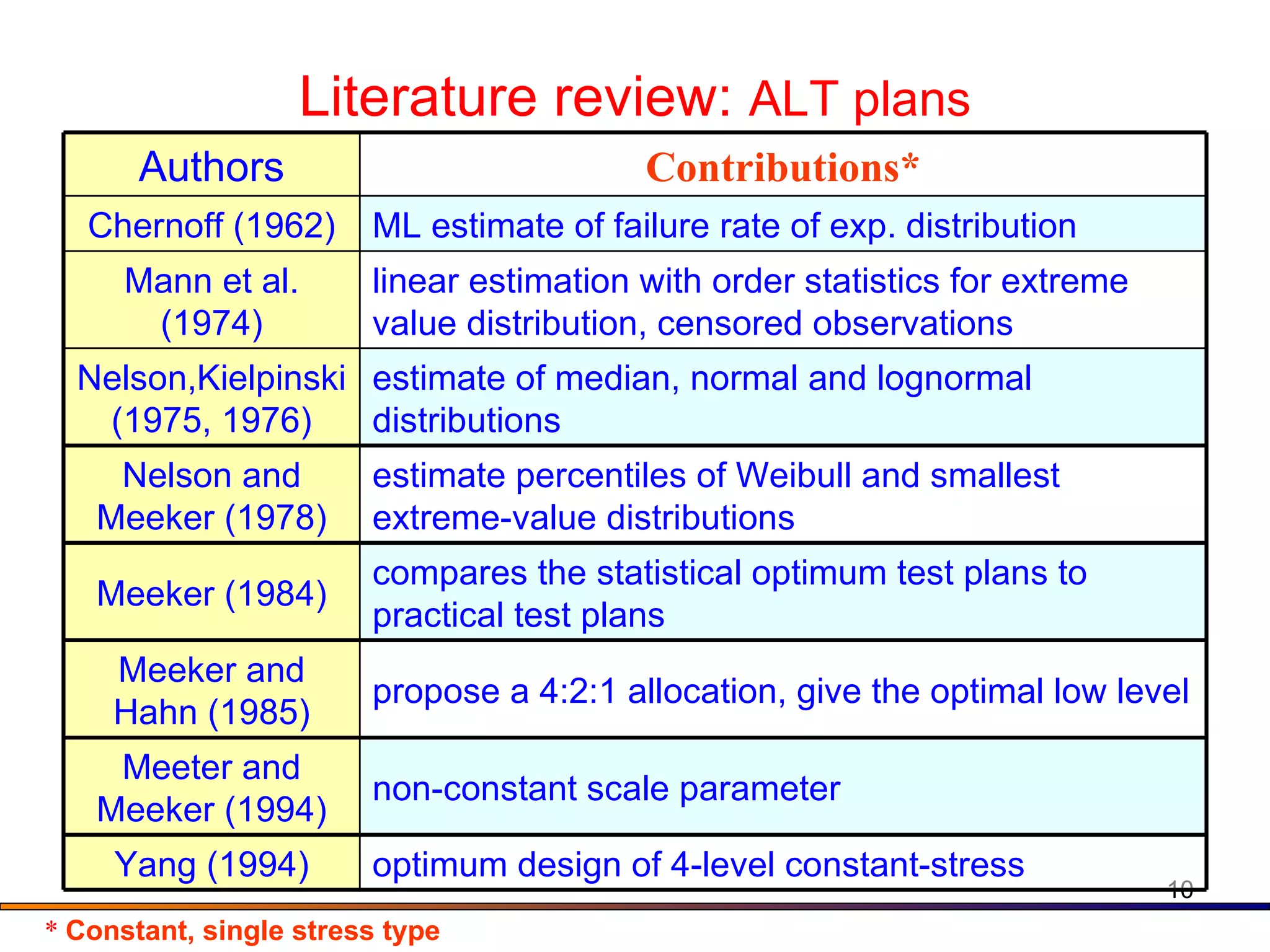
Literature review:  ALT plans *  Constant, single stress type Authors Contributions* Chernoff (1962) ML estimate of failure rate of exp. distribution Mann et al. (1974) linear estimation with order statistics for extreme value distribution, censored observations Nelson,Kielpinski (1975, 1976) estimate of median, normal and lognormal distributions Nelson and Meeker (1978) estimate percentiles of Weibull and smallest extreme-value distributions Meeker (1984) compares the statistical optimum test plans to practical test plans Meeker and Hahn (1985) propose a 4:2:1 allocation, give the optimal low level  Meeter and Meeker (1994) non-constant scale parameter Yang (1994) optimum design of 4-level constant-stress
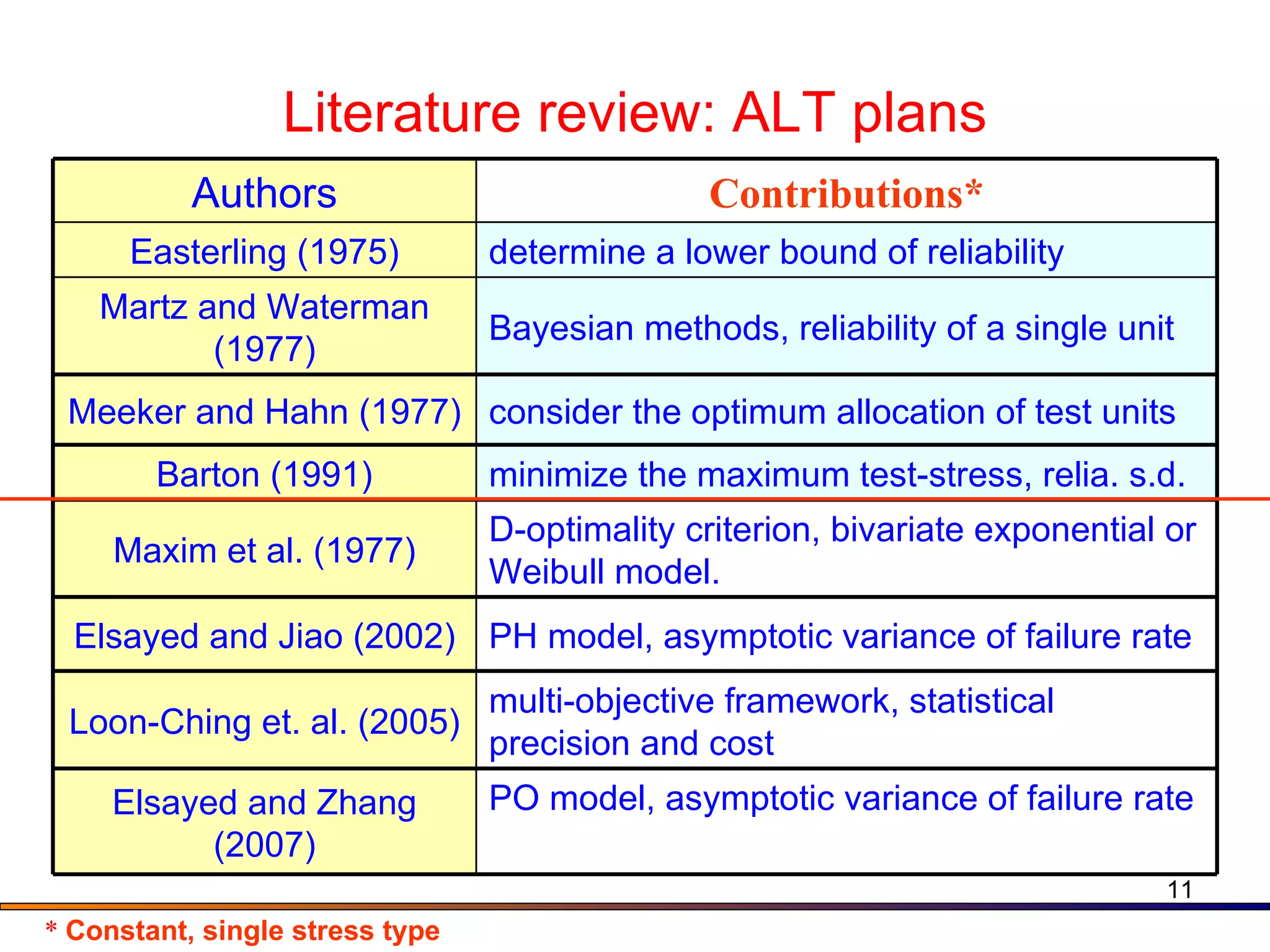
Literature review: ALT plans *  Constant, single stress type Authors Contributions* Easterling (1975) determine a lower bound of reliability Martz and Waterman (1977) Bayesian methods, reliability of a single unit Meeker and Hahn (1977) consider the optimum allocation of test units Barton (1991) minimize the maximum test-stress, relia. s.d.  Maxim et al. (1977) D-optimality criterion, bivariate exponential or Weibull model. Elsayed and Jiao (2002) PH model, asymptotic variance of failure rate Loon-Ching et. al. (2005) multi-objective framework, statistical precision and cost Elsayed and Zhang (2007) PO model, asymptotic variance of failure rate
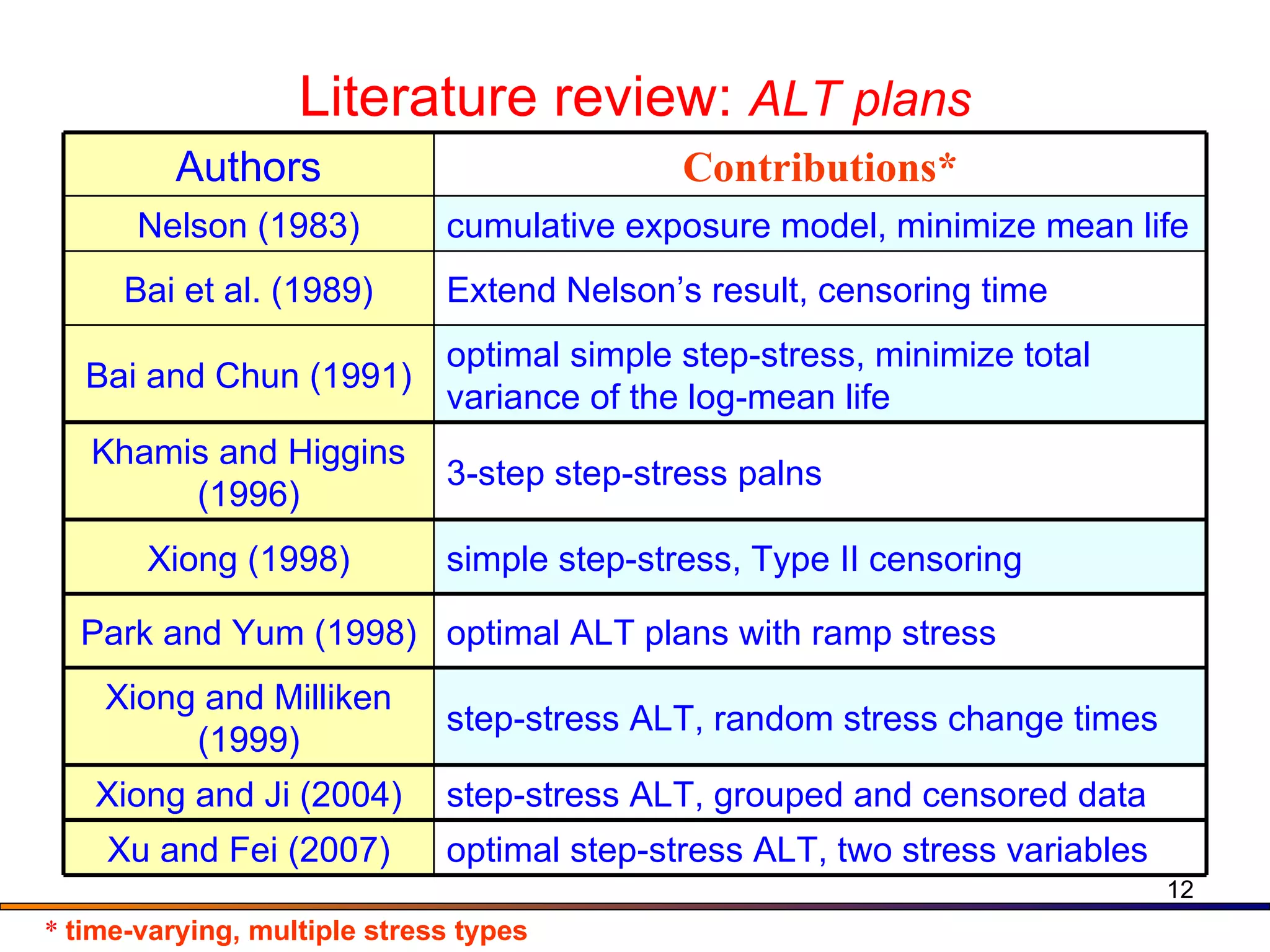
Literature review:  ALT plans *  time-varying, multiple stress types Authors Contributions* Nelson (1983) cumulative exposure model, minimize mean life Bai et al. (1989) Extend Nelson’s result, censoring time Bai and Chun (1991) optimal simple step-stress, minimize total variance of the log-mean life  Khamis and Higgins (1996) 3-step step-stress palns Xiong (1998) simple step-stress, Type II censoring Park and Yum (1998) optimal ALT plans with ramp stress  Xiong and Milliken (1999) step-stress ALT, random stress change times Xiong and Ji (2004) step-stress ALT, grouped and censored data Xu and Fei (2007) optimal step-stress ALT, two stress variables
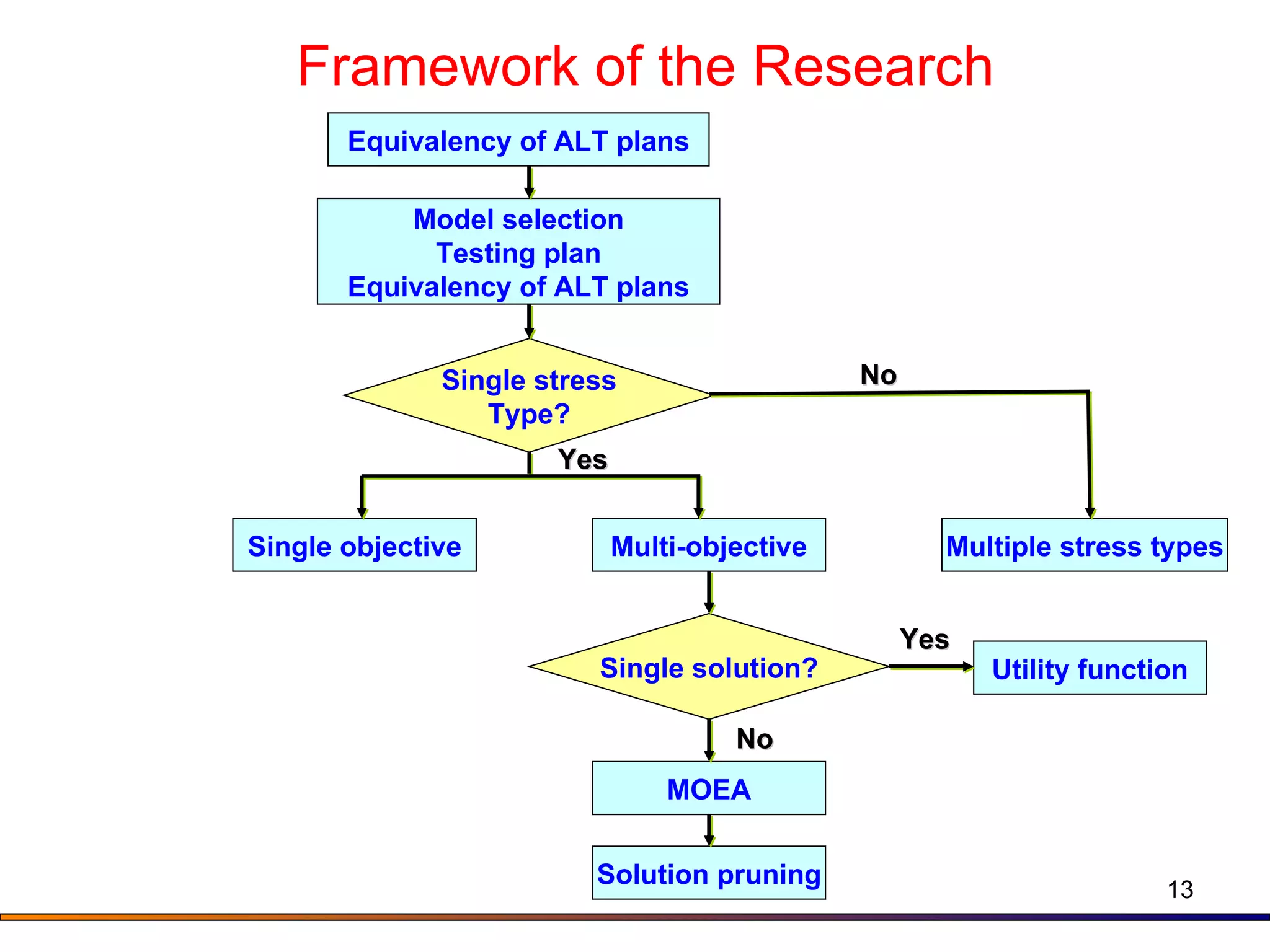
Framework of the Research Single stress Type? Single objective Multi-objective Single solution? Model selection Testing plan Equivalency of ALT plans Equivalency of ALT plans Multiple stress types MOEA Solution pruning Utility function No Yes No Yes
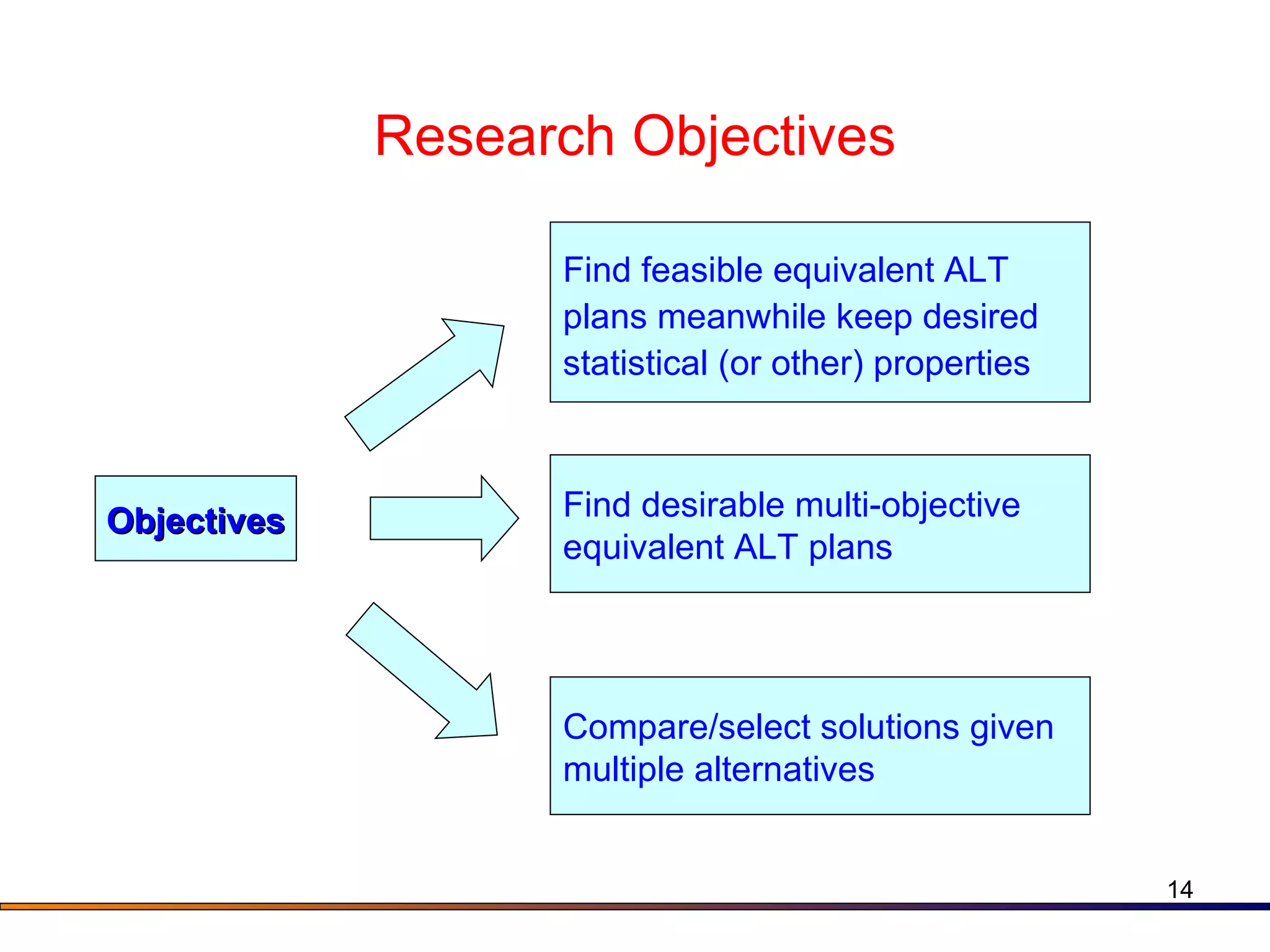
Research Objectives Objectives Find feasible equivalent ALT plans meanwhile keep desired statistical (or other) properties Compare/select solutions given multiple alternatives Find desirable multi-objective equivalent ALT plans
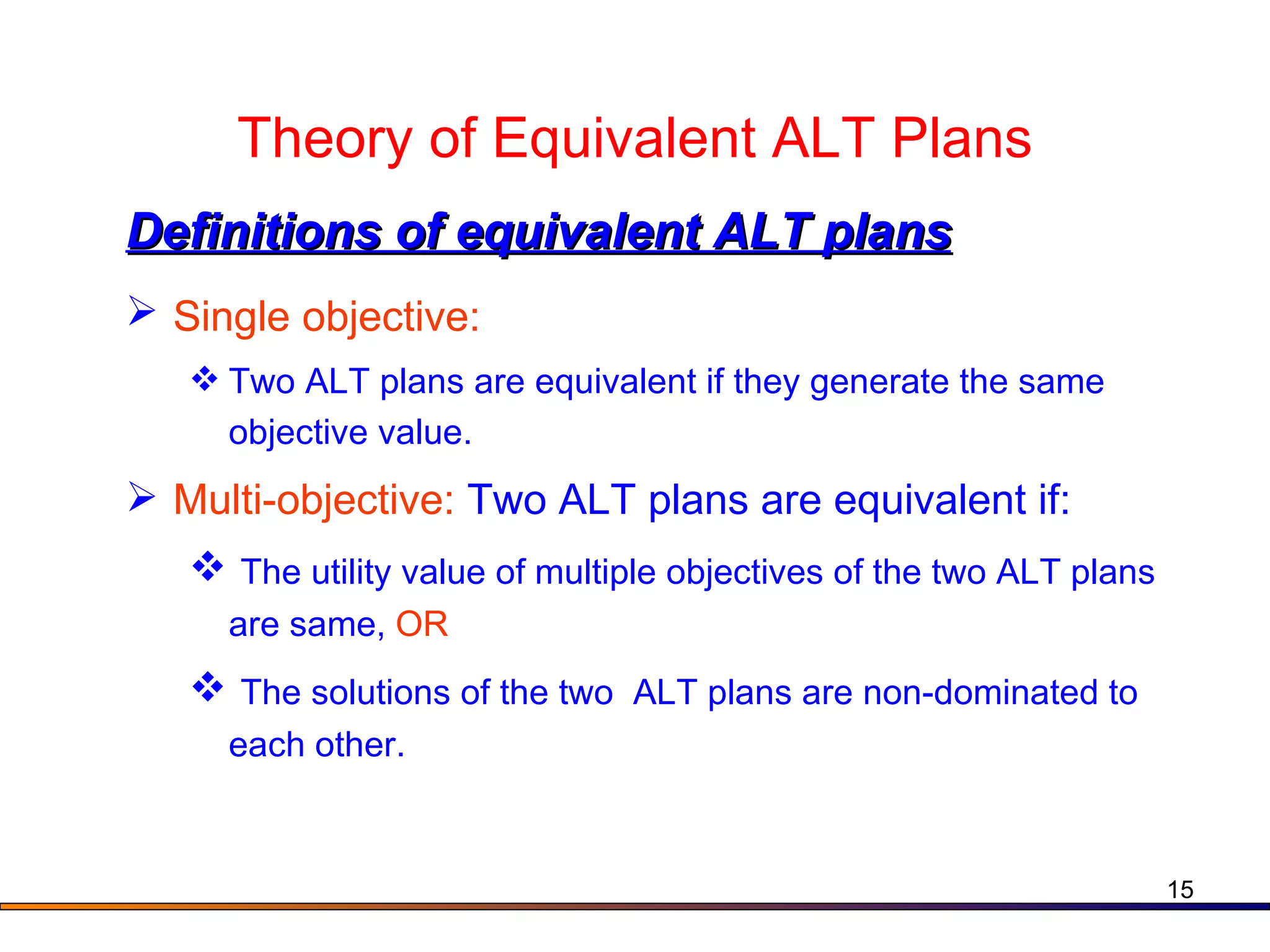
Theory of Equivalent ALT Plans Definitions of equivalent ALT plans Single objective:   Two ALT plans are equivalent if they generate the same objective value. Multi-objective:  Two ALT plans are equivalent if: The utility value of multiple objectives of the two ALT plans are same,  OR The solutions of the two  ALT plans are non-dominated to each other.
Theory of Equivalent ALT Plans General log-likelihood function Information matrix Uncertainty propagation (delta method) Let  be a function (e.g.,  R ( t ),  MTTF ) of model parameter
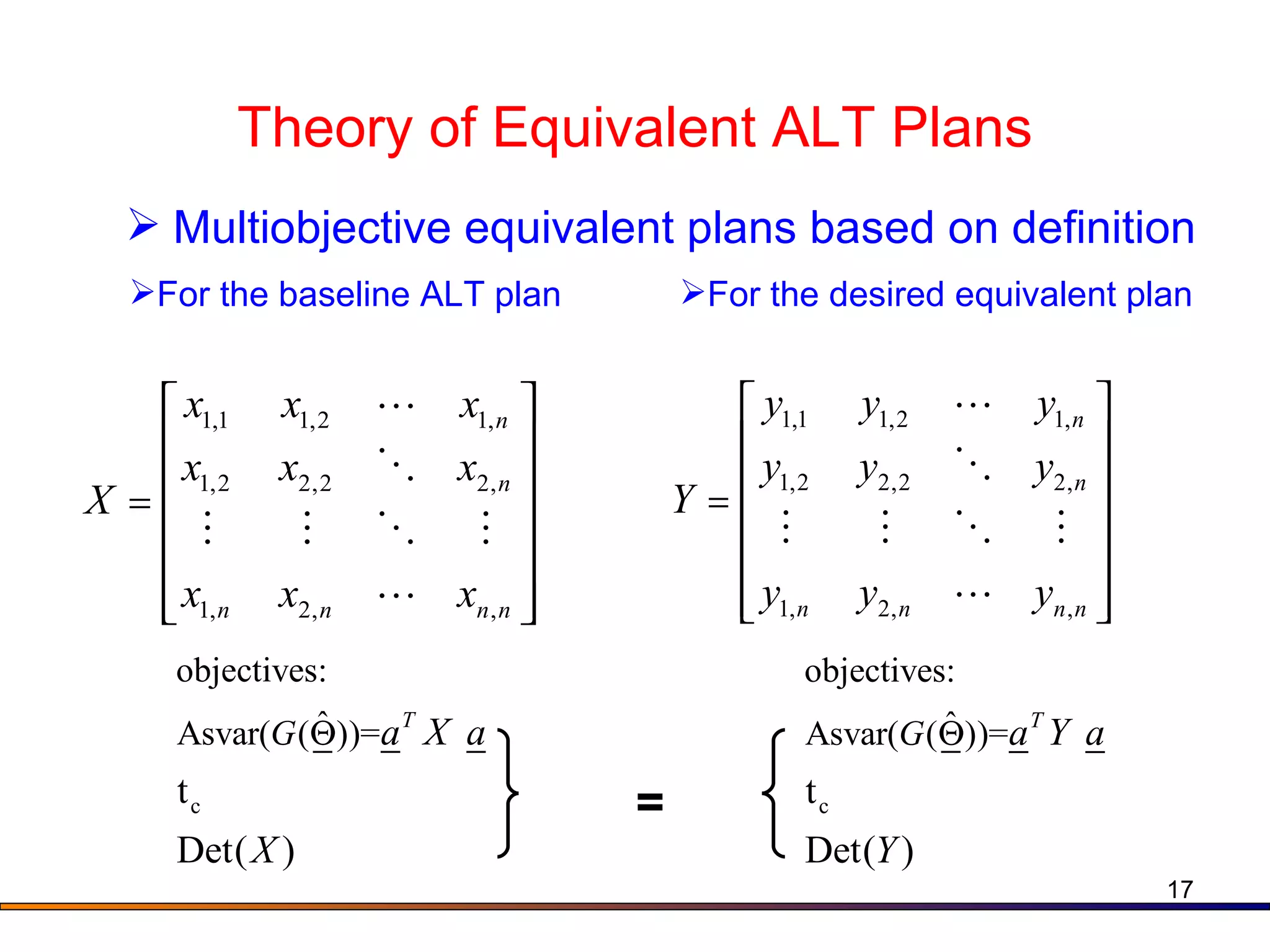
Theory of Equivalent ALT Plans Multiobjective equivalent plans based on definition For the baseline ALT plan  For the desired equivalent plan  =
Application of Equivalent ALT Plans Log-linear Weibull model with shape parameter and scale parameter  , the CDF of logarithm time is: Example: log-linear exponential model with  where  ,  and  . Note:  ,  and  .
Application of Equivalent ALT Plans Derivation of gradient vector  Suppose the baseline estimates of the parameters are: =-7.3646 and  =0.3398. Of our interest is the estimate of reliability function of the product under the standardized use condition  Z 0 =0 at time T 0 =1000 hours. The gradient vector is:  a  =[- T 0  exp(  0 )exp(- T 0 exp(  0 )),0] T  =[-0.33618,0]  T .
Application of Equivalent ALT Plans Suppose the given ALT plan generates the following covariance matrix of  is The  goal  is to find a  three-level   constant-stress  ALT plan which is equivalent to the given plan in terms of  For the desired plan, the number of test units is  N =70 ,  Z 3 =1  and Type I censoring is utilized.
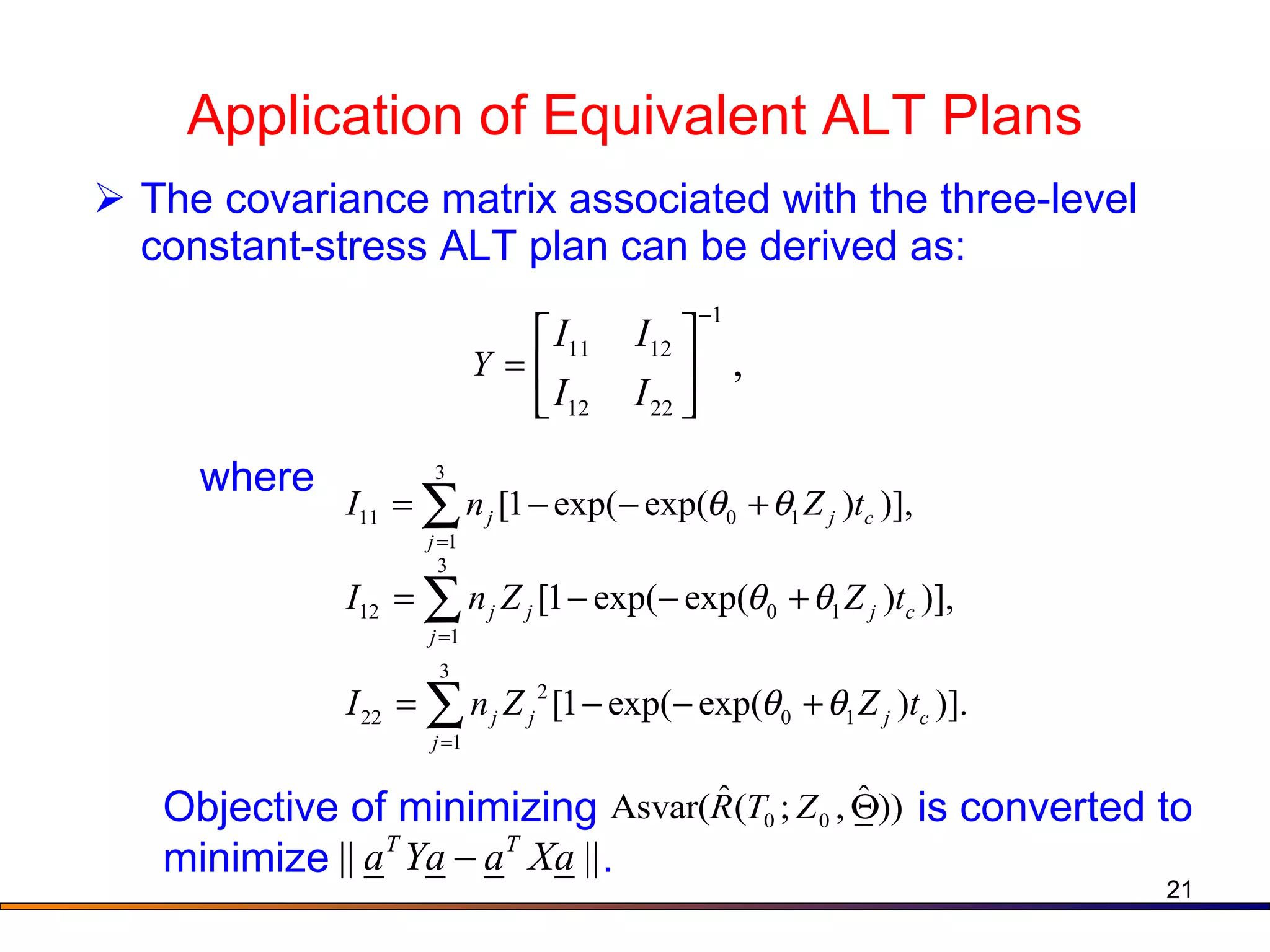
Application of Equivalent ALT Plans The covariance matrix associated with the three-level constant-stress ALT plan can be derived as: where  Objective of minimizing  is converted to  minimize  .
Application of Equivalent ALT Plans Formulation of multiobjective equivalent ALT plan: Let  n 3 =15 .   ={( Z 1 , Z 2 ,  t c ,   n 1 ,   n 2 )|: 0< Z 1 < Z 2 <1;  t c >0;  n 1 , n 2    {1,2,…} } in the design space
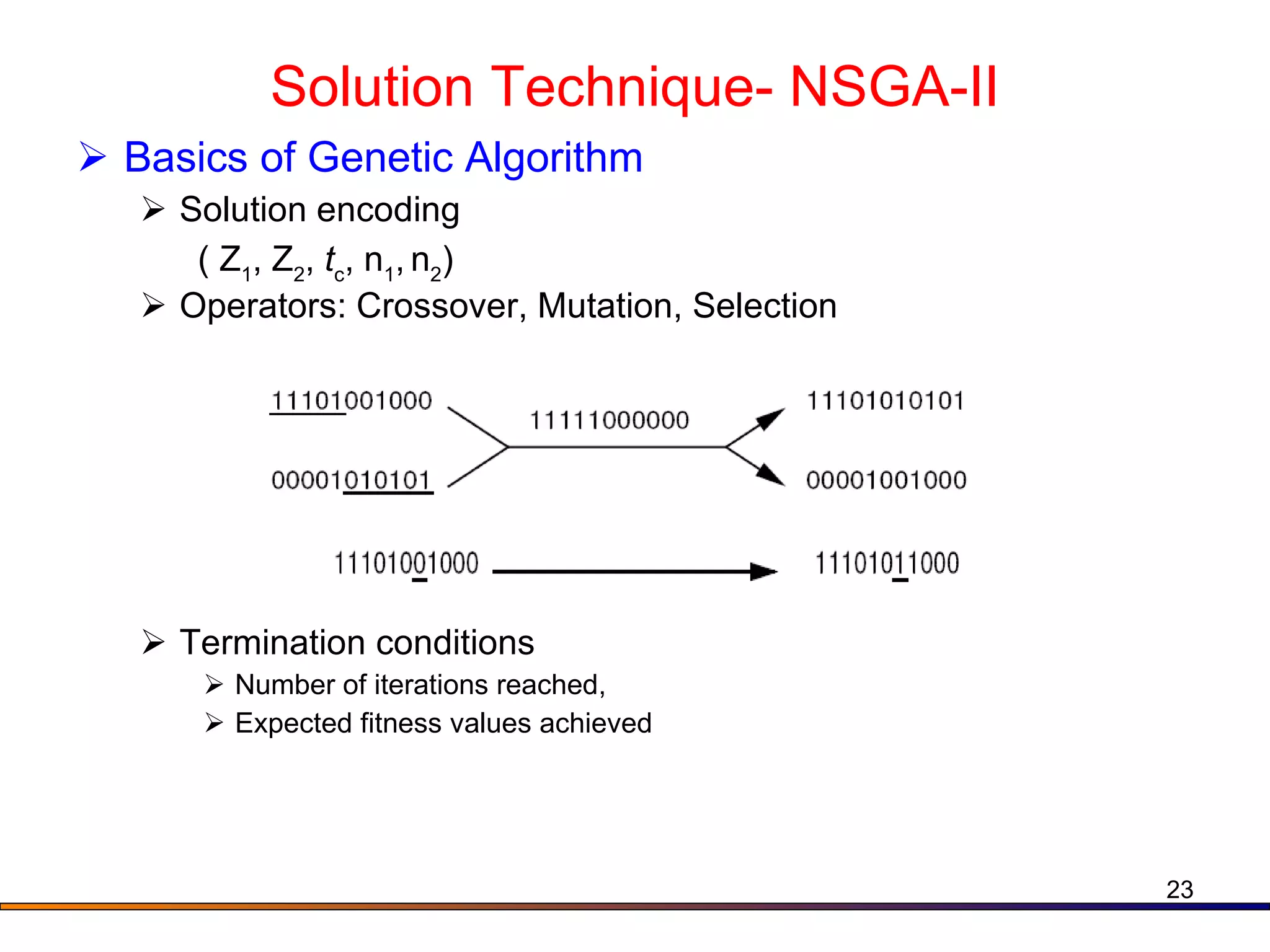
Solution Technique- NSGA-II Basics of Genetic Algorithm Solution encoding Operators: Crossover, Mutation, Selection Termination conditions Number of iterations reached, Expected fitness values achieved ( Z 1 , Z 2 ,  t c ,   n 1 ,   n 2 )
The algorithm of GA Solution Technique- NSGA-II con’t
The algorithm of NSGA-II Solution Technique- NSGA-II con’t
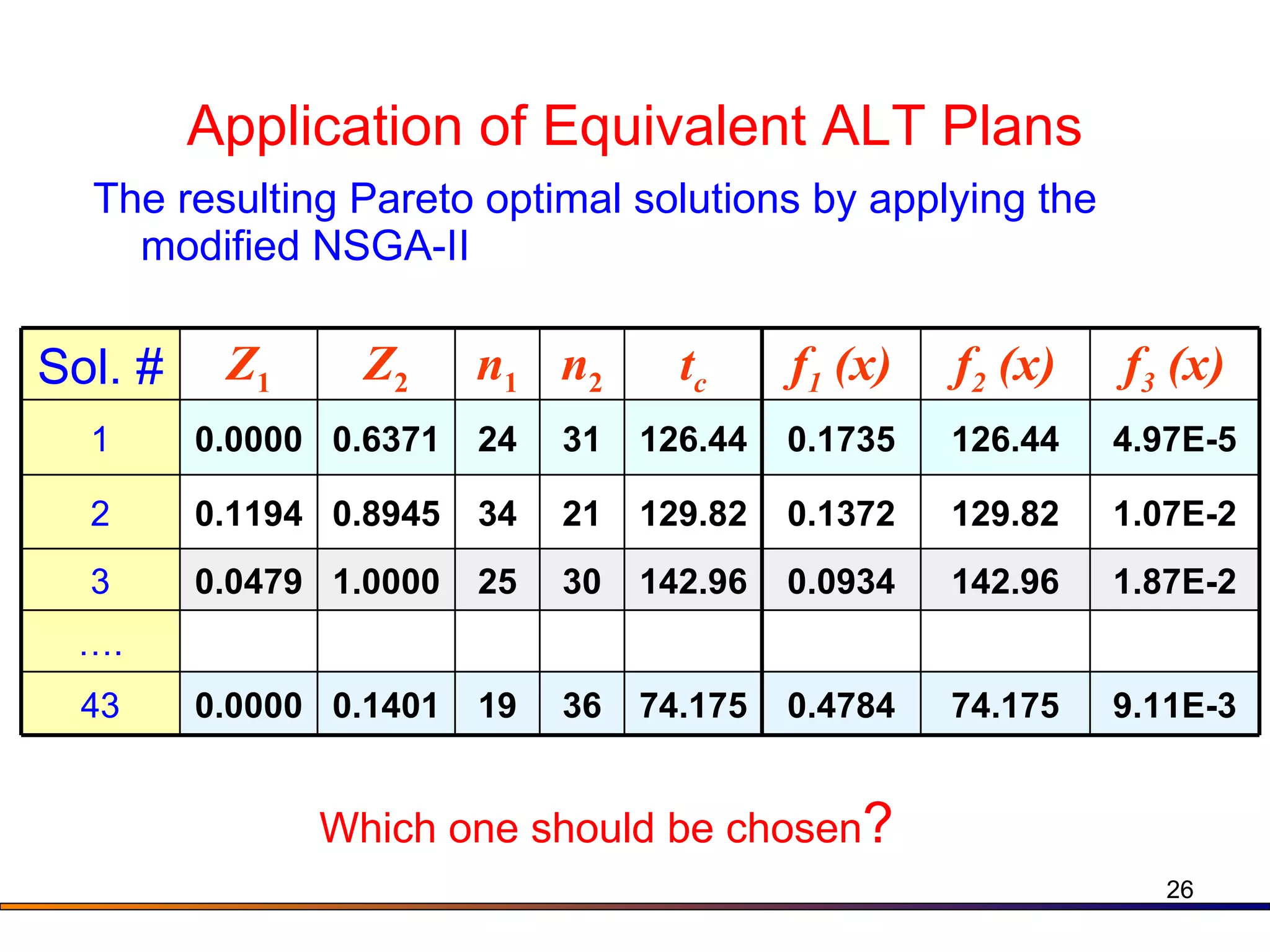
Application of Equivalent ALT Plans The resulting Pareto optimal solutions by applying the modified NSGA-II Which one should be chosen ? Sol. # Z 1 Z 2 n 1 n 2 t c f 1  (x) f 2  (x) f 3  (x) 1 0.0000 0.6371 24 31 126.44 0.1735 126.44 4.97E-5 2 0.1194  0.8945 34 21 129.82 0.1372 129.82 1.07E-2 3 0.0479 1.0000 25 30 142.96 0.0934 142.96 1.87E-2 … . 43 0.0000 0.1401 19 36 74.175 0.4784 74.175 9.11E-3
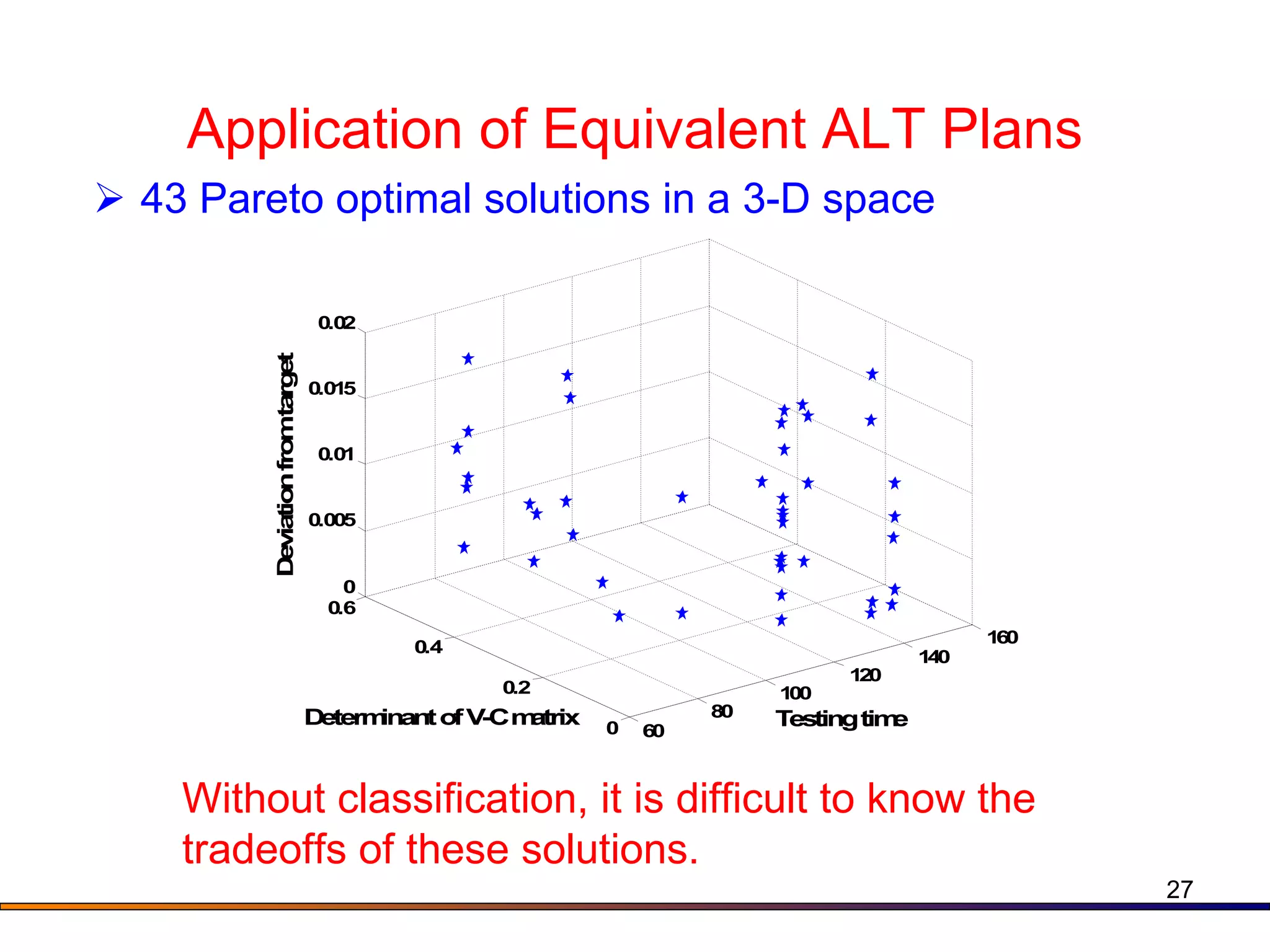
Application of Equivalent ALT Plans 43 Pareto optimal solutions in a 3-D space Without classification, it is difficult to know the  tradeoffs of these solutions.
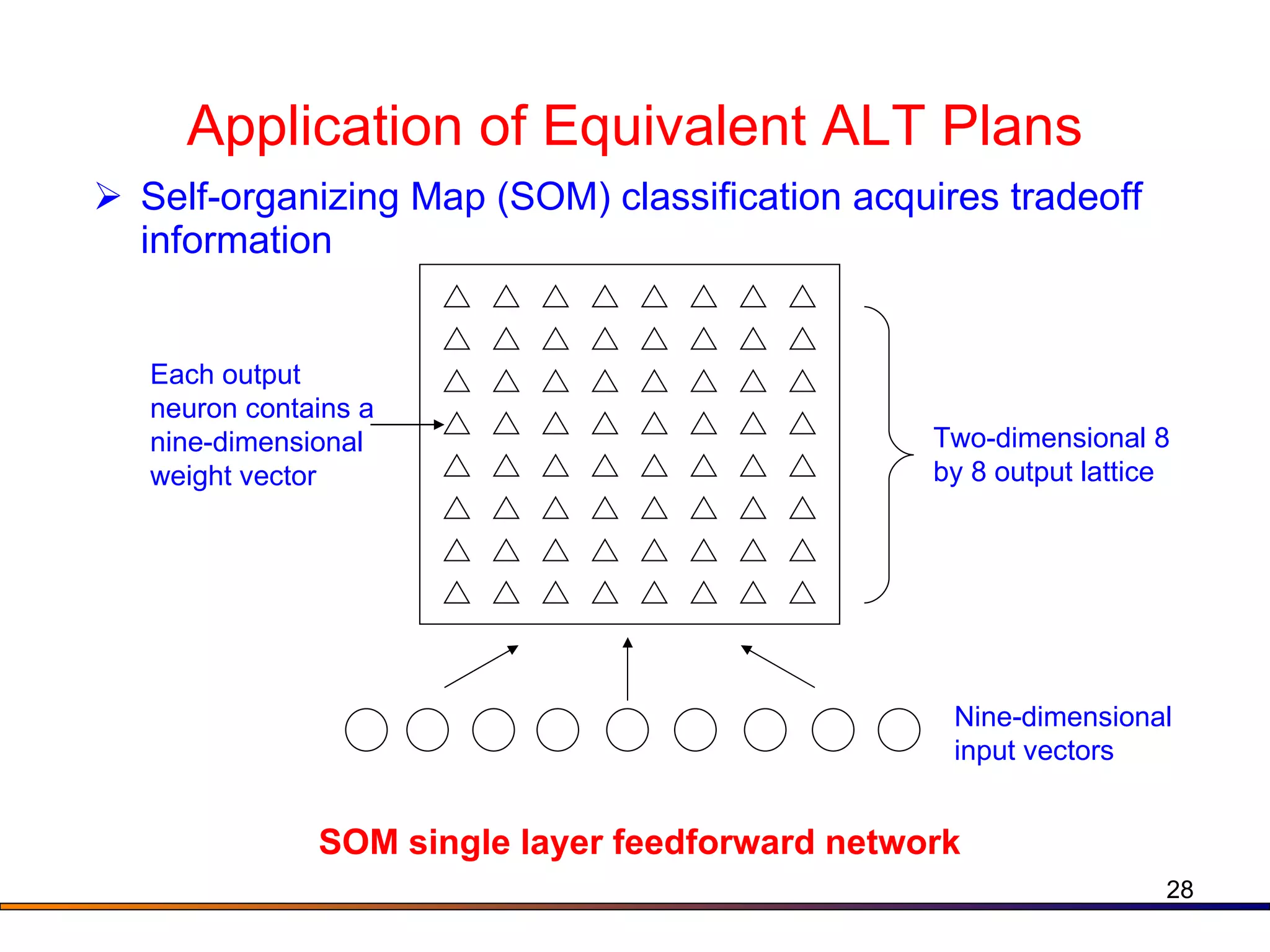
Application of Equivalent ALT Plans Self-organizing Map (SOM) classification acquires tradeoff information SOM single layer feedforward network   Two-dimensional 8 by 8 output lattice Each output neuron contains a nine-dimensional weight vector Nine-dimensional input vectors
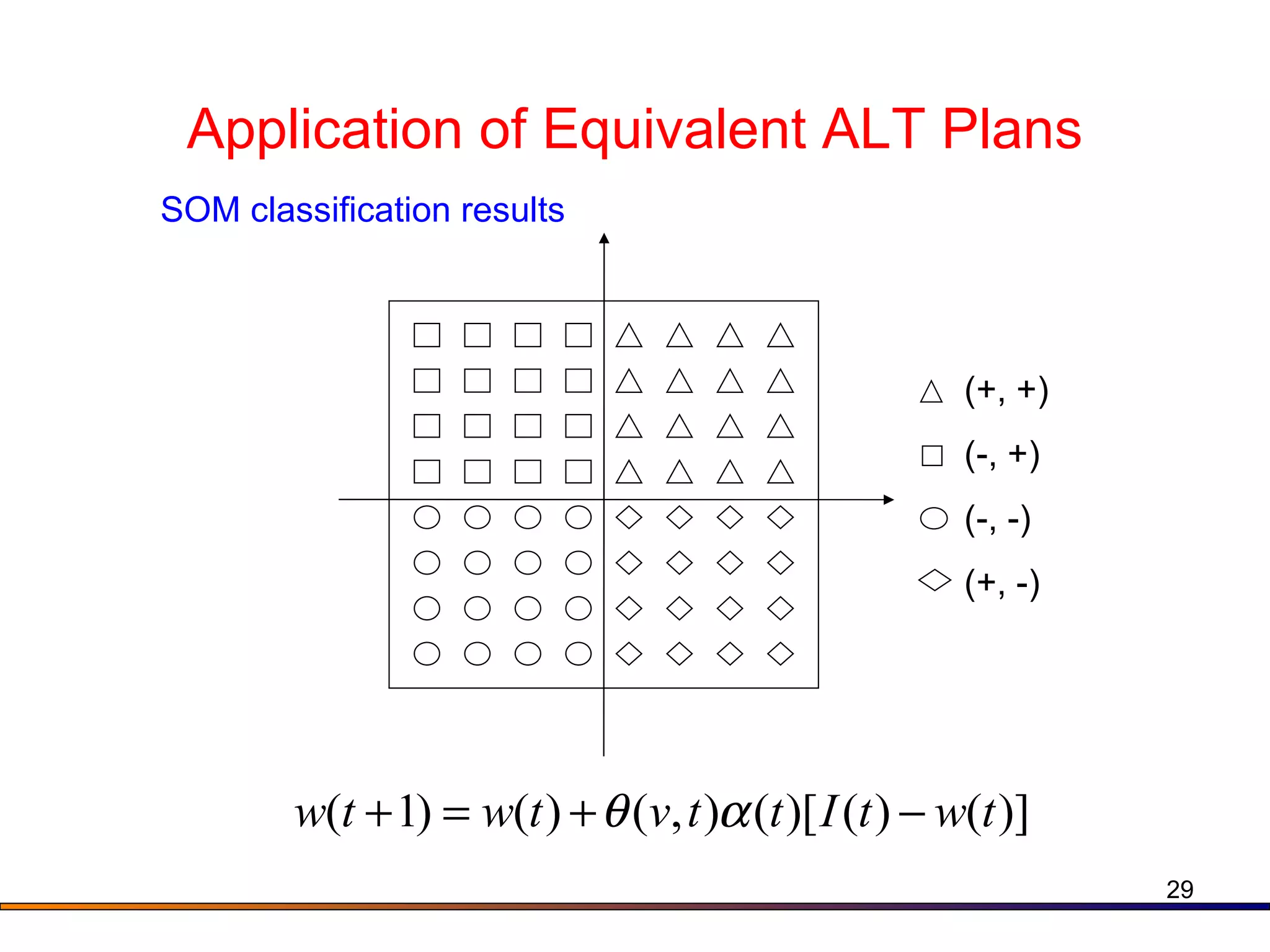
Application of Equivalent ALT Plans (+, +) (-, +) (-, -) (+, -) SOM classification results
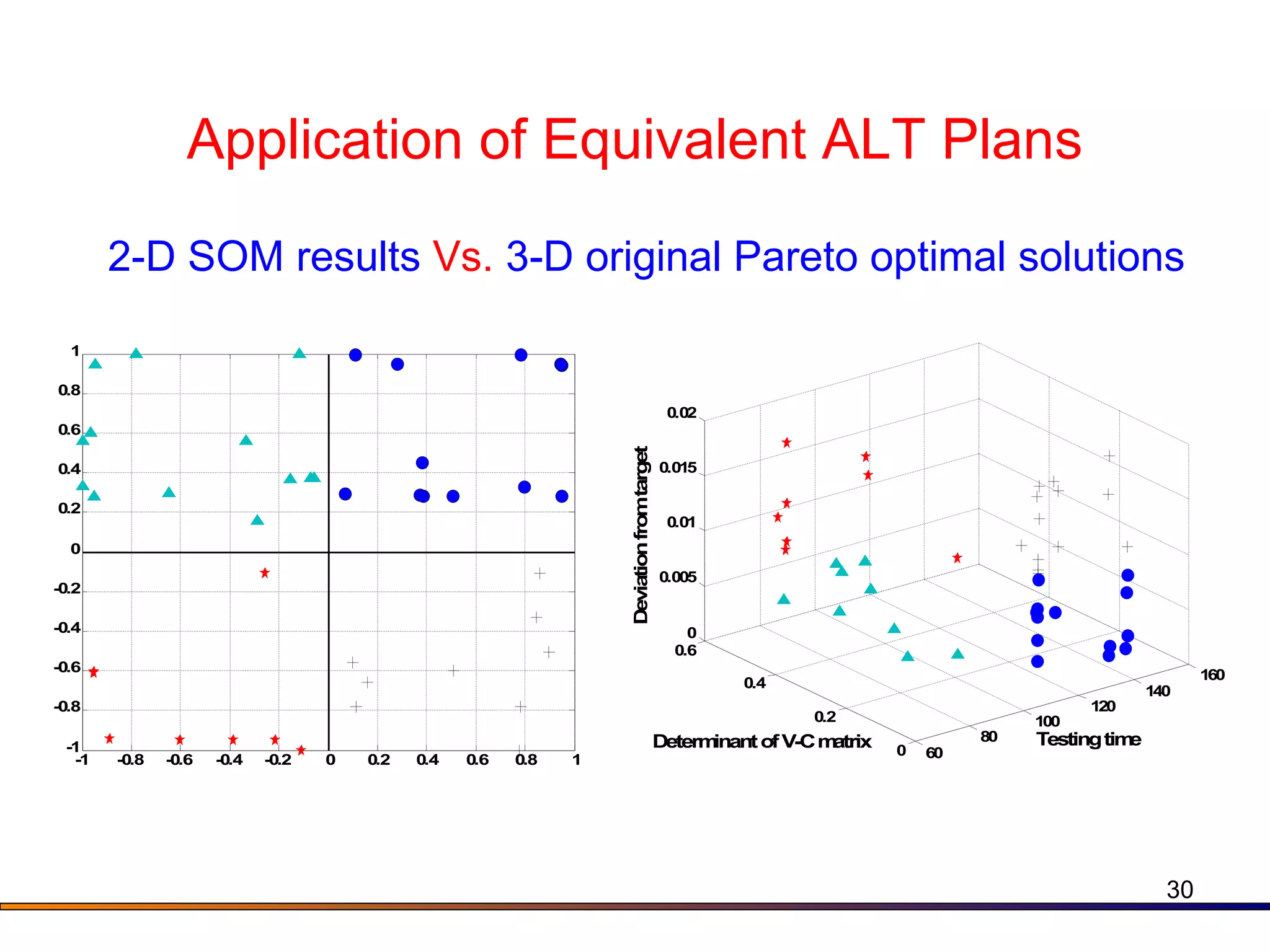
Application of Equivalent ALT Plans 2-D SOM results  Vs.  3-D original Pareto optimal solutions
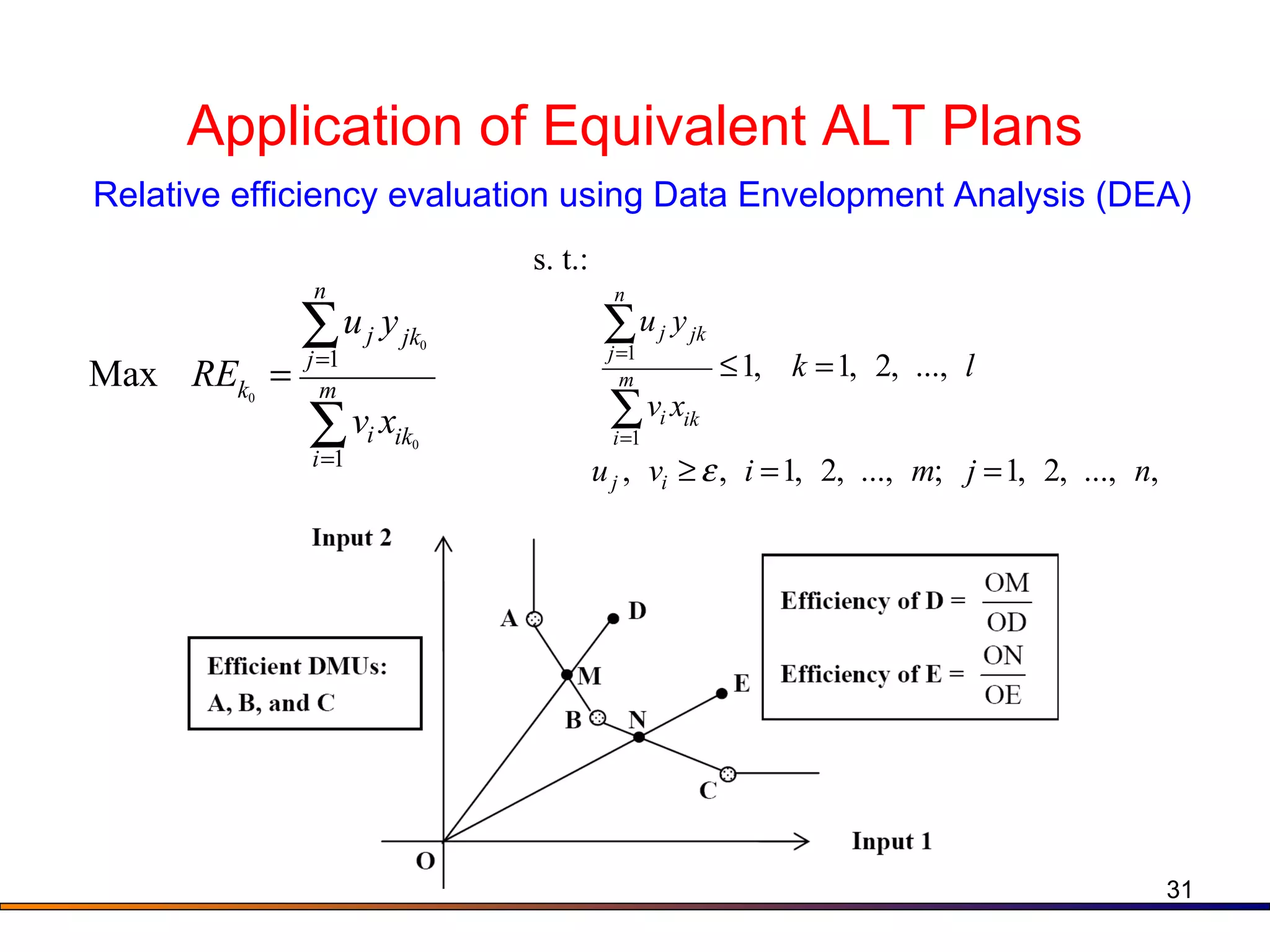
Application of Equivalent ALT Plans Relative efficiency evaluation using Data Envelopment Analysis (DEA)
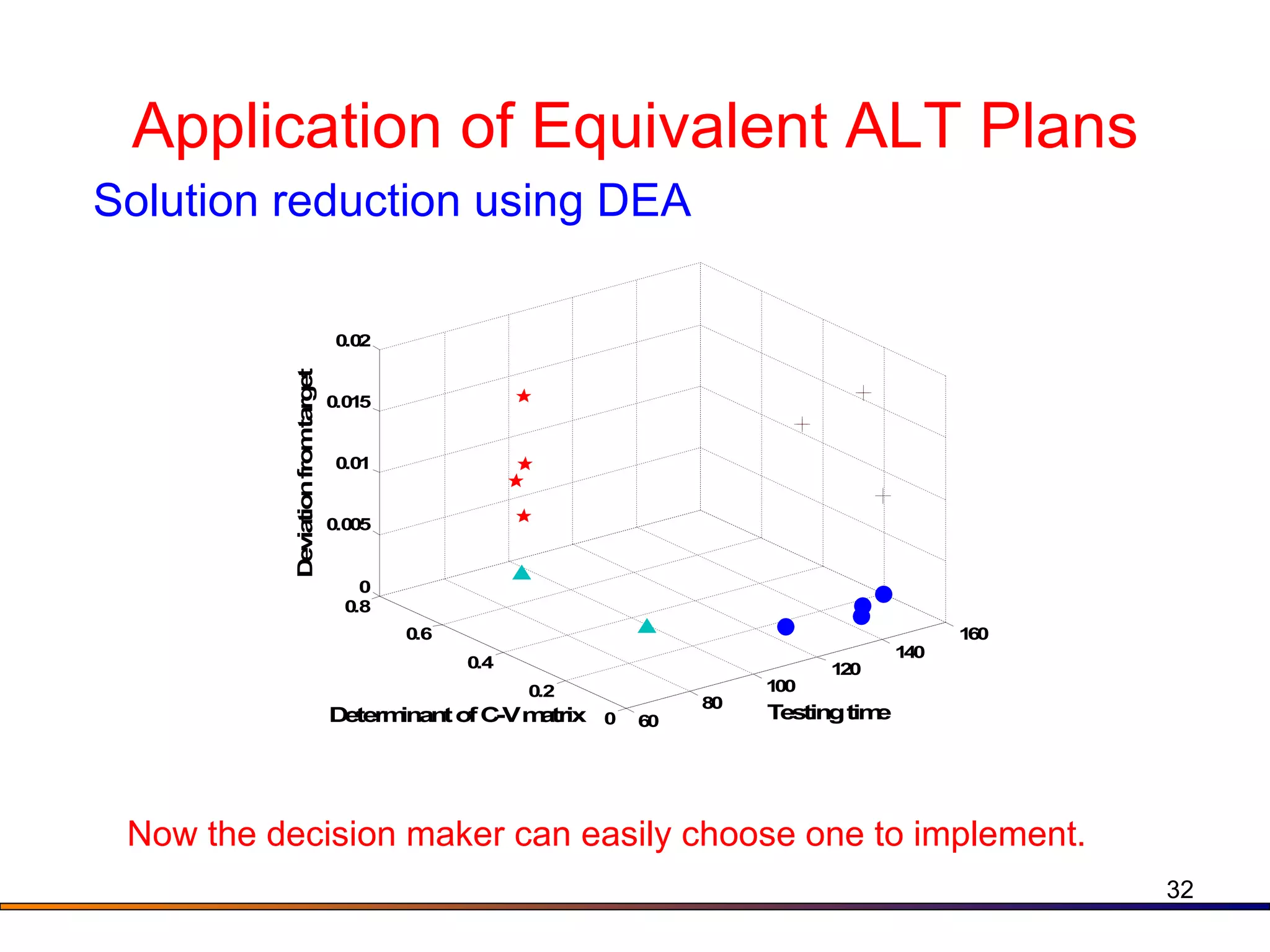
Application of Equivalent ALT Plans Solution reduction using DEA Now the decision maker can easily choose one to implement.
Research Results Contributions: Investigated Equivalent ALT plans under multiobjective consideration, Liao and Li (2008). Multiobjective formulation of equivalent ALT plans has not been well investigated. Data mining and multiobjective decision making methods have not been applied in assisting the design of ALT plan, let alone equivalent ALT plan design. Consequences: Reliability practitioners can choose the appropriate ALT plan according to practice and resource restrictions.  Questions such as why one ALT plan should be preferred over the other will be well understood.
Conclusion and Discussion Equivalent ALT plans are determined under multiple objective consideration. Wider design space is achieved. Self-organizing map is effectively applied to extract tradeoff information. Data envelopment analysis is effective in reducing the size of Pareto solution set from a meaningful economic perspective.
Relationship to the Research at IHME Optimization:  Efficiency and effectiveness evaluation for health policies and interventions using Multi-Criteria Decision Making methods, such as DEA and NSGA Trend analysis and prediction:  child mortality analysis, occurrence rate for certain diseases, correlation analysis using statistical modeling techniques such as regression analysis (Logistic regression), ANN prediction, or time series methods Classification analysis:  similarity of the various health policies, health conditions in terms of various factors, population health evaluation among different regions  Causation Analysis:  Design of Experiments to explore the causes for certain observations or diseases
Haitao Liao and  Zhaojun Li,  “ Multi-objective Design of Equivalent Accelerated Life Testing Plans ”, International Journal of Reliability, Quality and Safety Engineering, vol. 15(6), 515-538, 2008. Zhaojun Li,  Haitao Liao, and David W. Coit. “ A Two-stage Approach for Multi-objective Decision Making with Applications to System Reliability Optimization ”, Reliability Engineering and System Safety, 94(10), 1585-1592, 2009.  Zhaojun Li,  Kailash C. Kapur, and Tong Chen, “ A New Approach for Multicriteria Design of an X-bar Control Chart ”,   Proceedings of the 8 th  International Conference of Reliability, Maintainability, and Safety,   Chengdu, China, July 20-24, 2009. Related Publications
Zhaojun Li  and Kailash C. Kapur, “ Models and Measures for  Fuzzy Reliability and Relationship to Multi-state Reliability ”, Special Issue on Multi-State System Reliability, International Journal of Performability Engineering , 7(3), 241-250, 2011.  Zhaojun Li  and Kailash C. Kapur, “ Models and Customer-Centric System Performance Measures using Fuzzy Reliability ”, Proceedings of the 2010 IEEE International Conference on Systems, Man, and Cybernetics , Istanbul,  Turkey, October, 2010.  Zhaojun Li  and Kailash C. Kapur, “ New Models Based on Fuzzy Sets for Reliability/Safety Analysis ”, Proceedings of the 2010 Modeling and Analysis of Safety and Risk in Complex Systems, Saint-Petersburg, Russian, July, 2010.  Zhaojun Li  and Kailash C. Kapur, “ New Models and Measures for Reliability using Fuzzy Sets ”, Proceedings of the 2010 Industrial Engineering Research Conference (IERC) ,  Cancun, Mexico, June, 2010.  Other Publications
Zhaojun Li  and Kailash C. Kapur, “ Generalized Reliability Measures Based on Fuzzy Sets ”, submitted to the IIE Transactions,  under  second revision . Zhaojun Li  and Kailash C. Kapur, “ Some Perspectives to Define and Model Reliability Using Fuzzy Sets ”, submitted to Quality Engineering,  under review . Zhaojun Li  and Kailash C. Kapur, “ System Reliability Performance Measures using Fuzzy Set Theory ”,  in preparation . Working Papers
Thank you.

Accelerated life testing

  • 1.
    Design of MultiobjectiveEquivalent Accelerated Life Testing Plans Zhaojun (Steven) Li, Ph.D. Candidate Industrial and Systems Engineering Department University of Washington
  • 2.
    Background Education Ph.D.Candidate, August, 2010 – Present, UW Ph.D. Student at Wichita State University, August, 2005- July 2008 M.S. Business Management, Tianjin University, Feb. 2004 B.S. Materials Science & Engineering, Daliao Jiaotong University, Jul. 1999 Professional Experiences Manager, Shanghai Sany Heavy Industry Co., Ltd, Shanghai, China, 02/2004 – 05/2005 R&D engineer, Tianjin Locomotive & Vehicle Company, Tianjin, China, 07/1999 – 07/2001
  • 3.
    Outline Introduction ResearchProcedure Theory of Equivalent ALT plans Application of Equivalent ALT plans Algorithm for Multi-objective Decision making Solutions Classification Solutions Reduction Conclusion and Discussion Relationship to the Research at IHME
  • 4.
    Introduction: Accelerated LifeTesting Estimate the reliability of a highly reliable product, use compression and extrapolation Life Stress ? X :Failure time MTTF=50 hours MTTF=100 hours MTTF=150 hours MTTF X X X X X X X X X X X X
  • 5.
    Introduction: Accelerated LifeTesting Reliability estimation System configuration Warranty and preventive maintenance ALT Severer conditions Induce failures quickly Extrapolate the reliability Normal operating conditions ALT models ALT plans
  • 6.
    Introduction: Accelerated LifeTesting ALT ALT models Relate the failure time under severer conditions to that at normal operating conditions Accelerated failure time models (AFT) Proportional hazards model (PH) Extended hazards regression model Extended linear hazards regression model Proportional odds model ALT plans Improve accuracy and efficiency of the reliability estimation Stress loadings, stress types, & stress levels Sample size & units to each stress level Test duration
  • 7.
    Introduction: Equivalent ALTPlans ALT plans based on various stress loadings
  • 8.
    Introduction: Equivalent ALTPlans ALT is traditionally conducted under specified stress loading type. Equivalent ALT plans: Maintain/improve the desired statistical properties Satisfy the specific equipment restrictions and resource constraints. Issues How to measure equivalency? How can we justify the existence of equivalent ALT plans? Can we obtain equivalent ALT plans considering multiple objectives?
  • 9.
    Literature review: ALT Models * Ciampi and Etezadi (1985) proposed EHR. Elsayed, Liao and Wang (2006) extended to ELHR. Models Assumptions Examples or equations AFT model Stresses take effect on the failure time multiplicatively Arrhenius model, inverse power law model, Eyring model, etc. PH model ( Cox, 1972 ) Stresses take effect on the failure rate multiplicatively EHR/ELHR models * (1985,2006) Incorporating both AFT and PH models PO model (Brass, 1971 ) Stresses take effect on the odds of failure rate multiplicatively
  • 10.
    Literature review: ALT plans * Constant, single stress type Authors Contributions* Chernoff (1962) ML estimate of failure rate of exp. distribution Mann et al. (1974) linear estimation with order statistics for extreme value distribution, censored observations Nelson,Kielpinski (1975, 1976) estimate of median, normal and lognormal distributions Nelson and Meeker (1978) estimate percentiles of Weibull and smallest extreme-value distributions Meeker (1984) compares the statistical optimum test plans to practical test plans Meeker and Hahn (1985) propose a 4:2:1 allocation, give the optimal low level Meeter and Meeker (1994) non-constant scale parameter Yang (1994) optimum design of 4-level constant-stress
  • 11.
    Literature review: ALTplans * Constant, single stress type Authors Contributions* Easterling (1975) determine a lower bound of reliability Martz and Waterman (1977) Bayesian methods, reliability of a single unit Meeker and Hahn (1977) consider the optimum allocation of test units Barton (1991) minimize the maximum test-stress, relia. s.d. Maxim et al. (1977) D-optimality criterion, bivariate exponential or Weibull model. Elsayed and Jiao (2002) PH model, asymptotic variance of failure rate Loon-Ching et. al. (2005) multi-objective framework, statistical precision and cost Elsayed and Zhang (2007) PO model, asymptotic variance of failure rate
  • 12.
    Literature review: ALT plans * time-varying, multiple stress types Authors Contributions* Nelson (1983) cumulative exposure model, minimize mean life Bai et al. (1989) Extend Nelson’s result, censoring time Bai and Chun (1991) optimal simple step-stress, minimize total variance of the log-mean life Khamis and Higgins (1996) 3-step step-stress palns Xiong (1998) simple step-stress, Type II censoring Park and Yum (1998) optimal ALT plans with ramp stress Xiong and Milliken (1999) step-stress ALT, random stress change times Xiong and Ji (2004) step-stress ALT, grouped and censored data Xu and Fei (2007) optimal step-stress ALT, two stress variables
  • 13.
    Framework of theResearch Single stress Type? Single objective Multi-objective Single solution? Model selection Testing plan Equivalency of ALT plans Equivalency of ALT plans Multiple stress types MOEA Solution pruning Utility function No Yes No Yes
  • 14.
    Research Objectives ObjectivesFind feasible equivalent ALT plans meanwhile keep desired statistical (or other) properties Compare/select solutions given multiple alternatives Find desirable multi-objective equivalent ALT plans
  • 15.
    Theory of EquivalentALT Plans Definitions of equivalent ALT plans Single objective: Two ALT plans are equivalent if they generate the same objective value. Multi-objective: Two ALT plans are equivalent if: The utility value of multiple objectives of the two ALT plans are same, OR The solutions of the two ALT plans are non-dominated to each other.
  • 16.
    Theory of EquivalentALT Plans General log-likelihood function Information matrix Uncertainty propagation (delta method) Let be a function (e.g., R ( t ), MTTF ) of model parameter
  • 17.
    Theory of EquivalentALT Plans Multiobjective equivalent plans based on definition For the baseline ALT plan For the desired equivalent plan =
  • 18.
    Application of EquivalentALT Plans Log-linear Weibull model with shape parameter and scale parameter , the CDF of logarithm time is: Example: log-linear exponential model with where , and . Note: , and .
  • 19.
    Application of EquivalentALT Plans Derivation of gradient vector Suppose the baseline estimates of the parameters are: =-7.3646 and =0.3398. Of our interest is the estimate of reliability function of the product under the standardized use condition Z 0 =0 at time T 0 =1000 hours. The gradient vector is: a =[- T 0 exp(  0 )exp(- T 0 exp(  0 )),0] T =[-0.33618,0] T .
  • 20.
    Application of EquivalentALT Plans Suppose the given ALT plan generates the following covariance matrix of is The goal is to find a three-level constant-stress ALT plan which is equivalent to the given plan in terms of For the desired plan, the number of test units is N =70 , Z 3 =1 and Type I censoring is utilized.
  • 21.
    Application of EquivalentALT Plans The covariance matrix associated with the three-level constant-stress ALT plan can be derived as: where Objective of minimizing is converted to minimize .
  • 22.
    Application of EquivalentALT Plans Formulation of multiobjective equivalent ALT plan: Let n 3 =15 . ={( Z 1 , Z 2 , t c , n 1 , n 2 )|: 0< Z 1 < Z 2 <1; t c >0; n 1 , n 2  {1,2,…} } in the design space
  • 23.
    Solution Technique- NSGA-IIBasics of Genetic Algorithm Solution encoding Operators: Crossover, Mutation, Selection Termination conditions Number of iterations reached, Expected fitness values achieved ( Z 1 , Z 2 , t c , n 1 , n 2 )
  • 24.
    The algorithm ofGA Solution Technique- NSGA-II con’t
  • 25.
    The algorithm ofNSGA-II Solution Technique- NSGA-II con’t
  • 26.
    Application of EquivalentALT Plans The resulting Pareto optimal solutions by applying the modified NSGA-II Which one should be chosen ? Sol. # Z 1 Z 2 n 1 n 2 t c f 1 (x) f 2 (x) f 3 (x) 1 0.0000 0.6371 24 31 126.44 0.1735 126.44 4.97E-5 2 0.1194 0.8945 34 21 129.82 0.1372 129.82 1.07E-2 3 0.0479 1.0000 25 30 142.96 0.0934 142.96 1.87E-2 … . 43 0.0000 0.1401 19 36 74.175 0.4784 74.175 9.11E-3
  • 27.
    Application of EquivalentALT Plans 43 Pareto optimal solutions in a 3-D space Without classification, it is difficult to know the tradeoffs of these solutions.
  • 28.
    Application of EquivalentALT Plans Self-organizing Map (SOM) classification acquires tradeoff information SOM single layer feedforward network Two-dimensional 8 by 8 output lattice Each output neuron contains a nine-dimensional weight vector Nine-dimensional input vectors
  • 29.
    Application of EquivalentALT Plans (+, +) (-, +) (-, -) (+, -) SOM classification results
  • 30.
    Application of EquivalentALT Plans 2-D SOM results Vs. 3-D original Pareto optimal solutions
  • 31.
    Application of EquivalentALT Plans Relative efficiency evaluation using Data Envelopment Analysis (DEA)
  • 32.
    Application of EquivalentALT Plans Solution reduction using DEA Now the decision maker can easily choose one to implement.
  • 33.
    Research Results Contributions:Investigated Equivalent ALT plans under multiobjective consideration, Liao and Li (2008). Multiobjective formulation of equivalent ALT plans has not been well investigated. Data mining and multiobjective decision making methods have not been applied in assisting the design of ALT plan, let alone equivalent ALT plan design. Consequences: Reliability practitioners can choose the appropriate ALT plan according to practice and resource restrictions. Questions such as why one ALT plan should be preferred over the other will be well understood.
  • 34.
    Conclusion and DiscussionEquivalent ALT plans are determined under multiple objective consideration. Wider design space is achieved. Self-organizing map is effectively applied to extract tradeoff information. Data envelopment analysis is effective in reducing the size of Pareto solution set from a meaningful economic perspective.
  • 35.
    Relationship to theResearch at IHME Optimization: Efficiency and effectiveness evaluation for health policies and interventions using Multi-Criteria Decision Making methods, such as DEA and NSGA Trend analysis and prediction: child mortality analysis, occurrence rate for certain diseases, correlation analysis using statistical modeling techniques such as regression analysis (Logistic regression), ANN prediction, or time series methods Classification analysis: similarity of the various health policies, health conditions in terms of various factors, population health evaluation among different regions Causation Analysis: Design of Experiments to explore the causes for certain observations or diseases
  • 36.
    Haitao Liao and Zhaojun Li, “ Multi-objective Design of Equivalent Accelerated Life Testing Plans ”, International Journal of Reliability, Quality and Safety Engineering, vol. 15(6), 515-538, 2008. Zhaojun Li, Haitao Liao, and David W. Coit. “ A Two-stage Approach for Multi-objective Decision Making with Applications to System Reliability Optimization ”, Reliability Engineering and System Safety, 94(10), 1585-1592, 2009. Zhaojun Li, Kailash C. Kapur, and Tong Chen, “ A New Approach for Multicriteria Design of an X-bar Control Chart ”, Proceedings of the 8 th International Conference of Reliability, Maintainability, and Safety, Chengdu, China, July 20-24, 2009. Related Publications
  • 37.
    Zhaojun Li and Kailash C. Kapur, “ Models and Measures for Fuzzy Reliability and Relationship to Multi-state Reliability ”, Special Issue on Multi-State System Reliability, International Journal of Performability Engineering , 7(3), 241-250, 2011. Zhaojun Li and Kailash C. Kapur, “ Models and Customer-Centric System Performance Measures using Fuzzy Reliability ”, Proceedings of the 2010 IEEE International Conference on Systems, Man, and Cybernetics , Istanbul, Turkey, October, 2010. Zhaojun Li and Kailash C. Kapur, “ New Models Based on Fuzzy Sets for Reliability/Safety Analysis ”, Proceedings of the 2010 Modeling and Analysis of Safety and Risk in Complex Systems, Saint-Petersburg, Russian, July, 2010. Zhaojun Li and Kailash C. Kapur, “ New Models and Measures for Reliability using Fuzzy Sets ”, Proceedings of the 2010 Industrial Engineering Research Conference (IERC) , Cancun, Mexico, June, 2010. Other Publications
  • 38.
    Zhaojun Li and Kailash C. Kapur, “ Generalized Reliability Measures Based on Fuzzy Sets ”, submitted to the IIE Transactions, under second revision . Zhaojun Li and Kailash C. Kapur, “ Some Perspectives to Define and Model Reliability Using Fuzzy Sets ”, submitted to Quality Engineering, under review . Zhaojun Li and Kailash C. Kapur, “ System Reliability Performance Measures using Fuzzy Set Theory ”, in preparation . Working Papers
  • 39.