Mahdi Khademi
Fall 2015
Introduction
 Class Expectations
 To be able to provide a complete design package of
a chemical plant and complete report
 Groups of maximum 4 students
 Project due on Dec 1st in electronic pdf format
Project
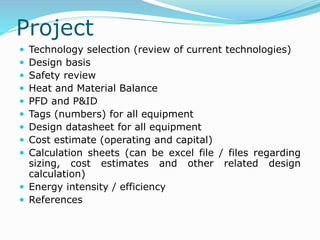
 Technology selection (review of current technologies)
 Design basis
 Safety review
 Heat and Material Balance
 PFD and P&ID
 Tags (numbers) for all equipment
 Design datasheet for all equipment
 Cost estimate (operating and capital)
 Calculation sheets (can be excel file / files regarding
sizing, cost estimates and other related design
calculation)
 Energy intensity / efficiency
 References
Project
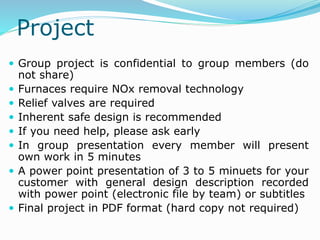
 Group project is confidential to group members (do
not share)
 Furnaces require NOx removal technology
 Relief valves are required
 Inherent safe design is recommended
 If you need help, please ask early
 In group presentation every member will present
own work in 5 minutes
 A power point presentation of 3 to 5 minuets for your
customer with general design description recorded
with power point (electronic file by team) or subtitles
 Final project in PDF format (hard copy not required)
Report requirement
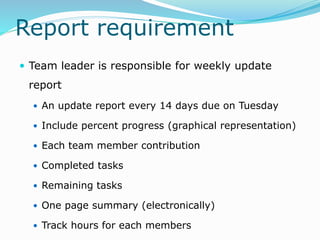
 Team leader is responsible for weekly update
report
 An update report every 14 days due on Tuesday
 Include percent progress (graphical representation)
 Each team member contribution
 Completed tasks
 Remaining tasks
 One page summary (electronically)
 Track hours for each members
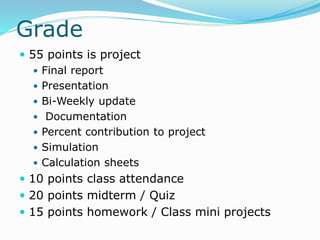
Grade
 55 points is project
 Final report
 Presentation
 Bi-Weekly update
 Documentation
 Percent contribution to project
 Simulation
 Calculation sheets
 10 points class attendance
 20 points midterm / Quiz
 15 points homework / Class mini projects
Project Gas treatment
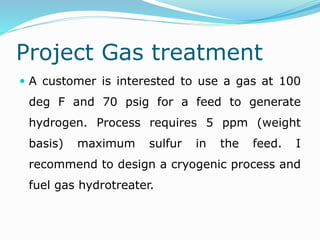
 A customer is interested to use a gas at 100
deg F and 70 psig for a feed to generate
hydrogen. Process requires 5 ppm (weight
basis) maximum sulfur in the feed. I
recommend to design a cryogenic process and
fuel gas hydrotreater.
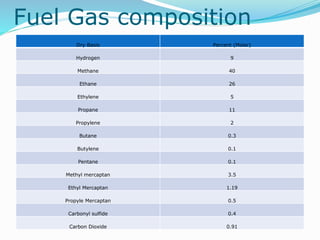
Fuel Gas composition
Dry Basis Percent (Molar)
Hydrogen 9
Methane 40
Ethane 26
Ethylene 5
Propane 11
Propylene 2
Butane 0.3
Butylene 0.1
Pentane 0.1
Methyl mercaptan 3.5
Ethyl Mercaptan 1.19
Propyle Mercaptan 0.5
Carbonyl sulfide 0.4
Carbon Dioxide 0.91
Project Hydrogen
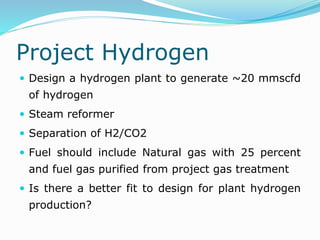
 Design a hydrogen plant to generate ~20 mmscfd
of hydrogen
 Steam reformer
 Separation of H2/CO2
 Fuel should include Natural gas with 25 percent
and fuel gas purified from project gas treatment
 Is there a better fit to design for plant hydrogen
production?
CO2 Recovery
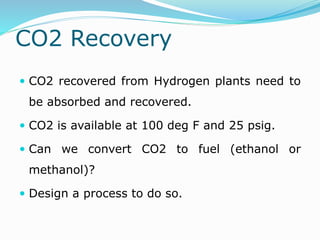
 CO2 recovered from Hydrogen plants need to
be absorbed and recovered.
 CO2 is available at 100 deg F and 25 psig.
 Can we convert CO2 to fuel (ethanol or
methanol)?
 Design a process to do so.
Alkylation plant
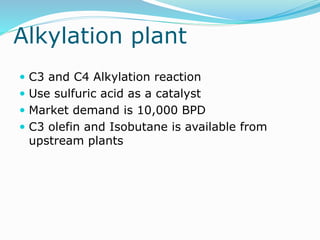
 C3 and C4 Alkylation reaction
 Use sulfuric acid as a catalyst
 Market demand is 10,000 BPD
 C3 olefin and Isobutane is available from
upstream plants
Isomerization plant -
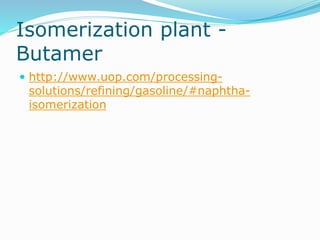
Butamer
 http://www.uop.com/processing-
solutions/refining/gasoline/#naphtha-
isomerization
Isomerization plant - Penex
 http://www.uop.com/isomerization-penex/
Produce propylene from
propane
 http://www.uop.com/processing-
solutions/petrochemicals/olefins/#propylene
 https://sites.google.com/a/intratec.us/intratec
-base/home/chemical-
processes/propylene/propylene-from-
propane-via-dehydrogenation-similar-to-
uhde-star-process
Production of Ethanol
 Use Ethylene to product ethanol
 Evaluate other potential technologies and cost’
 Can use ethylene as feed stock or bio based materials
 Need a comparison and technology selection criteria
Crude unit
 Crude distillation in atmospheric column
 Includes Desalter, heater
 Should produce Gas, Naphtha, Jet and Diesel
within accepted specification
 Can use any crude composition available
 Calculate how much EFO/bbl (energy
efficiency)
Ethylene Glycol production
Mono Ethanol Amine Production
Acetone Production
Styrene production
Ethylene Oxide production
Diethyl Ether production
Design a light naphtha
hydrotreater
 Feed is C3 to C6 hydrocarbon (0.8% sulfur, 0.2
% nitrogen) with 10 mbpd feed rate.
 http://kolmetz.com/pdf/EDG/ENGINEERING%2
0DESIGN%20GUIDELINE-
HYDROTREATING%20Rev%2002%20web.pdf
Literature Survey Data
 Online resources including (knovel.com),
 Manufacture and technology owner / Consultant
 Patents
 Encyclopedia of Chemical Technology (Kirk & Othmer)
 Ullmann’s Encyclopedia of industrial technology
 Hydrocarbon processing publications
 Libraries
Chemical Engineering plant
design
 All engineering aspects involved in the development of
a new, modified, or expanded commercial process in a
chemical or biochemical plant.
 Chemical engineer will
 make economic evaluation of process
 Design each individual piece of equipment
 Develops plant layout
 Provides guidance for the plant control and operation
Team work
 Most effective design is when a design team
members are familiar with fundamental and
general aspects of other engineers in the design
team.
 Leadership of project manager and management
is critical in the success of the project
 Consideration of Business aspects of the design is
a critical factor
 Failure to consider all the design aspects can
create safety, economic and process challenges.
(link to examples)
Error !
Primary causes of engineering
disasters
 The primary causes of engineering disasters
are usually considered to be
 Human factors (including both 'ethical' failure
and accidents)
 Design flaws (many of which are also the result
of unethical practices)
 Materials failures
 Extreme conditions or environments, and, most
commonly and importantly
 Combinations of these reasons
Overall design consideration
 Process design development
 Flowsheet development
 Computer aided design
 Cost estimation
 Profitability analysis of investment
 Optimum design
 Optimum operation design
Typical design steps
 Recognize a market need for new or existing product
 Evaluate potential solution to meet the market need
(literature survey, patent, etc.)
 Preliminary process design (reaction, synthesis ,
separation, process safety, operation, environmental
limits, local laws and regulations, etc.)
 Assess profitability of the process
 Refine and verify the design data
 Detailed engineering design
 Develop base case
 Process flowsheet
 Integration and optimization
 Process control
 Equipment sizing
 Capital cost estimate
Typical design steps - continued
 Reassess the economic viability of the process
 Environmental, health and safety review
 Written process design report
 Complete engineering design package
 Equipment layout and specifications
 Piping and instrumentation diagrams
 Prepare bids for equipment and construction
 Equipment procurement
 Construction and installation
 Operations profiles and procedures
 Start up
Health and Safety Hazards
 Health and chemicals:
 Inherent toxicity of material
 Frequency and duration of exposure
 Will come back to this subject
Safety Data Sheet (SDS)
safety data sheet (SDS), material safety data sheet (MSDS), or
product safety data sheet (PSDS) is an important component of
product stewardship and occupational safety and health. It is
intended to provide workers and emergency personnel with
procedures for handling or working with that substance in a safe
manner, and includes information such as physical data (melting
point, boiling point, flash point, etc.), toxicity, health effects, first
aid, reactivity, storage, disposal, protective equipment, and spill-
handling procedures. SDS formats can vary from source to source
within a country depending on national requirements.
Codes and Standards
 API (American Petroleum institute)
 Since 1924, The American Petroleum Institute (API)
has been the leader in developing equipment and
operating standards for the oil and natural gas industry
 ASME (American Society of Mechanical Engineers)
 ASME is the leading international developer of codes
and standards associated with the art, science, and
practice of mechanical engineering. Starting with the
first issuance of its legendary Boiler & Pressure Vessel
Code in 1914, ASME's codes and standards have grown
to nearly 600 offerings currently in print. These
offerings cover a breadth of topics, including pressure
technology, nuclear plants, elevators / escalators,
construction, engineering design, standardization, and
performance testing.
 ANSI (American National Standards Institute)
Codes and Standards -
Continued
 ISO
 NIST (National Institute of Standards and
Technology)
 NFPA
Codes and Standards -
Continued
 TEMA
 ISA
 Local/regional government codes is the primary
source of guidance that needs to be followed in
addition / or accordance to accepted industry
codes and standards.
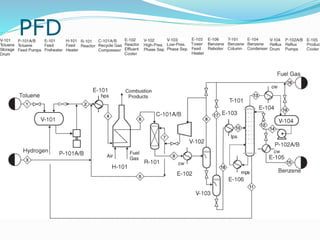
Process flow diagram (PFD)
 Can be qualitative / quantitative or combined
 Qualitative
 Flow of materials
 Unit operations
 Equipment necessary
 T, P …
 Quantitative
 quantities of materials used in operation
 Preliminary PFD should be constructed in early
stages of project.
PFD
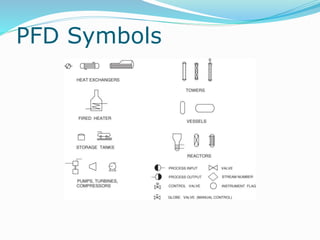
PFD Symbols
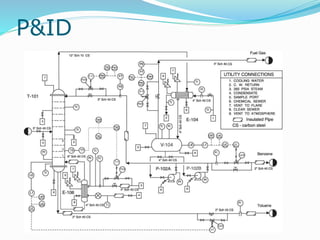
Piping and Instrumentation
Diagrams (P&IDs)
 Additional level of details for overall design process
 Contain schematics for all piping, valves,
instrumentation components, utilities, and control
mechanism.
 Need major design specifications for equipment like
design pressure and temperature, pump flow, etc.
 Microsoft Vizio professional has PFD library
P&ID
P&ID
 The process and instrumentation diagram (“P&ID” as it
often called) represents a document that can take on many
different forms depending upon the following factors:
 Nature of the process being depicted. The more
complicated the process, or the more one process is
interconnected to other portions of the P&ID, the more
complex the P&ID will become.
 The individual or firm performing the design work. This
approach is used to achieve economies on system design.
 Design philosophy. Some design philosophies include P&IDs
as an item issued with the instrumentation or electrical
design (developed at the middle or end of the project).
Other design philosophies allow the P&IDs to be used as the
basis for all other design disciplines. In this philosophy, the
electrical, mechanical, and piping engineers on a project
would start their work once the P&IDs are complete.
 Follow ISA link for more detailed explanation
Process Design
 Vessel and piping Isometric drawings
 Location / layout/orientation
 Can use computer software
 Used for construction / Evaluation
 Scale up equipment in design (new technologies from
pilot plant) see book table 3-1
 Safety factors for equipment design and
 Overdesign in uncertain conditions
 Fouling
 Corrosion / Life
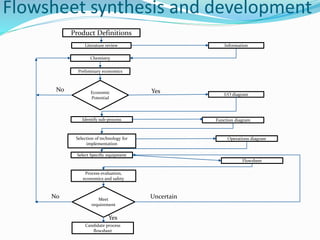
Flowsheet synthesis and development
Product Definitions
Literature review Information
Chemistry
Preliminary economics
Economic
Potential
I/O diagram
Identify sub-process
Selection of technology for
implementation
Function diagram
Operations diagram
Flowsheet
Process evaluation,
economics and safety
Meet
requirement
Candidate process
flowsheet
YesNo
Select Specific equipment
No
Yes
Uncertain
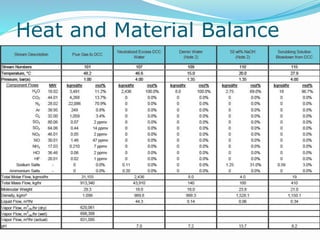
Heat and Material Balance
 Wet and Dry basis
 Temperature / Pressure / Composition /
Enthalpy / Phase (vapor or liquid or two phase),
mass rate, …
 For gases Cp, Cv, Z, density and viscosity, …
 For liquid heat capacity, flash point, heat of
vaporization, thermal expansion coefficient,
surface tension, normal boiling point, …
Heat and Material Balance
Equipment Specification
 Identification
 Function
 Operation
 Material’s handled
 Basic design data
 Essential Controls
 Insulation requirements
 Allowable tolerances
 Special information related to operation/start up
maintenance
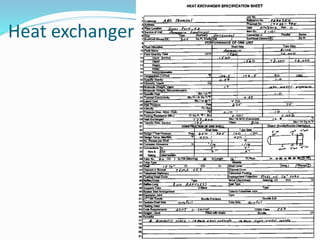
Heat exchanger

Process design for chemical engineers

  • 1.
  • 2.
    Introduction  Class Expectations To be able to provide a complete design package of a chemical plant and complete report  Groups of maximum 4 students  Project due on Dec 1st in electronic pdf format
  • 3.
    Project  Technology selection(review of current technologies)  Design basis  Safety review  Heat and Material Balance  PFD and P&ID  Tags (numbers) for all equipment  Design datasheet for all equipment  Cost estimate (operating and capital)  Calculation sheets (can be excel file / files regarding sizing, cost estimates and other related design calculation)  Energy intensity / efficiency  References
  • 4.
    Project  Group projectis confidential to group members (do not share)  Furnaces require NOx removal technology  Relief valves are required  Inherent safe design is recommended  If you need help, please ask early  In group presentation every member will present own work in 5 minutes  A power point presentation of 3 to 5 minuets for your customer with general design description recorded with power point (electronic file by team) or subtitles  Final project in PDF format (hard copy not required)
  • 5.
    Report requirement  Teamleader is responsible for weekly update report  An update report every 14 days due on Tuesday  Include percent progress (graphical representation)  Each team member contribution  Completed tasks  Remaining tasks  One page summary (electronically)  Track hours for each members
  • 6.
    Grade  55 pointsis project  Final report  Presentation  Bi-Weekly update  Documentation  Percent contribution to project  Simulation  Calculation sheets  10 points class attendance  20 points midterm / Quiz  15 points homework / Class mini projects
  • 7.
    Project Gas treatment A customer is interested to use a gas at 100 deg F and 70 psig for a feed to generate hydrogen. Process requires 5 ppm (weight basis) maximum sulfur in the feed. I recommend to design a cryogenic process and fuel gas hydrotreater.
  • 8.
    Fuel Gas composition DryBasis Percent (Molar) Hydrogen 9 Methane 40 Ethane 26 Ethylene 5 Propane 11 Propylene 2 Butane 0.3 Butylene 0.1 Pentane 0.1 Methyl mercaptan 3.5 Ethyl Mercaptan 1.19 Propyle Mercaptan 0.5 Carbonyl sulfide 0.4 Carbon Dioxide 0.91
  • 9.
    Project Hydrogen  Designa hydrogen plant to generate ~20 mmscfd of hydrogen  Steam reformer  Separation of H2/CO2  Fuel should include Natural gas with 25 percent and fuel gas purified from project gas treatment  Is there a better fit to design for plant hydrogen production?
  • 10.
    CO2 Recovery  CO2recovered from Hydrogen plants need to be absorbed and recovered.  CO2 is available at 100 deg F and 25 psig.  Can we convert CO2 to fuel (ethanol or methanol)?  Design a process to do so.
  • 11.
    Alkylation plant  C3and C4 Alkylation reaction  Use sulfuric acid as a catalyst  Market demand is 10,000 BPD  C3 olefin and Isobutane is available from upstream plants
  • 12.
    Isomerization plant - Butamer http://www.uop.com/processing- solutions/refining/gasoline/#naphtha- isomerization
  • 13.
    Isomerization plant -Penex  http://www.uop.com/isomerization-penex/
  • 14.
    Produce propylene from propane http://www.uop.com/processing- solutions/petrochemicals/olefins/#propylene  https://sites.google.com/a/intratec.us/intratec -base/home/chemical- processes/propylene/propylene-from- propane-via-dehydrogenation-similar-to- uhde-star-process
  • 15.
    Production of Ethanol Use Ethylene to product ethanol  Evaluate other potential technologies and cost’  Can use ethylene as feed stock or bio based materials  Need a comparison and technology selection criteria
  • 16.
    Crude unit  Crudedistillation in atmospheric column  Includes Desalter, heater  Should produce Gas, Naphtha, Jet and Diesel within accepted specification  Can use any crude composition available  Calculate how much EFO/bbl (energy efficiency)
  • 17.
  • 18.
  • 19.
  • 20.
  • 21.
  • 22.
  • 23.
    Design a lightnaphtha hydrotreater  Feed is C3 to C6 hydrocarbon (0.8% sulfur, 0.2 % nitrogen) with 10 mbpd feed rate.  http://kolmetz.com/pdf/EDG/ENGINEERING%2 0DESIGN%20GUIDELINE- HYDROTREATING%20Rev%2002%20web.pdf
  • 24.
    Literature Survey Data Online resources including (knovel.com),  Manufacture and technology owner / Consultant  Patents  Encyclopedia of Chemical Technology (Kirk & Othmer)  Ullmann’s Encyclopedia of industrial technology  Hydrocarbon processing publications  Libraries
  • 25.
    Chemical Engineering plant design All engineering aspects involved in the development of a new, modified, or expanded commercial process in a chemical or biochemical plant.  Chemical engineer will  make economic evaluation of process  Design each individual piece of equipment  Develops plant layout  Provides guidance for the plant control and operation
  • 26.
    Team work  Mosteffective design is when a design team members are familiar with fundamental and general aspects of other engineers in the design team.  Leadership of project manager and management is critical in the success of the project  Consideration of Business aspects of the design is a critical factor  Failure to consider all the design aspects can create safety, economic and process challenges. (link to examples)
  • 27.
  • 28.
    Primary causes ofengineering disasters  The primary causes of engineering disasters are usually considered to be  Human factors (including both 'ethical' failure and accidents)  Design flaws (many of which are also the result of unethical practices)  Materials failures  Extreme conditions or environments, and, most commonly and importantly  Combinations of these reasons
  • 29.
    Overall design consideration Process design development  Flowsheet development  Computer aided design  Cost estimation  Profitability analysis of investment  Optimum design  Optimum operation design
  • 30.
    Typical design steps Recognize a market need for new or existing product  Evaluate potential solution to meet the market need (literature survey, patent, etc.)  Preliminary process design (reaction, synthesis , separation, process safety, operation, environmental limits, local laws and regulations, etc.)  Assess profitability of the process  Refine and verify the design data  Detailed engineering design  Develop base case  Process flowsheet  Integration and optimization  Process control  Equipment sizing  Capital cost estimate
  • 31.
    Typical design steps- continued  Reassess the economic viability of the process  Environmental, health and safety review  Written process design report  Complete engineering design package  Equipment layout and specifications  Piping and instrumentation diagrams  Prepare bids for equipment and construction  Equipment procurement  Construction and installation  Operations profiles and procedures  Start up
  • 32.
    Health and SafetyHazards  Health and chemicals:  Inherent toxicity of material  Frequency and duration of exposure  Will come back to this subject
  • 33.
    Safety Data Sheet(SDS) safety data sheet (SDS), material safety data sheet (MSDS), or product safety data sheet (PSDS) is an important component of product stewardship and occupational safety and health. It is intended to provide workers and emergency personnel with procedures for handling or working with that substance in a safe manner, and includes information such as physical data (melting point, boiling point, flash point, etc.), toxicity, health effects, first aid, reactivity, storage, disposal, protective equipment, and spill- handling procedures. SDS formats can vary from source to source within a country depending on national requirements.
  • 34.
    Codes and Standards API (American Petroleum institute)  Since 1924, The American Petroleum Institute (API) has been the leader in developing equipment and operating standards for the oil and natural gas industry  ASME (American Society of Mechanical Engineers)  ASME is the leading international developer of codes and standards associated with the art, science, and practice of mechanical engineering. Starting with the first issuance of its legendary Boiler & Pressure Vessel Code in 1914, ASME's codes and standards have grown to nearly 600 offerings currently in print. These offerings cover a breadth of topics, including pressure technology, nuclear plants, elevators / escalators, construction, engineering design, standardization, and performance testing.  ANSI (American National Standards Institute)
  • 35.
    Codes and Standards- Continued  ISO  NIST (National Institute of Standards and Technology)  NFPA
  • 36.
    Codes and Standards- Continued  TEMA  ISA  Local/regional government codes is the primary source of guidance that needs to be followed in addition / or accordance to accepted industry codes and standards.
  • 37.
    Process flow diagram(PFD)  Can be qualitative / quantitative or combined  Qualitative  Flow of materials  Unit operations  Equipment necessary  T, P …  Quantitative  quantities of materials used in operation  Preliminary PFD should be constructed in early stages of project.
  • 38.
  • 39.
  • 40.
    Piping and Instrumentation Diagrams(P&IDs)  Additional level of details for overall design process  Contain schematics for all piping, valves, instrumentation components, utilities, and control mechanism.  Need major design specifications for equipment like design pressure and temperature, pump flow, etc.  Microsoft Vizio professional has PFD library
  • 41.
  • 42.
    P&ID  The processand instrumentation diagram (“P&ID” as it often called) represents a document that can take on many different forms depending upon the following factors:  Nature of the process being depicted. The more complicated the process, or the more one process is interconnected to other portions of the P&ID, the more complex the P&ID will become.  The individual or firm performing the design work. This approach is used to achieve economies on system design.  Design philosophy. Some design philosophies include P&IDs as an item issued with the instrumentation or electrical design (developed at the middle or end of the project). Other design philosophies allow the P&IDs to be used as the basis for all other design disciplines. In this philosophy, the electrical, mechanical, and piping engineers on a project would start their work once the P&IDs are complete.  Follow ISA link for more detailed explanation
  • 43.
    Process Design  Vesseland piping Isometric drawings  Location / layout/orientation  Can use computer software  Used for construction / Evaluation  Scale up equipment in design (new technologies from pilot plant) see book table 3-1  Safety factors for equipment design and  Overdesign in uncertain conditions  Fouling  Corrosion / Life
  • 44.
    Flowsheet synthesis anddevelopment Product Definitions Literature review Information Chemistry Preliminary economics Economic Potential I/O diagram Identify sub-process Selection of technology for implementation Function diagram Operations diagram Flowsheet Process evaluation, economics and safety Meet requirement Candidate process flowsheet YesNo Select Specific equipment No Yes Uncertain
  • 45.
    Heat and MaterialBalance  Wet and Dry basis  Temperature / Pressure / Composition / Enthalpy / Phase (vapor or liquid or two phase), mass rate, …  For gases Cp, Cv, Z, density and viscosity, …  For liquid heat capacity, flash point, heat of vaporization, thermal expansion coefficient, surface tension, normal boiling point, …
  • 46.
  • 47.
    Equipment Specification  Identification Function  Operation  Material’s handled  Basic design data  Essential Controls  Insulation requirements  Allowable tolerances  Special information related to operation/start up maintenance
  • 48.