Malaria
Arun Kumar Parthasarathy
D.Y Patil Medical College, Kolhapur
Malaria parasites
Belongs to the genus Plasmodium
Approx 156 named spp- infect vertebrates
4 – infect humans
1. P.falciparum
2. P.vivax
3. P. malariae
4. P.ovale
Important vector borne disease.
• P. Knowlesi-parasite of monkey but can also affect
humans and many cases affecting man were recently
reported fromAsia.
95% of infection
Distribution
P. falciparum- Tropics
P. vivax- widest distribution (Tropics, Subtropics &
Temperate
P. malariae- Sporodically
P.ovale- Rare, common in western Africa
In India- P.vivax & P.falciparum- common
Few cases- P.malariae & P.ovale reported
Vector – Female Anopheline mosquito
Out of 45 species of Anopheline mosquitoes in India,
only a few are regarded as vectors of primary
importance.
A. culicifacies rural areas
A. stephensi urban areas
A. fluviatilis hilly areas
A. minimus, A. philippinensis,
A. sundaicus and A. maculatus
Others
Life Cycle
Complex life cycle
Intermediate host: man (Asexual Phase)
Definitive host: Mosquito (Female anopheles)- Sexual Phase
Infective form : Sporozoites
Stages..
1. Primary exo-erythrocytic stages/ Pre- erythrocytic
schizogony
2. Erythrocytic schizogony
3. Gametogony
4. Secondary exo-erythrocytic or dormant schizogony
Pre-patent period
Ring forms are the first asexual form that can be
demonstrated in the peripheral blood.
The time interval betweeen the entry of the parasite into
man and demonstration of the parasites in the peripheral
blood- pre-patent period.
It varies b/w the species
1. P.falciparum- 5 days
2. P.ovale-13 days
3. P.malaraie -9 days
4. P.vivax -8 days
P. vivax P. falciparum P. malariae P.ovale
Yellowish
brown, Fine
granules
Dark brown,
one/two solid
blocks
Bark brown,
Coarse granules
Dark yellowish
brown, coarser
than those of P.
vivax
Malarial Pigment…
Plasmodium feeds on haemoglobulin. The undigested product of
haemoglobulin metabolism like hematin, excess protein and iron
porphyrin combine to form malarial pigment
P. vivax P. falciparum P. malariae P.ovale
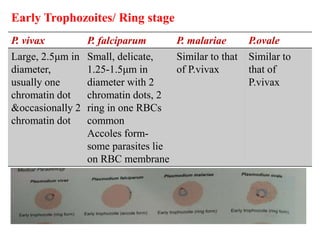
Large, 2.5μm in
diameter,
usually one
chromatin dot
&occasionally 2
chromatin dot
Small, delicate,
1.25-1.5μm in
diameter with 2
chromatin dots, 2
ring in one RBCs
common
Accoles form-
some parasites lie
on RBC membrane
Similar to that
of P.vivax
Similar to
that of
P.vivax
Early Trophozoites/ Ring stage
P. vivax P. falciparum P. malariae P.ovale
Large,
amoeboid,
predominant
vacuole
Medium size,
compact &
rounded
Small, compact,
band-shaped,
slightly amoeboid,
vacuole disappears
early
Slightly
amoeboid
Late Trophozoites
P. vivax P. falciparum P. malariae P.ovale
Large, 9-10μm
in dm, almost
fills an enlarged
RBCs
Small, 4.5-5μm in
diameter fills two
thirds of normal
size RBCs which
is not enlarged
Small, 6.5-7
μm , almost
fills a of
normal size
RBCs
Small, 6.2 μm
, fills about
three quarters
of slightly
enlarged
RBCs
Schizonts
P. vivax P. falciparum P. malariae P.ovale
14-24 14-32 6-12 6-12
Merozoites
On 10th day – oocyst is fully mature and releases the Sporozoites (Body cavity of
mosquito )
Through the body fluids – Sporozoites are distributed to various organs of the
body except ovaries
Sporozoites are special predilection for salivary glands and reach in
maximum number ultimately in the salivary ducts .
Laboratory Diagnosis
Malaria is one of the few parasitic infections considered to be
immediately life-threatening and a medical emergency
Microscopy:
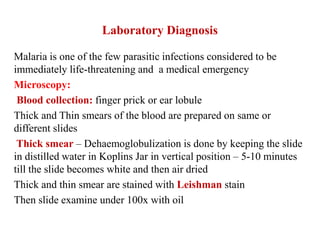
Blood collection: finger prick or ear lobule
Thick and Thin smears of the blood are prepared on same or
different slides
Thick smear – Dehaemoglobulization is done by keeping the slide
in distilled water in Koplins Jar in vertical position – 5-10 minutes
till the slide becomes white and then air dried
Thick and thin smear are stained with Leishman stain
Then slide examine under 100x with oil
Parasite are abundant in peripheral blood, late in the febrile paroxysm
All asexual erythrocytic stages as well as gametocytes can be seen –
peripheral blood (P.vivax, P.malariae, P.ovale)
P.falciparum – ring form and Crescent shape gametocytes
Late Trophozoite and Schizonts – internal organs and appear in
peripheral blood only in severe or perinecious anemia
Malaria pigments may be demonstrated inside the monocytes and
PMNL cells
Presence of malaria pigment and absence of malaria parasites-P.
falciparum infection
RBCs –enlarged in vivax infection
Thin film is examined first and if parasites are found – no need to
examine thick smear
If parasite not seen in thin smear in a few minutes the thick smear
should be examined
Parasites are more along the upper and lower margins of the tail
Atleast 200-300 oil immersion field should be examined before the
smears are considered negative
Fluorescence microscope: stains with Acridine orange -
allows quicker screening of films, because parasites are
more readily recognized and a low power lens may be used
Quantification
Quantification is done by calculating the number of parasites
counted compared to number of WBCs in the thick smear or the
number RBCs counted in the thin smear
Quantification by thick smear =
No. of parasites counted
No. of WBC Counted
X 100
Quantification is helpful for
1. Assessing the severity of infection
2. Monitoring the response to the treatment
3. Detecting drug resistance P.falciparum
Rapid Test
Most frequently they employ a dipstick or test strip bearing monoclonal
antibodies directed against the targeted parasite antigens .
Within 15 minutes test can be performed
Targeted antigens:
1. Histidine-Rich Protein II (HRP-II): water soluble protein
produced by trophozoites and young gametocytes of P.falciparum.
2. Parasite Lactate Dehydrogenase (pLDH): produced by asexual
and sexual stages of malaria parasites. They can distinguish
P.falciparum from the non-P.falciparum spp but cannot distinguished
between other 3 spp
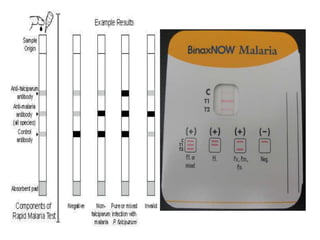
Dual antigen test
Test detect pLDH (Parasite Lactate Dehydrogenase) produced by
trophozoites and gametocytes of all plasmodium spp and PF-HRP-2
antigen.
2 bands are seen,
one is genus specific (Plasmodium) and other is species specific
(P.flaciparum)
It is a Rapid 2 site sandwich immunoassay
Used for species detection and differentiation of P.vivax and
P.falciparum malaria in areas with high rates of malaria infection.
Disadvantage:- cannot differentiate between P.vivax, P.ovale and
P.malariae
Quantitative Buffy Coat Test (QBC)
Developed by Becton and Dickenson Inc.
It involves staining of centrifuged and compressed of red cell layer
with acridine orange
Examination under UV light source
Other Technique
PCR, Serology
Culture
Trager and Jensen(1976) successfully
cultivated and maintained P.falciparum in
vitro in human red blood cells
Used RPMI 1640 medium in a continuous
flow system
Human erythrocytes were in a shallow
stationery layered covered by a shallow
layer of medium
Medium was flowed slowly and
continuously under an atmosphere with
7% CO2 , 1-5% O2
Now it is widely used for the production
for the antigen
Treatment
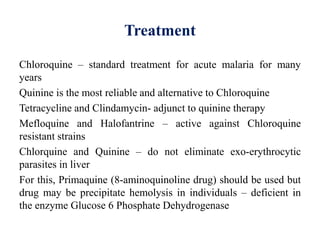
Chloroquine – standard treatment for acute malaria for many
years
Quinine is the most reliable and alternative to Chloroquine
Tetracycline and Clindamycin- adjunct to quinine therapy
Mefloquine and Halofantrine – active against Chloroquine
resistant strains
Chlorquine and Quinine – do not eliminate exo-erythrocytic
parasites in liver
For this, Primaquine (8-aminoquinoline drug) should be used but
drug may be precipitate hemolysis in individuals – deficient in
the enzyme Glucose 6 Phosphate Dehydrogenase
WHO definition and Classification of Drug
Resistance
Ability of a parasite to multiply or to survive in the presence of
concentrations of a drug that normally destroy parasites of the
same species or prevent their multiplication.
Three levels of resistance[R] are defined by WHO
RI: following treatment, Parasitaemia clears but a recrudescence
occurs
RII: following treatment, there is a reduction but not a clearance
of parasitaemia
RIII: Following treatment, there is no reduction of parasitaemia
Method classifying resistance, based on counting trophozoites
in blood films for upto 7 days after treatment and monitoring
the patient for any subsequent recrudescence
Prophylaxis
Spraying Insecticides such as DDT or Malathion
Spraying the breeding sites with petroleum oils and Paris Green
(Copper Acetoarsenite)- larvicides
Using Larvivorous fish (Gambusia affinis),
Bacterium (Bacillus thuringiensis var. israelensis or serotype
H14)- spore forming bacteria produce a crystal of toxic protein(γ-
endotoxin)- spores and crystals are ingested by mosquito larva,
the mouthparts and gut are paralysed and gut epithelium is
destroyed – leading to death
Avoiding exposure to mosquito bite
Thank You

Malaria lab diagnosis

  • 1.
    Malaria Arun Kumar Parthasarathy D.YPatil Medical College, Kolhapur
  • 2.
    Malaria parasites Belongs tothe genus Plasmodium Approx 156 named spp- infect vertebrates 4 – infect humans 1. P.falciparum 2. P.vivax 3. P. malariae 4. P.ovale Important vector borne disease. • P. Knowlesi-parasite of monkey but can also affect humans and many cases affecting man were recently reported fromAsia. 95% of infection
  • 3.
    Distribution P. falciparum- Tropics P.vivax- widest distribution (Tropics, Subtropics & Temperate P. malariae- Sporodically P.ovale- Rare, common in western Africa In India- P.vivax & P.falciparum- common Few cases- P.malariae & P.ovale reported
  • 4.
    Vector – FemaleAnopheline mosquito Out of 45 species of Anopheline mosquitoes in India, only a few are regarded as vectors of primary importance. A. culicifacies rural areas A. stephensi urban areas A. fluviatilis hilly areas A. minimus, A. philippinensis, A. sundaicus and A. maculatus Others
  • 5.
    Life Cycle Complex lifecycle Intermediate host: man (Asexual Phase) Definitive host: Mosquito (Female anopheles)- Sexual Phase Infective form : Sporozoites
  • 6.
    Stages.. 1. Primary exo-erythrocyticstages/ Pre- erythrocytic schizogony 2. Erythrocytic schizogony 3. Gametogony 4. Secondary exo-erythrocytic or dormant schizogony
  • 8.
    Pre-patent period Ring formsare the first asexual form that can be demonstrated in the peripheral blood. The time interval betweeen the entry of the parasite into man and demonstration of the parasites in the peripheral blood- pre-patent period. It varies b/w the species 1. P.falciparum- 5 days 2. P.ovale-13 days 3. P.malaraie -9 days 4. P.vivax -8 days
  • 9.
    P. vivax P.falciparum P. malariae P.ovale Yellowish brown, Fine granules Dark brown, one/two solid blocks Bark brown, Coarse granules Dark yellowish brown, coarser than those of P. vivax Malarial Pigment… Plasmodium feeds on haemoglobulin. The undigested product of haemoglobulin metabolism like hematin, excess protein and iron porphyrin combine to form malarial pigment
  • 10.
    P. vivax P.falciparum P. malariae P.ovale Large, 2.5μm in diameter, usually one chromatin dot &occasionally 2 chromatin dot Small, delicate, 1.25-1.5μm in diameter with 2 chromatin dots, 2 ring in one RBCs common Accoles form- some parasites lie on RBC membrane Similar to that of P.vivax Similar to that of P.vivax Early Trophozoites/ Ring stage
  • 11.
    P. vivax P.falciparum P. malariae P.ovale Large, amoeboid, predominant vacuole Medium size, compact & rounded Small, compact, band-shaped, slightly amoeboid, vacuole disappears early Slightly amoeboid Late Trophozoites
  • 12.
    P. vivax P.falciparum P. malariae P.ovale Large, 9-10μm in dm, almost fills an enlarged RBCs Small, 4.5-5μm in diameter fills two thirds of normal size RBCs which is not enlarged Small, 6.5-7 μm , almost fills a of normal size RBCs Small, 6.2 μm , fills about three quarters of slightly enlarged RBCs Schizonts
  • 13.
    P. vivax P.falciparum P. malariae P.ovale 14-24 14-32 6-12 6-12 Merozoites
  • 14.
    On 10th day– oocyst is fully mature and releases the Sporozoites (Body cavity of mosquito ) Through the body fluids – Sporozoites are distributed to various organs of the body except ovaries Sporozoites are special predilection for salivary glands and reach in maximum number ultimately in the salivary ducts .
  • 15.
    Laboratory Diagnosis Malaria isone of the few parasitic infections considered to be immediately life-threatening and a medical emergency Microscopy: Blood collection: finger prick or ear lobule Thick and Thin smears of the blood are prepared on same or different slides Thick smear – Dehaemoglobulization is done by keeping the slide in distilled water in Koplins Jar in vertical position – 5-10 minutes till the slide becomes white and then air dried Thick and thin smear are stained with Leishman stain Then slide examine under 100x with oil
  • 17.
    Parasite are abundantin peripheral blood, late in the febrile paroxysm All asexual erythrocytic stages as well as gametocytes can be seen – peripheral blood (P.vivax, P.malariae, P.ovale) P.falciparum – ring form and Crescent shape gametocytes Late Trophozoite and Schizonts – internal organs and appear in peripheral blood only in severe or perinecious anemia Malaria pigments may be demonstrated inside the monocytes and PMNL cells Presence of malaria pigment and absence of malaria parasites-P. falciparum infection RBCs –enlarged in vivax infection
  • 18.
    Thin film isexamined first and if parasites are found – no need to examine thick smear If parasite not seen in thin smear in a few minutes the thick smear should be examined Parasites are more along the upper and lower margins of the tail Atleast 200-300 oil immersion field should be examined before the smears are considered negative
  • 20.
    Fluorescence microscope: stainswith Acridine orange - allows quicker screening of films, because parasites are more readily recognized and a low power lens may be used
  • 21.
    Quantification Quantification is doneby calculating the number of parasites counted compared to number of WBCs in the thick smear or the number RBCs counted in the thin smear Quantification by thick smear = No. of parasites counted No. of WBC Counted X 100 Quantification is helpful for 1. Assessing the severity of infection 2. Monitoring the response to the treatment 3. Detecting drug resistance P.falciparum
  • 22.
    Rapid Test Most frequentlythey employ a dipstick or test strip bearing monoclonal antibodies directed against the targeted parasite antigens . Within 15 minutes test can be performed Targeted antigens: 1. Histidine-Rich Protein II (HRP-II): water soluble protein produced by trophozoites and young gametocytes of P.falciparum. 2. Parasite Lactate Dehydrogenase (pLDH): produced by asexual and sexual stages of malaria parasites. They can distinguish P.falciparum from the non-P.falciparum spp but cannot distinguished between other 3 spp
  • 23.
    Dual antigen test Testdetect pLDH (Parasite Lactate Dehydrogenase) produced by trophozoites and gametocytes of all plasmodium spp and PF-HRP-2 antigen. 2 bands are seen, one is genus specific (Plasmodium) and other is species specific (P.flaciparum) It is a Rapid 2 site sandwich immunoassay Used for species detection and differentiation of P.vivax and P.falciparum malaria in areas with high rates of malaria infection. Disadvantage:- cannot differentiate between P.vivax, P.ovale and P.malariae
  • 25.
    Quantitative Buffy CoatTest (QBC) Developed by Becton and Dickenson Inc. It involves staining of centrifuged and compressed of red cell layer with acridine orange Examination under UV light source Other Technique PCR, Serology
  • 28.
    Culture Trager and Jensen(1976)successfully cultivated and maintained P.falciparum in vitro in human red blood cells Used RPMI 1640 medium in a continuous flow system Human erythrocytes were in a shallow stationery layered covered by a shallow layer of medium Medium was flowed slowly and continuously under an atmosphere with 7% CO2 , 1-5% O2 Now it is widely used for the production for the antigen
  • 29.
    Treatment Chloroquine – standardtreatment for acute malaria for many years Quinine is the most reliable and alternative to Chloroquine Tetracycline and Clindamycin- adjunct to quinine therapy Mefloquine and Halofantrine – active against Chloroquine resistant strains Chlorquine and Quinine – do not eliminate exo-erythrocytic parasites in liver For this, Primaquine (8-aminoquinoline drug) should be used but drug may be precipitate hemolysis in individuals – deficient in the enzyme Glucose 6 Phosphate Dehydrogenase
  • 30.
    WHO definition andClassification of Drug Resistance Ability of a parasite to multiply or to survive in the presence of concentrations of a drug that normally destroy parasites of the same species or prevent their multiplication. Three levels of resistance[R] are defined by WHO RI: following treatment, Parasitaemia clears but a recrudescence occurs RII: following treatment, there is a reduction but not a clearance of parasitaemia RIII: Following treatment, there is no reduction of parasitaemia Method classifying resistance, based on counting trophozoites in blood films for upto 7 days after treatment and monitoring the patient for any subsequent recrudescence
  • 31.
    Prophylaxis Spraying Insecticides suchas DDT or Malathion Spraying the breeding sites with petroleum oils and Paris Green (Copper Acetoarsenite)- larvicides Using Larvivorous fish (Gambusia affinis), Bacterium (Bacillus thuringiensis var. israelensis or serotype H14)- spore forming bacteria produce a crystal of toxic protein(γ- endotoxin)- spores and crystals are ingested by mosquito larva, the mouthparts and gut are paralysed and gut epithelium is destroyed – leading to death Avoiding exposure to mosquito bite
  • 32.

Editor's Notes

  • #8 Prepatent period:-