Classification, Morphology and
Pathogenesis of Malaria
◦ Himanshu Shekhar
◦ Roll No. 41
◦ MBBS Batch 2021-22
◦ Moderator: Dr. Rajesh Sir
CLASSIFICATION
◦ Malaria parasite belongs to:
• Phylum:Apicomplexa
• Class:Sporozoa
• Order: Hemosporida
• Genus:Plasmodium
• Species:
• vivax
• falciparum
• Ovale
• Malariae
• knowlesi
MORPHOLOGY
Plasmodium vivax
Synonym: P multinucleatum
P hybernans
Causes Benign Tertian Malaria
Commonly found in tropics and sub tropics regions
Prefers to infect the reticulocytes (young RBCs)
Forms of parasite seen in peripheral blood- trophozoites , schizonts and gametocytes.
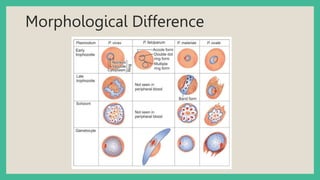
◦ Ring form in RBC- large 2.5 micrometer single chromatin prominent
◦ Late trophozoites-large irregular with prominent vacuole, actively amoeboid
◦ Schizonts 9-10 large fills entire Cell
◦ Gametocyte –spherical or globular
◦ Host cell – enlarges with Schnuffer‘s dots. Fine golden brown pigments present.
Plasmodium falciparum
Causes Malignant Tertian Malaria
Synonym: Pernicious malaria
Quite lethal in nature.
Prefers to affect young RBCs but can affect RBCs of all ages.
Formation of parasite in peripheral blood-only ring and crescent gametocytes.
Ring form in RBCs – Delicate small 1.5 micrometre .Double chromatin and multiple rings common
. Accole form found.
Gametocytes – crescentic. Larger than RBCs.
Morphological Difference
Plasmodium malariae
Cause benign Quartan Malaria
◦ Prefers to infect old RBCs.
◦ Forms of parasite in peripheral blood –trophozoites, schizonts and gametocytes.
◦ Ring form in RBCs – large 2.5 single, thick prominent Chromatin.
◦ Late trophozoites – band like, slightly amoeboid.
◦ Schizonts almost fills a normal RBCs.
◦ Gametocytes spherical or globular.
◦ Malarial pigments- dark brown coarse granules.
Plasmodium ovale
◦ Causes Benign tertian malaria
◦ Synonyms-ovale tertian malaria
◦ Due to it’s tertian periodicity and irregular oval shape of infected RBCs.
◦ Prefers to infects reticulocytes.
◦ Relapse is seen due to dormant sporozoites.
PATHOGENESIS
◦ The incubation period varies between the species –P vivax(14 days), P falciparum (12 days), P
malariae(28 days) and P ovale (17 days).
◦ It is characterized by a triad of febrile paroxysm, anemia and splenomegaly.
◦ FEBRILE PAROXYSM- fever comes intermittently depending on the species.
◦ Apperance of paroxysm is due to release of successive merozoites into the bloodstream.
◦ Each paroxysm is comprised of three stages such as:
◦ 1) cold stage
◦ 2) hot stage
◦ 3) Sweating stage
◦ ANEMIA- It results from the lysis of RBCs due to release of merozoites.
◦ Anemia is severe in most cases of P falciparum as it infects RBCs of all age group.
◦ SPLENOMEGALYl-It occurs due to the passive proliferation of macrophages inside the spleen to
remove the parasitized and non parasitized coated RBCs.
Life cycle and Clinical features
of malaria
Asexual cycle in man
• After the mosquito bite: Sporozoites are discharged to blood, carried to
liver
• Liver cycle (pre or exoerythrocytic cycle): Sporozoites transform to
trophozoites →pre-erythrocytic schizont undergoes schizogony to produce
→ Pre erythrocytic merozoites
• Erythrocytic cycle: pre erythrocytic merozoites infect RBCs → transform to
early trophozoites (ring form)→ late trophozoites → erythrocytic schizont
→ Undergoes schizogony to produce merozoites
• Release of merozoites leads to appearance of clinical manifestations
• Merozoites either attack RBCs to repeat the cycle or transform to
gametocytes which infect mosquito
Sexual cycle (Sporogony)
Begins when gametocytes infect the female anopheles mosquito and
then transform to gametes → zygote → ookinete → oocyst →
sporozoites
Clinical features
1. Febrile paroxysm
Fever comes intermittently depending on the species. It occurs every fourth day (72 hour cycle for P. malariae) and
every third day (48 hour cycle for other three species)
Each paroxysm of fever is comprised of three stages—(1) cold stage (2) hot stage and (3) sweating stage
Cold stage: Lasts for 15 minutes to 1 hour. The patient feels lassitude, headache, nausea, intense cold, chill and rigor
Hot stage: Patient develops high grade fever of 39–41°C and dry burning skin. Headache persists but nausea
diminishes.
Sweating stage: Fever comes down with profuse sweating. Skin becomes cold and moist. Patient feels relieved and
often asleep. This stage lasts for 2–4 hours
2. Anemia
After a few paroxysms of fever, patient deve lops a normocytic normochromic anemia. Various factors can attribute
to the development of anemia such as:
• Parasite induced RBC destruction—Lysis of RBC due to release of merozoites
• Splenic removal of both infected RBC and uninfected RBC coated with immune complexes
• Bone marrow suppression leading to decrease RBC production
• Increased fragility of RBCs
• Autoimmune lysis of coated RBCs
3. Splenomegaly (enlarged spleen):After a few weeks of febrile paroxysms, spleen gets enlarged and becomes
palpable. Splenomegaly is due to massive proliferation macrophages that engulf parasitized and nonparasitized
coated RBCs.
4. Irritability
5. Coma, Retinal Hemorrhages
7. Algid malaria ( a shock like syndrome)
6. Respiratory distress syndrome

1.pptx

  • 1.
    Classification, Morphology and Pathogenesisof Malaria ◦ Himanshu Shekhar ◦ Roll No. 41 ◦ MBBS Batch 2021-22 ◦ Moderator: Dr. Rajesh Sir
  • 2.
    CLASSIFICATION ◦ Malaria parasitebelongs to: • Phylum:Apicomplexa • Class:Sporozoa • Order: Hemosporida • Genus:Plasmodium • Species: • vivax • falciparum • Ovale • Malariae • knowlesi
  • 3.
    MORPHOLOGY Plasmodium vivax Synonym: Pmultinucleatum P hybernans Causes Benign Tertian Malaria Commonly found in tropics and sub tropics regions Prefers to infect the reticulocytes (young RBCs) Forms of parasite seen in peripheral blood- trophozoites , schizonts and gametocytes.
  • 4.
    ◦ Ring formin RBC- large 2.5 micrometer single chromatin prominent ◦ Late trophozoites-large irregular with prominent vacuole, actively amoeboid ◦ Schizonts 9-10 large fills entire Cell ◦ Gametocyte –spherical or globular ◦ Host cell – enlarges with Schnuffer‘s dots. Fine golden brown pigments present.
  • 5.
    Plasmodium falciparum Causes MalignantTertian Malaria Synonym: Pernicious malaria Quite lethal in nature. Prefers to affect young RBCs but can affect RBCs of all ages. Formation of parasite in peripheral blood-only ring and crescent gametocytes. Ring form in RBCs – Delicate small 1.5 micrometre .Double chromatin and multiple rings common . Accole form found. Gametocytes – crescentic. Larger than RBCs.
  • 6.
  • 7.
    Plasmodium malariae Cause benignQuartan Malaria ◦ Prefers to infect old RBCs. ◦ Forms of parasite in peripheral blood –trophozoites, schizonts and gametocytes. ◦ Ring form in RBCs – large 2.5 single, thick prominent Chromatin. ◦ Late trophozoites – band like, slightly amoeboid. ◦ Schizonts almost fills a normal RBCs. ◦ Gametocytes spherical or globular. ◦ Malarial pigments- dark brown coarse granules.
  • 8.
    Plasmodium ovale ◦ CausesBenign tertian malaria ◦ Synonyms-ovale tertian malaria ◦ Due to it’s tertian periodicity and irregular oval shape of infected RBCs. ◦ Prefers to infects reticulocytes. ◦ Relapse is seen due to dormant sporozoites.
  • 9.
    PATHOGENESIS ◦ The incubationperiod varies between the species –P vivax(14 days), P falciparum (12 days), P malariae(28 days) and P ovale (17 days). ◦ It is characterized by a triad of febrile paroxysm, anemia and splenomegaly. ◦ FEBRILE PAROXYSM- fever comes intermittently depending on the species. ◦ Apperance of paroxysm is due to release of successive merozoites into the bloodstream. ◦ Each paroxysm is comprised of three stages such as: ◦ 1) cold stage ◦ 2) hot stage ◦ 3) Sweating stage
  • 10.
    ◦ ANEMIA- Itresults from the lysis of RBCs due to release of merozoites. ◦ Anemia is severe in most cases of P falciparum as it infects RBCs of all age group. ◦ SPLENOMEGALYl-It occurs due to the passive proliferation of macrophages inside the spleen to remove the parasitized and non parasitized coated RBCs.
  • 12.
    Life cycle andClinical features of malaria
  • 14.
    Asexual cycle inman • After the mosquito bite: Sporozoites are discharged to blood, carried to liver • Liver cycle (pre or exoerythrocytic cycle): Sporozoites transform to trophozoites →pre-erythrocytic schizont undergoes schizogony to produce → Pre erythrocytic merozoites • Erythrocytic cycle: pre erythrocytic merozoites infect RBCs → transform to early trophozoites (ring form)→ late trophozoites → erythrocytic schizont → Undergoes schizogony to produce merozoites • Release of merozoites leads to appearance of clinical manifestations • Merozoites either attack RBCs to repeat the cycle or transform to gametocytes which infect mosquito
  • 15.
    Sexual cycle (Sporogony) Beginswhen gametocytes infect the female anopheles mosquito and then transform to gametes → zygote → ookinete → oocyst → sporozoites
  • 16.
    Clinical features 1. Febrileparoxysm Fever comes intermittently depending on the species. It occurs every fourth day (72 hour cycle for P. malariae) and every third day (48 hour cycle for other three species) Each paroxysm of fever is comprised of three stages—(1) cold stage (2) hot stage and (3) sweating stage Cold stage: Lasts for 15 minutes to 1 hour. The patient feels lassitude, headache, nausea, intense cold, chill and rigor Hot stage: Patient develops high grade fever of 39–41°C and dry burning skin. Headache persists but nausea diminishes. Sweating stage: Fever comes down with profuse sweating. Skin becomes cold and moist. Patient feels relieved and often asleep. This stage lasts for 2–4 hours 2. Anemia After a few paroxysms of fever, patient deve lops a normocytic normochromic anemia. Various factors can attribute to the development of anemia such as: • Parasite induced RBC destruction—Lysis of RBC due to release of merozoites • Splenic removal of both infected RBC and uninfected RBC coated with immune complexes • Bone marrow suppression leading to decrease RBC production • Increased fragility of RBCs • Autoimmune lysis of coated RBCs
  • 17.
    3. Splenomegaly (enlargedspleen):After a few weeks of febrile paroxysms, spleen gets enlarged and becomes palpable. Splenomegaly is due to massive proliferation macrophages that engulf parasitized and nonparasitized coated RBCs. 4. Irritability 5. Coma, Retinal Hemorrhages 7. Algid malaria ( a shock like syndrome) 6. Respiratory distress syndrome