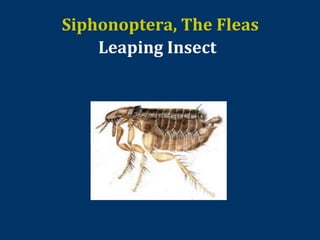
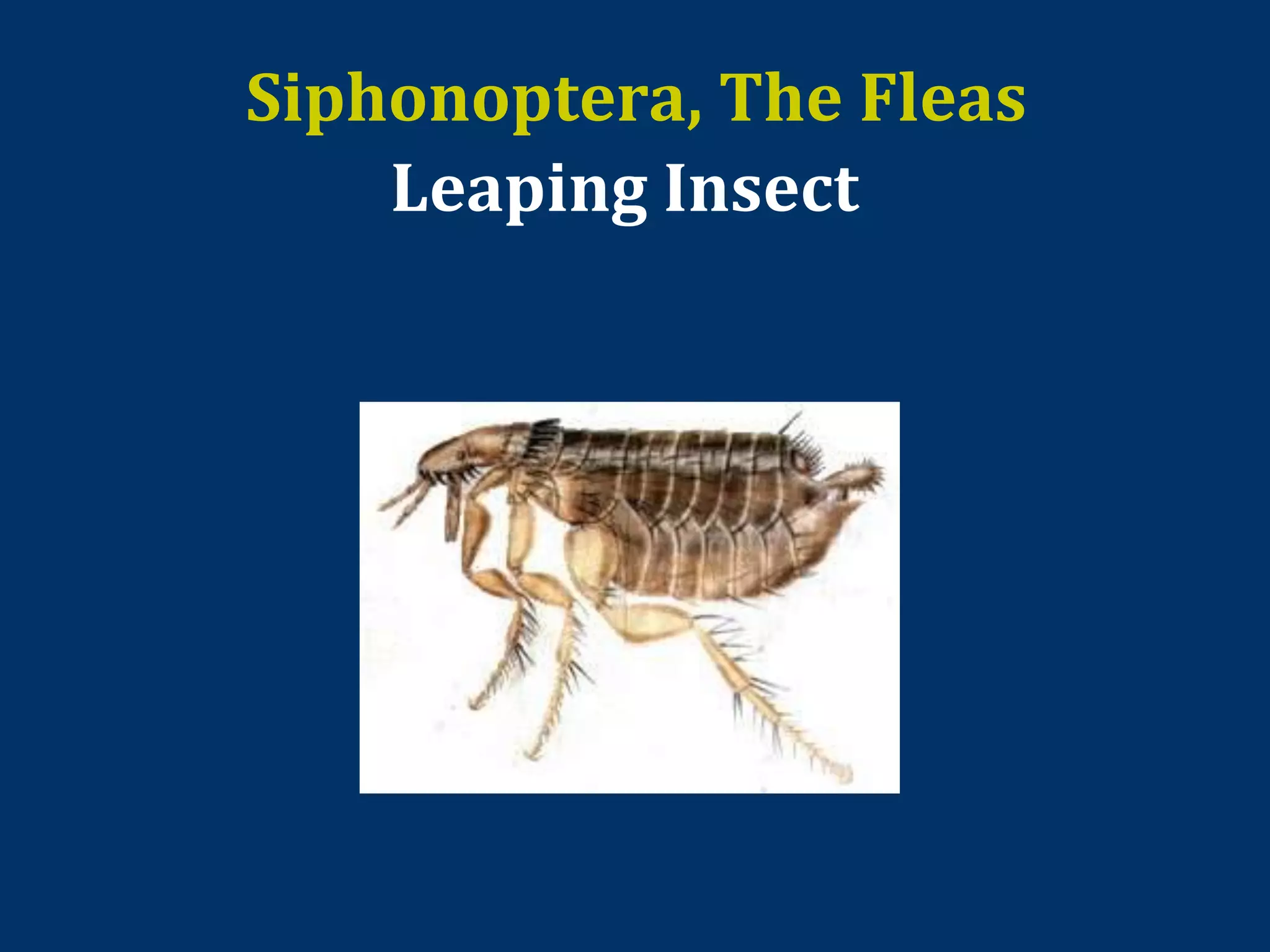
Siphonoptera, The Fleas
Leaping Insect
Morphology
• The body is laterally compressed and the first segment on each leg
(the coxa) is large and provides incredible power for jumping; lateral
compression allows ease of movement through the hairs on the host;
being a good jumper allows them to effectively move from one host to
another
•The antennae of males are nearly always longer than those of
females; during copulation, the male takes up a position beneath the
female and holds her firmly with his antennae from below
• The male body has an upward tilt posteriorly, but the female body is
evenly rounded terminally
Morphology cont.
• Fleas are encased in a suit of armor; each segment of the thorax may
be regarding as a membranous ring of adjoining plates
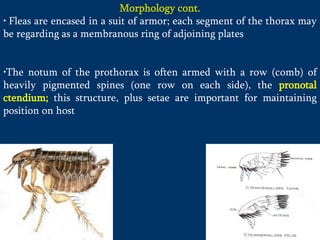
•The notum of the prothorax is often armed with a row (comb) of
heavily pigmented spines (one row on each side), the pronotal
ctendium; this structure, plus setae are important for maintaining
position on host
Morphology cont.
1. The abdomen consists of ten segments, and each segment has a
dorsal and ventral sclerite; these plates overlap on the abdomen,
permitting considerable flexibility of the abdomen
2. Dorsal sclerite 9 of the male is modified to form a clasping
apparatus used during copulation with the female
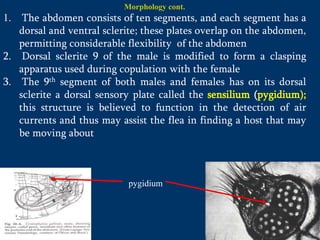
3. The 9th segment of both males and females has on its dorsal
sclerite a dorsal sensory plate called the sensilium (pygidium);
this structure is believed to function in the detection of air
currents and thus may assist the flea in finding a host that may
be moving about
pygidium
Morphology cont.
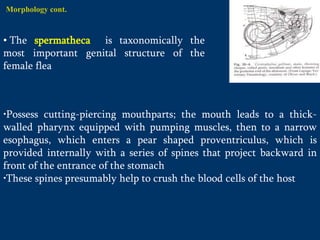
• The spermatheca is taxonomically the
most important genital structure of the
female flea
•Possess cutting-piercing mouthparts; the mouth leads to a thick-
walled pharynx equipped with pumping muscles, then to a narrow
esophagus, which enters a pear shaped proventriculus, which is
provided internally with a series of spines that project backward in
front of the entrance of the stomach
•These spines presumably help to crush the blood cells of the host
Morphology cont.
1. Between the proventiculus and the stomach is a valve that
prevents the food in the stomach from being regurgitated during
the process of digestion
2. A salivary gland lies on each side of the stomach and a duct
leads from these glands to the pharynx
3. During the process of biting and feeding, the piercing
mouthparts enter the host skin, and the flea thrusts its head
downward, elevating the abdomen and the hind legs; after
feeding the mouthparts are withdrawn with a sudden jerk
4. When a flea bites, the salivary pump pours out a stream of saliva
that eventually reaches the host blood vessels; at the same time,
the pharyngeal pumps works to draw up the host blood, mixed
with saliva and forces it into the esophagus and stomach where
it is digested
Life History and Habits
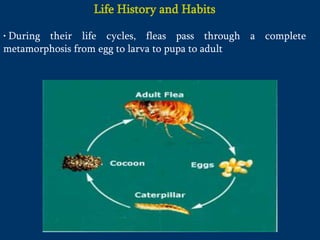
• During their life cycles, fleas pass through a complete
metamorphosis from egg to larva to pupa to adult
Life History and Habits cont.
1. Eggs are large, smooth and oval and translucent
2. In 2-10 days the eggs hatch into eyeless, legless active larvae; the
heads are strongly sclerotized
3. Under favorable conditions, the larvae may reach their 3rd stage
in about 2 weeks, but development may be delayed for 6 months
or more
4. Larvae feed on organic debris in the host’s nest, in crevices on the
floor or under rugs; larvae of bird fleas thrive on broken-down
sheaths of feathers on the epidermal scales of young birds
5. Most fleas have 3 larval stages; each 3rd instar larva spins a cocoon
within which it pupates
6. Pupae may live for a week up to a year depending on the species
and the environmental conditions related to temperature and
moisture
7. The fully formed adult may lie quiescent for an indefinite period
of time before its becomes active and attempt to infect a host
Life History and Habits
1. Fleas are usually equally common on hosts of either sex; however,
there are some exceptions
2. Bat fleas tend to crowd onto female bats before they migrate to
summer colonies
3. Fleas of small mammals may be found more commonly on male
hosts
4. It is not clear why this is the case: larger male size, larger home
ranges, mutually groom females
5. Females usually require a blood meal before they copulate; males
typically die after mating while females live long enough to lay
large quantities of eggs
Fleas and Human Diseases
1. The bacterial causative agent of plague, Yersinia pestis, is
transmitted by fleas (Xenopsylla cheopis and Nosopsyllus
fasciatus) from rodents to man
2. Bacilli in an infected flea so congest its proventriclus and
stomach that blood sucked from a mammalian host fails to pass
into the stomach
3. A “blocked” fleas continues its attempt to feed and bits of
bacillary mass break off and are injected into the host
4. Xenopsylla cheopis and Nosopsyllus fasciatus are also vectors of
a nonepidemic typhus of man, “murine typhus”
5. This fleas borne disease is caused by Rickettsia typhi, which
normally occurs in rats
6. Other diseases that can be transmitted by fleas include
tularemia in man caused by the bacterium Francisella tularensis
7. Cysticercoids stages of several tapeworms (e.g., Dipylidium
caninum) develop in larva of several species of fleas

Flea lecture

  • 1.
  • 2.
    Morphology • The bodyis laterally compressed and the first segment on each leg (the coxa) is large and provides incredible power for jumping; lateral compression allows ease of movement through the hairs on the host; being a good jumper allows them to effectively move from one host to another •The antennae of males are nearly always longer than those of females; during copulation, the male takes up a position beneath the female and holds her firmly with his antennae from below • The male body has an upward tilt posteriorly, but the female body is evenly rounded terminally
  • 3.
    Morphology cont. • Fleasare encased in a suit of armor; each segment of the thorax may be regarding as a membranous ring of adjoining plates •The notum of the prothorax is often armed with a row (comb) of heavily pigmented spines (one row on each side), the pronotal ctendium; this structure, plus setae are important for maintaining position on host
  • 4.
    Morphology cont. 1. Theabdomen consists of ten segments, and each segment has a dorsal and ventral sclerite; these plates overlap on the abdomen, permitting considerable flexibility of the abdomen 2. Dorsal sclerite 9 of the male is modified to form a clasping apparatus used during copulation with the female 3. The 9th segment of both males and females has on its dorsal sclerite a dorsal sensory plate called the sensilium (pygidium); this structure is believed to function in the detection of air currents and thus may assist the flea in finding a host that may be moving about pygidium
  • 5.
    Morphology cont. • Thespermatheca is taxonomically the most important genital structure of the female flea •Possess cutting-piercing mouthparts; the mouth leads to a thick- walled pharynx equipped with pumping muscles, then to a narrow esophagus, which enters a pear shaped proventriculus, which is provided internally with a series of spines that project backward in front of the entrance of the stomach •These spines presumably help to crush the blood cells of the host
  • 6.
    Morphology cont. 1. Betweenthe proventiculus and the stomach is a valve that prevents the food in the stomach from being regurgitated during the process of digestion 2. A salivary gland lies on each side of the stomach and a duct leads from these glands to the pharynx 3. During the process of biting and feeding, the piercing mouthparts enter the host skin, and the flea thrusts its head downward, elevating the abdomen and the hind legs; after feeding the mouthparts are withdrawn with a sudden jerk 4. When a flea bites, the salivary pump pours out a stream of saliva that eventually reaches the host blood vessels; at the same time, the pharyngeal pumps works to draw up the host blood, mixed with saliva and forces it into the esophagus and stomach where it is digested
  • 7.
    Life History andHabits • During their life cycles, fleas pass through a complete metamorphosis from egg to larva to pupa to adult
  • 8.
    Life History andHabits cont. 1. Eggs are large, smooth and oval and translucent 2. In 2-10 days the eggs hatch into eyeless, legless active larvae; the heads are strongly sclerotized 3. Under favorable conditions, the larvae may reach their 3rd stage in about 2 weeks, but development may be delayed for 6 months or more 4. Larvae feed on organic debris in the host’s nest, in crevices on the floor or under rugs; larvae of bird fleas thrive on broken-down sheaths of feathers on the epidermal scales of young birds 5. Most fleas have 3 larval stages; each 3rd instar larva spins a cocoon within which it pupates 6. Pupae may live for a week up to a year depending on the species and the environmental conditions related to temperature and moisture 7. The fully formed adult may lie quiescent for an indefinite period of time before its becomes active and attempt to infect a host
  • 9.
    Life History andHabits 1. Fleas are usually equally common on hosts of either sex; however, there are some exceptions 2. Bat fleas tend to crowd onto female bats before they migrate to summer colonies 3. Fleas of small mammals may be found more commonly on male hosts 4. It is not clear why this is the case: larger male size, larger home ranges, mutually groom females 5. Females usually require a blood meal before they copulate; males typically die after mating while females live long enough to lay large quantities of eggs
  • 10.
    Fleas and HumanDiseases 1. The bacterial causative agent of plague, Yersinia pestis, is transmitted by fleas (Xenopsylla cheopis and Nosopsyllus fasciatus) from rodents to man 2. Bacilli in an infected flea so congest its proventriclus and stomach that blood sucked from a mammalian host fails to pass into the stomach 3. A “blocked” fleas continues its attempt to feed and bits of bacillary mass break off and are injected into the host 4. Xenopsylla cheopis and Nosopsyllus fasciatus are also vectors of a nonepidemic typhus of man, “murine typhus” 5. This fleas borne disease is caused by Rickettsia typhi, which normally occurs in rats 6. Other diseases that can be transmitted by fleas include tularemia in man caused by the bacterium Francisella tularensis 7. Cysticercoids stages of several tapeworms (e.g., Dipylidium caninum) develop in larva of several species of fleas