Dr. P.
Saranraj
Plasma Membrane
Structure and Function
Plasma Membrane
Also called as Cytoplasmic Membrane
or Cell Membrane.
Act as a boundary of cell.
5 to 10 nm thick.
 Prokaryotes – Phospholipids and
Proteins; Eukaryotes – Carbohydrates
and Streols (Cholesterol)
Made up of Phospholipid Bilayer
Phospholipids Structure
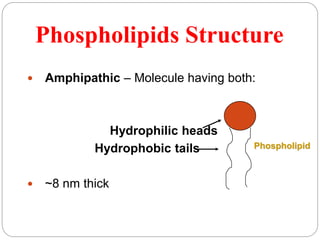
 Amphipathic – Molecule having both:
Hydrophilic heads
Hydrophobic tails
 ~8 nm thick
Phospholipid
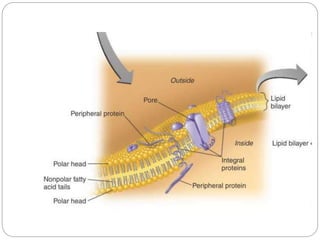
Fluid-Mosaic Model Structure
The dynamic arrangement of
Proteins and Phospholipids in
Plasma membrane is called as Fluid-
Mosaic Model Structure.
Discovered by Jonathan Singer and
Garth Nicholson.
Two types of Membrane proteins are
present (i) Peripheral Proteins and (ii)
Integral Proteins.
Peripheral Proteins
 Connected to the membrane and easily
removed by mild treatments.
 It lies at the inner and outer surface of
the membrane.
 They are soluble in aqueous solution and
make upto 20 to 30 % of total proteins.
 They may function as enzymes that
catalyze chemical reactions and act as a
mediators of changes in membrane shape
during movement.
Integral Proteins
 Integral proteins can be removed from the
membrane only after disrupting the lipid
bilayer (by using detergents).
 Not soluble in aqueous solutions and
forms above 70 – 80 % of Membrane
proteins.
 Most integral proteins penetrate the
membrane completely and are called
Transmembrane proteins.
Glycoproteins & Glycolipids
 Many of the proteins and some of the lipids
on the outer surface of the plasma
membrane have carbohydrates attached to
them.
 Proteins attached to carbohydrates are
called Glycoproteins.
 Lipids attached to carbohydrates are called
Glycolipids.
 Both glycoproteins and glycolipids helps to
protect the cell and lubricate the cells
Plasma Membrane Functions
Protection
ATP Synthesis by Electron Transport
Chain (ETC)
Communication (Cell to cell
interaction)
Transport of substances
Pigments and enzymes responsible
for Photosynthesis are present in Cell
membrane.
Exocytosis and Endocytosis

Plasma membrane

  • 1.
  • 2.
    Plasma Membrane Also calledas Cytoplasmic Membrane or Cell Membrane. Act as a boundary of cell. 5 to 10 nm thick.  Prokaryotes – Phospholipids and Proteins; Eukaryotes – Carbohydrates and Streols (Cholesterol) Made up of Phospholipid Bilayer
  • 3.
    Phospholipids Structure  Amphipathic– Molecule having both: Hydrophilic heads Hydrophobic tails  ~8 nm thick Phospholipid
  • 4.
    Fluid-Mosaic Model Structure Thedynamic arrangement of Proteins and Phospholipids in Plasma membrane is called as Fluid- Mosaic Model Structure. Discovered by Jonathan Singer and Garth Nicholson. Two types of Membrane proteins are present (i) Peripheral Proteins and (ii) Integral Proteins.
  • 6.
    Peripheral Proteins  Connectedto the membrane and easily removed by mild treatments.  It lies at the inner and outer surface of the membrane.  They are soluble in aqueous solution and make upto 20 to 30 % of total proteins.  They may function as enzymes that catalyze chemical reactions and act as a mediators of changes in membrane shape during movement.
  • 7.
    Integral Proteins  Integralproteins can be removed from the membrane only after disrupting the lipid bilayer (by using detergents).  Not soluble in aqueous solutions and forms above 70 – 80 % of Membrane proteins.  Most integral proteins penetrate the membrane completely and are called Transmembrane proteins.
  • 8.
    Glycoproteins & Glycolipids Many of the proteins and some of the lipids on the outer surface of the plasma membrane have carbohydrates attached to them.  Proteins attached to carbohydrates are called Glycoproteins.  Lipids attached to carbohydrates are called Glycolipids.  Both glycoproteins and glycolipids helps to protect the cell and lubricate the cells
  • 9.
    Plasma Membrane Functions Protection ATPSynthesis by Electron Transport Chain (ETC) Communication (Cell to cell interaction) Transport of substances Pigments and enzymes responsible for Photosynthesis are present in Cell membrane. Exocytosis and Endocytosis