guess this:
type ofcell division
that results in the
formation of two
daughter cells each
with the same number
and kind of
chromosomes as the
parent cell.
OBJECTIVES;
01
identify and describethe structural components of the cell membrane
using the fluid mosaic model of membranes.
At the end of the lesson, the learners shall be able to:
02
relate the structure and composition of the cell membrane to its function
03
understand the functions of phospholipids, proteins, and carbohydrates
in membranes
12.
what is acell
membrane?
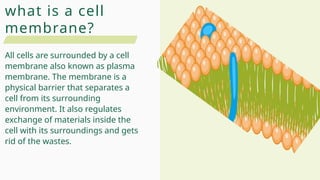
All cells are surrounded by a cell
membrane also known as plasma
membrane. The membrane is a
physical barrier that separates a
cell from its surrounding
environment. It also regulates
exchange of materials inside the
cell with its surroundings and gets
rid of the wastes.
13.
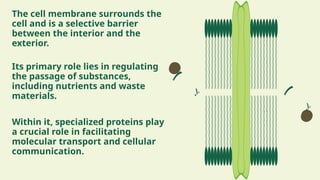
The cell membranesurrounds the
cell and is a selective barrier
between the interior and the
exterior.
Its primary role lies in regulating
the passage of substances,
including nutrients and waste
materials.
Within it, specialized proteins play
a crucial role in facilitating
molecular transport and cellular
communication.
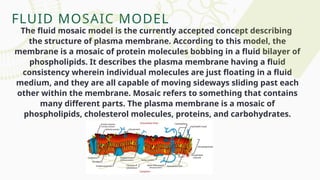
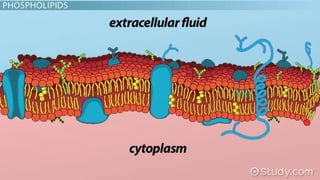
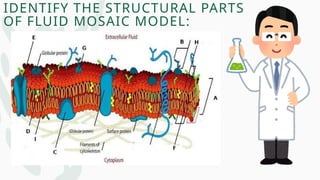
The fluid mosaicmodel is the currently accepted concept describing
the structure of plasma membrane. According to this model, the
membrane is a mosaic of protein molecules bobbing in a fluid bilayer of
phospholipids. It describes the plasma membrane having a fluid
consistency wherein individual molecules are just floating in a fluid
medium, and they are all capable of moving sideways sliding past each
other within the membrane. Mosaic refers to something that contains
many different parts. The plasma membrane is a mosaic of
phospholipids, cholesterol molecules, proteins, and carbohydrates.
FLUID MOSAIC MODEL
17.
CELL MEMBRANE
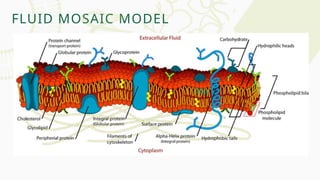
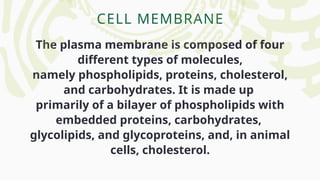
The plasmamembrane is composed of four
different types of molecules,
namely phospholipids, proteins, cholesterol,
and carbohydrates. It is made up
primarily of a bilayer of phospholipids with
embedded proteins, carbohydrates,
glycolipids, and glycoproteins, and, in animal
cells, cholesterol.
18.
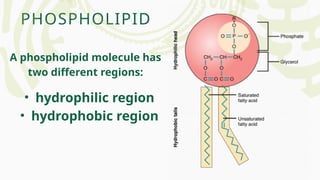
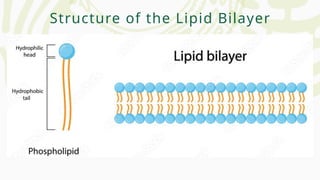
PHOSPHOLIPID
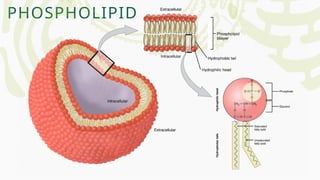
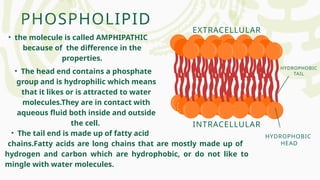
The bulk ofthe membrane structure is composed of two
back-to-back layers of phospholipid molecules.
PHOSPHOLIPID
EXTRACELLULAR
INTRACELLULAR
HYDROPHOBIC
HEAD
HYDROPHOBIC
TAIL
• the moleculeis called AMPHIPATHIC
because of the difference in the
properties.
• The head end contains a phosphate
group and is hydrophilic which means
that it likes or is attracted to water
molecules.They are in contact with
aqueous fluid both inside and outside
the cell.
• The tail end is made up of fatty acid
chains.Fatty acids are long chains that are mostly made up of
hydrogen and carbon which are hydrophobic, or do not like to
mingle with water molecules.
INTEGRAL Proteins
Two majorpopulations of membrane proteins are found in the plasma membrane.
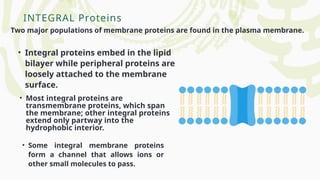
• Integral proteins embed in the lipid
bilayer while peripheral proteins are
loosely attached to the membrane
surface.
• Most integral proteins are
transmembrane proteins, which span
the membrane; other integral proteins
extend only partway into the
hydrophobic interior.
• Some integral membrane proteins
form a channel that allows ions or
other small molecules to pass.
24.
PERIPHERAL Proteins
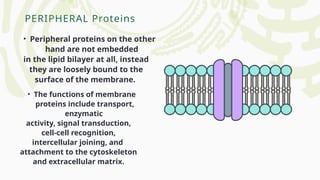
• Peripheralproteins on the other
hand are not embedded
in the lipid bilayer at all, instead
they are loosely bound to the
surface of the membrane.
• The functions of membrane
proteins include transport,
enzymatic
activity, signal transduction,
cell-cell recognition,
intercellular joining, and
attachment to the cytoskeleton
and extracellular matrix.
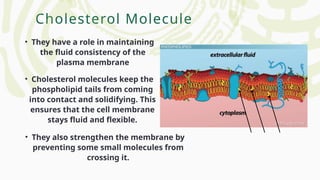
Cholesterol Molecule
• Theyhave a role in maintaining
the fluid consistency of the
plasma membrane
• Cholesterol molecules keep the
phospholipid tails from coming
into contact and solidifying. This
ensures that the cell membrane
stays fluid and flexible.
• They also strengthen the membrane by
preventing some small molecules from
crossing it.
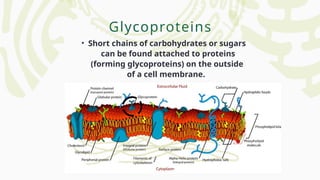
Glycoproteins
• Short chainsof carbohydrates or sugars
can be found attached to proteins
(forming glycoproteins) on the outside
of a cell membrane.
31.
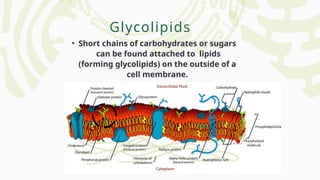
Glycolipids
• Short chainsof carbohydrates or sugars
can be found attached to lipids
(forming glycolipids) on the outside of a
cell membrane.
33.
Together, these carbohydratesform the glycocalyx. The
glycocalyx cushions and protects the plasma
membrane, and it is also important in cell recognition.
A lipid bilayeris a biological membrane consisting of two
layers of lipid molecules. Each lipid molecule, or
phospholipid, contains a hydrophilic head and a
hydrophobic tail. The tail regions, being repelled by
water and slightly attracted to each other, congregate
together. This exposes the head regions to the outside,
creating a barrier between two bodies of water. A lipid
bilayer is the foundational part of all cellular
membranes, typically completed with species-specific
integral proteins and other functional aspects.
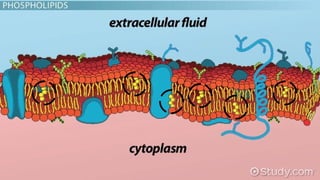
lipid bilayer
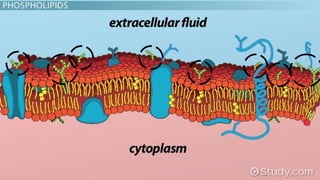
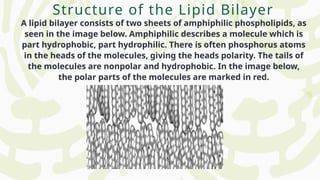
A lipid bilayerconsists of two sheets of amphiphilic phospholipids, as
seen in the image below. Amphiphilic describes a molecule which is
part hydrophobic, part hydrophilic. There is often phosphorus atoms
in the heads of the molecules, giving the heads polarity. The tails of
the molecules are nonpolar and hydrophobic. In the image below,
the polar parts of the molecules are marked in red.
Structure of the Lipid Bilayer
38.
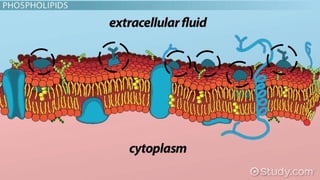
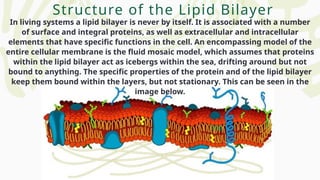
In living systemsa lipid bilayer is never by itself. It is associated with a number
of surface and integral proteins, as well as extracellular and intracellular
elements that have specific functions in the cell. An encompassing model of the
entire cellular membrane is the fluid mosaic model, which assumes that proteins
within the lipid bilayer act as icebergs within the sea, drifting around but not
bound to anything. The specific properties of the protein and of the lipid bilayer
keep them bound within the layers, but not stationary. This can be seen in the
image below.
Structure of the Lipid Bilayer
39.
A lipid bilayerfunctions through the actions of polarity. The
inside of the lipid bilayer is non-polar, while the heads are polar
molecules and create hydrogen bonds with other polar
molecules. This also means that polar molecules like water and
ions cannot as easily cross through the nonpolar tail region of the
lipid bilayer. The cellular membranes of most organisms are
created with lipid bilayer, as well as the nuclear membrane and
various organelle membranes. The various functions of these
membrane are then specified with a variety of proteins which
allow or disallow certain substances to cross the membrane. In
doing so, cells and individual organelles can create an ideal
environment for biochemical reactions to occur, allowing them to
stay in homeostasis.
function
40.
Nonpolar molecules, suchas hydrocarbons, carbon dioxide, and
oxygen, are hydrophobic and can dissolve in the lipid bilayer of the
membrane and cross it rapidly. Remember that phospholipids are
lipid in nature, thus the concept like dissolves like‖ applies. Polar
molecules on the other hand such as glucose and other sugars pass
only slowly through a lipid bilayer, and even water, a very small polar
molecule, does not cross very rapidly. Ions such as sodium and
potassium must have a special means of penetrating plasma
membranes. Cell membranes allow these ions and a variety of polar
molecules while avoiding meeting the lipid bilayer. This can be done
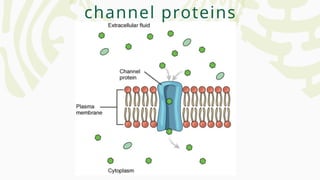
by passing through transport proteins called channel proteins used
by certain molecules or ions as tunnels through the membrane.
function
41.
Substances moving acrossthe selectively permeable plasma
membrane can be either ―passive‖—i.e., occurring without
the input of cellular energy —or ―active‖—i.e., its transport
requires the cell to expend energy. Plasma membranes must
allow certain substances to enter and leave a cell, while
preventing harmful materials or wastes from entering and
essential material from leaving. If plasma membranes were
to lose this selectivity, the cell would no longer be
functioning well, and it would be destroyed. The cell employs
various transport mechanisms involving cell membranes.
channel proteins
Membrane proteins functionin transport, enzymatic activity,
signal transduction, cell-cell recognition, intercellular joining, and
attachment to the cytoskeleton and extracellular matrix. Among
the most sophisticated functions of the plasma membrane is its
ability to transmit signals via complex proteins. These proteins
can be receptors, which work as receivers of extracellular inputs
and as activators of intracellular processes, or markers, which
allow cells to recognize each other. Membrane receptors provide
extracellular attachment sites for hormones and growth factors,
which then trigger intracellular responses. Some viruses, such as
the human immunodeficiency virus (HIV), can hijack these
receptors to enter the cells, causing infections.
function
44.
MULTIPLE CHOICE:
1. Whichis not a component of
the cell membrane?
a. phospholipids
b. sterols
c. proteins
d. nucleic acids
45.
MULTIPLE CHOICE:
2. Whichmolecules make up the
bulk of a cell membrane?
a. phospholipids
b. carbohydrates
c. proteins
d. all of these
46.
MULTIPLE CHOICE:
3. Whichplasma membrane component
can be either found On its SURrface or
embedded in the membrane structure?
a. protein
b. cholesterol
c. carbohydrate
d. phospholipid
47.
MULTIPLE CHOICE:
4.The tailsof the phospholipids of the
plasma membrane are
composed of _____and are_______?
a. phosphate groups; hydrophobic
b. fatty acid groups; hydrophilic
c. phosphate groups; hydrophilic
d. fatty acid groups; hydrophobic
48.
MULTIPLE CHOICE:
5. Whatis the primary function of
carbohydrates attached to the
exterior of cell membranes?
a. cell recognition
b. flexibility of the membrane
c. strengthening the membrane
d. channels through membrane
49.
MULTIPLE CHOICE:
6. Whichcomponent of the cell membrane
functions to allow for
communication between cells?
a. Phospholipids
b. Carbohydrates
c. Proteins
d. None of these choices is correct.