Mr. Vijay Salvekar
Associate Professor
GRY Institute of Pharmacy,Borawan
Principles of membrane transport
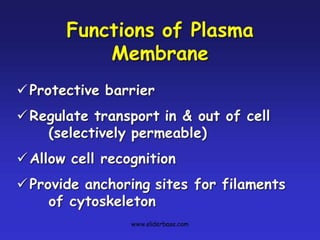
(1) Membranes are
barriers to
movement of water-
soluble molecules.
Principles of membrane transport
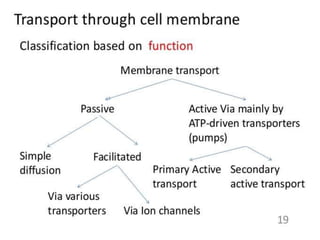
Two classes of transport
-channels
-carriers (=transporters, carriers, exchangers)
Type of transport distinguished based upon how
energy is used
Passive and facilitated diffusion
• movements of molecules from one site from high
concentration to low concentration is diffusion
•Passive diffusion is unassisted
•Its facilitated diffusion if a protein allows
diffusion across a membrane barrier
•Channels (with selective permeability) allow
diffusion of ions down their
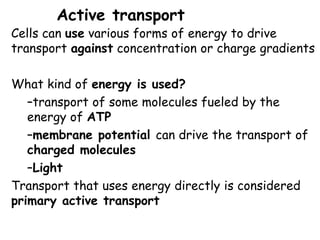
Active transport
Cells can use various forms of energy to drive
transport against concentration or charge gradients
What kind of energy is used?
–transport of some molecules fueled by the
energy of ATP
–membrane potential can drive the transport of
charged molecules
–Light
Transport that uses energy directly is considered
primary active transport
Concentration Gradient
• The formal definition of a concentration gradient is
the process of particles, which are sometimes called
solutes, moving through a solution or gas from an area
with a higher number of particles to an area with a
lower number of particles. The areas are typically
separated by a membrane.
electrochemical gradient.
it is a gradient of electrochemical potential, usually for
an ion that can move across a membrane.
The gradient consists of two parts, the
chemical gradient, or difference in solute
concentration across a membrane, and the electrical
gradient, or difference in charge across a membrane.
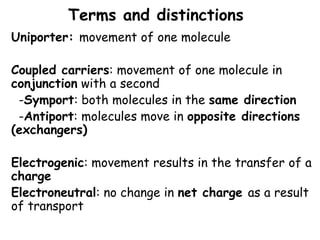
Terms and distinctions
Uniporter: movement of one molecule
Coupled carriers: movement of one molecule in
conjunction with a second
-Symport: both molecules in the same direction
-Antiport: molecules move in opposite directions
(exchangers)
Electrogenic: movement results in the transfer of a
charge
Electroneutral: no change in net charge as a result
of transport
ATPases
Many proteins use the energy of ATP hydrolysis to
fuel transport.
(1) P-type ATPase
Ca2+-ATPase is important in muscle activation
is important in acid secretion in stomach
ATPases
(2) V-type ATPase
Multimeric transporters often work in the reverse
direction (ATP synthesis)
F1Fo ATPase is the mitochondrial ATP synthase
H+-ATPase of lysosomes acidify the organelle
ATPases
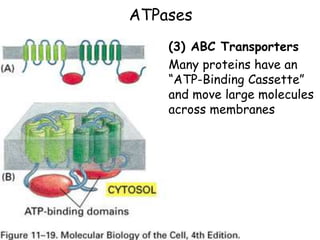
(3) ABC Transporters
Many proteins have an
“ATP-Binding Cassette”
and move large molecules
across membranes
Ion channels
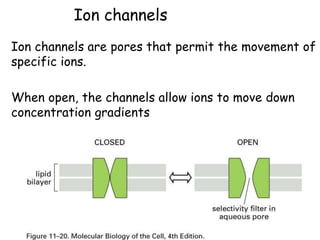
Ion channels are pores that permit the movement of
specific ions.
When open, the channels allow ions to move down
concentration gradients
Ion channels
Can “transport” 100,000,000 ions/ sec
A “selectivity filter” restricts movement to specific
ions
Ion channels
Movement is controlled by regulating “openness” –
the proportion of time spent in the open
configuration
Ion channels can be regulated by specific conditions
to be open or closed
If opened for a prolonged period, the channels can
become desensitized
Ion channels
Types of ion channels
(1) Ligand-gated channels:
Usually opened by intracellular or extracellular
ligands
e.g. IP3-sensitive Ca2+ channel opens in the
presence of IP3
Ion channels
(2) Voltage-gated channels:
Altering voltage beyond a threshold will cause the
channel to open.
Ion channels
(3) Mechanically-gated channels:
e.g. “stretch-activated channels” open when cell
shape is altered.
Since channel is attached to the cytoskeleton,
stretching causes a physical change in the
protein

membrane transport.pptx

  • 1.
    Mr. Vijay Salvekar AssociateProfessor GRY Institute of Pharmacy,Borawan
  • 5.
    Principles of membranetransport (1) Membranes are barriers to movement of water- soluble molecules.
  • 6.
    Principles of membranetransport Two classes of transport -channels -carriers (=transporters, carriers, exchangers) Type of transport distinguished based upon how energy is used
  • 7.
    Passive and facilitateddiffusion • movements of molecules from one site from high concentration to low concentration is diffusion •Passive diffusion is unassisted •Its facilitated diffusion if a protein allows diffusion across a membrane barrier •Channels (with selective permeability) allow diffusion of ions down their
  • 9.
    Active transport Cells canuse various forms of energy to drive transport against concentration or charge gradients What kind of energy is used? –transport of some molecules fueled by the energy of ATP –membrane potential can drive the transport of charged molecules –Light Transport that uses energy directly is considered primary active transport
  • 10.
    Concentration Gradient • Theformal definition of a concentration gradient is the process of particles, which are sometimes called solutes, moving through a solution or gas from an area with a higher number of particles to an area with a lower number of particles. The areas are typically separated by a membrane. electrochemical gradient. it is a gradient of electrochemical potential, usually for an ion that can move across a membrane. The gradient consists of two parts, the chemical gradient, or difference in solute concentration across a membrane, and the electrical gradient, or difference in charge across a membrane.
  • 12.
    Terms and distinctions Uniporter:movement of one molecule Coupled carriers: movement of one molecule in conjunction with a second -Symport: both molecules in the same direction -Antiport: molecules move in opposite directions (exchangers) Electrogenic: movement results in the transfer of a charge Electroneutral: no change in net charge as a result of transport
  • 13.
    ATPases Many proteins usethe energy of ATP hydrolysis to fuel transport. (1) P-type ATPase Ca2+-ATPase is important in muscle activation is important in acid secretion in stomach
  • 14.
    ATPases (2) V-type ATPase Multimerictransporters often work in the reverse direction (ATP synthesis) F1Fo ATPase is the mitochondrial ATP synthase H+-ATPase of lysosomes acidify the organelle
  • 15.
    ATPases (3) ABC Transporters Manyproteins have an “ATP-Binding Cassette” and move large molecules across membranes
  • 16.
    Ion channels Ion channelsare pores that permit the movement of specific ions. When open, the channels allow ions to move down concentration gradients
  • 17.
    Ion channels Can “transport”100,000,000 ions/ sec A “selectivity filter” restricts movement to specific ions
  • 18.
    Ion channels Movement iscontrolled by regulating “openness” – the proportion of time spent in the open configuration Ion channels can be regulated by specific conditions to be open or closed If opened for a prolonged period, the channels can become desensitized
  • 19.
  • 20.
    Types of ionchannels (1) Ligand-gated channels: Usually opened by intracellular or extracellular ligands e.g. IP3-sensitive Ca2+ channel opens in the presence of IP3
  • 21.
    Ion channels (2) Voltage-gatedchannels: Altering voltage beyond a threshold will cause the channel to open.
  • 22.
    Ion channels (3) Mechanically-gatedchannels: e.g. “stretch-activated channels” open when cell shape is altered. Since channel is attached to the cytoskeleton, stretching causes a physical change in the protein