 bubble-like membranous
structure that stores and
transports cellular
products, and digests
metabolic wastes within
the cell;
 an intracellular
membranous sac that is
separated from
the cytosol by at least one
lipid bilayer.
 Secretory Vesicles
 Transport Vesicles
 Storage Vesicles
 Transport across but not through the
membrane
 Mode of transport of macromolecules
 Requires metabolic energy but is independent
of concentration gradient
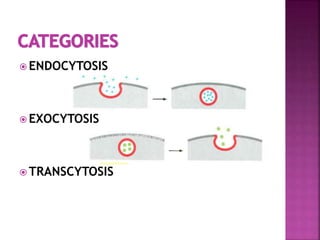
 ENDOCYTOSIS
 EXOCYTOSIS
 TRANSCYTOSIS
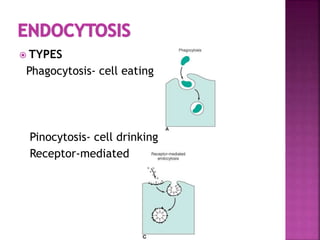
 TYPES
Phagocytosis- cell eating
Pinocytosis- cell drinking
Receptor-mediated
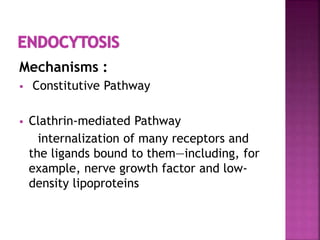
Mechanisms :
 Constitutive Pathway
 Clathrin-mediated Pathway
internalization of many receptors and
the ligands bound to them—including, for
example, nerve growth factor and low-
density lipoproteins
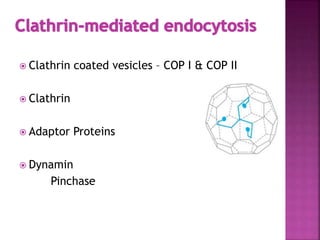
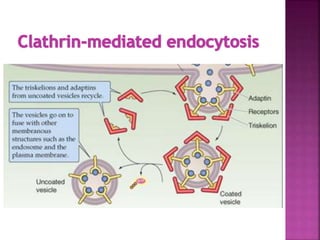
 Clathrin coated vesicles – COP I & COP II
 Clathrin
 Adaptor Proteins
 Dynamin
Pinchase
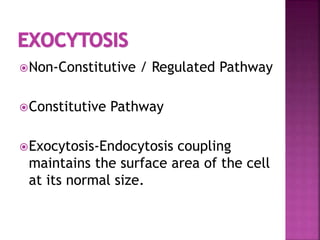
Non-Constitutive / Regulated Pathway
Constitutive Pathway
Exocytosis-Endocytosis coupling
maintains the surface area of the cell
at its normal size.
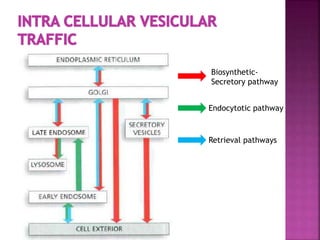
Biosynthetic-
Secretory pathway
Endocytotic pathway
Retrieval pathways
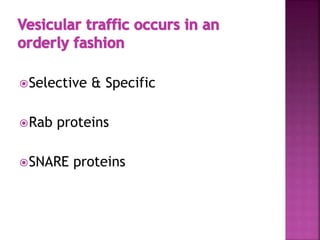
Selective & Specific
Rab proteins
SNARE proteins
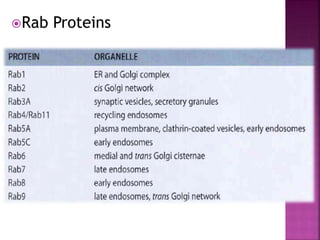
Rab Proteins
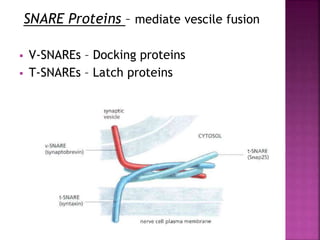
SNARE Proteins – mediate vescile fusion
 V-SNAREs – Docking proteins
 T-SNAREs – Latch proteins
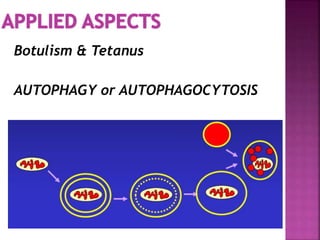
Botulism & Tetanus
AUTOPHAGY or AUTOPHAGOCYTOSIS
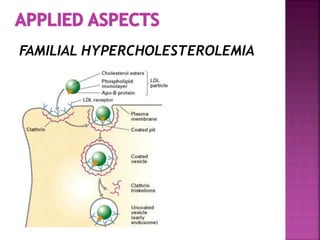
FAMILIAL HYPERCHOLESTEROLEMIA
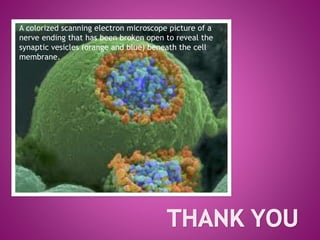
A colorized scanning electron microscope picture of a
nerve ending that has been broken open to reveal the
synaptic vesicles (orange and blue) beneath the cell
membrane.

Vesicular transport