The Cell MembraneThe Cell Membrane
FunctionsFunctions
FunctionFunction
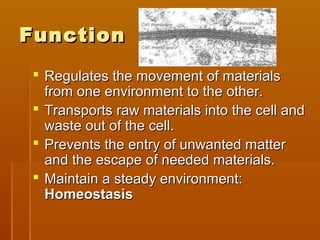
 Regulates the movement of materialsRegulates the movement of materials
from one environment to the other.from one environment to the other.
 Transports raw materials into the cell andTransports raw materials into the cell and
waste out of the cell.waste out of the cell.
 Prevents the entry of unwanted matterPrevents the entry of unwanted matter
and the escape of needed materials.and the escape of needed materials.
 Maintain a steady environment:Maintain a steady environment:
HomeostasisHomeostasis
Structure:Structure:
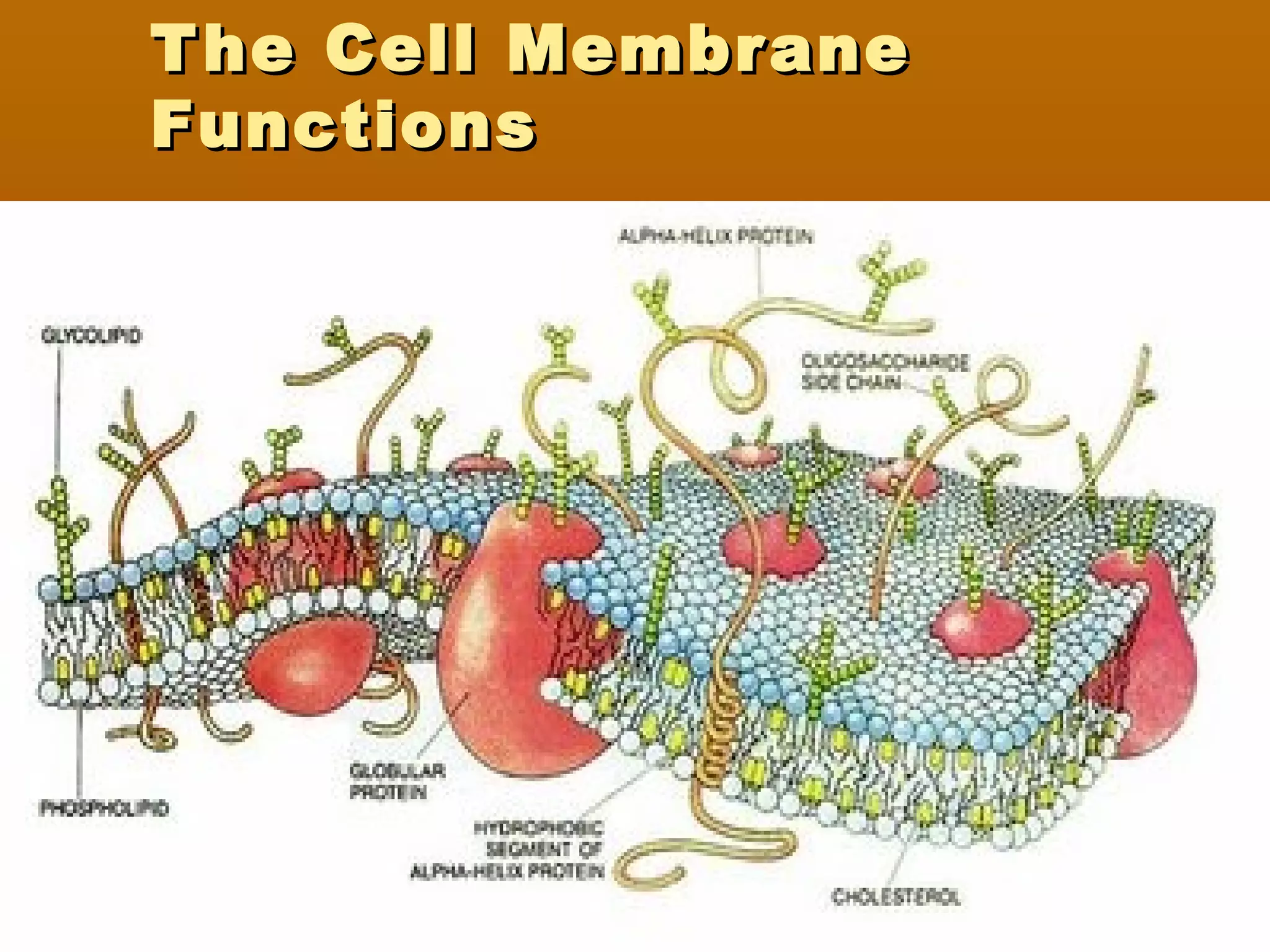
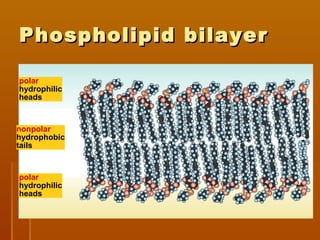
 Composed of a phospholipid bilayer withComposed of a phospholipid bilayer with
a collage of many different proteins,a collage of many different proteins,
lipids and carbohydrates.lipids and carbohydrates.
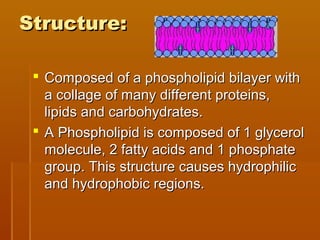
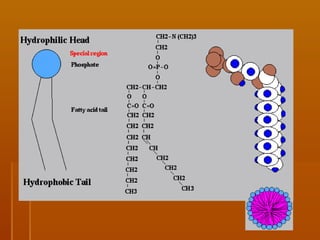
 A Phospholipid is composed of 1 glycerolA Phospholipid is composed of 1 glycerol
molecule, 2 fatty acids and 1 phosphatemolecule, 2 fatty acids and 1 phosphate
group. This structure causes hydrophilicgroup. This structure causes hydrophilic
and hydrophobic regions.and hydrophobic regions.
Phospholipid bilayerPhospholipid bilayer
polar
hydrophilic
heads
nonpolar
hydrophobic
tails
polar
hydrophilic
heads
The Fluid-MosaicThe Fluid-Mosaic
Membrane ModelMembrane Model
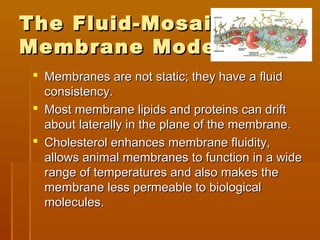
 Membranes are not static; they have a fluidMembranes are not static; they have a fluid
consistency.consistency.
 Most membrane lipids and proteins can driftMost membrane lipids and proteins can drift
about laterally in the plane of the membrane.about laterally in the plane of the membrane.
 Cholesterol enhances membrane fluidity,Cholesterol enhances membrane fluidity,
allows animal membranes to function in a wideallows animal membranes to function in a wide
range of temperatures and also makes therange of temperatures and also makes the
membrane less permeable to biologicalmembrane less permeable to biological
molecules.molecules.
Membrane Proteins:Membrane Proteins:
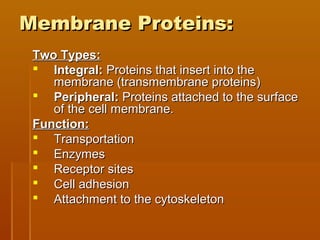
Two Types:Two Types:
 Integral:Integral: Proteins that insert into theProteins that insert into the
membrane (transmembrane proteins)membrane (transmembrane proteins)
 Peripheral:Peripheral: Proteins attached to the surfaceProteins attached to the surface
of the cell membrane.of the cell membrane.
Function:Function:
 TransportationTransportation
 EnzymesEnzymes
 Receptor sitesReceptor sites
 Cell adhesionCell adhesion
 Attachment to the cytoskeletonAttachment to the cytoskeleton
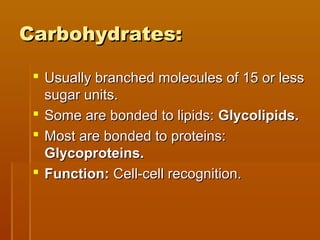
Carbohydrates:Carbohydrates:
 Usually branched molecules of 15 or lessUsually branched molecules of 15 or less
sugar units.sugar units.
 Some are bonded to lipids:Some are bonded to lipids: Glycolipids.Glycolipids.
 Most are bonded to proteins:Most are bonded to proteins:
Glycoproteins.Glycoproteins.
 Function:Function: Cell-cell recognition.Cell-cell recognition.
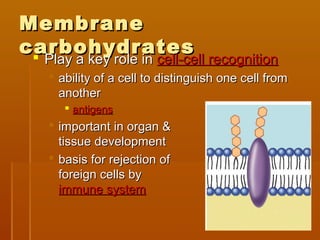
MembraneMembrane
carbohydratescarbohydrates Play a key role inPlay a key role in cell-cell recognitioncell-cell recognition
 ability of a cell to distinguish one cell fromability of a cell to distinguish one cell from
anotheranother
 antigensantigens
 important in organ &important in organ &
tissue developmenttissue development
 basis for rejection ofbasis for rejection of
foreign cells byforeign cells by
immune systemimmune system
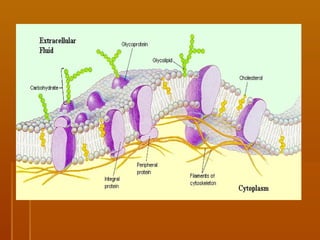
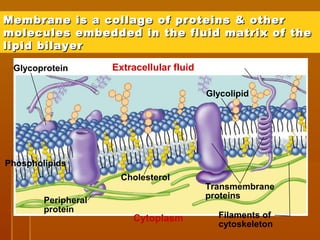
Membrane is a collage of proteins & otherMembrane is a collage of proteins & other
molecules embedded in the fluid matrix of themolecules embedded in the fluid matrix of the
lipid bilayerlipid bilayer
Extracellular fluid
Cholesterol
Cytoplasm
Glycolipid
Transmembrane
proteins
Filaments of
cytoskeleton
Peripheral
protein
Glycoprotein
Phospholipids
Through the CellThrough the Cell
MembraneMembrane
1.1. DiffusionDiffusion
2.2. OsmosisOsmosis
3.3. Facilitated DiffusionFacilitated Diffusion
4.4. Active TransportActive Transport
5.5. Bulk TransportBulk Transport
1. Diffusion:1. Diffusion:
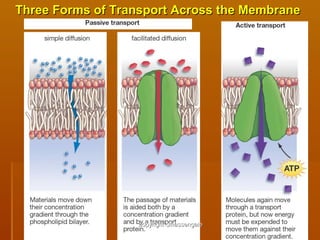
 PassivePassive movement of molecules from a regionmovement of molecules from a region
of high concentration to a region of lowof high concentration to a region of low
concentration.concentration.
 ((Concentration gradientConcentration gradient is the difference inis the difference in
concentration between the two regions)concentration between the two regions)
 Small, uncharged molecules like OSmall, uncharged molecules like O22, CO, CO22 andand
HH22O can move easily through the membrane.O can move easily through the membrane.
 Works well over short distances. OnceWorks well over short distances. Once
molecules enter the cell the rate of diffusionmolecules enter the cell the rate of diffusion
slows.slows.
 Limits cell size.Limits cell size.
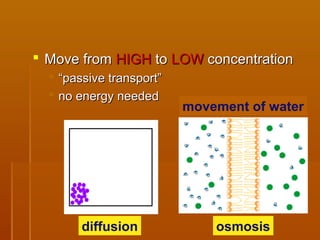
 Move fromMove from HIGHHIGH toto LOWLOW concentrationconcentration
 ““passive transport”passive transport”
 no energy neededno energy needed
diffusion osmosis
movement of water
1515
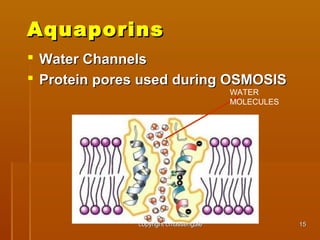
AquaporinsAquaporins
 Water ChannelsWater Channels
 Protein pores used during OSMOSISProtein pores used during OSMOSIS
WATER
MOLECULES
copyright cmassengalecopyright cmassengale
1616
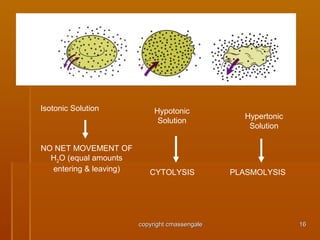
Isotonic Solution
NO NET MOVEMENT OF
H2O (equal amounts
entering & leaving)
Hypotonic
Solution
CYTOLYSIS
Hypertonic
Solution
PLASMOLYSIS
copyright cmassengalecopyright cmassengale
1717
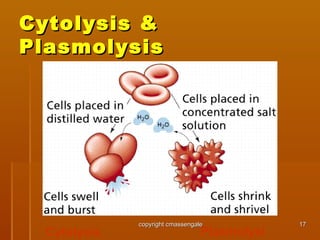
Cytolysis &Cytolysis &
PlasmolysisPlasmolysis
Cytolysis Plasmolysi
copyright cmassengalecopyright cmassengale
1818
Three Forms of Transport Across the MembraneThree Forms of Transport Across the Membrane
copyright cmassengalecopyright cmassengale
2. Osmosis2. Osmosis
 Diffusion of the solvent across a semi-permeableDiffusion of the solvent across a semi-permeable
membrane separating two solutions. (Diffusion ofmembrane separating two solutions. (Diffusion of
water)water)
 Water molecules move from a region of highWater molecules move from a region of high
concentration to a region of low concentration.concentration to a region of low concentration.
 Direction depends on the relative concentration ofDirection depends on the relative concentration of
water molecules on either side of the cell membrane.water molecules on either side of the cell membrane.
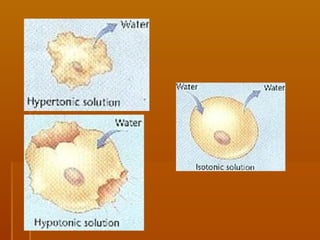
 Isotonic:Isotonic: Water inside the cell equals the waterWater inside the cell equals the water
outside the cell and equal amounts of water move inoutside the cell and equal amounts of water move in
and out of the cell.and out of the cell.
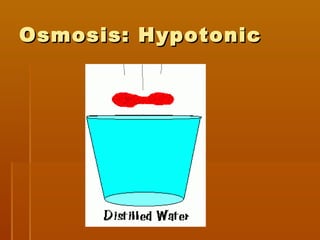
 Hypotonic:Hypotonic: Water outside the cell is greater than thatWater outside the cell is greater than that
inside the cell, water moves into the cell, may causeinside the cell, water moves into the cell, may cause
cell to burst (lysis)cell to burst (lysis)
 Hypertonic:Hypertonic: Water inside the cell is greater thanWater inside the cell is greater than
outside. Water moves out of the cell, may cause theoutside. Water moves out of the cell, may cause the
cell to shrink (plasmolysis)cell to shrink (plasmolysis)
Osmosis: HypotonicOsmosis: Hypotonic
3. Facilitated Diffusion3. Facilitated Diffusion
 Assists with the movement of large moleculesAssists with the movement of large molecules
like glucose.like glucose.
 PassivePassive movement of a substance into or outmovement of a substance into or out
of the cell by means of carrier proteins orof the cell by means of carrier proteins or
channel proteins.channel proteins.
 Moves molecules from high to low regions ofMoves molecules from high to low regions of
concentration.concentration.
 Carrier proteins:Carrier proteins: Transports non-chargedTransports non-charged
molecules with a specific shape.molecules with a specific shape.
 Channel proteins:Channel proteins: Tunnel shape thatTunnel shape that
transports small charged molecules.transports small charged molecules.
4. Active Transport4. Active Transport
 The process of moving substances against theirThe process of moving substances against their
concentration gradients. Requires energy.concentration gradients. Requires energy.
 Examples:Examples:
 Kidney cells pump glucose and amino acids out of theKidney cells pump glucose and amino acids out of the
urine and back into the blood.urine and back into the blood.
 Intestinal cells pump in nutrients from the gut.Intestinal cells pump in nutrients from the gut.
 Root cells pump in nutrients from the soil.Root cells pump in nutrients from the soil.
 Gill cells in fish pump out sodium ions.Gill cells in fish pump out sodium ions.
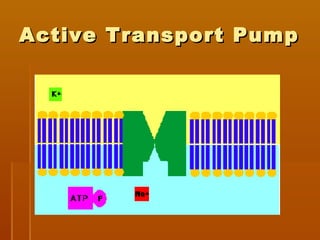
 Active Transport Pump:Active Transport Pump:
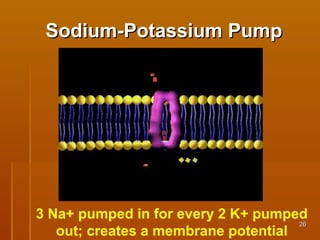
 Sodium-potassium pumpSodium-potassium pump
 3 sodium ions inside the cell and 2 potassium ions3 sodium ions inside the cell and 2 potassium ions
outside the cell bind to the pump.outside the cell bind to the pump.
 This allows the release of energy from ATP andThis allows the release of energy from ATP and
causes the protein complex to change shape.causes the protein complex to change shape.
 The change in shape allow the Na + and K+ ions toThe change in shape allow the Na + and K+ ions to
move across and be released.move across and be released.
Active Transport PumpActive Transport Pump
2525
ActiveActive
transporttransport
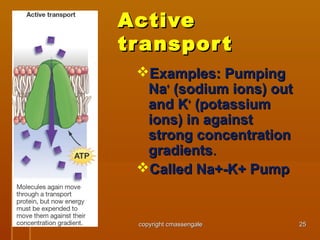
Examples: PumpingExamples: Pumping
NaNa++
(sodium ions) out(sodium ions) out
and Kand K++
(potassium(potassium
ions) in againstions) in against
strong concentrationstrong concentration
gradientsgradients..
Called Na+-K+ PumpCalled Na+-K+ Pump
copyright cmassengalecopyright cmassengale
2626
Sodium-Potassium PumpSodium-Potassium Pump
3 Na+ pumped in for every 2 K+ pumped
out; creates a membrane potential
5. Bulk Transport5. Bulk Transport
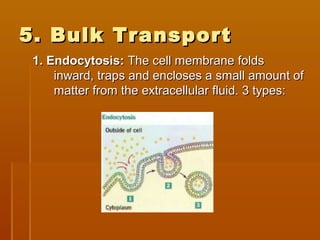
1. Endocytosis:1. Endocytosis: The cell membrane foldsThe cell membrane folds
inward, traps and encloses a small amount ofinward, traps and encloses a small amount of
matter from the extracellular fluid. 3 types:matter from the extracellular fluid. 3 types:
EndocytosisEndocytosis
 Pinocytosis:Pinocytosis: The intake of a small droplet ofThe intake of a small droplet of
extracellular fluid. This occurs in nearly all cell types.extracellular fluid. This occurs in nearly all cell types.
 Phagocytosis:Phagocytosis: The intake of a large droplet ofThe intake of a large droplet of
extracellular fluid. This occurs in specialized cells.extracellular fluid. This occurs in specialized cells.
 Receptor-assisted endocytosis:Receptor-assisted endocytosis: The intake ofThe intake of
specific molecules that attach to special proteins inspecific molecules that attach to special proteins in
the cell membrane. These proteins are uniquelythe cell membrane. These proteins are uniquely
shaped to fit the shape of a specific molecule.shaped to fit the shape of a specific molecule.
Bulk TransportBulk Transport
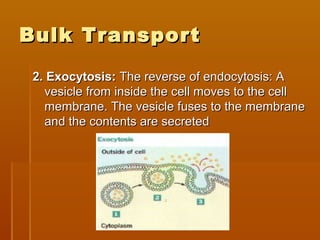
2. Exocytosis:2. Exocytosis: The reverse of endocytosis: AThe reverse of endocytosis: A
vesicle from inside the cell moves to the cellvesicle from inside the cell moves to the cell
membrane. The vesicle fuses to the membranemembrane. The vesicle fuses to the membrane
and the contents are secretedand the contents are secreted

The cell membrane function

  • 1.
    The Cell MembraneTheCell Membrane FunctionsFunctions
  • 2.
    FunctionFunction  Regulates themovement of materialsRegulates the movement of materials from one environment to the other.from one environment to the other.  Transports raw materials into the cell andTransports raw materials into the cell and waste out of the cell.waste out of the cell.  Prevents the entry of unwanted matterPrevents the entry of unwanted matter and the escape of needed materials.and the escape of needed materials.  Maintain a steady environment:Maintain a steady environment: HomeostasisHomeostasis
  • 3.
    Structure:Structure:  Composed ofa phospholipid bilayer withComposed of a phospholipid bilayer with a collage of many different proteins,a collage of many different proteins, lipids and carbohydrates.lipids and carbohydrates.  A Phospholipid is composed of 1 glycerolA Phospholipid is composed of 1 glycerol molecule, 2 fatty acids and 1 phosphatemolecule, 2 fatty acids and 1 phosphate group. This structure causes hydrophilicgroup. This structure causes hydrophilic and hydrophobic regions.and hydrophobic regions.
  • 4.
  • 6.
    The Fluid-MosaicThe Fluid-Mosaic MembraneModelMembrane Model  Membranes are not static; they have a fluidMembranes are not static; they have a fluid consistency.consistency.  Most membrane lipids and proteins can driftMost membrane lipids and proteins can drift about laterally in the plane of the membrane.about laterally in the plane of the membrane.  Cholesterol enhances membrane fluidity,Cholesterol enhances membrane fluidity, allows animal membranes to function in a wideallows animal membranes to function in a wide range of temperatures and also makes therange of temperatures and also makes the membrane less permeable to biologicalmembrane less permeable to biological molecules.molecules.
  • 7.
    Membrane Proteins:Membrane Proteins: TwoTypes:Two Types:  Integral:Integral: Proteins that insert into theProteins that insert into the membrane (transmembrane proteins)membrane (transmembrane proteins)  Peripheral:Peripheral: Proteins attached to the surfaceProteins attached to the surface of the cell membrane.of the cell membrane. Function:Function:  TransportationTransportation  EnzymesEnzymes  Receptor sitesReceptor sites  Cell adhesionCell adhesion  Attachment to the cytoskeletonAttachment to the cytoskeleton
  • 8.
    Carbohydrates:Carbohydrates:  Usually branchedmolecules of 15 or lessUsually branched molecules of 15 or less sugar units.sugar units.  Some are bonded to lipids:Some are bonded to lipids: Glycolipids.Glycolipids.  Most are bonded to proteins:Most are bonded to proteins: Glycoproteins.Glycoproteins.  Function:Function: Cell-cell recognition.Cell-cell recognition.
  • 9.
    MembraneMembrane carbohydratescarbohydrates Play akey role inPlay a key role in cell-cell recognitioncell-cell recognition  ability of a cell to distinguish one cell fromability of a cell to distinguish one cell from anotheranother  antigensantigens  important in organ &important in organ & tissue developmenttissue development  basis for rejection ofbasis for rejection of foreign cells byforeign cells by immune systemimmune system
  • 11.
    Membrane is acollage of proteins & otherMembrane is a collage of proteins & other molecules embedded in the fluid matrix of themolecules embedded in the fluid matrix of the lipid bilayerlipid bilayer Extracellular fluid Cholesterol Cytoplasm Glycolipid Transmembrane proteins Filaments of cytoskeleton Peripheral protein Glycoprotein Phospholipids
  • 12.
    Through the CellThroughthe Cell MembraneMembrane 1.1. DiffusionDiffusion 2.2. OsmosisOsmosis 3.3. Facilitated DiffusionFacilitated Diffusion 4.4. Active TransportActive Transport 5.5. Bulk TransportBulk Transport
  • 13.
    1. Diffusion:1. Diffusion: PassivePassive movement of molecules from a regionmovement of molecules from a region of high concentration to a region of lowof high concentration to a region of low concentration.concentration.  ((Concentration gradientConcentration gradient is the difference inis the difference in concentration between the two regions)concentration between the two regions)  Small, uncharged molecules like OSmall, uncharged molecules like O22, CO, CO22 andand HH22O can move easily through the membrane.O can move easily through the membrane.  Works well over short distances. OnceWorks well over short distances. Once molecules enter the cell the rate of diffusionmolecules enter the cell the rate of diffusion slows.slows.  Limits cell size.Limits cell size.
  • 14.
     Move fromMovefrom HIGHHIGH toto LOWLOW concentrationconcentration  ““passive transport”passive transport”  no energy neededno energy needed diffusion osmosis movement of water
  • 15.
    1515 AquaporinsAquaporins  Water ChannelsWaterChannels  Protein pores used during OSMOSISProtein pores used during OSMOSIS WATER MOLECULES copyright cmassengalecopyright cmassengale
  • 16.
    1616 Isotonic Solution NO NETMOVEMENT OF H2O (equal amounts entering & leaving) Hypotonic Solution CYTOLYSIS Hypertonic Solution PLASMOLYSIS copyright cmassengalecopyright cmassengale
  • 17.
    1717 Cytolysis &Cytolysis & PlasmolysisPlasmolysis CytolysisPlasmolysi copyright cmassengalecopyright cmassengale
  • 18.
    1818 Three Forms ofTransport Across the MembraneThree Forms of Transport Across the Membrane copyright cmassengalecopyright cmassengale
  • 19.
    2. Osmosis2. Osmosis Diffusion of the solvent across a semi-permeableDiffusion of the solvent across a semi-permeable membrane separating two solutions. (Diffusion ofmembrane separating two solutions. (Diffusion of water)water)  Water molecules move from a region of highWater molecules move from a region of high concentration to a region of low concentration.concentration to a region of low concentration.  Direction depends on the relative concentration ofDirection depends on the relative concentration of water molecules on either side of the cell membrane.water molecules on either side of the cell membrane.  Isotonic:Isotonic: Water inside the cell equals the waterWater inside the cell equals the water outside the cell and equal amounts of water move inoutside the cell and equal amounts of water move in and out of the cell.and out of the cell.  Hypotonic:Hypotonic: Water outside the cell is greater than thatWater outside the cell is greater than that inside the cell, water moves into the cell, may causeinside the cell, water moves into the cell, may cause cell to burst (lysis)cell to burst (lysis)  Hypertonic:Hypertonic: Water inside the cell is greater thanWater inside the cell is greater than outside. Water moves out of the cell, may cause theoutside. Water moves out of the cell, may cause the cell to shrink (plasmolysis)cell to shrink (plasmolysis)
  • 21.
  • 22.
    3. Facilitated Diffusion3.Facilitated Diffusion  Assists with the movement of large moleculesAssists with the movement of large molecules like glucose.like glucose.  PassivePassive movement of a substance into or outmovement of a substance into or out of the cell by means of carrier proteins orof the cell by means of carrier proteins or channel proteins.channel proteins.  Moves molecules from high to low regions ofMoves molecules from high to low regions of concentration.concentration.  Carrier proteins:Carrier proteins: Transports non-chargedTransports non-charged molecules with a specific shape.molecules with a specific shape.  Channel proteins:Channel proteins: Tunnel shape thatTunnel shape that transports small charged molecules.transports small charged molecules.
  • 23.
    4. Active Transport4.Active Transport  The process of moving substances against theirThe process of moving substances against their concentration gradients. Requires energy.concentration gradients. Requires energy.  Examples:Examples:  Kidney cells pump glucose and amino acids out of theKidney cells pump glucose and amino acids out of the urine and back into the blood.urine and back into the blood.  Intestinal cells pump in nutrients from the gut.Intestinal cells pump in nutrients from the gut.  Root cells pump in nutrients from the soil.Root cells pump in nutrients from the soil.  Gill cells in fish pump out sodium ions.Gill cells in fish pump out sodium ions.  Active Transport Pump:Active Transport Pump:  Sodium-potassium pumpSodium-potassium pump  3 sodium ions inside the cell and 2 potassium ions3 sodium ions inside the cell and 2 potassium ions outside the cell bind to the pump.outside the cell bind to the pump.  This allows the release of energy from ATP andThis allows the release of energy from ATP and causes the protein complex to change shape.causes the protein complex to change shape.  The change in shape allow the Na + and K+ ions toThe change in shape allow the Na + and K+ ions to move across and be released.move across and be released.
  • 24.
  • 25.
    2525 ActiveActive transporttransport Examples: PumpingExamples: Pumping NaNa++ (sodiumions) out(sodium ions) out and Kand K++ (potassium(potassium ions) in againstions) in against strong concentrationstrong concentration gradientsgradients.. Called Na+-K+ PumpCalled Na+-K+ Pump copyright cmassengalecopyright cmassengale
  • 26.
    2626 Sodium-Potassium PumpSodium-Potassium Pump 3Na+ pumped in for every 2 K+ pumped out; creates a membrane potential
  • 27.
    5. Bulk Transport5.Bulk Transport 1. Endocytosis:1. Endocytosis: The cell membrane foldsThe cell membrane folds inward, traps and encloses a small amount ofinward, traps and encloses a small amount of matter from the extracellular fluid. 3 types:matter from the extracellular fluid. 3 types:
  • 28.
    EndocytosisEndocytosis  Pinocytosis:Pinocytosis: Theintake of a small droplet ofThe intake of a small droplet of extracellular fluid. This occurs in nearly all cell types.extracellular fluid. This occurs in nearly all cell types.  Phagocytosis:Phagocytosis: The intake of a large droplet ofThe intake of a large droplet of extracellular fluid. This occurs in specialized cells.extracellular fluid. This occurs in specialized cells.  Receptor-assisted endocytosis:Receptor-assisted endocytosis: The intake ofThe intake of specific molecules that attach to special proteins inspecific molecules that attach to special proteins in the cell membrane. These proteins are uniquelythe cell membrane. These proteins are uniquely shaped to fit the shape of a specific molecule.shaped to fit the shape of a specific molecule.
  • 29.
    Bulk TransportBulk Transport 2.Exocytosis:2. Exocytosis: The reverse of endocytosis: AThe reverse of endocytosis: A vesicle from inside the cell moves to the cellvesicle from inside the cell moves to the cell membrane. The vesicle fuses to the membranemembrane. The vesicle fuses to the membrane and the contents are secretedand the contents are secreted

Editor's Notes

  • #10 The four human blood groups (A, B, AB, and O) differ in the external carbohydrates on red blood cells.
  • #12 The carbohydrates are not inserted into the membrane -- they are too hydrophilic for that. They are attached to embedded proteins -- glycoproteins.