
Dr. P. Saranraj
Head
Department of Microbiology
Sacred Heart College (Autonomous)
Tirupattur – 635 601
Tamil Nadu, India
Mobile: +91-9994146964; E.mail:
microsaranraj@gmail.com
PRECIPITATION REACTION
 Precipitation reactions are based on the
interaction of antibodies and antigens. In this
reaction, two soluble reactants that come
together to make one insoluble product, the
precipitate.
 Any antibody which reacts with an antigen to
form a precipitate is called Precipitin.
 Precipitation assays are performed in semi-solid
media such as Agar or Agarose where antibodies
and antigens can diffuse toward one another and
form a visible line of precipitation.
 Precipitation reactions are serological assays for
the detection of immunoglobulin levels from
the serum of a patient with infection.
 Precipitation reactions are widely used in
Medicine for analysis of Hormones, Enzymes,
Toxins and Immune system products.
 Some of the examples of Precipitation reactions
are 1) Capillary Tube Precipitation (Ring Test), 2)
Ouchterlony Double Immunodiffusion
(Immunodiffusion or Agar gel Immunodiffusion or
Passive Double Immunodiffusion), 3) Single
Radial Immunodiffusion (SRID) (Mancini
Method), 4) Immunoelectrophoresis (IEP), 5)
Rocket electrophoresis and 6)
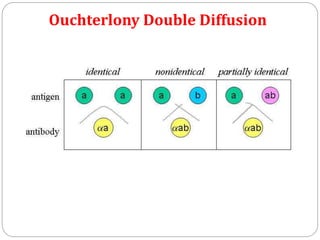
Ouchterlony Double Immunodiffusion
 Ouchterlony Double Immunodiffusion (ODD) is
also called as Immunodiffusion or Agar gel
Immunodiffusion or Passive Double
Immunodiffusion.
 ODD method was used in the detection,
identification and quantification of antibodies
and antigens, such
as Immunoglobulins and extractable nuclear
antigens.
 The technique is named after Orjan
Ouchterlony, the Swedish physician who
invented the test in 1948.
 In ODD method, the pattern of lines that form
Ouchterlony Double Diffusion
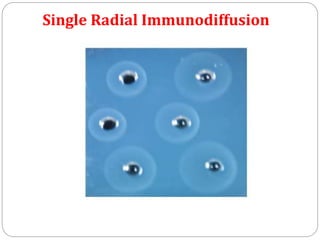
Single Radial Immunodiffusion (SRID)
 Radial Immunodiffusion or Mancini method,
Mancini Immunodiffusion or Single Radial
Immunodiffusion (SRID).
 SRID is an Immunodiffusion technique used to
determine the quantity or concentration of
an antigen in a sample.
 In SRID method the Antibody is incorporated into
the Agarose gel whereas the Antigen diffuses
into it in a radial pattern.
 SRID is an Immunodiffusion technique used to
detect the concentration of antigen by
measuring the diameter of the precipitin ring
formed by the interaction of the antigen and the
Single Radial Immunodiffusion
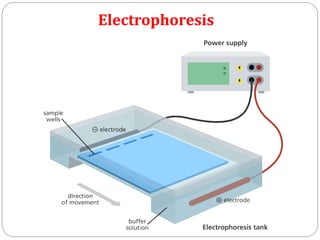
Electrophoresis
IMMUNOELECTROPHORESIS
 Immunoelectrophoresis was first coined by
Grabar and Williams in 1953.
 Immunoelectrophoresis is a general name for a
number of biochemical methods for separation
and characterization of proteins based
on electrophoresis and reaction
with antibodies.
 Immunoelectrophoresis is the combination of
Immunodiffusion (Mancini’s Single Radial
Immunodiffusion and Ouchterlony Double
Diffusion) and Electrophoresis.
IMMUNOELECTROPHORESIS
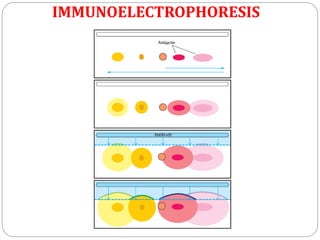
 In Immunoelectrophoresis, the antigen mixture is
first electrophoresed to separate its components
by charge.
 Troughs are then cut into the agar gel parallel to
the direction of the electric field, and antiserum is
added to the troughs.
 Antibody and antigen then diffuse toward each
other and produce lines of precipitation where
they meet in appropriate proportions.
 Immunoelectrophoresis is a strictly Qualitative
technique that only detects relatively high
antibody concentrations (greater than 100 g/ml),
it utility is limited to the detection of quantitative
abnormalities only when the departure from
IMMUNOELECTROPHORESIS
Applications of Immunoelectrophoresis
 Immunoelectrophoresis is used in clinical
laboratories to detect the presence or absence of
proteins in the serum.
 Detection of Immunodeficiency (In
Immunodeficiency sample, no precipitin band is
formed with particular antigen).
 Detection of Over production of Serum proteins
(Albumin, Immunoglobulin and Transferrin).
 Detection of deficiency in Complement.
 Used to identify normal and abnormal proteins in
Urine or Serum.
 Testing the purity of Antigen.
ROCKET ELECTROPHORESIS
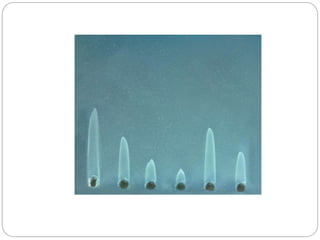
 A related Quantitative technique, Rocket
electrophoresis, does permit measurement of
antigen levels.
 Also called as Laurell Technique or One
dimension electroimmunodiffusion.
 It is called as an adaption of SRID and more
rapid than SRID.
 In Rocket electrophoresis, a negatively charged
antigen is electrophoresed in a gel containing
antibody.
 The precipitate formed between antigen and
antibody has the shape of a Rocket
(measured), the height of which is proportional
 One limitation of rocket electrophoresis is the
need for the antigen to be negatively charged for
electrophoretic movement within the agar matrix.
Some proteins, immunoglobulins for example,
are not sufficiently charged to be quantitatively
analyzed by Rocket electrophoresis.
Precipitation Reaction

Precipitation Reaction

  • 1.
    Dr. P. Saranraj Head Departmentof Microbiology Sacred Heart College (Autonomous) Tirupattur – 635 601 Tamil Nadu, India Mobile: +91-9994146964; E.mail: microsaranraj@gmail.com PRECIPITATION REACTION
  • 2.
    PRECIPITATION REACTION  Precipitationreactions are based on the interaction of antibodies and antigens. In this reaction, two soluble reactants that come together to make one insoluble product, the precipitate.  Any antibody which reacts with an antigen to form a precipitate is called Precipitin.  Precipitation assays are performed in semi-solid media such as Agar or Agarose where antibodies and antigens can diffuse toward one another and form a visible line of precipitation.
  • 3.
     Precipitation reactionsare serological assays for the detection of immunoglobulin levels from the serum of a patient with infection.  Precipitation reactions are widely used in Medicine for analysis of Hormones, Enzymes, Toxins and Immune system products.  Some of the examples of Precipitation reactions are 1) Capillary Tube Precipitation (Ring Test), 2) Ouchterlony Double Immunodiffusion (Immunodiffusion or Agar gel Immunodiffusion or Passive Double Immunodiffusion), 3) Single Radial Immunodiffusion (SRID) (Mancini Method), 4) Immunoelectrophoresis (IEP), 5) Rocket electrophoresis and 6)
  • 4.
    Ouchterlony Double Immunodiffusion Ouchterlony Double Immunodiffusion (ODD) is also called as Immunodiffusion or Agar gel Immunodiffusion or Passive Double Immunodiffusion.  ODD method was used in the detection, identification and quantification of antibodies and antigens, such as Immunoglobulins and extractable nuclear antigens.  The technique is named after Orjan Ouchterlony, the Swedish physician who invented the test in 1948.  In ODD method, the pattern of lines that form
  • 5.
  • 6.
    Single Radial Immunodiffusion(SRID)  Radial Immunodiffusion or Mancini method, Mancini Immunodiffusion or Single Radial Immunodiffusion (SRID).  SRID is an Immunodiffusion technique used to determine the quantity or concentration of an antigen in a sample.  In SRID method the Antibody is incorporated into the Agarose gel whereas the Antigen diffuses into it in a radial pattern.  SRID is an Immunodiffusion technique used to detect the concentration of antigen by measuring the diameter of the precipitin ring formed by the interaction of the antigen and the
  • 7.
  • 8.
  • 9.
    IMMUNOELECTROPHORESIS  Immunoelectrophoresis wasfirst coined by Grabar and Williams in 1953.  Immunoelectrophoresis is a general name for a number of biochemical methods for separation and characterization of proteins based on electrophoresis and reaction with antibodies.  Immunoelectrophoresis is the combination of Immunodiffusion (Mancini’s Single Radial Immunodiffusion and Ouchterlony Double Diffusion) and Electrophoresis.
  • 10.
    IMMUNOELECTROPHORESIS  In Immunoelectrophoresis,the antigen mixture is first electrophoresed to separate its components by charge.  Troughs are then cut into the agar gel parallel to the direction of the electric field, and antiserum is added to the troughs.  Antibody and antigen then diffuse toward each other and produce lines of precipitation where they meet in appropriate proportions.  Immunoelectrophoresis is a strictly Qualitative technique that only detects relatively high antibody concentrations (greater than 100 g/ml), it utility is limited to the detection of quantitative abnormalities only when the departure from
  • 11.
  • 12.
    Applications of Immunoelectrophoresis Immunoelectrophoresis is used in clinical laboratories to detect the presence or absence of proteins in the serum.  Detection of Immunodeficiency (In Immunodeficiency sample, no precipitin band is formed with particular antigen).  Detection of Over production of Serum proteins (Albumin, Immunoglobulin and Transferrin).  Detection of deficiency in Complement.  Used to identify normal and abnormal proteins in Urine or Serum.  Testing the purity of Antigen.
  • 13.
    ROCKET ELECTROPHORESIS  Arelated Quantitative technique, Rocket electrophoresis, does permit measurement of antigen levels.  Also called as Laurell Technique or One dimension electroimmunodiffusion.  It is called as an adaption of SRID and more rapid than SRID.  In Rocket electrophoresis, a negatively charged antigen is electrophoresed in a gel containing antibody.  The precipitate formed between antigen and antibody has the shape of a Rocket (measured), the height of which is proportional
  • 14.
     One limitationof rocket electrophoresis is the need for the antigen to be negatively charged for electrophoretic movement within the agar matrix. Some proteins, immunoglobulins for example, are not sufficiently charged to be quantitatively analyzed by Rocket electrophoresis.