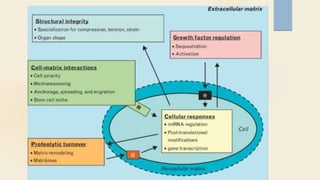
Extracellular Matrix
and Its Components
ECM
Extracellular matrix (ECM)
 Extracellular matrix (ECM) is a network of extracellular
macromolecules, such as collagen, enzymes, and
glycoproteins, that provide structural and biochemical support
to surrounding cells
 ECM includes the interstitial matrix and the basement
membrane
 Gels of polysaccharides and fibrous proteins fill the interstitial
space
 This gel act as a compression buffer against the stress placed
on the ECM
General Structure of Extracellular
Matrix
 Animal cells embedded in an extracellular matrix Basal
laminae: thin layer on which epithelial cells rest.
 Also surrounds muscle cells, adipose cells, and
peripheral nerves most abundant in connective tissues
 Connective tissue loose connective tissue Bone
tendon cartilage
Extracellular matrix (ECM)
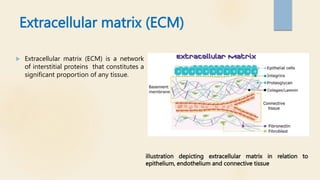
 Extracellular matrix (ECM) is a network
of interstitial proteins that constitutes a
significant proportion of any tissue.
ilIustration depicting extracellular matrix in relation to
epithelium, endothelium and connective tissue
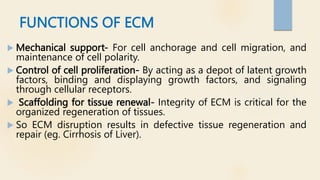
FUNCTIONS OF ECM
 Mechanical support- For cell anchorage and cell migration, and
maintenance of cell polarity.
 Control of cell proliferation- By acting as a depot of latent growth
factors, binding and displaying growth factors, and signaling
through cellular receptors.
 Scaffolding for tissue renewal- Integrity of ECM is critical for the
organized regeneration of tissues.
 So ECM disruption results in defective tissue regeneration and
repair (eg. Cirrhosis of Liver).
FUNCTIONS OF ECM
Establishment of tissue microenvironments-
Basement membrane acts as boundary
between epithelium and connective tissue, and
is also functional.
 Cellular interaction- For maintaining normal
tissue architecture.
 ECM is important for cell adhesion and serve as a
reservoir for growth factors, thus, ECM regulates the
proliferation, movement, and differentiation of the
cells living within it.
 Synthesis and degradation of ECM accompanies
morphogenesis, wound healing, chronic fibrotic
processes, and tumor invasion and metastasis
TWO BASIC FORMS OF ECM
 ECM occurs in two basic forms:
interstitial matrix and basement membrane
 1- Interstitial Matrix:
 present in the spaces between cells in connective tissue;
 it is synthesized by mesenchymal cells (e.g., fibroblasts) and tends to
form a three-dimensional, amorphous gel.
 Its major constituents are fibrillar and nonfibrillar collagens, as well
as fibronectin, elastin, proteoglycans, hyaluronate, and other
elements
The basement membrane:
lies beneath the epithelium
It is synthesized by overlying epithelium and
underlying mesenchymal cells
Its major constituents are amorphous
nonfibrillar type IV collagen and laminin
COMPONENTS OF ECM
 Components of ECM are categorized into 3 groups of proteins;
 1) Fibrous structural proteins- Collagens, Elastins & Fibrillin.
Confer tensile strength and recoil.
 2) Water-hydrated gels- Proteagylcans & Hyaluronan
Permit compressive resistance and lubrication.
 3) Adhesive gl roteins & r y- F bronectin, Laminin & integan
Connect ECM elements to one another and to cells.
 4) Water - 65%
Collagens
 Collagens are fibrous structural proteins that confer tensile strength.
 Collagens are composed of three separate polypeptide chains braided into a ropelike
triple helix.
 About 30 collagen types have been identified
 Some collagen types (e.g., types I, II, III, and V) form fibrils by virtue of lateral cross-
linking of the triple helices. These are called the fibrillarcollagens, and form a major
proportion of the connective tissue in healing wounds and particularly in scars
 Other collagens are nonfibrillar and present in basement membrane (type IV)
 The tensile strength of the fibrillar collagens derives from their cross-linking, which is the
result of covalent bonds.
 This process is dependent on vitamin C; therefore, children with vitamin C
deficiencyhave skeletal deformities, bleed easily because of weak vascular wall basement
membrane, and heal poorly
Elastin
 the ability of tissues to recoil and return to a baseline
structure after physical stress is conferred by elastic
tissue.
 This is especially important in the walls of: vessels , the
uterus, skin, and ligaments.
Proteoglycans and Hyaluronan
 Proteoglycans form highly hydrated compressible gels conferring resilience
and lubrication (such as in the cartilage in joints).
 They consist of long polysaccharides called glycosaminoglycans (examples
are dermatan sulfate and heparan sulfate) linked to a protein backbone.
 Hyaluronan a huge molecule composed of many disaccharide repeats
without a protein core, is also an important constituent of the ECM.
 Because of its ability to bind water, it forms a viscous, gelatin-like matrix
Adhesive glycoproteins and adhesion
receptors
 Adhesive glycoproteins and adhesion receptors are structurally diverse
molecules involved in cell-to-cell adhesion, the linkage between cells and
ECM, and binding between ECM components.
 The adhesive glycoproteins include fibronectin (major component of the
interstitial ECM) and laminin (major constituent of basement membrane).
 The adhesion receptors, also known as cell adhesion molecules (CAMs), are
grouped into four families: immunoglobulins, cadherins, selectins, and
integrins
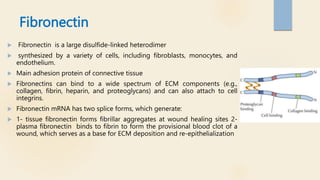
Fibronectin
 Fibronectin is a large disulfide-linked heterodimer
 synthesized by a variety of cells, including fibroblasts, monocytes, and
endothelium.
 Main adhesion protein of connective tissue
 Fibronectins can bind to a wide spectrum of ECM components (e.g.,
collagen, fibrin, heparin, and proteoglycans) and can also attach to cell
integrins.
 Fibronectin mRNA has two splice forms, which generate:
 1- tissue fibronectin forms fibrillar aggregates at wound healing sites 2-
plasma fibronectin binds to fibrin to form the provisional blood clot of a
wound, which serves as a base for ECM deposition and re-epithelialization
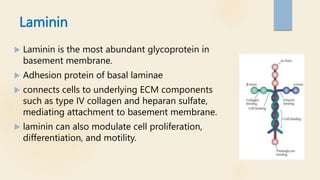
Laminin
 Laminin is the most abundant glycoprotein in
basement membrane.
 Adhesion protein of basal laminae
 connects cells to underlying ECM components
such as type IV collagen and heparan sulfate,
mediating attachment to basement membrane.
 laminin can also modulate cell proliferation,
differentiation, and motility.
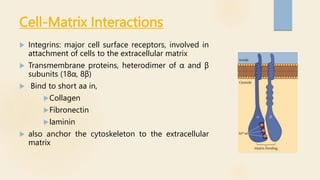
Cell-Matrix Interactions
 Integrins: major cell surface receptors, involved in
attachment of cells to the extracellular matrix
 Transmembrane proteins, heterodimer of α and β
subunits (18α, 8β)
 Bind to short aa in,
Collagen
Fibronectin
laminin
 also anchor the cytoskeleton to the extracellular
matrix
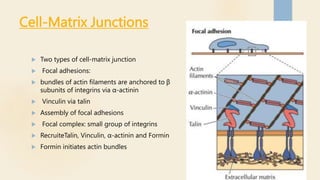
Cell-Matrix Junctions
 Two types of cell-matrix junction
 Focal adhesions:
 bundles of actin filaments are anchored to β
subunits of integrins via α-actinin
 Vinculin via talin
 Assembly of focal adhesions
 Focal complex: small group of integrins
 RecruiteTalin, Vinculin, α-actinin and Formin
 Formin initiates actin bundles
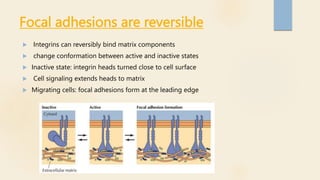
Focal adhesions are reversible
 Integrins can reversibly bind matrix components
 change conformation between active and inactive states
 Inactive state: integrin heads turned close to cell surface
 Cell signaling extends heads to matrix
 Migrating cells: focal adhesions form at the leading edge
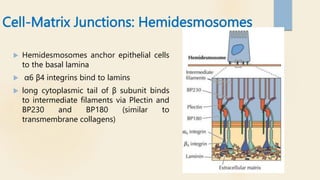
Cell-Matrix Junctions: Hemidesmosomes
 Hemidesmosomes anchor epithelial cells
to the basal lamina
 α6 β4 integrins bind to lamins
 long cytoplasmic tail of β subunit binds
to intermediate filaments via Plectin and
BP230 and BP180 (similar to
transmembrane collagens)

EXTRACELLULAR MATRIX AND ITS COMPONENTS

  • 1.
  • 2.
    Extracellular matrix (ECM) Extracellular matrix (ECM) is a network of extracellular macromolecules, such as collagen, enzymes, and glycoproteins, that provide structural and biochemical support to surrounding cells  ECM includes the interstitial matrix and the basement membrane  Gels of polysaccharides and fibrous proteins fill the interstitial space  This gel act as a compression buffer against the stress placed on the ECM
  • 3.
    General Structure ofExtracellular Matrix  Animal cells embedded in an extracellular matrix Basal laminae: thin layer on which epithelial cells rest.  Also surrounds muscle cells, adipose cells, and peripheral nerves most abundant in connective tissues  Connective tissue loose connective tissue Bone tendon cartilage
  • 4.
    Extracellular matrix (ECM) Extracellular matrix (ECM) is a network of interstitial proteins that constitutes a significant proportion of any tissue. ilIustration depicting extracellular matrix in relation to epithelium, endothelium and connective tissue
  • 6.
    FUNCTIONS OF ECM Mechanical support- For cell anchorage and cell migration, and maintenance of cell polarity.  Control of cell proliferation- By acting as a depot of latent growth factors, binding and displaying growth factors, and signaling through cellular receptors.  Scaffolding for tissue renewal- Integrity of ECM is critical for the organized regeneration of tissues.  So ECM disruption results in defective tissue regeneration and repair (eg. Cirrhosis of Liver).
  • 7.
    FUNCTIONS OF ECM Establishmentof tissue microenvironments- Basement membrane acts as boundary between epithelium and connective tissue, and is also functional.  Cellular interaction- For maintaining normal tissue architecture.
  • 8.
     ECM isimportant for cell adhesion and serve as a reservoir for growth factors, thus, ECM regulates the proliferation, movement, and differentiation of the cells living within it.  Synthesis and degradation of ECM accompanies morphogenesis, wound healing, chronic fibrotic processes, and tumor invasion and metastasis
  • 9.
    TWO BASIC FORMSOF ECM  ECM occurs in two basic forms: interstitial matrix and basement membrane  1- Interstitial Matrix:  present in the spaces between cells in connective tissue;  it is synthesized by mesenchymal cells (e.g., fibroblasts) and tends to form a three-dimensional, amorphous gel.  Its major constituents are fibrillar and nonfibrillar collagens, as well as fibronectin, elastin, proteoglycans, hyaluronate, and other elements
  • 10.
    The basement membrane: liesbeneath the epithelium It is synthesized by overlying epithelium and underlying mesenchymal cells Its major constituents are amorphous nonfibrillar type IV collagen and laminin
  • 11.
    COMPONENTS OF ECM Components of ECM are categorized into 3 groups of proteins;  1) Fibrous structural proteins- Collagens, Elastins & Fibrillin. Confer tensile strength and recoil.  2) Water-hydrated gels- Proteagylcans & Hyaluronan Permit compressive resistance and lubrication.  3) Adhesive gl roteins & r y- F bronectin, Laminin & integan Connect ECM elements to one another and to cells.  4) Water - 65%
  • 12.
    Collagens  Collagens arefibrous structural proteins that confer tensile strength.  Collagens are composed of three separate polypeptide chains braided into a ropelike triple helix.  About 30 collagen types have been identified  Some collagen types (e.g., types I, II, III, and V) form fibrils by virtue of lateral cross- linking of the triple helices. These are called the fibrillarcollagens, and form a major proportion of the connective tissue in healing wounds and particularly in scars  Other collagens are nonfibrillar and present in basement membrane (type IV)  The tensile strength of the fibrillar collagens derives from their cross-linking, which is the result of covalent bonds.  This process is dependent on vitamin C; therefore, children with vitamin C deficiencyhave skeletal deformities, bleed easily because of weak vascular wall basement membrane, and heal poorly
  • 13.
    Elastin  the abilityof tissues to recoil and return to a baseline structure after physical stress is conferred by elastic tissue.  This is especially important in the walls of: vessels , the uterus, skin, and ligaments.
  • 14.
    Proteoglycans and Hyaluronan Proteoglycans form highly hydrated compressible gels conferring resilience and lubrication (such as in the cartilage in joints).  They consist of long polysaccharides called glycosaminoglycans (examples are dermatan sulfate and heparan sulfate) linked to a protein backbone.  Hyaluronan a huge molecule composed of many disaccharide repeats without a protein core, is also an important constituent of the ECM.  Because of its ability to bind water, it forms a viscous, gelatin-like matrix
  • 15.
    Adhesive glycoproteins andadhesion receptors  Adhesive glycoproteins and adhesion receptors are structurally diverse molecules involved in cell-to-cell adhesion, the linkage between cells and ECM, and binding between ECM components.  The adhesive glycoproteins include fibronectin (major component of the interstitial ECM) and laminin (major constituent of basement membrane).  The adhesion receptors, also known as cell adhesion molecules (CAMs), are grouped into four families: immunoglobulins, cadherins, selectins, and integrins
  • 16.
    Fibronectin  Fibronectin isa large disulfide-linked heterodimer  synthesized by a variety of cells, including fibroblasts, monocytes, and endothelium.  Main adhesion protein of connective tissue  Fibronectins can bind to a wide spectrum of ECM components (e.g., collagen, fibrin, heparin, and proteoglycans) and can also attach to cell integrins.  Fibronectin mRNA has two splice forms, which generate:  1- tissue fibronectin forms fibrillar aggregates at wound healing sites 2- plasma fibronectin binds to fibrin to form the provisional blood clot of a wound, which serves as a base for ECM deposition and re-epithelialization
  • 17.
    Laminin  Laminin isthe most abundant glycoprotein in basement membrane.  Adhesion protein of basal laminae  connects cells to underlying ECM components such as type IV collagen and heparan sulfate, mediating attachment to basement membrane.  laminin can also modulate cell proliferation, differentiation, and motility.
  • 18.
    Cell-Matrix Interactions  Integrins:major cell surface receptors, involved in attachment of cells to the extracellular matrix  Transmembrane proteins, heterodimer of α and β subunits (18α, 8β)  Bind to short aa in, Collagen Fibronectin laminin  also anchor the cytoskeleton to the extracellular matrix
  • 19.
    Cell-Matrix Junctions  Twotypes of cell-matrix junction  Focal adhesions:  bundles of actin filaments are anchored to β subunits of integrins via α-actinin  Vinculin via talin  Assembly of focal adhesions  Focal complex: small group of integrins  RecruiteTalin, Vinculin, α-actinin and Formin  Formin initiates actin bundles
  • 20.
    Focal adhesions arereversible  Integrins can reversibly bind matrix components  change conformation between active and inactive states  Inactive state: integrin heads turned close to cell surface  Cell signaling extends heads to matrix  Migrating cells: focal adhesions form at the leading edge
  • 21.
    Cell-Matrix Junctions: Hemidesmosomes Hemidesmosomes anchor epithelial cells to the basal lamina  α6 β4 integrins bind to lamins  long cytoplasmic tail of β subunit binds to intermediate filaments via Plectin and BP230 and BP180 (similar to transmembrane collagens)