Shri Shankaracharya Mahavidyalaya, Junwani , Bhilai
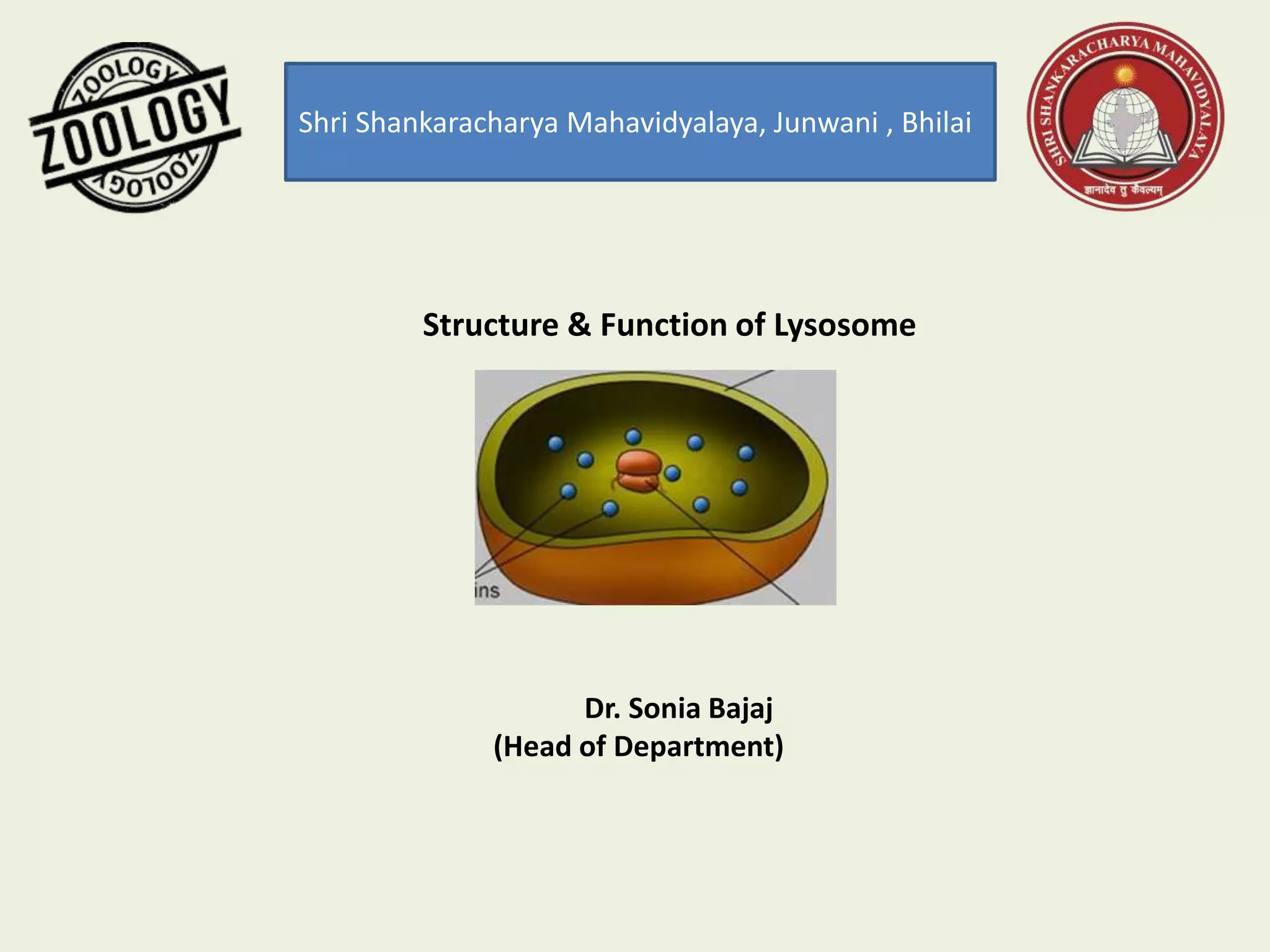
Structure & Function of Lysosome
Dr. Sonia Bajaj
(Head of Department)
Introduction
Lysosomes are membrane-bound, dense granular structures containing hydrolytic
enzymes.
Origen of lysosome is from SER and from golgi.
Size varies from 0.2-0.8 micrometer.
The word “lysosome” is made up of two words “lysis” meaning breakdown and
“soma” meaning body.
Lysosomes occur freely in the cytoplasm and Found in eukaryotic animal cells &
Plant cell, except mature mammalian RBC.
Lysosomes were discovered by De Duve a Belgian Cytologist in 1955 who
designated them as suicide bags.
They are also known as the “suicide bags” of the cell. when cell gets
damaged, lysosome may burst and the enzymes digest their own cell. they posses
different kind of hydrolases on release of these enzymes that cause death of cell.
. “Lysosomes are sphere-shaped sacs filled with hydrolytic enzymes that have the
capability to break down many types of biomolecules.”
Lysosomal Enzymes-
lysosomes contains acidic hydrolytic enzymes, about 50 of enzymes have been
identify far. All this enzyme have been classify in to 6 categories-
Proteases, which digest proteins
Lipases, which digests lipids
Amylase, which digests carbohydrates
Nucleases, which digest nucleic acids
Phosphoric acid monoesters
Sulphatases
Collectively the group of enzymes is called hydrolases which cause cleavage of
substrates by the addition of water molecules. Most of the lysosomal enzymes
function in the acidic medium.
Lysosome Structure
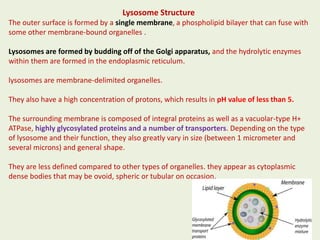
The outer surface is formed by a single membrane, a phospholipid bilayer that can fuse with
some other membrane-bound organelles .
Lysosomes are formed by budding off of the Golgi apparatus, and the hydrolytic enzymes
within them are formed in the endoplasmic reticulum.
lysosomes are membrane-delimited organelles.
They also have a high concentration of protons, which results in pH value of less than 5.
The surrounding membrane is composed of integral proteins as well as a vacuolar-type H+
ATPase, highly glycosylated proteins and a number of transporters. Depending on the type
of lysosome and their function, they also greatly vary in size (between 1 micrometer and
several microns) and general shape.
They are less defined compared to other types of organelles. they appear as cytoplasmic
dense bodies that may be ovoid, spheric or tubular on occasion.
Types of lysosomes
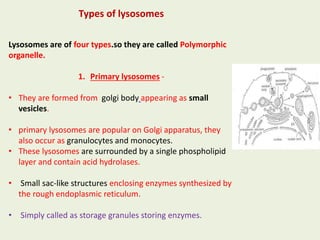
Lysosomes are of four types.so they are called Polymorphic
organelle.
1. Primary lysosomes -
• They are formed from golgi body appearing as small
vesicles.
• primary lysosomes are popular on Golgi apparatus, they
also occur as granulocytes and monocytes.
• These lysosomes are surrounded by a single phospholipid
layer and contain acid hydrolases.
• Small sac-like structures enclosing enzymes synthesized by
the rough endoplasmic reticulum.
• Simply called as storage granules storing enzymes.
2. Secondary lysosomes -
• Secondary lysosomes are formed by the fusion of primary lysosomes with
phagosomes /pinosome / endosomes.
• Compared to primary lysosomes, secondary are larger in size and capable of
releasing their content (enzymes) outside the cells where they degrade foreign
material.
• Contain active enzymes.
• Materials are progressively digested.
3. Tertiary lysosomes -
• Tertiary lysosome also known as Telosome or residual
body .
• Contain undigested food which is expelled by
exocytosis.
4. Auto lysosome-
• Auto lysosome also known as autophagosome.
• Formed by fusion of primary lysosome with cell
organelles( which is old or damage and need to be
digested).
• Auto lysosome also function during deficiency of food
(by digesting the reserved food).
• They are called suicidal bag when they rapture to
release all the enzyme to digest and old or worn- out
cell.
Functions of Lysosomes
Primary function of lysosome is intracellular and extracellular digestion at acidic
pH.
• Intracellular Digestion
• To digest food, the lysosome membrane fuses with the membrane of food
vacuole and squirts the enzymes inside.
• The digested food then diffuses through the vacuole membrane and enters the
cell to be used for energy and growth.
• Extracellular Digestion
• Primary lysosomes secrete hydrolases outside by exocytosis resulting in
degradation of extracellular materials.
eg. Saprophytic fungi
• Heterophagy
• The taking into the cell of exogenous material by phagocytosis or pinocytosis
and the digestion of the ingested material after fusion of the newly formed
vacuole with a lysosome.
Autophagy
A normal physiological process that deals with the destruction of cells in the
body. It is essential for maintaining homeostasis, for normal functioning by
protein degradation, turn over of destroyed cell organelles for new cell
formation.
Autolysis
It refers to the self killing of an entire set of cells by the breakdown of the
lysosome membrane. It occurs during amphibian and insect metamorphosis.
Fertilization
The acrosome of the sperm head is a giant lysosome that ruptures and releases
lytic enzymes like hyaluronidase, on the surface of the egg. This provides the
way for sperm entry into the egg by digesting the egg membrane.
As Janitors of the Cell
Lysosomes remove ‘junk’ that may accumulate in the cell helping to prevent
diseases.
Lysosome

Lysosome

  • 1.
    Shri Shankaracharya Mahavidyalaya,Junwani , Bhilai Structure & Function of Lysosome Dr. Sonia Bajaj (Head of Department)
  • 2.
    Introduction Lysosomes are membrane-bound,dense granular structures containing hydrolytic enzymes. Origen of lysosome is from SER and from golgi. Size varies from 0.2-0.8 micrometer. The word “lysosome” is made up of two words “lysis” meaning breakdown and “soma” meaning body. Lysosomes occur freely in the cytoplasm and Found in eukaryotic animal cells & Plant cell, except mature mammalian RBC. Lysosomes were discovered by De Duve a Belgian Cytologist in 1955 who designated them as suicide bags. They are also known as the “suicide bags” of the cell. when cell gets damaged, lysosome may burst and the enzymes digest their own cell. they posses different kind of hydrolases on release of these enzymes that cause death of cell. . “Lysosomes are sphere-shaped sacs filled with hydrolytic enzymes that have the capability to break down many types of biomolecules.”
  • 3.
    Lysosomal Enzymes- lysosomes containsacidic hydrolytic enzymes, about 50 of enzymes have been identify far. All this enzyme have been classify in to 6 categories- Proteases, which digest proteins Lipases, which digests lipids Amylase, which digests carbohydrates Nucleases, which digest nucleic acids Phosphoric acid monoesters Sulphatases Collectively the group of enzymes is called hydrolases which cause cleavage of substrates by the addition of water molecules. Most of the lysosomal enzymes function in the acidic medium.
  • 4.
    Lysosome Structure The outersurface is formed by a single membrane, a phospholipid bilayer that can fuse with some other membrane-bound organelles . Lysosomes are formed by budding off of the Golgi apparatus, and the hydrolytic enzymes within them are formed in the endoplasmic reticulum. lysosomes are membrane-delimited organelles. They also have a high concentration of protons, which results in pH value of less than 5. The surrounding membrane is composed of integral proteins as well as a vacuolar-type H+ ATPase, highly glycosylated proteins and a number of transporters. Depending on the type of lysosome and their function, they also greatly vary in size (between 1 micrometer and several microns) and general shape. They are less defined compared to other types of organelles. they appear as cytoplasmic dense bodies that may be ovoid, spheric or tubular on occasion.
  • 5.
    Types of lysosomes Lysosomesare of four types.so they are called Polymorphic organelle. 1. Primary lysosomes - • They are formed from golgi body appearing as small vesicles. • primary lysosomes are popular on Golgi apparatus, they also occur as granulocytes and monocytes. • These lysosomes are surrounded by a single phospholipid layer and contain acid hydrolases. • Small sac-like structures enclosing enzymes synthesized by the rough endoplasmic reticulum. • Simply called as storage granules storing enzymes.
  • 6.
    2. Secondary lysosomes- • Secondary lysosomes are formed by the fusion of primary lysosomes with phagosomes /pinosome / endosomes. • Compared to primary lysosomes, secondary are larger in size and capable of releasing their content (enzymes) outside the cells where they degrade foreign material. • Contain active enzymes. • Materials are progressively digested.
  • 7.
    3. Tertiary lysosomes- • Tertiary lysosome also known as Telosome or residual body . • Contain undigested food which is expelled by exocytosis. 4. Auto lysosome- • Auto lysosome also known as autophagosome. • Formed by fusion of primary lysosome with cell organelles( which is old or damage and need to be digested). • Auto lysosome also function during deficiency of food (by digesting the reserved food). • They are called suicidal bag when they rapture to release all the enzyme to digest and old or worn- out cell.
  • 8.
    Functions of Lysosomes Primaryfunction of lysosome is intracellular and extracellular digestion at acidic pH. • Intracellular Digestion • To digest food, the lysosome membrane fuses with the membrane of food vacuole and squirts the enzymes inside. • The digested food then diffuses through the vacuole membrane and enters the cell to be used for energy and growth. • Extracellular Digestion • Primary lysosomes secrete hydrolases outside by exocytosis resulting in degradation of extracellular materials. eg. Saprophytic fungi • Heterophagy • The taking into the cell of exogenous material by phagocytosis or pinocytosis and the digestion of the ingested material after fusion of the newly formed vacuole with a lysosome.
  • 9.
    Autophagy A normal physiologicalprocess that deals with the destruction of cells in the body. It is essential for maintaining homeostasis, for normal functioning by protein degradation, turn over of destroyed cell organelles for new cell formation. Autolysis It refers to the self killing of an entire set of cells by the breakdown of the lysosome membrane. It occurs during amphibian and insect metamorphosis. Fertilization The acrosome of the sperm head is a giant lysosome that ruptures and releases lytic enzymes like hyaluronidase, on the surface of the egg. This provides the way for sperm entry into the egg by digesting the egg membrane. As Janitors of the Cell Lysosomes remove ‘junk’ that may accumulate in the cell helping to prevent diseases.