Fluid Mosaic Model
of The Structure of
Cell Membrane
Wenny Pintalitna Tarigan
Pend.Biologi
2013
Background
Biological membranes play a crucial role
in almost all cellular phenomena
Organization of proteins and lipids of
membranes can be discerned
Generalizations about protein structure –
understanding the properties and
functions of protein molecules
Detailed structure
Objectives
 Thermodynamics and Membrane Structure
 Properties of proteins and lipids of functional
membrane
 The fluid mosaic model in detail
 Experimental evidence in terms of the model
 The fluid mosaic model suggests new ways of
thinking about membrane functions and
membrane phenomena
Thermodynamics and
Membrane Structure
 Two kinds of non covalent
interactions are hydrophobic and
hydrophilic
 Hydrophybic – non polar groups,
away from water, requires energy
 Hydrophylic – polar groups for
aqueous environment
Thermodynamics and
Membrane Structure
 Ratio of proteins to lipids = 1.5 – 4
 Cell membrane recognition sites
activate enzyme in membrane
which begins "cascade" of events
which activate other enzymes. This
is called signal transduction
(pg 155 Campbell)
Properties of Proteins
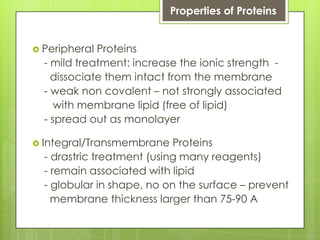
 Peripheral Proteins
- mild treatment: increase the ionic strength -
dissociate them intact from the membrane
- weak non covalent – not strongly associated
with membrane lipid (free of lipid)
- spread out as monolayer
 Integral/Transmembrane Proteins
- drastric treatment (using many reagents)
- remain associated with lipid
- globular in shape, no on the surface – prevent
membrane thickness larger than 75-90 A
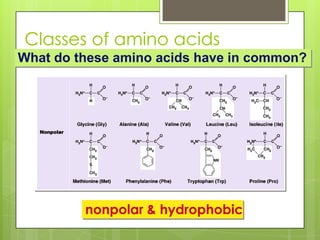
Classes of amino acids
What do these amino acids have in common?
nonpolar & hydrophobic
Classes of amino acids
What do these amino acids have in common?
polar & hydrophilic
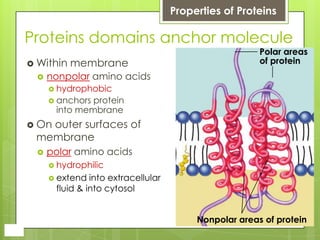
Proteins domains anchor molecule
 Within membrane
 nonpolar amino acids
 hydrophobic
 anchors protein
into membrane
 On outer surfaces of
membrane
 polar amino acids
 hydrophilic
 extend into extracellular
fluid & into cytosol
Polar areas
of protein
Nonpolar areas of protein
Properties of Proteins
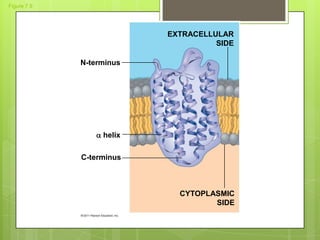
Figure 7.9
N-terminus
 helix
C-terminus
EXTRACELLULAR
SIDE
CYTOPLASMIC
SIDE
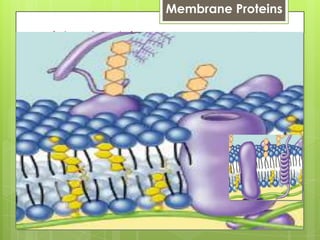
Membrane Proteins
peripheral proteins
loosely bound to surface of
membrane
cell surface identity marker
(antigens)
integral proteins
penetrate lipid bilayer, usually
across whole membrane
transmembrane protein
transport proteins
 channels, permeases (pumps)
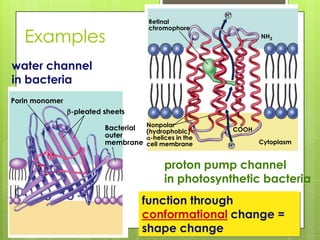
NH2
H+
COOH
Cytoplasm
Retinal
chromophore
Nonpolar
(hydrophobic)
-helices in the
cell membrane H+
Porin monomer
b-pleated sheets
Bacterial
outer
membrane
proton pump channel
in photosynthetic bacteria
water channel
in bacteria
function through
conformational change =
shape change
Examples
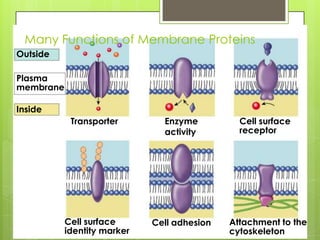
Many Functions of Membrane Proteins
Outside
Plasma
membrane
Inside
Transporter Cell surface
receptor
Enzyme
activity
Cell surface
identity marker
Attachment to the
cytoskeleton
Cell adhesion
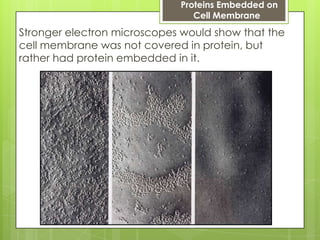
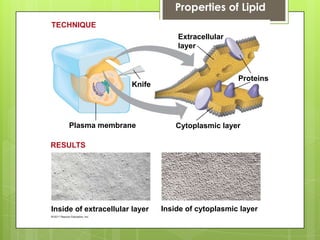
Stronger electron microscopes would show that the
cell membrane was not covered in protein, but
rather had protein embedded in it.
Proteins Embedded on
Cell Membrane
Knife
Plasma membrane Cytoplasmic layer
Proteins
Extracellular
layer
Inside of extracellular layer Inside of cytoplasmic layer
TECHNIQUE
RESULTS
Properties of Lipid
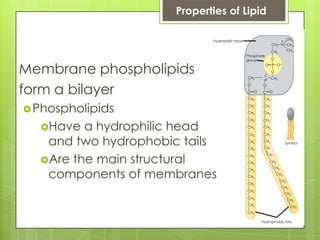
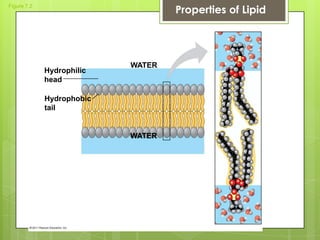
Membrane phospholipids
form a bilayer
Phospholipids
Have a hydrophilic head
and two hydrophobic tails
Are the main structural
components of membranes
CH2
CH2
CH2
CH2
CH2
CH2
CH2
CH2
CH2
CH2
CH2
CH2
CH2
CH2
CH2
CH3
CH2
CH2
CH2
CH2
CH2
CH2
CH2
CH2
CH
CH
CH2
CH2
CH2
CH2
CH2
CH2
CH2
CH3
CH2
CH2
CH3
CH3
CH3
N
+
O
O O–P
O
CH2
C
H
CH2
C O C O
O O
Phosphate
group
Symbol
Hydrophilic head
Hydrophobic tails
Properties of Lipid
Figure 7.2
Hydrophilic
head
Hydrophobic
tail
WATER
WATER
Properties of Lipid
Figure 7.6
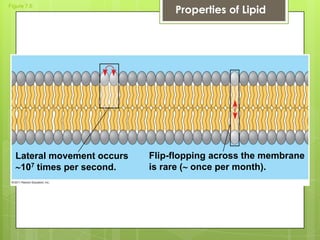
Lateral movement occurs
107 times per second.
Flip-flopping across the membrane
is rare ( once per month).
Properties of Lipid
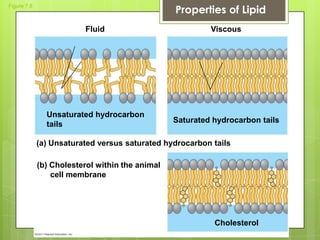
Figure 7.8
Fluid
Unsaturated hydrocarbon
tails
Viscous
Saturated hydrocarbon tails
(a) Unsaturated versus saturated hydrocarbon tails
(b) Cholesterol within the animal
cell membrane
Cholesterol
Properties of Lipid
Properties of Lipid
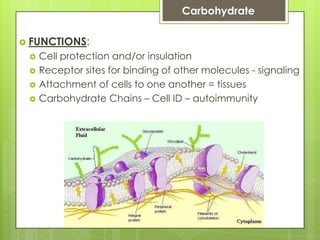
 FUNCTIONS:
 Cell protection and/or insulation
 Receptor sites for binding of other molecules - signaling
 Attachment of cells to one another = tissues
 Carbohydrate Chains – Cell ID – autoimmunity
Carbohydrate
Mosaic:
something made
of small pieces
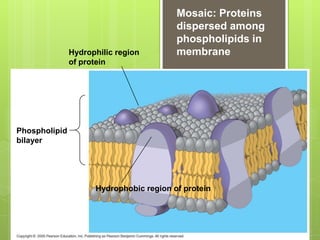
Hydrophilic region
of protein
Hydrophobic region of protein
Phospholipid
bilayer
Mosaic: Proteins
dispersed among
phospholipids in
membrane
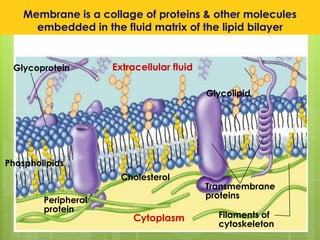
Membrane is a collage of proteins & other molecules
embedded in the fluid matrix of the lipid bilayer
Extracellular fluid
Cholesterol
Cytoplasm
Glycolipid
Transmembrane
proteins
Filaments of
cytoskeleton
Peripheral
protein
Glycoprotein
Phospholipids
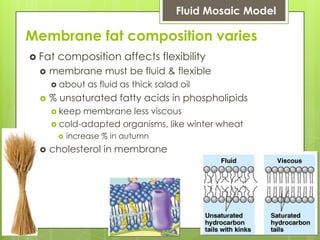
Membrane fat composition varies
 Fat composition affects flexibility
 membrane must be fluid & flexible
 about as fluid as thick salad oil
 % unsaturated fatty acids in phospholipids
 keep membrane less viscous
 cold-adapted organisms, like winter wheat
 increase % in autumn
 cholesterol in membrane
Fluid Mosaic Model
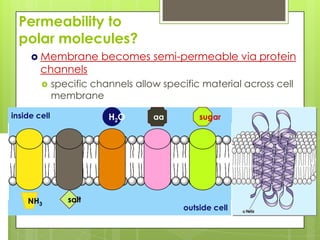
Permeability to
polar molecules?
 Membrane becomes semi-permeable via protein
channels
 specific channels allow specific material across cell
membrane
outside cell
inside cell sugaraaH2O
saltNH3
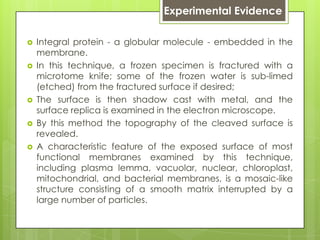
Experimental Evidence
 Integral protein - a globular molecule - embedded in the
membrane.
 In this technique, a frozen specimen is fractured with a
microtome knife; some of the frozen water is sub-limed
(etched) from the fractured surface if desired;
 The surface is then shadow cast with metal, and the
surface replica is examined in the electron microscope.
 By this method the topography of the cleaved surface is
revealed.
 A characteristic feature of the exposed surface of most
functional membranes examined by this technique,
including plasma lemma, vacuolar, nuclear, chloroplast,
mitochondrial, and bacterial membranes, is a mosaic-like
structure consisting of a smooth matrix interrupted by a
large number of particles.
New Ways of Thinking
Model restrictions imposed by thermodynamics. In this
model, the proteins that are integral to the membrane
are a heterogeneous set of globular molecules
(amphipathic structure)
The bulk of the phospholipid is organized as a fluid
bilayer, although a small fraction of the lipid may
interact specifically with the membrane proteins.
The fluid mosaic structure is therefore formally
analogous to a two-dimensional oriented solution of
integral proteins (or lipoproteins) in the viscous
phospholipid bilayer solvent.
Evidence stated that all of which are consistent with,
and add much detail to, the fluid mosaic model.
Any Questions??
Bakteri Anthrax
Kapsul bakteri

Fluid Mosaic Model

  • 1.
    Fluid Mosaic Model ofThe Structure of Cell Membrane Wenny Pintalitna Tarigan Pend.Biologi 2013
  • 2.
    Background Biological membranes playa crucial role in almost all cellular phenomena Organization of proteins and lipids of membranes can be discerned Generalizations about protein structure – understanding the properties and functions of protein molecules Detailed structure
  • 3.
    Objectives  Thermodynamics andMembrane Structure  Properties of proteins and lipids of functional membrane  The fluid mosaic model in detail  Experimental evidence in terms of the model  The fluid mosaic model suggests new ways of thinking about membrane functions and membrane phenomena
  • 4.
    Thermodynamics and Membrane Structure Two kinds of non covalent interactions are hydrophobic and hydrophilic  Hydrophybic – non polar groups, away from water, requires energy  Hydrophylic – polar groups for aqueous environment
  • 5.
    Thermodynamics and Membrane Structure Ratio of proteins to lipids = 1.5 – 4  Cell membrane recognition sites activate enzyme in membrane which begins "cascade" of events which activate other enzymes. This is called signal transduction (pg 155 Campbell)
  • 6.
    Properties of Proteins Peripheral Proteins - mild treatment: increase the ionic strength - dissociate them intact from the membrane - weak non covalent – not strongly associated with membrane lipid (free of lipid) - spread out as monolayer  Integral/Transmembrane Proteins - drastric treatment (using many reagents) - remain associated with lipid - globular in shape, no on the surface – prevent membrane thickness larger than 75-90 A
  • 7.
    Classes of aminoacids What do these amino acids have in common? nonpolar & hydrophobic
  • 8.
    Classes of aminoacids What do these amino acids have in common? polar & hydrophilic
  • 9.
    Proteins domains anchormolecule  Within membrane  nonpolar amino acids  hydrophobic  anchors protein into membrane  On outer surfaces of membrane  polar amino acids  hydrophilic  extend into extracellular fluid & into cytosol Polar areas of protein Nonpolar areas of protein Properties of Proteins
  • 10.
  • 11.
    Membrane Proteins peripheral proteins looselybound to surface of membrane cell surface identity marker (antigens) integral proteins penetrate lipid bilayer, usually across whole membrane transmembrane protein transport proteins  channels, permeases (pumps)
  • 12.
    NH2 H+ COOH Cytoplasm Retinal chromophore Nonpolar (hydrophobic) -helices in the cellmembrane H+ Porin monomer b-pleated sheets Bacterial outer membrane proton pump channel in photosynthetic bacteria water channel in bacteria function through conformational change = shape change Examples
  • 13.
    Many Functions ofMembrane Proteins Outside Plasma membrane Inside Transporter Cell surface receptor Enzyme activity Cell surface identity marker Attachment to the cytoskeleton Cell adhesion
  • 14.
    Stronger electron microscopeswould show that the cell membrane was not covered in protein, but rather had protein embedded in it. Proteins Embedded on Cell Membrane
  • 15.
    Knife Plasma membrane Cytoplasmiclayer Proteins Extracellular layer Inside of extracellular layer Inside of cytoplasmic layer TECHNIQUE RESULTS Properties of Lipid
  • 16.
    Membrane phospholipids form abilayer Phospholipids Have a hydrophilic head and two hydrophobic tails Are the main structural components of membranes CH2 CH2 CH2 CH2 CH2 CH2 CH2 CH2 CH2 CH2 CH2 CH2 CH2 CH2 CH2 CH3 CH2 CH2 CH2 CH2 CH2 CH2 CH2 CH2 CH CH CH2 CH2 CH2 CH2 CH2 CH2 CH2 CH3 CH2 CH2 CH3 CH3 CH3 N + O O O–P O CH2 C H CH2 C O C O O O Phosphate group Symbol Hydrophilic head Hydrophobic tails Properties of Lipid
  • 17.
  • 18.
    Figure 7.6 Lateral movementoccurs 107 times per second. Flip-flopping across the membrane is rare ( once per month). Properties of Lipid
  • 19.
    Figure 7.8 Fluid Unsaturated hydrocarbon tails Viscous Saturatedhydrocarbon tails (a) Unsaturated versus saturated hydrocarbon tails (b) Cholesterol within the animal cell membrane Cholesterol Properties of Lipid
  • 20.
  • 21.
     FUNCTIONS:  Cellprotection and/or insulation  Receptor sites for binding of other molecules - signaling  Attachment of cells to one another = tissues  Carbohydrate Chains – Cell ID – autoimmunity Carbohydrate
  • 22.
  • 23.
    Hydrophilic region of protein Hydrophobicregion of protein Phospholipid bilayer Mosaic: Proteins dispersed among phospholipids in membrane
  • 24.
    Membrane is acollage of proteins & other molecules embedded in the fluid matrix of the lipid bilayer Extracellular fluid Cholesterol Cytoplasm Glycolipid Transmembrane proteins Filaments of cytoskeleton Peripheral protein Glycoprotein Phospholipids
  • 25.
    Membrane fat compositionvaries  Fat composition affects flexibility  membrane must be fluid & flexible  about as fluid as thick salad oil  % unsaturated fatty acids in phospholipids  keep membrane less viscous  cold-adapted organisms, like winter wheat  increase % in autumn  cholesterol in membrane Fluid Mosaic Model
  • 26.
    Permeability to polar molecules? Membrane becomes semi-permeable via protein channels  specific channels allow specific material across cell membrane outside cell inside cell sugaraaH2O saltNH3
  • 27.
    Experimental Evidence  Integralprotein - a globular molecule - embedded in the membrane.  In this technique, a frozen specimen is fractured with a microtome knife; some of the frozen water is sub-limed (etched) from the fractured surface if desired;  The surface is then shadow cast with metal, and the surface replica is examined in the electron microscope.  By this method the topography of the cleaved surface is revealed.  A characteristic feature of the exposed surface of most functional membranes examined by this technique, including plasma lemma, vacuolar, nuclear, chloroplast, mitochondrial, and bacterial membranes, is a mosaic-like structure consisting of a smooth matrix interrupted by a large number of particles.
  • 28.
    New Ways ofThinking Model restrictions imposed by thermodynamics. In this model, the proteins that are integral to the membrane are a heterogeneous set of globular molecules (amphipathic structure) The bulk of the phospholipid is organized as a fluid bilayer, although a small fraction of the lipid may interact specifically with the membrane proteins. The fluid mosaic structure is therefore formally analogous to a two-dimensional oriented solution of integral proteins (or lipoproteins) in the viscous phospholipid bilayer solvent. Evidence stated that all of which are consistent with, and add much detail to, the fluid mosaic model.
  • 29.
  • 30.

Editor's Notes

  • #5 Thermodynamics- energy uses
  • #6 Cascade = menyatukanMatriks phospholipid terdiriatasdualapisan, dandidalamnyaterdapatduatipe protein, ialah protein periferyang dapatbereaksidandapatlarutpada air (polar), dan protein integral yang sukarberikatandansukarlarut air (nonpolar)