Light, Energy, and More October 23, 2007 Chemistry
Recap… Electromagnetic Spectrum High Energy Low Energy Wave Nature of Light
 
What’s Going On Here?
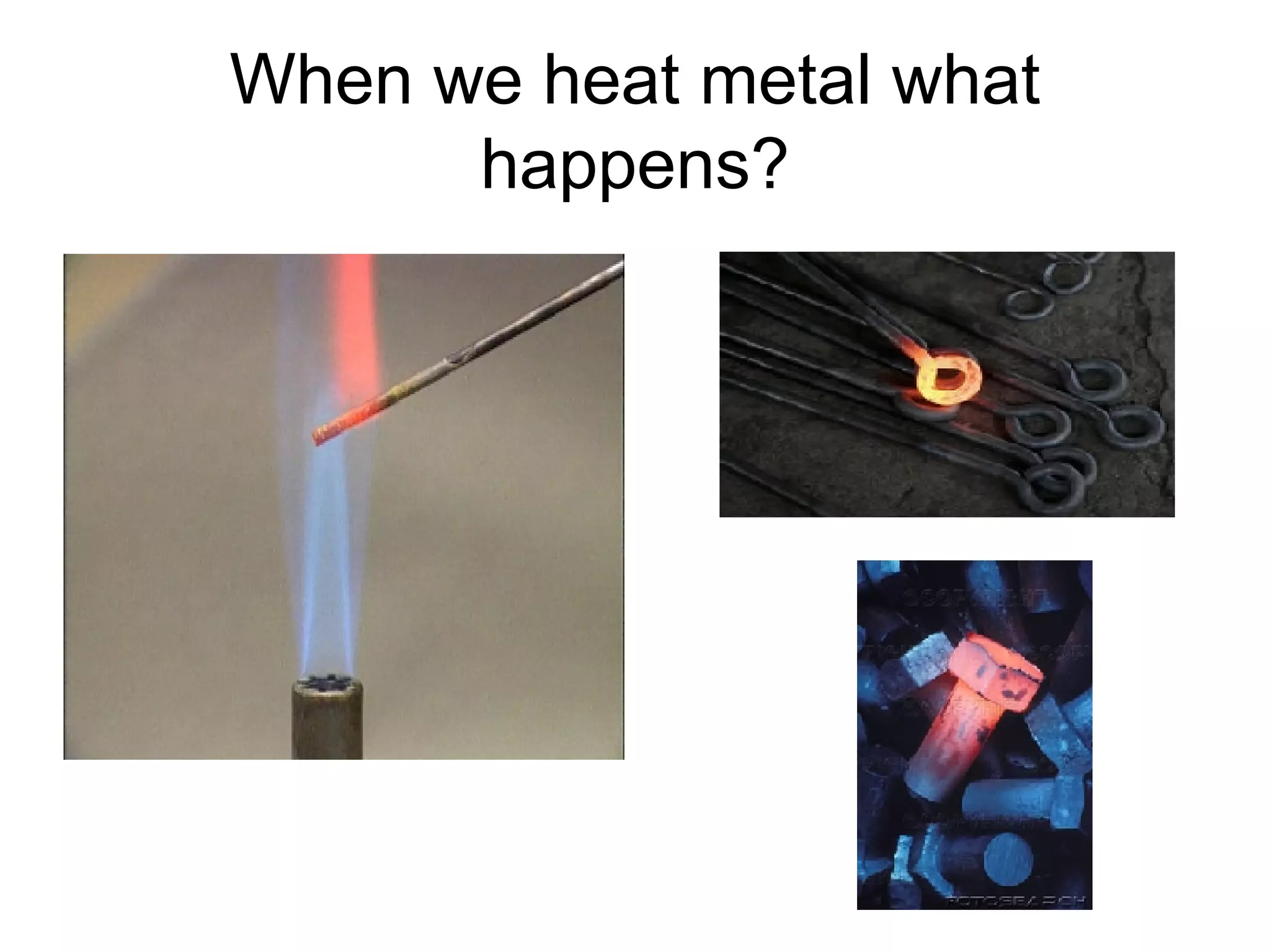
When we heat metal what happens?
Does the wave model of light explain these changes? Does not explain different wavelengths and frequencies at different temperatures What is light? Radiation….what is radiation? Particles or rays of energy What is temperature anyways? The measure of the average kinetic energy of the particles in an object Kinetic Energy vs. Potential Energy Too many questions….
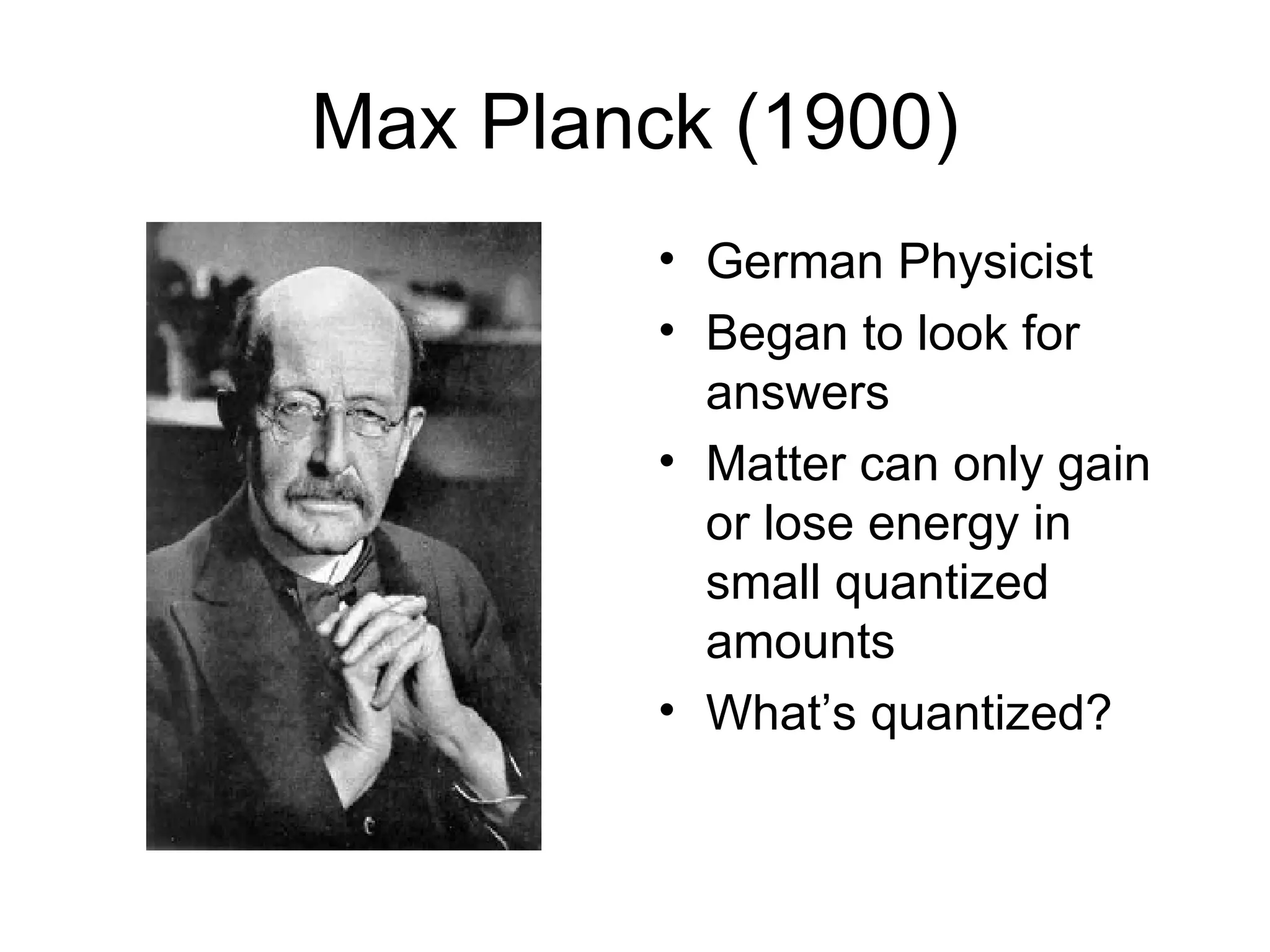
Max Planck (1900) German Physicist Began to look for answers Matter can only gain or lose energy in small quantized amounts What’s quantized?
Vocab Word!!! QUANTUM Minimum amount of energy that can be gained or lost by an atom The emitted light from a glowing metal is a ENERGY…this energy is quantized
If energy is now quantized…how can we determine the amount of energy of a quantum? What is energy measured in? What are we observing? What happens to the color when we increase the temperature (energy)? Proportional or inversely proportional? Now we need a constant… Planck’s constant, h=6.626 x 10^-34 J*s
 
Time to put these words into action! What is the frequency and wavelength electromagnetic radiation that emits 1.68 x 10^-17 J of energy? What type of electromagnetic radiation is this? Wavelength= 1.18 x 10^-8 m Ultraviolet radiation
Some questions to answer… What is the color we see? What happens to the energy of the radiation when we increase the frequency, v, of the radiation emitted? Iron at room temp…color and E? Iron with a little heat…color and E? Iron with lots of heat…color and E?
According to Planck’s Theory… If we have a given v, matter can emit or absorb E only in whole number multiples of hv (1hv, 2hv, 3 hv…) Matter can ONLY have specific amounts of energy Wall of kids building blocks We can only add or take away in increments of whole blocks…we cannot remove half a block
The Big Mystery of the 1900’s… The Photoelectric Effect… What caused these color changes in metals???
Photoelectric Effect Electrons (photoelectrons) are emitted from a metal’s surface when a light of a certain frequency shines on the surface Certain specific amounts of energy (what’s this called???) needed to knock out electrons from metal atoms.
 
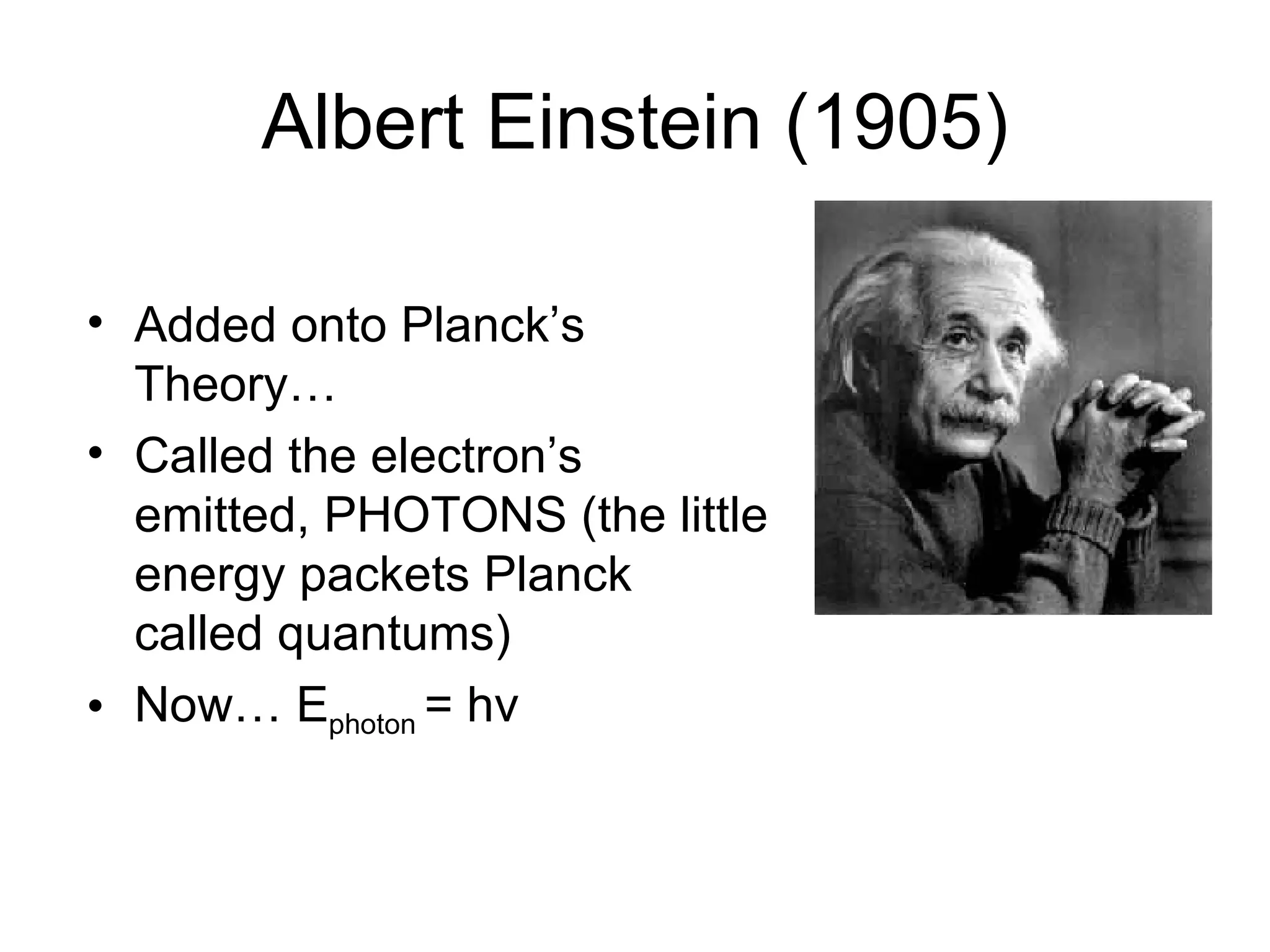
Albert Einstein (1905) Added onto Planck’s Theory… Called the electron’s emitted, PHOTONS (the little energy packets Planck called quantums) Now… E photon  = hv
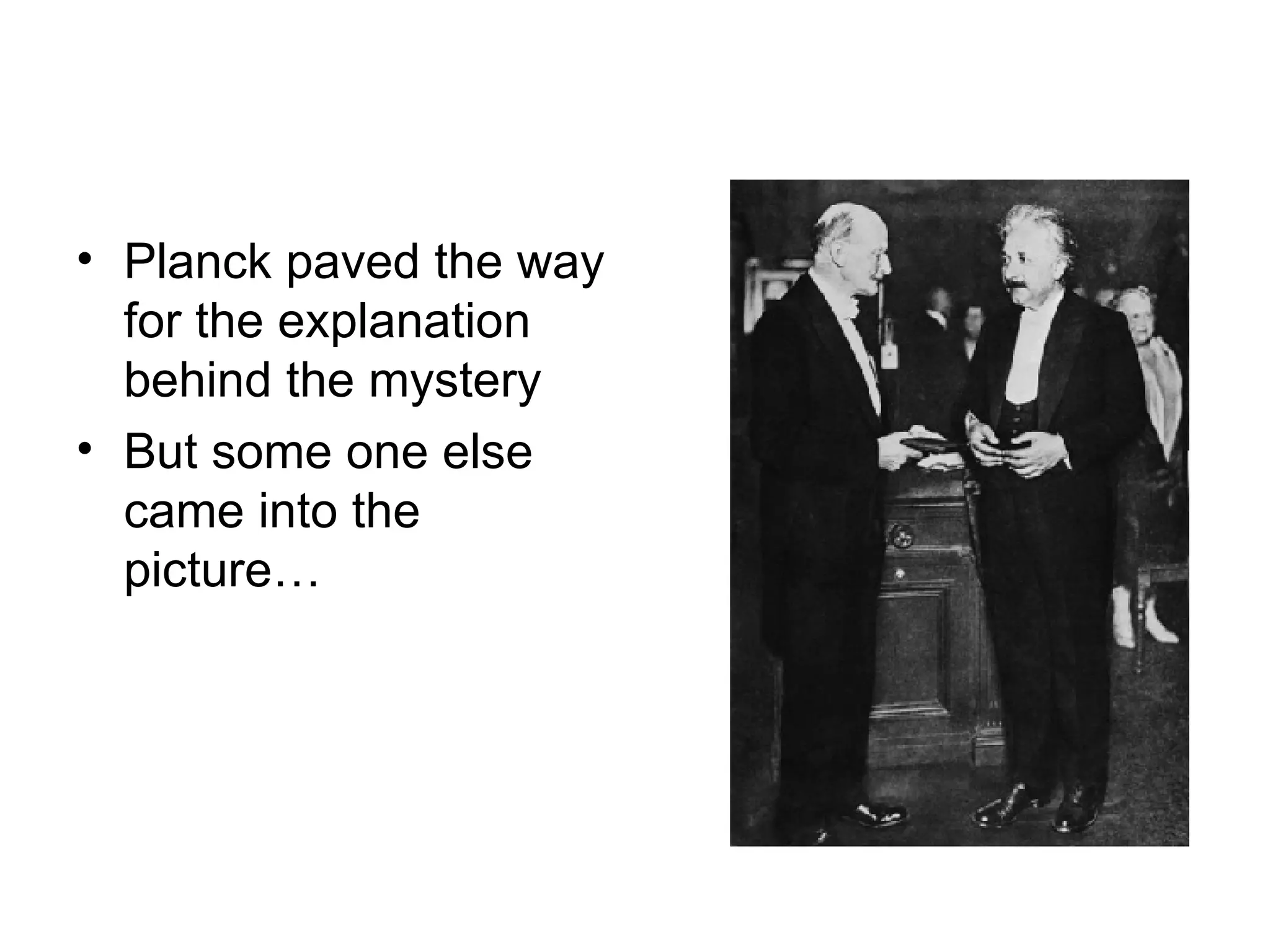
Planck paved the way for the explanation behind the mystery But some one else came into the picture…
Now light is not just a wave… Einstein’s Dual Nature of Light Particle and wave characteristics Light is a beam of tiny particles, called photons, acting like a wave
NEW WORD!!! Photon A particle of electromagnetic radiation with no mass that carries a quantum of energy
 
What Einstein added… Energy of a photon has a minimum or threshold value to eject photoelectrons What must happen for the photoelectric effect to occur? Energy of a photon (particle of EM radiation) must have the minimum energy requirement to free the electron from the atom of metal
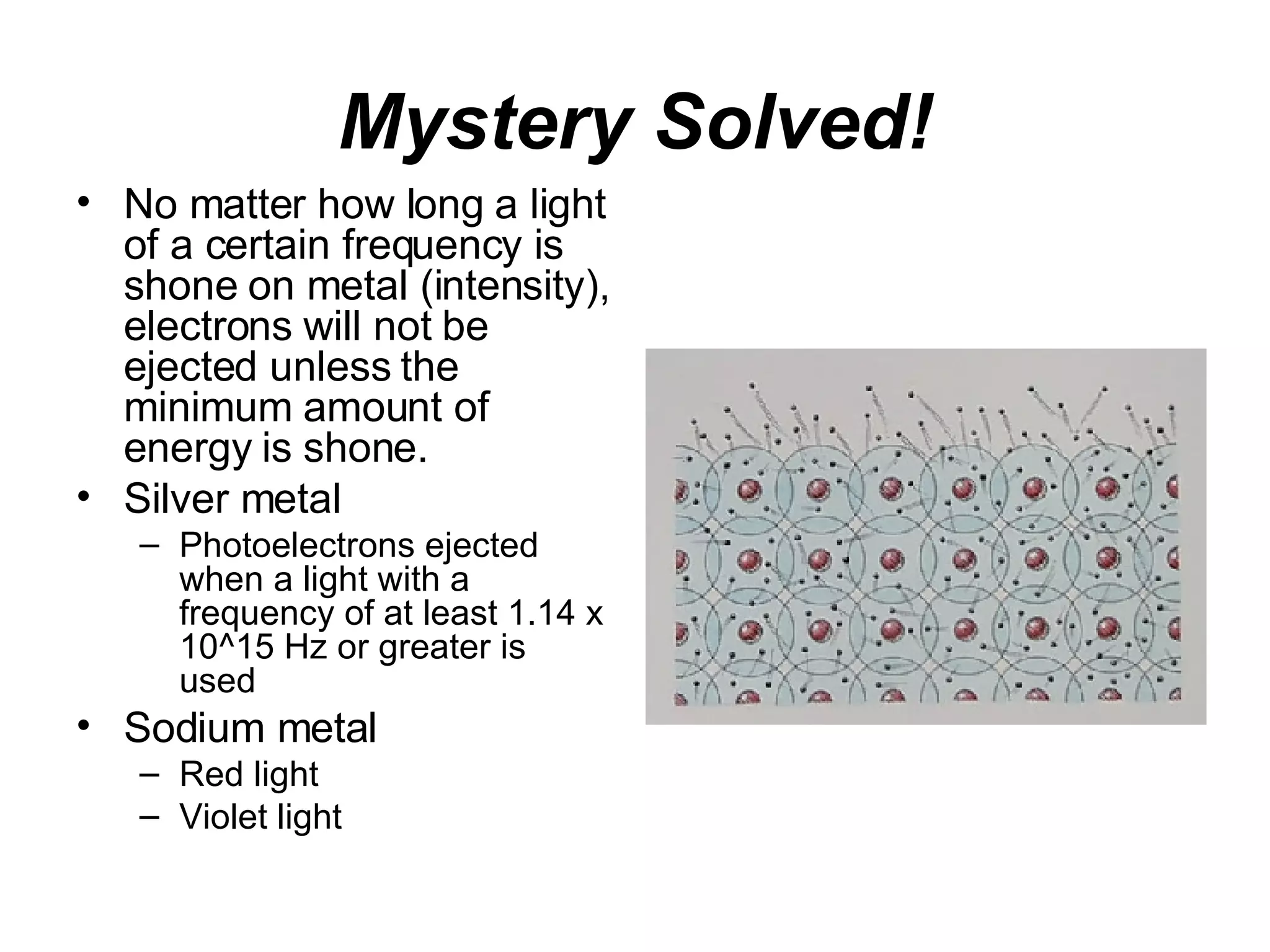
Mystery Solved! No matter how long a light of a certain frequency is shone on metal (intensity), electrons will not be ejected unless the minimum amount of energy is shone. Silver metal Photoelectrons ejected when a light with a frequency of at least 1.14 x 10^15 Hz or greater is used Sodium metal Red light Violet light
Revised Planck’s Work… Einstein piggy-backed off of Planck’s Theory and we now have….. Photon
Time to do a little work…. Tiny water drops in the air disperse the white light of the sun into a rainbow.  What is the Energy oa a photon from the violet portion of the rainbow if it has a frequency of 7.23x10^14 Hz? E=4.79 x 10^-19 J Energy in a photon of violet light
A couple more…   A photon has an energy of 2.93 x 10^-25 J.  What is its frequency? What type of electromagnetic radiation is the photon? V=4.42 x 10^8 Hz TV or FM waves
Practice makes perfect…   What is the energy of each photon in the following types of radiation? 6.32 x 10^20 Hz 9.50 x 10^13 Hz 1.05 x 10^16 Hz What types of radiation are each? 4.19 x 10^-13 J gamma or x-ray 6.29 x 10^20 J infrared 6.96 x 10^-18 J ultraviolet

Planck And Photoelectric Effect

  • 1.
    Light, Energy, andMore October 23, 2007 Chemistry
  • 2.
    Recap… Electromagnetic SpectrumHigh Energy Low Energy Wave Nature of Light
  • 3.
  • 4.
  • 5.
    When we heatmetal what happens?
  • 6.
    Does the wavemodel of light explain these changes? Does not explain different wavelengths and frequencies at different temperatures What is light? Radiation….what is radiation? Particles or rays of energy What is temperature anyways? The measure of the average kinetic energy of the particles in an object Kinetic Energy vs. Potential Energy Too many questions….
  • 7.
    Max Planck (1900)German Physicist Began to look for answers Matter can only gain or lose energy in small quantized amounts What’s quantized?
  • 8.
    Vocab Word!!! QUANTUMMinimum amount of energy that can be gained or lost by an atom The emitted light from a glowing metal is a ENERGY…this energy is quantized
  • 9.
    If energy isnow quantized…how can we determine the amount of energy of a quantum? What is energy measured in? What are we observing? What happens to the color when we increase the temperature (energy)? Proportional or inversely proportional? Now we need a constant… Planck’s constant, h=6.626 x 10^-34 J*s
  • 10.
  • 11.
    Time to putthese words into action! What is the frequency and wavelength electromagnetic radiation that emits 1.68 x 10^-17 J of energy? What type of electromagnetic radiation is this? Wavelength= 1.18 x 10^-8 m Ultraviolet radiation
  • 12.
    Some questions toanswer… What is the color we see? What happens to the energy of the radiation when we increase the frequency, v, of the radiation emitted? Iron at room temp…color and E? Iron with a little heat…color and E? Iron with lots of heat…color and E?
  • 13.
    According to Planck’sTheory… If we have a given v, matter can emit or absorb E only in whole number multiples of hv (1hv, 2hv, 3 hv…) Matter can ONLY have specific amounts of energy Wall of kids building blocks We can only add or take away in increments of whole blocks…we cannot remove half a block
  • 14.
    The Big Mysteryof the 1900’s… The Photoelectric Effect… What caused these color changes in metals???
  • 15.
    Photoelectric Effect Electrons(photoelectrons) are emitted from a metal’s surface when a light of a certain frequency shines on the surface Certain specific amounts of energy (what’s this called???) needed to knock out electrons from metal atoms.
  • 16.
  • 17.
    Albert Einstein (1905)Added onto Planck’s Theory… Called the electron’s emitted, PHOTONS (the little energy packets Planck called quantums) Now… E photon = hv
  • 18.
    Planck paved theway for the explanation behind the mystery But some one else came into the picture…
  • 19.
    Now light isnot just a wave… Einstein’s Dual Nature of Light Particle and wave characteristics Light is a beam of tiny particles, called photons, acting like a wave
  • 20.
    NEW WORD!!! PhotonA particle of electromagnetic radiation with no mass that carries a quantum of energy
  • 21.
  • 22.
    What Einstein added…Energy of a photon has a minimum or threshold value to eject photoelectrons What must happen for the photoelectric effect to occur? Energy of a photon (particle of EM radiation) must have the minimum energy requirement to free the electron from the atom of metal
  • 23.
    Mystery Solved! Nomatter how long a light of a certain frequency is shone on metal (intensity), electrons will not be ejected unless the minimum amount of energy is shone. Silver metal Photoelectrons ejected when a light with a frequency of at least 1.14 x 10^15 Hz or greater is used Sodium metal Red light Violet light
  • 24.
    Revised Planck’s Work…Einstein piggy-backed off of Planck’s Theory and we now have….. Photon
  • 25.
    Time to doa little work…. Tiny water drops in the air disperse the white light of the sun into a rainbow. What is the Energy oa a photon from the violet portion of the rainbow if it has a frequency of 7.23x10^14 Hz? E=4.79 x 10^-19 J Energy in a photon of violet light
  • 26.
    A couple more…  A photon has an energy of 2.93 x 10^-25 J. What is its frequency? What type of electromagnetic radiation is the photon? V=4.42 x 10^8 Hz TV or FM waves
  • 27.
    Practice makes perfect…  What is the energy of each photon in the following types of radiation? 6.32 x 10^20 Hz 9.50 x 10^13 Hz 1.05 x 10^16 Hz What types of radiation are each? 4.19 x 10^-13 J gamma or x-ray 6.29 x 10^20 J infrared 6.96 x 10^-18 J ultraviolet