MEIOSIS Pp275-278
What Mendel Knew… Each organism must inherit a single copy of every gene from each of its “parents” Each of the organisms gametes must contain just one set genes When gametes are formed, there must be a process that separates the 2 sets of genes so each gamete gets one set
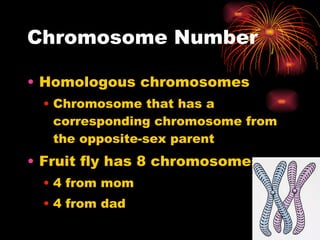
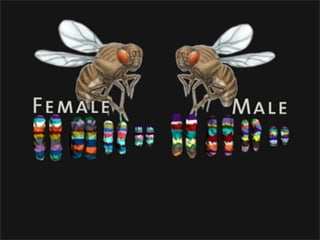
Chromosome Number Homologous chromosomes Chromosome that has a corresponding chromosome from the opposite-sex parent Fruit fly has 8 chromosomes 4 from mom 4 from dad
Diploid Di= two sets Cell that contains both sets of homologus chromosomes Cell contains  2 complete sets of chromosome 2 complete sets of genes Number of chrms in diploid cell represented by 2N For Drosophilia (fruit fly) 2N=8 Mendel said: Each adult cell contains two copies of each gene
Haploid Means “one set” Refers to cells that contain only one set of chromosomes Gametes (sex cells) Represented by N Drosophilia fruit fly N=4
How are haploid (N) gametes made from diploid (2N) cells?
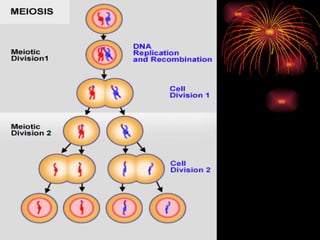
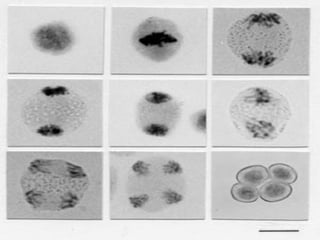
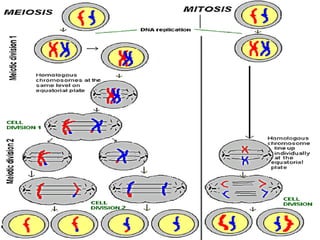
Meiosis Process of reduction division in which the number of chromosomes per cell is cut in half through the separation of homologous chromosomes in a diploid cell
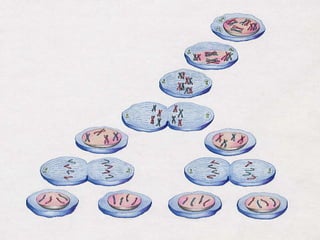
Meiosis 2 distinct stages Meiosis I  A diploid cell enters here Meiosis II At the end of this, the diploid cell that entered meiosis has become 4 haploid cells
 
 
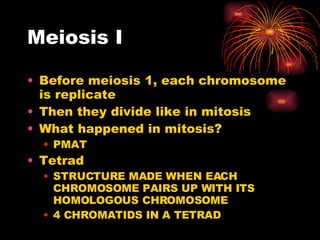
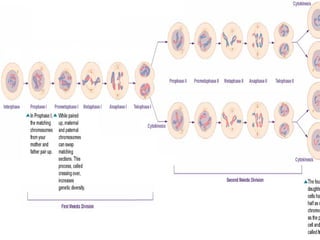
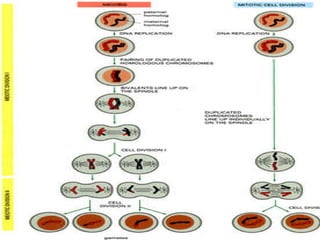
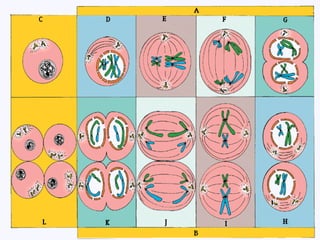
Meiosis I Before meiosis 1, each chromosome is replicate Then they divide like in mitosis What happened in mitosis? PMAT Tetrad STRUCTURE MADE WHEN EACH CHROMOSOME PAIRS UP WITH ITS HOMOLOGOUS CHROMOSOME 4 CHROMATIDS IN A TETRAD
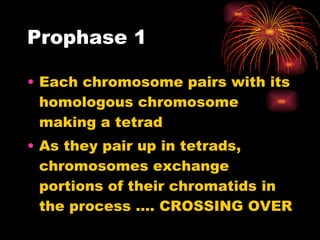
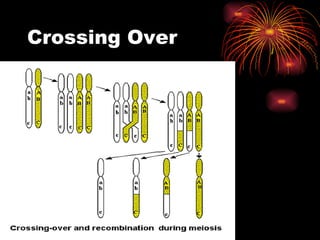
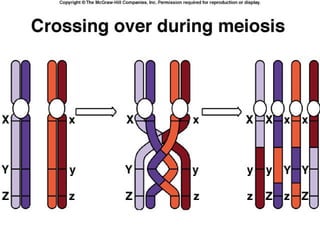
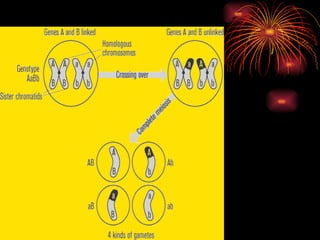
Prophase 1 Each chromosome pairs with its homologous chromosome making a tetrad As they pair up in tetrads, chromosomes exchange portions of their chromatids in the process …. CROSSING OVER
Crossing Over
 
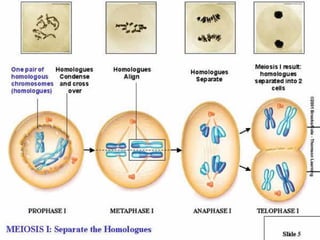
Metaphase1 Spindle fibers attach to chromosomes Anaphase 1 The spindles pull homologous chromosomes apart to opposite poles/ends Telophase 1 Nuclear membranes form and cell separates into two new cells
 
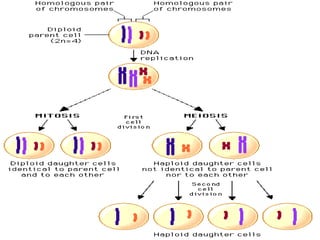
Now what do we have? 2 new daughter cells Are they identical to the parents? No The parent has 4 chromosomes Each daughter cell only has 2 chromosomes (4 chromatids, but they are different because of crossing-over) Each daughter cell has a set of chromosomes and alleles different from each other and different from the parent diploid cell
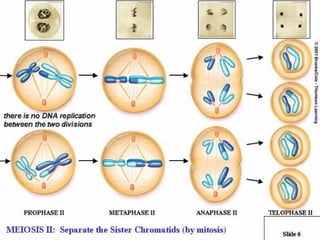
Meiosis II Unlike Mitosis, Neither cell goes through a round of chromosome replication Each cell’s chromosome has 2 chromatids
Prophase II Meiosis resulted in 2 haploid (N) cells, each with ½ the number of chromosomes in the original cell
Metaphase 2 Chromosomes line up in middle Anaphase 2 Sister chromatids separate and move to opposite poles Telophase 2 Meiosis II results in 4 haploid (N) daughter cells 4 daughter cells contain haploid number of chromosomes, just 2 each
 
 
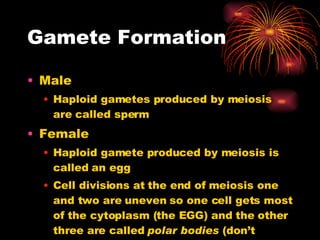
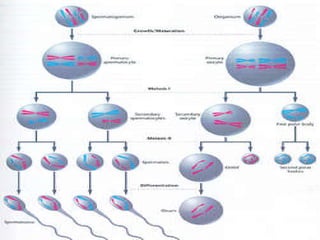
Gamete Formation Male Haploid gametes produced by meiosis are called sperm Female Haploid gamete produced by meiosis is called an egg Cell divisions at the end of meiosis one and two are uneven so one cell gets most of the cytoplasm (the EGG) and the other three are called  polar bodies  (don’t participate in reproduction)


Mitosis vs. Meiosis Mitosis Results in the production of two genetically identical DIPLOID cells Daughter cells have sets of chromosomes identical to each other and to parent cell MITOSIS allows body to grow and replace other cells Asexual reproduction Meiosis Results in four genetically different HAPLOID cells MEIOSIS is how sexually reproducing organisms make gametes
 
 
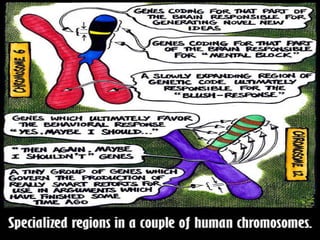
Genes
Gene Linkage Would genes on the same chromosome be inherited together? Thomas Hunt Morgan gave us the answer 1910 PRINCIPLE of LINKAGE 50 Drosophilia genes Seemed to contradict Principle of Independent Assortment b/c certain genes were always inherited together He grouped the fly’s genes into linkage groups
Linkage groups are made up of genes that seem to be inherited together Linkage groups assort independently but all genes in one group are inherited together Drosophilia 4 linkage groups 4 chromosomes What can be concluded?
 
Conclusions Each chromosome is actually a group of linked genes Mendel’s Principle of Independent Assortment holds true IT IS THE CHROMOSOMES THAT ASSORT INDEPENDENTLY, NOT THE INDIVIDUAL GENES
How Mendel missed it… What 7 genes did he study? 6 of the 7 genes were on different chromosomes Two genes were on the same chromosome but they were so far apart on the same chromosome that they assorted independently
If two genes are on the same chromosome, does that mean they are linked for ever? No, chromosomes cross over during meiosis so they can separate Crossing over produces new combinations of alleles Important for genetic diversity
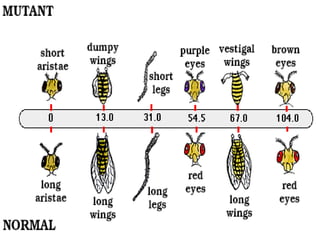
Lucky Student Alfred Sturtevant 1911 Columbia University Worked in Morgan’s Lab Hypothesis If two genes are farther apart on a chromosome, the they are more likely to be separated during meiosis Experiment Measured the rate at which linked genes were separated and recombined to make a “map” of distances between genes Conclusion Recombination rates could be used to make gene maps Gene maps showed the location of a gene on a chromosome


Meiosis

  • 1.
  • 2.
    What Mendel Knew…Each organism must inherit a single copy of every gene from each of its “parents” Each of the organisms gametes must contain just one set genes When gametes are formed, there must be a process that separates the 2 sets of genes so each gamete gets one set
  • 3.
    Chromosome Number Homologouschromosomes Chromosome that has a corresponding chromosome from the opposite-sex parent Fruit fly has 8 chromosomes 4 from mom 4 from dad
  • 4.
    Diploid Di= twosets Cell that contains both sets of homologus chromosomes Cell contains 2 complete sets of chromosome 2 complete sets of genes Number of chrms in diploid cell represented by 2N For Drosophilia (fruit fly) 2N=8 Mendel said: Each adult cell contains two copies of each gene
  • 5.
    Haploid Means “oneset” Refers to cells that contain only one set of chromosomes Gametes (sex cells) Represented by N Drosophilia fruit fly N=4
  • 6.
    How are haploid(N) gametes made from diploid (2N) cells?
  • 7.
    Meiosis Process ofreduction division in which the number of chromosomes per cell is cut in half through the separation of homologous chromosomes in a diploid cell
  • 8.
    Meiosis 2 distinctstages Meiosis I A diploid cell enters here Meiosis II At the end of this, the diploid cell that entered meiosis has become 4 haploid cells
  • 9.
  • 10.
  • 11.
    Meiosis I Beforemeiosis 1, each chromosome is replicate Then they divide like in mitosis What happened in mitosis? PMAT Tetrad STRUCTURE MADE WHEN EACH CHROMOSOME PAIRS UP WITH ITS HOMOLOGOUS CHROMOSOME 4 CHROMATIDS IN A TETRAD
  • 12.
    Prophase 1 Eachchromosome pairs with its homologous chromosome making a tetrad As they pair up in tetrads, chromosomes exchange portions of their chromatids in the process …. CROSSING OVER
  • 13.
  • 14.
  • 15.
    Metaphase1 Spindle fibersattach to chromosomes Anaphase 1 The spindles pull homologous chromosomes apart to opposite poles/ends Telophase 1 Nuclear membranes form and cell separates into two new cells
  • 16.
  • 17.
    Now what dowe have? 2 new daughter cells Are they identical to the parents? No The parent has 4 chromosomes Each daughter cell only has 2 chromosomes (4 chromatids, but they are different because of crossing-over) Each daughter cell has a set of chromosomes and alleles different from each other and different from the parent diploid cell
  • 18.
    Meiosis II UnlikeMitosis, Neither cell goes through a round of chromosome replication Each cell’s chromosome has 2 chromatids
  • 19.
    Prophase II Meiosisresulted in 2 haploid (N) cells, each with ½ the number of chromosomes in the original cell
  • 20.
    Metaphase 2 Chromosomesline up in middle Anaphase 2 Sister chromatids separate and move to opposite poles Telophase 2 Meiosis II results in 4 haploid (N) daughter cells 4 daughter cells contain haploid number of chromosomes, just 2 each
  • 21.
  • 22.
  • 23.
    Gamete Formation MaleHaploid gametes produced by meiosis are called sperm Female Haploid gamete produced by meiosis is called an egg Cell divisions at the end of meiosis one and two are uneven so one cell gets most of the cytoplasm (the EGG) and the other three are called polar bodies (don’t participate in reproduction)
  • 24.
  • 25.
  • 26.
  • 27.
  • 28.
  • 29.
    Mitosis vs. MeiosisMitosis Results in the production of two genetically identical DIPLOID cells Daughter cells have sets of chromosomes identical to each other and to parent cell MITOSIS allows body to grow and replace other cells Asexual reproduction Meiosis Results in four genetically different HAPLOID cells MEIOSIS is how sexually reproducing organisms make gametes
  • 30.
  • 31.
  • 32.
  • 33.
    Gene Linkage Wouldgenes on the same chromosome be inherited together? Thomas Hunt Morgan gave us the answer 1910 PRINCIPLE of LINKAGE 50 Drosophilia genes Seemed to contradict Principle of Independent Assortment b/c certain genes were always inherited together He grouped the fly’s genes into linkage groups
  • 34.
    Linkage groups aremade up of genes that seem to be inherited together Linkage groups assort independently but all genes in one group are inherited together Drosophilia 4 linkage groups 4 chromosomes What can be concluded?
  • 35.
  • 36.
    Conclusions Each chromosomeis actually a group of linked genes Mendel’s Principle of Independent Assortment holds true IT IS THE CHROMOSOMES THAT ASSORT INDEPENDENTLY, NOT THE INDIVIDUAL GENES
  • 37.
    How Mendel missedit… What 7 genes did he study? 6 of the 7 genes were on different chromosomes Two genes were on the same chromosome but they were so far apart on the same chromosome that they assorted independently
  • 38.
    If two genesare on the same chromosome, does that mean they are linked for ever? No, chromosomes cross over during meiosis so they can separate Crossing over produces new combinations of alleles Important for genetic diversity
  • 39.
    Lucky Student AlfredSturtevant 1911 Columbia University Worked in Morgan’s Lab Hypothesis If two genes are farther apart on a chromosome, the they are more likely to be separated during meiosis Experiment Measured the rate at which linked genes were separated and recombined to make a “map” of distances between genes Conclusion Recombination rates could be used to make gene maps Gene maps showed the location of a gene on a chromosome
  • 40.
  • 41.
  • 42.