ChaPtER
3 :

pHotOElecTriC
SCOPE OF STUDY
5 main sub topics students should learn and understand in this
chapter are :
Effect of intensity and frequency of a light wave on the
photoelectrons produced
Photoelectric current against potential graph
Quantitative study of the equations, work function and
threshold frequency
Photon theory of light
Failure of wave optics in explaining the photoelectric effect
PHOTOELECTRIC EFFECT
DEFINITION
DEFINITION

It's been determined experimentally that
when light shines on a metal surface, the
surface emits electrons
PHOTOELECTRIC EFFECT
Example : You can start a current in a circuit just by shining a light on
a metal plate.
PHOTOELECTRIC EFFECT
Why do you think this happens?
Well, we were saying earlier that light is made up of
electromagnetic waves, and that the waves carry energy. So if a
wave
of light hit an electron in one of the atoms in the metal, it might
transfer enough energy to knock the electron out of its atom.
PHOTOELECTRIC EFFECT
Example :
PHOTOELECTRIC EFFECT
A metal plate, P and a small electrode, C are placed inside an
evacuated glass tube (photocell).
2 electrodes are connected to an ammeter and a source of emf.
When photocell is in dark, ammeter reads zero (I = 0A).
When light of sufficiently high frequency illuminates the plate, the
ammeter indicates the current following in the circuit.
PHOTOELECTRIC EFFECT
How it works??
Imagining that electrons ejected from the plate by the impinging
radiation flow across the tube from the plate to the collector, C.
That electrons emit when light shines on a metal surface is consistent
with the electromagnetic (EM) wave theory of light : The electric field
of EM wave exert a force on electrons in the metal eject some of the
electrons.
PHOTOELECTRIC EFFECT
PHOTOEMISSIVE
PHOTOEMISSIVE
A material that can exhibit the
photoelectric effect

PHOTOELECTRONS
PHOTOELECTRONS
The ejected electrons
PHOTOELECTRIC EFFECT
Historically, light has sometimes been viewed as a particle rather
than a wave.
Einstein pointed out the wave theory and the photon theory of light
give different predictions of the photoelectric effects.
Two important properties of light wave are its intensity and its
frequency (or wavelength).
Effect of intensity and frequency of a light wave on the
photoelectron produced is described on wave theory predictions and
photon theory predictions.
PHOTOELECTRIC EFFECT
Wave Theory Predictions
If light is aawave, theory predicts:
If light is wave, theory predicts:
1. If the light intensity increase, the number of electrons
ejected and their maximum kinetic energy increase.
Because the higher intensity means aa greater electric field
Because the higher intensity means greater electric field
amplitude and the greater electric field should eject
electrons with higher speed.
2. The frequency of light not affect the kinetic energy of the
ejected electrons.
ejected electrons.
PHOTOELECTRIC EFFECT
Photon Theory Predictions
If light is particles, theory predicts:
•• Increasing intensity increases number of electrons but not
Increasing intensity increases number of electrons but not
energy.
energy.
•• Above aa minimum energy required to break atomic bond,
Above
minimum energy required to break atomic bond,
kinetic energy will increase linearly with frequency.
•• There is aa cutoff frequency below which no electrons will be
There is cutoff frequency below which no electrons will be
emitted, regardless of intensity.
PHOTOELECTRIC EFFECT
Stopping Potential or Cutoff Potential, Vo

The negative potential of the plate 'C' at which the
photo electric current becomes zero. Stopping potential
is that value of retarding potential difference between
two plates which is just sufficient to halt the most
energetic photo electrons emitted.
PHOTOELECTRIC EFFECT
*To determine the maximum kinetic energy, K max
from VO,,use the conservation of energy ::
from VO use the conservation of energy
Loss of kinetic energy = Gain in potential energy

K max = e VO
K max = e VO
PHOTOELECTRIC EFFECT
If we draw the photo electric curve by plotting the photo electric
current 'I' verses the accelerating voltage 'V', the graph so obtained is
shown below.
Graph shows that there is a saturation current for different
intensities and even when V=0, there is some photo electric current io.
The curve shows that the stopping potential is independent of the
intensity of radiation.
PHOTOELECTRIC EFFECT
I
At intensity III
At intensity II
At intensity I
i
Vo

V

Saturation current
PHOTOELECTRIC EFFECT
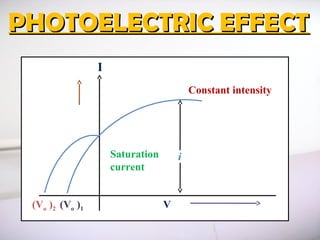
If these curves are plotted for different frequencies V1 and V2 but
with same intensity, the curve shows the behavior as shown.

The saturation current depends upon intensity and not on frequency.
However, the stopping potential becomes more negative from (Vo)1
to (Vo)2 with the increase in frequency.
PHOTOELECTRIC EFFECT
I
Constant intensity

Saturation
current
(Vo )2 (Vo )1

i

V
PHOTOELECTRIC EFFECT
OTHER FUNDAMENTAL LAWS OF PHOTO
ELECTRIC EMISSION
ELECTRIC EMISSION


The no. of electrons emitted per second i.e. photo current is

proportional to the intensity of incident light.
 If frequency of incident radiation is below threshold
frequency, no photo electric emission will take place.
 The max. velocity or max. K.E of photoelectrons depends on
the frequency of radiation not on intensity. K.E. Increases with
the increase in frequency.
.
PHOTOELECTRIC EFFECT
 The rate at which the electrons are emitted from a photo

cathode

is

independent

of

its

temperature.

This shows that photo electric effect is entirely different from
thermionic emission.
 For a given metal surface, stopping potential (Vo) is
directly proportional to frequency but independent of
intensity.
PHOTOELECTRIC EFFECT
Work Function, WO
Work Function, WO
Minimum amount of energy which is necessary to
start photo electric emission
# Remember that :
1. It is a property of material.
2. Different materials have different values of work function.
3. Generally, elements with low I.P values have low work function
such as Li, Na, K, Rb, and Cs.
PHOTOELECTRIC EFFECT
All the photon energy is transferred to the electron and the photon
ceases to exist.
ceases to exist.
Electrons are held in the metal by attractive forces, some minimum
energy, WOOis required just to get an electron out through the surface.
energy, W is required just to get an electron out through the surface.
If hf < Woo ,, the photons will not have enough energy to eject any
If hf < W the photons will not have enough energy to eject any
electrons at all.
electrons at all.
If hf > Woo ,, electrons will be ejected and energy will be conserved
If hf > W electrons will be ejected and energy will be conserved
in the process. This will come out equation ::
in the process. This will come out equation
If the least bound electrons,

hf = K + W
hf = K + W

hf = Kmax + Woo
hf = Kmax + W
PHOTOELECTRIC EFFECT
THRESHOLD FREQUENCY, ffo
THRESHOLD FREQUENCY, o

The minimum frequency of incident light which
can cause photo electric emission i.e. this
frequency is just able to eject electrons with out
giving them additional energy.
PHOTOELECTRIC EFFECT
The particle theory assumes that an electron absorbs a single photon.
Plotting the kinetic energy vs. frequency:
PHOTOELECTRIC EFFECT
This shows clear agreement with the photon theory, and not with
wave theory.
The maximum kinetic energy of ejected electrons increases linearly
with the frequency of incident light.

Kmax = hf - WO
No electrons are emitted if f < f0 where fO is the “cutoff” frequency.

WO = hfO
PHOTOELECTRIC EFFECT
The number of photo electrons depends upon:
The nature of material
The frequency of incident radiation
The intensity of incident radiation
Potential difference b/w the electrons
PHOTOELECTRIC EFFECT
Photon Theory of Light
According to the theory, light is an electromagnetic radiation with a
wavelength that is visible to the human eye.

A photon is an elementary particle that defines the light observed.
According to Einstein, there are three basic or fundamental
dimensions to be considered, when studying the Photon Theory of
Light.
PHOTOELECTRIC EFFECT
1) Intensity: The property of intensity that the light displays is related
to the subject's perception of the brightness of the light.
2) Frequency: The property of frequency that is displayed and
observed
observed

is
is

actually
actually

the
the

color
color

of
of

the
the

light
light

perceived.
perceived.

3) Polarization: Contrary to the other two, the property of polarization
of the light observed is only weakly perceptible, under
ordinary circumstances.
PHOTOELECTRIC EFFECT
According to the Albert Einstein's Photon Theory of Light, the
intensity of light shining on a metal determines the ability of the surface
to reflect and deflect the light.
It provides for observation the ability of a metal surface to receive and
throw out the light effectively and in an intensity that is observed to be
stronger than any other ordinary surface material.
PHOTOELECTRIC EFFECT
Einstein suggested that, given the success of Planck’s theory, light
must be emitted in small energy packets:
.

These tiny packets, or particles, are called
photons.
PHOTOELECTRIC EFFECT
Failure of wave optics in explaining the photoelectric effect
The light is giving its energy to electrons in the atoms of the metal
and allowing them to move around, producing the current.
However, not all colours of light affect metals in this way.
No matter how bright aa red light you have, it will not produce aa
No matter how bright red light you have, it will not produce
current in aametal, but even aavery dim blue light will result in aacurrent
current in metal, but even very dim blue light will result in current
flowing.
flowing.
The problem was that these results can't be explained if light is
thought of as aawave.
thought of as wave.
PHOTOELECTRIC EFFECT
Waves can have any amount of energy you want --big waves have aalot
Waves can have any amount of energy you want big waves have lot
of energy, small waves have very little.
And if light is aawave, then the brightness of the light affects the amount
And if light is wave, then the brightness of the light affects the amount
of energy -- the brighter the light, the bigger the wave, the more energy it
of energy the brighter the light, the bigger the wave, the more energy it
has.
has.
The different colours of light are defined by the amount of energy they
have.
have.
If all else is equal, blue light has more energy than red light with yellow
light somewhere in between.
But this means that if light is aa wave, aa dim blue light would have the
But this means that if light is wave, dim blue light would have the
same amount of energy as aavery bright red light.
same amount of energy as very bright red light.
~~THE END~~

“Genius is eternal
patience”

- MIChELanGeLo

Chapter 3 photoelectric effect

  • 1.
  • 2.
    SCOPE OF STUDY 5main sub topics students should learn and understand in this chapter are : Effect of intensity and frequency of a light wave on the photoelectrons produced Photoelectric current against potential graph Quantitative study of the equations, work function and threshold frequency Photon theory of light Failure of wave optics in explaining the photoelectric effect
  • 3.
    PHOTOELECTRIC EFFECT DEFINITION DEFINITION It's beendetermined experimentally that It's been determined experimentally that when light shines on a metal surface, the when light shines on a metal surface, the surface emits electrons surface emits electrons
  • 4.
    PHOTOELECTRIC EFFECT Example :You can start a current in a circuit just by shining a light on a metal plate.
  • 5.
    PHOTOELECTRIC EFFECT Why doyou think this happens? Well, we were saying earlier that light is made up of electromagnetic waves, and that the waves carry energy. So if a wave of light hit an electron in one of the atoms in the metal, it might transfer enough energy to knock the electron out of its atom.
  • 6.
  • 7.
    PHOTOELECTRIC EFFECT A metalplate, P and a small electrode, C are placed inside an evacuated glass tube (photocell). 2 electrodes are connected to an ammeter and a source of emf. When photocell is in dark, ammeter reads zero (I = 0A). When light of sufficiently high frequency illuminates the plate, the ammeter indicates the current following in the circuit.
  • 8.
    PHOTOELECTRIC EFFECT How itworks?? Imagining that electrons ejected from the plate by the impinging radiation flow across the tube from the plate to the collector, C. That electrons emit when light shines on a metal surface is consistent with the electromagnetic (EM) wave theory of light : The electric field of EM wave exert a force on electrons in the metal eject some of the electrons.
  • 9.
    PHOTOELECTRIC EFFECT PHOTOEMISSIVE PHOTOEMISSIVE A materialthat can exhibit the A material that can exhibit the photoelectric effect photoelectric effect PHOTOELECTRONS PHOTOELECTRONS The ejected electrons The ejected electrons
  • 10.
    PHOTOELECTRIC EFFECT Historically, lighthas sometimes been viewed as a particle rather than a wave. Einstein pointed out the wave theory and the photon theory of light give different predictions of the photoelectric effects. Two important properties of light wave are its intensity and its frequency (or wavelength). Effect of intensity and frequency of a light wave on the photoelectron produced is described on wave theory predictions and photon theory predictions.
  • 11.
    PHOTOELECTRIC EFFECT Wave TheoryPredictions Wave Theory Predictions If light is aawave, theory predicts: If light is wave, theory predicts: 1. If the light intensity increase, the number of electrons 1. If the light intensity increase, the number of electrons ejected and their maximum kinetic energy increase. ejected and their maximum kinetic energy increase. Because the higher intensity means aa greater electric field Because the higher intensity means greater electric field amplitude and the greater electric field should eject amplitude and the greater electric field should eject electrons with higher speed. electrons with higher speed. 2. The frequency of light not affect the kinetic energy of the 2. The frequency of light not affect the kinetic energy of the ejected electrons. ejected electrons.
  • 12.
    PHOTOELECTRIC EFFECT Photon TheoryPredictions Photon Theory Predictions If light is particles, theory predicts: If light is particles, theory predicts: •• Increasing intensity increases number of electrons but not Increasing intensity increases number of electrons but not energy. energy. •• Above aa minimum energy required to break atomic bond, Above minimum energy required to break atomic bond, kinetic energy will increase linearly with frequency. kinetic energy will increase linearly with frequency. •• There is aa cutoff frequency below which no electrons will be There is cutoff frequency below which no electrons will be emitted, regardless of intensity. emitted, regardless of intensity.
  • 13.
    PHOTOELECTRIC EFFECT Stopping Potentialor Cutoff Potential, Vo The negative potential of the plate 'C' at which the photo electric current becomes zero. Stopping potential is that value of retarding potential difference between two plates which is just sufficient to halt the most energetic photo electrons emitted.
  • 14.
    PHOTOELECTRIC EFFECT *To determinethe maximum kinetic energy, K max *To determine the maximum kinetic energy, K max from VO,,use the conservation of energy :: from VO use the conservation of energy Loss of kinetic energy = Gain in potential energy Loss of kinetic energy = Gain in potential energy K max = e VO K max = e VO
  • 15.
    PHOTOELECTRIC EFFECT If wedraw the photo electric curve by plotting the photo electric current 'I' verses the accelerating voltage 'V', the graph so obtained is shown below. Graph shows that there is a saturation current for different intensities and even when V=0, there is some photo electric current io. The curve shows that the stopping potential is independent of the intensity of radiation.
  • 16.
    PHOTOELECTRIC EFFECT I At intensityIII At intensity II At intensity I i Vo V Saturation current
  • 17.
    PHOTOELECTRIC EFFECT If thesecurves are plotted for different frequencies V1 and V2 but with same intensity, the curve shows the behavior as shown. The saturation current depends upon intensity and not on frequency. However, the stopping potential becomes more negative from (Vo)1 to (Vo)2 with the increase in frequency.
  • 18.
  • 19.
    PHOTOELECTRIC EFFECT OTHER FUNDAMENTALLAWS OF PHOTO OTHER FUNDAMENTAL LAWS OF PHOTO ELECTRIC EMISSION ELECTRIC EMISSION  The no. of electrons emitted per second i.e. photo current is proportional to the intensity of incident light.  If frequency of incident radiation is below threshold frequency, no photo electric emission will take place.  The max. velocity or max. K.E of photoelectrons depends on the frequency of radiation not on intensity. K.E. Increases with the increase in frequency. .
  • 20.
    PHOTOELECTRIC EFFECT  Therate at which the electrons are emitted from a photo cathode is independent of its temperature. This shows that photo electric effect is entirely different from thermionic emission.  For a given metal surface, stopping potential (Vo) is directly proportional to frequency but independent of intensity.
  • 21.
    PHOTOELECTRIC EFFECT Work Function,WO Work Function, WO Minimum amount of energy which is necessary to Minimum amount of energy which is necessary to start photo electric emission start photo electric emission # Remember that : 1. It is a property of material. 2. Different materials have different values of work function. 3. Generally, elements with low I.P values have low work function such as Li, Na, K, Rb, and Cs.
  • 22.
    PHOTOELECTRIC EFFECT All thephoton energy is transferred to the electron and the photon All the photon energy is transferred to the electron and the photon ceases to exist. ceases to exist. Electrons are held in the metal by attractive forces, some minimum Electrons are held in the metal by attractive forces, some minimum energy, WOOis required just to get an electron out through the surface. energy, W is required just to get an electron out through the surface. If hf < Woo ,, the photons will not have enough energy to eject any If hf < W the photons will not have enough energy to eject any electrons at all. electrons at all. If hf > Woo ,, electrons will be ejected and energy will be conserved If hf > W electrons will be ejected and energy will be conserved in the process. This will come out equation :: in the process. This will come out equation If the least bound electrons, If the least bound electrons, hf = K + W hf = K + W hf = Kmax + Woo hf = Kmax + W
  • 23.
    PHOTOELECTRIC EFFECT THRESHOLD FREQUENCY,ffo THRESHOLD FREQUENCY, o The minimum frequency of incident light which can cause photo electric emission i.e. this frequency is just able to eject electrons with out giving them additional energy.
  • 24.
    PHOTOELECTRIC EFFECT The particletheory assumes that an electron absorbs a single photon. Plotting the kinetic energy vs. frequency:
  • 25.
    PHOTOELECTRIC EFFECT This showsclear agreement with the photon theory, and not with wave theory. The maximum kinetic energy of ejected electrons increases linearly with the frequency of incident light. Kmax = hf - WO No electrons are emitted if f < f0 where fO is the “cutoff” frequency. WO = hfO
  • 26.
    PHOTOELECTRIC EFFECT The numberof photo electrons depends upon: The nature of material The frequency of incident radiation The intensity of incident radiation Potential difference b/w the electrons
  • 27.
    PHOTOELECTRIC EFFECT Photon Theoryof Light According to the theory, light is an electromagnetic radiation with a wavelength that is visible to the human eye. A photon is an elementary particle that defines the light observed. According to Einstein, there are three basic or fundamental dimensions to be considered, when studying the Photon Theory of Light.
  • 28.
    PHOTOELECTRIC EFFECT 1) Intensity:The property of intensity that the light displays is related 1) Intensity: The property of intensity that the light displays is related to the subject's perception of the brightness of the light. to the subject's perception of the brightness of the light. 2) Frequency: The property of frequency that is displayed and 2) Frequency: The property of frequency that is displayed and observed observed is is actually actually the the color color of of the the light light perceived. perceived. 3) Polarization: Contrary to the other two, the property of polarization 3) Polarization: Contrary to the other two, the property of polarization of the light observed is only weakly perceptible, under of the light observed is only weakly perceptible, under ordinary circumstances. ordinary circumstances.
  • 29.
    PHOTOELECTRIC EFFECT According tothe Albert Einstein's Photon Theory of Light, the intensity of light shining on a metal determines the ability of the surface to reflect and deflect the light. It provides for observation the ability of a metal surface to receive and throw out the light effectively and in an intensity that is observed to be stronger than any other ordinary surface material.
  • 30.
    PHOTOELECTRIC EFFECT Einstein suggestedthat, given the success of Planck’s theory, light must be emitted in small energy packets: . These tiny packets, or particles, are called photons.
  • 31.
    PHOTOELECTRIC EFFECT Failure ofwave optics in explaining the photoelectric effect Failure of wave optics in explaining the photoelectric effect The light is giving its energy to electrons in the atoms of the metal The light is giving its energy to electrons in the atoms of the metal and allowing them to move around, producing the current. and allowing them to move around, producing the current. However, not all colours of light affect metals in this way. However, not all colours of light affect metals in this way. No matter how bright aa red light you have, it will not produce aa No matter how bright red light you have, it will not produce current in aametal, but even aavery dim blue light will result in aacurrent current in metal, but even very dim blue light will result in current flowing. flowing. The problem was that these results can't be explained if light is The problem was that these results can't be explained if light is thought of as aawave. thought of as wave.
  • 32.
    PHOTOELECTRIC EFFECT Waves canhave any amount of energy you want --big waves have aalot Waves can have any amount of energy you want big waves have lot of energy, small waves have very little. of energy, small waves have very little. And if light is aawave, then the brightness of the light affects the amount And if light is wave, then the brightness of the light affects the amount of energy -- the brighter the light, the bigger the wave, the more energy it of energy the brighter the light, the bigger the wave, the more energy it has. has. The different colours of light are defined by the amount of energy they The different colours of light are defined by the amount of energy they have. have. If all else is equal, blue light has more energy than red light with yellow If all else is equal, blue light has more energy than red light with yellow light somewhere in between. light somewhere in between. But this means that if light is aa wave, aa dim blue light would have the But this means that if light is wave, dim blue light would have the same amount of energy as aavery bright red light. same amount of energy as very bright red light.
  • 33.
    ~~THE END~~ “Genius iseternal patience” - MIChELanGeLo