CHAPTER 14 SECTION 3
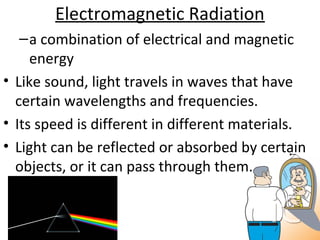
Electromagnetic Radiation
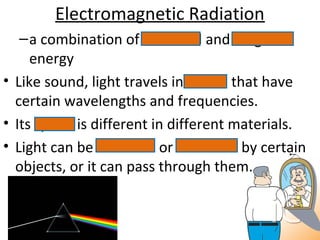
–a combination of electrical and magnetic
energy
• Like sound, light travels in waves that have
certain wavelengths and frequencies.
• Its speed is different in different materials.
• Light can be reflected or absorbed by certain
objects, or it can pass through them.
Electromagnetic Radiation
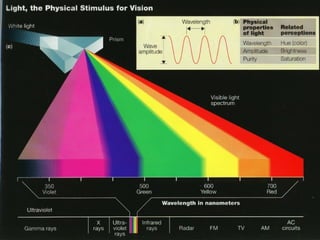
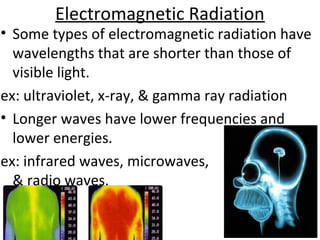
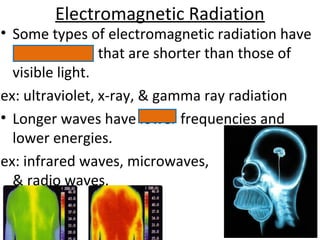
• Some types of electromagnetic radiation have
wavelengths that are shorter than those of
visible light.
ex: ultraviolet, x-ray, & gamma ray radiation
• Longer waves have lower frequencies and
lower energies.
ex: infrared waves, microwaves,
& radio waves.
How Does Light Move?
• Light travels the fastest in a vacuum.
• It travels more slowly through materials
such as air or water.
• Moves in straight lines.
• If it reflects off an object light still moves
in a straight line but in a different
direction.
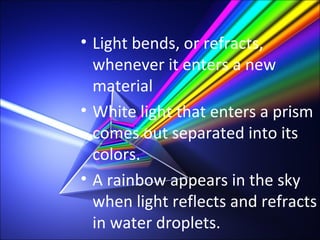
• Light bends, or refracts,
whenever it enters a new
material
• White light that enters a prism
comes out separated into its
colors.
• A rainbow appears in the sky
when light reflects and refracts
in water droplets.
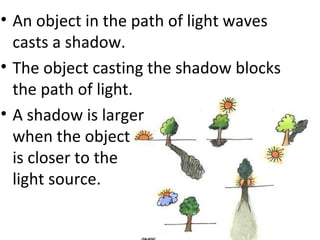
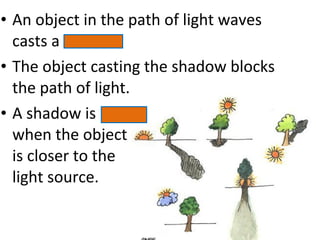
• An object in the path of light waves
casts a shadow.
• The object casting the shadow blocks
the path of light.
• A shadow is larger
when the object
is closer to the
light source.
CONCAVE vs. CONVEX
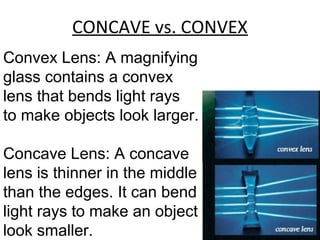
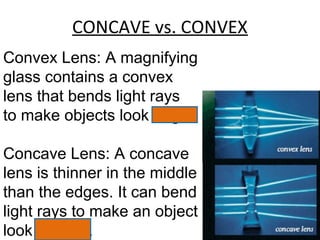
Convex Lens: A magnifying
glass contains a convex
lens that bends light rays
to make objects look larger.
Concave Lens: A concave
lens is thinner in the middle
than the edges. It can bend
light rays to make an object
look smaller.
Electromagnetic Radiation
–a combination of electrical and magnetic
energy
• Like sound, light travels in waves that have
certain wavelengths and frequencies.
• Its speed is different in different materials.
• Light can be reflected or absorbed by certain
objects, or it can pass through them.
Electromagnetic Radiation
• Some types of electromagnetic radiation have
wavelengths that are shorter than those of
visible light.
ex: ultraviolet, x-ray, & gamma ray radiation
• Longer waves have lower frequencies and
lower energies.
ex: infrared waves, microwaves,
& radio waves.
How Does Light Move?
• Light travels the fastest in a vacuum.
• It travels more slowly through materials
such as air or water.
• Moves in straight lines.
• If it reflects off an object light still moves
in a straight line but in a different
direction.
• Light bends, or refracts,
whenever it enters a new
material
• White light that enters a prism
comes out separated into its
colors.
• A rainbow appears in the sky
when light reflects and refracts
in water droplets.
• An object in the path of light waves
casts a shadow.
• The object casting the shadow blocks
the path of light.
• A shadow is larger
when the object
is closer to the
light source.
CONCAVE vs. CONVEX
Convex Lens: A magnifying
glass contains a convex
lens that bends light rays
to make objects look larger.
Concave Lens: A concave
lens is thinner in the middle
than the edges. It can bend
light rays to make an object
look smaller.

5th grade chapter 14 section 3 - what is light energy

  • 1.
  • 3.
    Electromagnetic Radiation –a combinationof electrical and magnetic energy • Like sound, light travels in waves that have certain wavelengths and frequencies. • Its speed is different in different materials. • Light can be reflected or absorbed by certain objects, or it can pass through them.
  • 4.
    Electromagnetic Radiation • Sometypes of electromagnetic radiation have wavelengths that are shorter than those of visible light. ex: ultraviolet, x-ray, & gamma ray radiation • Longer waves have lower frequencies and lower energies. ex: infrared waves, microwaves, & radio waves.
  • 5.
    How Does LightMove? • Light travels the fastest in a vacuum. • It travels more slowly through materials such as air or water. • Moves in straight lines. • If it reflects off an object light still moves in a straight line but in a different direction.
  • 6.
    • Light bends,or refracts, whenever it enters a new material • White light that enters a prism comes out separated into its colors. • A rainbow appears in the sky when light reflects and refracts in water droplets.
  • 7.
    • An objectin the path of light waves casts a shadow. • The object casting the shadow blocks the path of light. • A shadow is larger when the object is closer to the light source.
  • 8.
    CONCAVE vs. CONVEX ConvexLens: A magnifying glass contains a convex lens that bends light rays to make objects look larger. Concave Lens: A concave lens is thinner in the middle than the edges. It can bend light rays to make an object look smaller.
  • 10.
    Electromagnetic Radiation –a combinationof electrical and magnetic energy • Like sound, light travels in waves that have certain wavelengths and frequencies. • Its speed is different in different materials. • Light can be reflected or absorbed by certain objects, or it can pass through them.
  • 11.
    Electromagnetic Radiation • Sometypes of electromagnetic radiation have wavelengths that are shorter than those of visible light. ex: ultraviolet, x-ray, & gamma ray radiation • Longer waves have lower frequencies and lower energies. ex: infrared waves, microwaves, & radio waves.
  • 12.
    How Does LightMove? • Light travels the fastest in a vacuum. • It travels more slowly through materials such as air or water. • Moves in straight lines. • If it reflects off an object light still moves in a straight line but in a different direction.
  • 13.
    • Light bends,or refracts, whenever it enters a new material • White light that enters a prism comes out separated into its colors. • A rainbow appears in the sky when light reflects and refracts in water droplets.
  • 14.
    • An objectin the path of light waves casts a shadow. • The object casting the shadow blocks the path of light. • A shadow is larger when the object is closer to the light source.
  • 15.
    CONCAVE vs. CONVEX ConvexLens: A magnifying glass contains a convex lens that bends light rays to make objects look larger. Concave Lens: A concave lens is thinner in the middle than the edges. It can bend light rays to make an object look smaller.