Activity 1
Read aboutthe article entitled, The Life
Cycle of a Photon at
https://www.asu.edu/courses/phs208/patter
nsbb/PiN/rdg/photon/photon.shtml.
Write a short reflection about the reading.
2.
Activity 1:
•Read aboutthe article entitled, The
Life Cycle of a Photon.
•Write a short reflection about the
reading.
Photon
•Light can bedescribed as a particle (photon) or a wave
(electromagnetic wave).
•The electromagnetic wave can be pictured as
oscillating electric and magnetic fields that move in a
straight line at a constant velocity (the speed of light).
•Photon is defined as a discrete bundle of
electromagnetic energy moving at the speed of light,
has no rest mass but has momentum, and carries
energy
5.
Photon Theory
•The compositionof atoms are electrons, protons and
neutrons. In an atom, electrons are located at specific
energy levels.
•At a given certain amount of energy, electrons can move
from lower energy level to higher energy level.
•Photon theory of light states that photon is composed of
electromagnetic energy.
•The light formed has a certain wavelength and has specific
colors.
6.
Photoelectric effect
•Photoelectric effectwas proposed by Albert Einstein in
1905.
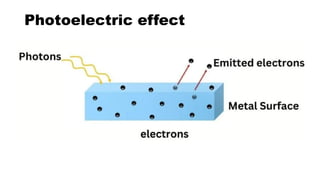
•Photoelectric effect refers to a photon incident to a metal
surface and transfer all its energy to the electron.
•For each frequency or color of the incident light, each
photon carried energy.
•Increasing incident of photons means increasing the
intensity of light and energy of the photons remained the
same.
Ultraviolet Radiation
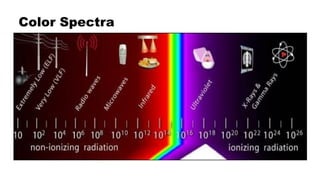
•Photons ofdifferent colors have different energies.
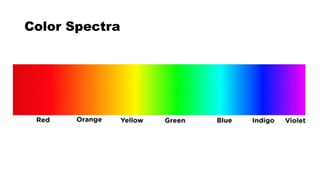
•Red light has low frequency and long wavelength,
this means that red light has low energy.
•Ultraviolet light is beyond the visible light, this
means it has higher frequency and shorter
wavelength.
•This explains why we get easily sunburned when
exposed under ultraviolet rays of
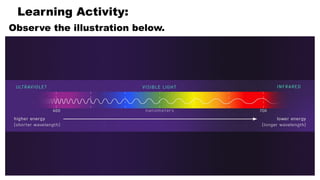
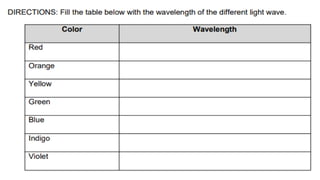
Guide questions:
1.What canyou observe on the energy of
light relative to wavelength?
2.What can you observe on the color of
lights relative to wavelength?
Editor's Notes
#5 This energy may be given to an electron during collision and causes the movement of the electron to a higher energy level. After 10 -8s, the electron will return to its energy level and will emit light in the form of photons.
The series of colored lines may be observed with black spaced in between them and it is called atomic spectra. Elements have different setoff spectra.
#6 This means that increasing the incident photons, more electrons are ejected. Energy of a photon is directly proportional to frequency. Increasing the frequency of light would increase the energy of the ejected electrons. This leads to the reason behind the arrangement of the visible spectrum of light. The visible spectrum of light shows that red color has the least frequency, which means it also has the least energy. Due to this property of the red light, photographers use red light so that the light-sensitive papers they use would not be over exposed and may ruin the pictures.
#8 Colors are not natural to objects. The colors of the objects appear due to the light they emit. Colors are determined by the frequencies. Colors are only perceived by the human brain. When the light reaches the eye, the receptor cell of the eye or retina, gives signal to the brain, which interprets the image with colors. As the frequency increases, the color gradually changes from red to violet.
#9 Colors are not natural to objects. The colors of the objects appear due to the light they emit. Colors are determined by the frequencies. Colors are only perceived by the human brain. When the light reaches the eye, the receptor cell of the eye or retina, gives signal to the brain, which interprets the image with colors. As the frequency increases, the color gradually changes from red to violet.
#10 2. On the other hand, blue has a higher frequency and shorter wavelength, which means it has more energy.



![ROCKS [Autosaved]111111111111111111.pptx](https://cdn.slidesharecdn.com/ss_thumbnails/rocksautosaved-241126014818-cf775d75-thumbnail.jpg?width=640&height=640&fit=bounds)


