Dr. Pradeep Samantaroy
Department of Chemistry
Rayagada Autonomous College, Rayagada
pksroy82@gmail.com; pksroy82@yahoo.in
9444078968
Oscillation
Periodic Variation
Any oscillation that can be expressed with a sinusoidal function is a harmonic
oscillation.
x(t) = x0 cos ( ωt + φ)
Where x0 is the amplitude
t is the time
ω is the angular frequency
φ is the phase angle
(ωt + φ) is the phase
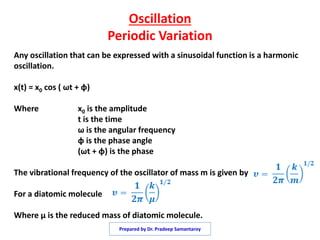
The vibrational frequency of the oscillator of mass m is given by
For a diatomic molecule
Where µ is the reduced mass of diatomic molecule.
Prepared by Dr. Pradeep Samantaroy
Let’s understand the case…!
According to Hooke’s law, the force acting on the molecule is given by
f = -kx
Where x is the displacement and k is the force constant.
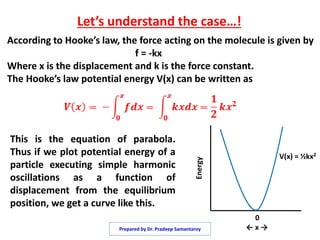
The Hooke’s law potential energy V(x) can be written as
This is the equation of parabola.
Thus if we plot potential energy of a
particle executing simple harmonic
oscillations as a function of
displacement from the equilibrium
position, we get a curve like this.
0
← x →
Energy
V(x) = ½kx2
Prepared by Dr. Pradeep Samantaroy
Let’s solve the case…!
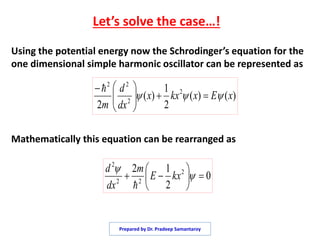
Using the potential energy now the Schrodinger’s equation for the
one dimensional simple harmonic oscillator can be represented as
)()(
2
1
)(
2
2
2
22
xExkxx
dx
d
m
 





Mathematically this equation can be rearranged as
0
2
12 2
22
2






 

kxE
m
dx
d

Prepared by Dr. Pradeep Samantaroy
Let’s solve the case…!
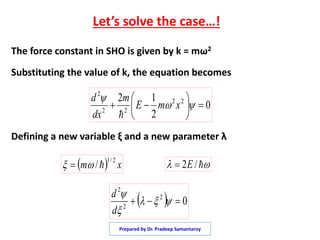
The force constant in SHO is given by k = mω2
Substituting the value of k, the equation becomes
Defining a new variable ξ and a new parameter λ
0
2
12 22
22
2






 

xmE
m
dx
d

  xm
2/1
/   /2E
  02
2
2
 


d
d
Prepared by Dr. Pradeep Samantaroy
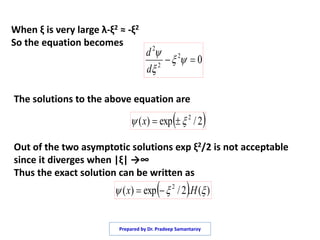
When ξ is very large λ-ξ2 ≈ -ξ2
So the equation becomes
02
2
2
 


d
d
 2/exp)( 2
 x
The solutions to the above equation are
Out of the two asymptotic solutions exp ξ2/2 is not acceptable
since it diverges when |ξ| →∞
Thus the exact solution can be written as
  )(.2/exp)( 2
 Hx 
Prepared by Dr. Pradeep Samantaroy
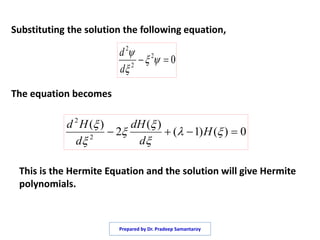
Substituting the solution the following equation,
The equation becomes
02
2
2
 


d
d
0)()1(
)(
2
)(
2
2
 





H
d
dH
d
Hd
This is the Hermite Equation and the solution will give Hermite
polynomials.
Prepared by Dr. Pradeep Samantaroy
n
n
naH  



0
)(
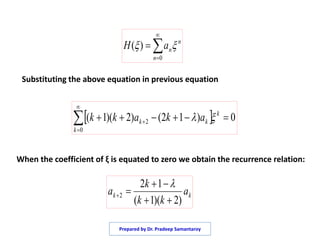
Substituting the above equation in previous equation
  0)12()2)(1(
0
2 



k
k
kk akakk 
kk a
kk
k
a
)2)(1(
12
2




When the coefficient of ξ is equated to zero we obtain the recurrence relation:
Prepared by Dr. Pradeep Samantaroy
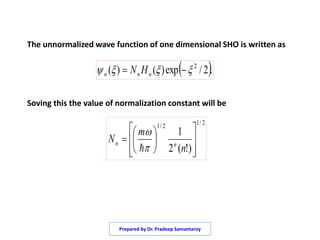
The unnormalized wave function of one dimensional SHO is written as
Soving this the value of normalization constant will be
 .2/exp)()( 2
  nnn HN
2/12/1
)!(2
1















n
m
N nn



Prepared by Dr. Pradeep Samantaroy
ENERGY
The series can be terminated choosing λ in such a way that
(2k+1-λ) vanishes for k = n.
0)/(212  En  /2E







2
1
nEn
hnEn 






2
1
 2
Since
Since
n = 0,1,2,3,4…
Prepared by Dr. Pradeep Samantaroy
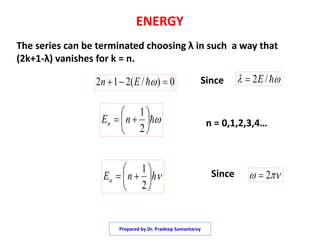
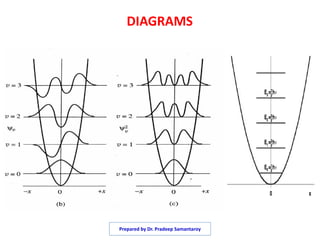
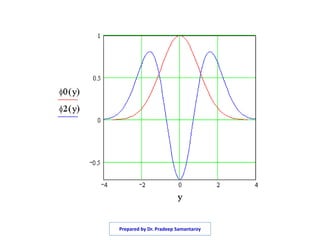
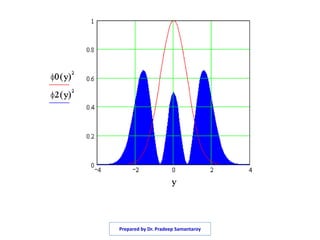
DIAGRAMS
Prepared by Dr. Pradeep Samantaroy

Simple harmonic oscillator

  • 1.
    Dr. Pradeep Samantaroy Departmentof Chemistry Rayagada Autonomous College, Rayagada pksroy82@gmail.com; pksroy82@yahoo.in 9444078968
  • 2.
    Oscillation Periodic Variation Any oscillationthat can be expressed with a sinusoidal function is a harmonic oscillation. x(t) = x0 cos ( ωt + φ) Where x0 is the amplitude t is the time ω is the angular frequency φ is the phase angle (ωt + φ) is the phase The vibrational frequency of the oscillator of mass m is given by For a diatomic molecule Where µ is the reduced mass of diatomic molecule. Prepared by Dr. Pradeep Samantaroy
  • 3.
    Let’s understand thecase…! According to Hooke’s law, the force acting on the molecule is given by f = -kx Where x is the displacement and k is the force constant. The Hooke’s law potential energy V(x) can be written as This is the equation of parabola. Thus if we plot potential energy of a particle executing simple harmonic oscillations as a function of displacement from the equilibrium position, we get a curve like this. 0 ← x → Energy V(x) = ½kx2 Prepared by Dr. Pradeep Samantaroy
  • 4.
    Let’s solve thecase…! Using the potential energy now the Schrodinger’s equation for the one dimensional simple harmonic oscillator can be represented as )()( 2 1 )( 2 2 2 22 xExkxx dx d m        Mathematically this equation can be rearranged as 0 2 12 2 22 2          kxE m dx d  Prepared by Dr. Pradeep Samantaroy
  • 5.
    Let’s solve thecase…! The force constant in SHO is given by k = mω2 Substituting the value of k, the equation becomes Defining a new variable ξ and a new parameter λ 0 2 12 22 22 2          xmE m dx d    xm 2/1 /   /2E   02 2 2     d d Prepared by Dr. Pradeep Samantaroy
  • 6.
    When ξ isvery large λ-ξ2 ≈ -ξ2 So the equation becomes 02 2 2     d d  2/exp)( 2  x The solutions to the above equation are Out of the two asymptotic solutions exp ξ2/2 is not acceptable since it diverges when |ξ| →∞ Thus the exact solution can be written as   )(.2/exp)( 2  Hx  Prepared by Dr. Pradeep Samantaroy
  • 7.
    Substituting the solutionthe following equation, The equation becomes 02 2 2     d d 0)()1( )( 2 )( 2 2        H d dH d Hd This is the Hermite Equation and the solution will give Hermite polynomials. Prepared by Dr. Pradeep Samantaroy
  • 8.
    n n naH      0 )( Substitutingthe above equation in previous equation   0)12()2)(1( 0 2     k k kk akakk  kk a kk k a )2)(1( 12 2     When the coefficient of ξ is equated to zero we obtain the recurrence relation: Prepared by Dr. Pradeep Samantaroy
  • 9.
    The unnormalized wavefunction of one dimensional SHO is written as Soving this the value of normalization constant will be  .2/exp)()( 2   nnn HN 2/12/1 )!(2 1                n m N nn    Prepared by Dr. Pradeep Samantaroy
  • 10.
    ENERGY The series canbe terminated choosing λ in such a way that (2k+1-λ) vanishes for k = n. 0)/(212  En  /2E        2 1 nEn hnEn        2 1  2 Since Since n = 0,1,2,3,4… Prepared by Dr. Pradeep Samantaroy
  • 11.
    DIAGRAMS Prepared by Dr.Pradeep Samantaroy
  • 12.
    Prepared by Dr.Pradeep Samantaroy
  • 13.
    Prepared by Dr.Pradeep Samantaroy